
What's the Best Stephen King Adaptation?
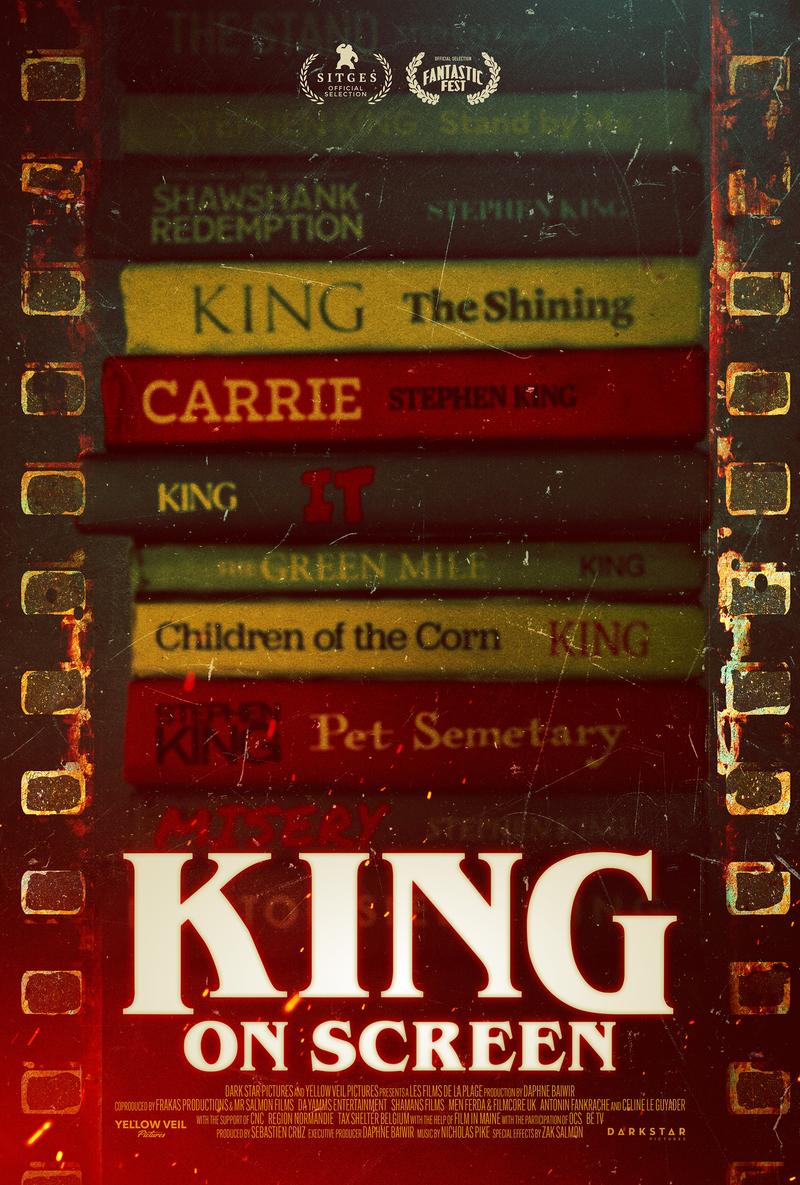
( Courtesy of Darkstar Productions )
[music]
Announcer: Listener-supported WNYC studios.
[music]
Arun Venugopal: I'm Arun Venugopal filling in for Alison Stewart. You're listening to All Of It. The Shining, The Shawshank Redemption, Misery, Stand By Me, The Green Mile. Those aren't just a list of great films. They're a list of great films adapted from the writing of Stephen King. Since 1976, when Brian De Palma's adaptation of care hit the big screen directors have clamored to bring King stories to life, but translating beloved King novels to a visual medium isn't always easy, especially when so many of the books are over 500 pages long, or even twice that.
A new documentary explores the joys and challenges of adapting King's work from the perspective of directors who've done it, from Mike Flanagan to Frank Darabont, to Taylor Hackford. It's titled King on Screen, and it'll be in theaters on Friday. Joining me now to discuss the films is Daphné Baiwir, the director. Listeners, we want to hear from you. What's your favorite film or TV adaptation of Stephen King's work? Is there one film in particular you think is the very best, one that was particularly terrifying to you as a kid, or moving? We want to hear your thoughts on Stephen King movies. 212-433-9692. That's 212-433-WNYC. Daphné, you are the director of this new documentary. When did you first become exposed to the work of Stephen King?
Daphné Baiwir: Well, the first time I discovered him, he was with the book, The Shining. I was very young at that time. I was only 10, but I was completely hooked into the story. I read the book in two days, something like that. I was so excited to discover something new somehow. After that, I've read all of his books and seen all the movies, so that's how I encounter Stephen King works.
Arun Venugopal: As someone who's devoured the entire written and, I guess, filmic ove of Stephen King and his film adaptations, are you a fan of one body of work more than the other since you started with the writings?
Daphné Baiwir: Regarding the books, I think there are so many interesting ones. I really enjoy some of the ones that are less known, like Joe McKee, for example.Regarding the films I always got a soft spot for Frank Darabont's work. I think he did amazing adaptations.
Arun Venugopal: He's done how many? Is it two or three?
Daphné Baiwir: It was three, actually, because he began with Shawshank Redemption, and he did The Green Mile and then The Mist. All three are excellent, I think
Arun Venugopal: It seems that so many of the directors you spoke to were first introduced to Stephen King's work when they were kids, I guess, just like you were. Is that a common theme that you found with all these people who were drawn to this?
Daphné Baiwir: Yes. It's something that is so interesting, because King has such this image of the king of horror. At the same time, when you are talking to directors or people who are fans of Stephen King, you realize that a lot of them discovered him when they were child, actually. It's something quite interesting for this master of horror that he has. It's something quite interesting to see how many people discovered him when they were child.
Arun Venugopal: You were 10. You read The Shining at the age of 10, which is probably earlier than a lot of people might think kids are supposed to unless you're free range in your parenting style or whatever. What is it about this body of work by this so-called horror writer who's clearly also so much more, but that draws children in at even an age of 10 or even earlier, I guess, in some people's cases?
Daphné Baiwir: At this age when I first read The Shining, I thought it was very interesting. I've always been a huge reader, and when I discovered him, it was like-- To put some context, my father was working night shift in a hotel at that time, so it was something quite thrilling to read a book like this when your father is doing the same job as Jack Torrance. It's a book that when you read it even as young as I did, you can find a lot of interesting things, a lot of themes that are very powerful, this functional family unit, for example, or sometimes over-- When you read it as an adult, I think you can see a lot of great things as well.
Arun Venugopal: We've got a caller calling in from Red Bank, New Jersey. Hi, John. Tell us what your favorite, and I guess, least favorite Stephen King adaptation is?
John: Not trying to be negative, I'm a big fan of Stephen King and I love many of the movies that've been made, but what I wanted to mention was The Dark Tower movie that came out a few years ago. It was one of the most traumatic movie-going experiences of my life. I was so excited for that movie. Everything about it sounded great. I thought Idris Elba was going to make a great Roland. I thought Matthew McConaughey was perfect for the men in black. The fact that they were going to make it kind of a sequel in that, it was a continuation after the ending of the novel, and anybody who's read it understands what happens at the end of it.
Everything sounded great, and they just completely destroyed it. They made Jake the main character instead of Roland. They completely misunderstood Roland's character, as far as I'm concerned, which is my favorite Stephen King character. They have him swear off The Dark Tower, and his whole reason for living is to get to The Dark Tower. He could never swear it off and it just [crosstalk].
Arun Venugopal: Traumatic. That's pretty intense. It was a traumatizing film experience for you.
John: Yes. I was so angry. I wanted to walk out, and I guess I just had to wait and see if there was any redeeming value to it whatsoever, and it just went downhill from the opening title.
Arun Venugopal: Deep disappointment.
John: It was just brutal, and everybody [crosstalk] horrible--
Arun Venugopal: If you had to recommend one, John, which film adaptation would you recommend to our listeners here?
John: There's so many, but certainly Shawshank Redemption, The Shining even though Stephen King hated Stanley Kubrick's version because of what they did to Wendy and how he diminished her character. There are no scarier movies out there than The Shining.
Arun Venugopal: Thank you, John, from Red Bank. Let's talk about that. In terms of The Shining, a controversial film for some Stephen King purists, am I right?
Daphné Baiwir: Yes, absolutely. It's something that is a particular because at the same time, Stanley Kubrick was an amazing director and filmmaker. When you see how fans react to the movie, The Shining, and King himself, you can totally understand why there are so many things that are disturbing for them. For example, we were talking about Wendy's character which is a strong female character in the book, and in the film, she's like completely this whole little thing afraid of her husband, not really taking things in charge.
Also, the image of that couple. When you see Jack Nicholson on the screen and the duality that we could have. Since the beginning, he looks a little bit crazy. Since the beginning, you're "Okay, but why is she with him? Why does she stays with him?" Because he's just being crazy from the start. It's something that disturbed a lot of the fans. In the book, it's not like that at all. You really see you are willing to this man's spot, and you see someone that is way more complex than what we had on the screen.
Arun Venugopal: Daphné, at the same time, as much as Stephen King has stated publicly he dislikes or hates The Shining by Stanley Kubrick, did films like The Shining also help burnish reputation of Stephen King as not just a guy who turns out novels but as a great American
Arun Venugopal: Writer?
Daphné Baiwir: I think the fact that he's been adapted by so many great filmmakers, because we are talking about Kubrick, but for sure, there is John Carpenter, and David Cronenberg, and Brian De Palma, all those great filmmakers, I think contributed to Stephen King fame, because you were able-- Even if you haven't read a Stephen King book, even for people who never read, for example, they still heard of him because of those directors who adapted him on screen. That's one of the topic in the documentary that we are talking about with directors is how much King had this great influence on cinema. Cinema helped a lot Stephen King as well.
Arun Venugopal: Got it. One of our listeners, Josh Waden said that The Myst is one of the best adapted films because it's a human study about how different types of people react to impossible and scary situations. I think The Myst is the first thing I ever read by Stephen King when I was 14. It's from Skeleton crew. I remember that and The Jaunt, which I don't know if that's been adapted to the screen. Let's take another caller. Ellen calling here from Manhattan. Hi, Ellen.
Ellen: Yes, hi. Thank you for having me on. I feel like I've been rediscovering Stephen King recently, and my favorite book series is The Dark Tower, of course, naturally. I have a very weird, not well-known film favorite, which is Thinner, which was a made-for-TV movie based on a book published by Stephen King under his pseudonym, Richard Bachman. I don't know how many people have seen this movie, but it follows the misadventures of a lawyer who accidentally kills a Romany woman, and has a curse put on him where he keeps losing weight. He gets thinner and thinner, and then eventually, he has to pass the curse to somebody else to survive. What I loved about it is, just like Josh, what you just read, it's really human-centric. This is the beauty of Stephen King's writing that I think sometimes gets lost in some of these adaptations, that is very, very focused on the experiences of the individual.
Arun Venugopal: Thank you, Ellen. I remember seeing Thinner when it came out. I don't remember loving the film, but I do occasionally find myself just saying thinner, randomly. Daphné, tell me about your own thoughts about Thinner. Where does it stand in the larger body of film adaptations?
Daphné Baiwir: Actually, I think Thinner, I really enjoyed the film. I think the actors done an incredible job. I really like the film. I think it's a film that you don't hear a lot because it was quite discreet. I wanted to respond to the characters as well. It's true that one of the great strengths of Stephen King is the fact that he is able to write amazing characters who have so many layers. It's so interesting to see how he created them, and how-- You are never in a black-and-white situation with Stephen King. There are so many gray zone in his work. Even the main characters, they are not the best human beings you can find on Earth. They are very complex, and that's what make them so human, actually.
Arun Venugopal: All right, let's take a call from Leia in Greenwich, Connecticut. It. Hi, Leia.
Leia: Hi, how are you?
Arun Venugopal: Great. What's the film that you want to talk about? A Stephen King adaptation?
Leia: Delors Cleyburn.
Arun Venugopal: Why is that?
Leia: I used it in a parenting program at a New York state prison about 15 years ago. We were trying to teach the men a way to get back together with their children. This film has so much in it. It's got alcoholism, it's got spousal abuse, it's got child abuse. What happens to a child after she's experienced this abuse as a grown-up. It was just really a great, great teaching tool. Of course, it's a good movie. Everybody loved it. That's all I can tell you.
Arun Venugopal: Thank you, Leia. Daphné, this is a film starring Kathy Bates, among others. Of course, we haven't brought up Misery, but this is one of the two roles in which Kathy Bates has really brought Stephen King's work to the screen. Also to the point, in addition to what Leia is saying, this conversation about all the strong female characters that Stephen King has written that have been immortalized by people like Kathy Bates.
Daphné Baiwir: Yes, absolutely. I think Dolores Cleyburn is a masterpiece because it has everything in it. It's one of the times where the director and the scriptwriter made some changes into Stephen King's original work. At the end, I think we got such a powerful film. You can see how those three women are connected. It's a very unique masterpiece. I have nothing else to say about it, but yes, except that you should see it if you haven't seen it.
Arun Venugopal: I haven't actually myself.
Daphné Baiwir: Yes, it's so powerful.
Arun Venugopal: I'm curious about the challenges of adapting King's writing to the screen, something that you've looked into as a documentary maker. When we talk about literary critics, they often cite the opening sentence of Metamorphosis by France Kafka. It's one of those great opening lines, but also an example of literature, which is really hard to translate into any other medium. As Gregor Samson awoke one morning from uneasy dreams. I was just wondering, are there aspects of Stephen King's writing that you've discovered are really hard to bring to the screen?
Daphné Baiwir: I think first of all, with Stephen King, since he writes a lot of huge books, it's sometimes more than 500 pages. What makes it quite difficult to adapt somehow because it's so rich. You really have to make tough decision about what you are not going to adapt. I think it's the most difficult part when you are adapting a Stephen King story because you really have to go into the book and you know that you have an hour and a half to tell a story that takes more than 500 pages. It's something quite difficult to say, "Okay, I'm not putting this in the film."
Each time it's like, "Okay, we are removing some of the stuff." I think that's why a lot of fans might be disappointed about the adaptations. It's the fact that it's always difficult to think about the book and not seeing the film as one object in itself, but comparing to the book each time and thinking, "Oh, that was so great in the book. Why is it not in the film?" I think the major difficulty of adapting Stephen King. It's knowing what you should not put in the film.
Arun Venugopal: We should have gotten this clip earlier, but let's hear a clip from Dolores Claiborne. This is Kathy Bates. Oh, I'm sorry.
Leia: The swearing pond.
Arun Venugopal: Misery.
Leia: There I said it.
Speaker 2: Yes, the profanity bothers you.
Leia: It has no nobility.
Speaker 2: These are slum kids. I was a slum kid. Everybody talks like that.
Speaker 3: I do not? What do you think I say when I go to the feed store in town? "Now, Wally, give me a bag of that effing pig feed and £10 of that bitchly cow corn." In the bank, do I tell Mrs. Bollinger, "Oh, here's one big bastard of a check. Give me some of your christy money." There, look there. See what you made me do.
Arun Venugopal: Misery, not Dolores Claiborne, but Kathy Bates in one of those legendary-- I actually was watching one of these clips a couple of days ago, and one of the most, I guess, terrifying scenes where she hobbles James Caan's character. I had to put my hand in front of the screen because even now, 30 years after first watching or however long it's been, it's still really terrifying, isn't it, Daphné?
Daphné Baiwir: Yes, absolutely. They are such a great duet on screen. James Caan and Kathy Bates, they are amazing together. They are working so well. I think it's such a great adaptation as well because of the two actors that are carrying the film.
Arun Venugopal: I want to read out another text message from a listener who's texting [unintelligible 00:20:18] about the Stephen King series, about this great female character, Holly Gibney from Mr. Mercedes and The Outsider. "Fantastic series, both and a great character that I'm hoping gets more screen and page time." I'm not familiar with this, but Daphné, is this also on your must-see list of adaptations?
Daphné Baiwir: Oh yes, absolutely. I think it's a great TV show, I mean, one of the greatest, probably. I think it's one of my favorites actually.
Arun Venugopal: Another listener with their, I guess, top adaptations, "The Shining and Stamp by Me, the worst, the shiny miniseries and Maximum Overdrive. Still waiting for a great adaptation of The Stand. Great topic." Do you have any, Daphné, that you think are like-- that you tell people maybe that's one that you can avoid?
Daphné Baiwir: I'm not sure, because I think that when you are watching a film, you should watch it and consider its context. For example, Maximum Overdrive has been so much criticized, but at the same time, I think it's one of the films that I like. It's not to take seriously, for sure, it's like going everywhere and it's crazy. It's the kind of film that you can really watch and just turn a drawing off and just laugh in front of it. I think there are never really bad films because you can always find something positive or something interesting in every film.
Arun Venugopal: A true lover of Stephen King on page and on screen. We have to wrap up soon, but Daphné, is there any one film that, to your knowledge, Stephen King himself most loves?
Daphné Baiwir: I think he's a great fan of The Shawshank Redemption and you can totally understand why because it's one of the masterpiece truly that we have in cinema. Even today when there is a list of the 50 films to see before you die or something like that, Shawshank Redemption is always in this list, and you can totally understand why.
Arun Venugopal: A film that, I guess, was slow to garner the appreciation it has come to have and consider one of the great films of all time, a beautiful film that was originally written by Stephen King, adapted by Frank Darabont, Labor of Love for him. That is our conversation with Daphné Baiwir, the director of King on Screen. Out in theaters on Friday. Daphné, thanks so much for joining us.
Daphné Baiwir: Thank you. Thank you so much for having me.
Copyright © 2023 New York Public Radio. All rights reserved. Visit our website terms of use at www.wnyc.org for further information.
New York Public Radio transcripts are created on a rush deadline, often by contractors. This text may not be in its final form and may be updated or revised in the future. Accuracy and availability may vary. The authoritative record of New York Public Radio’s programming is the audio record.