Summer in the City: Queens Edition
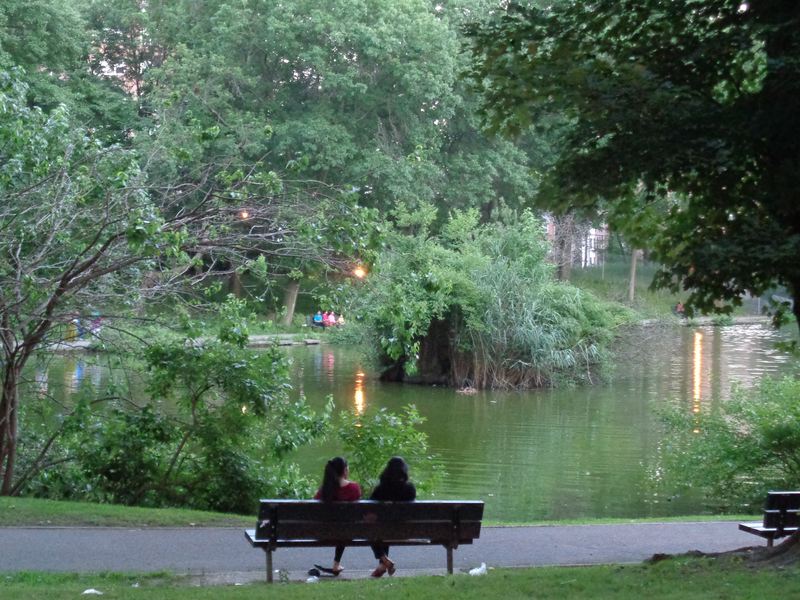
( Tdorante10 / Creative Commons )

[music]
Brigid Bergin: Full disclosure, I am a big fan of Queens. Not only because I live there, shout out to Rockaway Beach, but also because it is full of amazing history and activities. The city's second most populous borough spanning over 109 miles with home to vital cultural figures in New York City history, like 50 Cent and Nicki Minaj or Louis Armstrong, who made Corona, Queens, his home in the final years of his life. Let's not forget about another jazz legend, Astoria native, Tony Bennett, who passed away last Friday.
As the city's most diverse borough, it's also home to some incredible food. There's the Queen's Night Market in Flushing and the incredible Latin and South Asian restaurants in Jackson Heights. Queens is also diverse in landscapes, with those beaches in Rockaway stretching across the southern coast, and Flushing Meadows, Corona Park, in nearly 900-acre green space in the center of the borough. The list goes on and on.
If you're unfamiliar with Queens, you may be overwhelmed. Fortunately, we're joined by Christopher Bonanos, city editor of New York Magazine, who will be our guide to the borough. He's edited a book on New York City history and can give us the ins and outs of the past, present, and future of Queens. Chris, welcome back to WNYC, and thanks for joining us on All Of It.
Christopher Bonanos: Sure. Great to be here.
Brigid Bergin: Listeners, we want to hear from you. Are you from Queens? What do you love most about the borough, especially in the summer? Is there a specific store that you want to shout out, or what's a hidden or unappreciated gem in the borough? Maybe it's a boutique in Astoria, or a pool, or a museum that our listeners should go and check out this summer. Tell us what you love to do in Queens. Give us a call, 212-433-9692. That's 212-433-WNYC, or you can send us a message on social media @AllOfItWNYC.
We're talking about summer activities in Queens with Chris Bonanos, city editor of New York Magazine. Chris, before we dig into some of your recommendations, tell us a little bit about your relationship with the borough of Queens.
Christopher Bonanos: Sure. I come to it a little later in life because I am not a Queens native, I admit it. Like a lot of young people, when I moved to New York, I was focused on Manhattan. I thought French village was cool, but two things changed that. One is I am a Greek American, and the Greek restaurants in Queens pretty quickly became something to get on the train and go out there for, I discovered fast, as was, by the way, the great Greek grocery store, Titan Foods, which just closed in order to move, and that they said they're reopening soon. I hope it's true. Then secondarily, I married a Queen's gal, so, I started learning from her.
Brigid Bergin: Is it safe to assume the restaurants and the grocery store you're talking about, are we talking about Astoria?
Christopher Bonanos: Yes, they are in Astoria. The Greek place I started going to was a famous old-- it wasn't very fancy-looking, it was a place with pigs' pits with roasting [unintelligible 00:03:31] called Uncle George's. It was sold about 15 years ago and changed hands and the food arguably declined and has since closed. Something else is reopening there.
There's less of a Greek presence in Astoria than there was when I was a young person because Greek immigration has slowed down a little and so many more other immigrant groups have poured in that it's just diluted the Greek population. It's a sign of a healthy neighborhood that it continues to grow and change in turnover.
Brigid Bergin: Absolutely. You mentioned your spouse. Where are they from? What's the favorite neighborhood?
Christopher Bonanos: She is from Bayside, Queens. Went to Bayside High School, same high school as Mayor Eric Adams.
Brigid Bergin: Wow, and Speaker Adrienne Adams, and Brian Lehrer.
Christopher Bonanos: They make Adamses is like crazy out there.
[laughter]
Brigid Bergin: You spent some time in Bayside?
Christopher Bonanos: I do spend some time in Bayside. In fact, that's one thing I want to talk about, which is that Bill Boulevard, which is the main drag of Bayside, it used to be a place that had its share of Irish pubs and Italian restaurants. The older immigrant populations of Queens had places there. It has, in the past few years, just blown up with all sorts of new restaurants and bars.
It's a little off the beaten path. It's not a destination the way, say, Flushing is for Chinese and Korean food, but they have really good places there. There's a really good dumpling place called Shanghai You.
Brigid Bergin: Wow.
Christopher Bonanos: It's a Flushing place that opened a branch in Bell Boulevard. You can usually get a table. They have sun outside or did, and it's good and it's cheap, and they deliver in the neighborhood. You can go and really have a blast for not too much money.
Brigid Bergin: That's a great recommendation and good for someone who's looking for a new part of the borough maybe to explore that they haven't visited.
Christopher Bonanos: If you are a visitor, just let me add, it is almost exactly on top of the Bayside LIRR Stop. You get out of the train, you walk upstairs, and it's 10 steps away.
Brigid Bergin: Which is perfect. Chris, not surprisingly, our lines are filling up with folks who want to talk about Queens.
Christopher Bonanos: 1-8 numbers.
Brigid Bergin: Camilla in Rockaway, maybe a neighbor, welcome to WNYC and All Of It. Thanks so much for calling.
Camilla: You're welcome.
Brigid Bergin: What are your Queens recommendations?
Camilla: Well, of course, Rockaway Beach is a phenomenal beach. I grew up there, my mother grew up there. It had gone downhill, sorry to say, when I was a child. There was no surf camp. There was really nothing but the beach, which of course was wonderful in its own way. Now there's this wonderful resurgence largely due to the surfers who moved in, bought houses, new restaurants, and all this great stuff.
One great childhood memory was Rockaway's Playland. It was an amusement park in '96. In 1985, when they planned to tear it down, they asked for time capsule items. My friend, Jill Eisenstadt, who was a writer and has written two novels about Rockaway and other nonfiction, she and I put items in the time capsule, but we don't know where it is, and we don't know if it will ever be opened.
Brigid Bergin: So interesting. Well, listeners, if you know where the Rockaway time capsule is, then you can call and solve Camilla's mystery. Please call the number. We're talking Queens in the summer. We're trying to answer the mysteries of Queens. It's 212-433-9692. Again, you can reach us also on social media @AllOfItWNYC.
Along for the ride with some other great suggestions, we have the city editor from New York Magazine, Chris Bonanos. Chris, Rockaway is, maybe one could say, maybe an obvious summer suggestion, it's gotten a lot more attention because of the surf scenes, some of the great restaurants out there, and I could talk about Rockaway for a long time. There are lots more parts of Queens, and lots more food to talk about in the borough.
Let's talk a little bit about a Bhutanese restaurant in Woodside that you wanted to shout out. There's obviously the Queen's Night Market, which happens on Saturdays throughout the year, but there's tons of different food to check out in Queens. Can you tell us a little bit about this restaurant and why it's significant?
Christopher Bonanos: I have to admit, I haven't been there. I've just come straight from the recommendation of one of our food writers at Grub Street, who I trust implicitly. It's a Bhutanese restaurant. How many Bhutanese restaurants do you run into in New York City? They have this specialty, this buckwheat noodle dish. It looks a little like romaine or something like that, but it's a different flavor profile, I guess it's because it's buckwheat. It's in Woodside and he's on and on about it. The restaurant's called Zhego. I just hope I'm saying that right, Z-H-E-G-O.
Brigid Bergin: Can you talk a little bit about the history of some of the Asian immigration into that area? Is Woodside a place where there is a Bhutanese population in Queens?
Christopher Bonanos: I think that there is a South Asian population there. The thing about Queens is that it's not rigidly defined by ethnic neighborhoods because they all overlap because it's so full of immigration. They say, I've heard this a hundred times and I believe it to be true, that it's the most diverse county in the United States. There's 100 and something languages in steady daily use.
Really, just like I was talking about Astoria before, just as a random example, when I was a kid, it was full of Greeks. You go there now there's, there are still Greeks, but there's an Egyptian population. There's a Colombian population, there's a Guatemalan population. Who knows who else has just poured in, in the last year or two that I don't even know about yet? That's how neighborhoods stay alive in a lot of ways in New York, just being an immigrant city. That's how they develop and add layers and flavors. They're also wealth-building places.
Alison Stewart: Absolutely.
Christopher Bonanos: People start little businesses, little stores, little restaurants, whatever. Sometimes they stay and create a mini neighborhood empire, and other times, they move out to the suburbs, move to the upper east side, whatever they want, someplace less diverse and richer. Then the next generation comes in from wherever it's coming in and the cycle repeats.
Alison Stewart: Just one other neighborhood that gets a lot of attention for some of the amazing Asian food there, of course, is Flushing. Any spots you would recommend there?
Christopher Bonanos: There is a great big mall-like thing that has opened in downtown Flushing and is still growing called Tangram. You encountered this?
Alison Stewart: I think I went on an outing there with a colleague of mine, Richard Ye, who took us out, but I'm not sure if we're talking about the same exact spot.
Christopher Bonanos: Tangram Food Hall. It's lots of little stalls and different food options. There are all sorts of wraps and noodles, and really you can pick your way around. If you're Westerner and this food is unfamiliar to you, you can make your way through and try 100 different things. Also, what you see there a lot is food that mashes up different cuisines. There's a place called Crunchies, for example. It's a Korean chain. They've opened in New York, and they make-- I'm quoting one of my colleagues, Tammy [unintelligible 00:11:37] a half beef, half mozzarella corn dog dug dunked in squid ink fatter and rolled in cubes of potato confetti.
Alison Stewart: Wow. That sounds like something I have never tried.
Christopher Bonanos: I have never tried it.
Alison Stewart: It sounds amazing.
Christopher Bonanos: Would I try it? Absolutely. [laughs]
Alison Stewart: Yes, 100%.
Christopher Bonanos: It's that kind of thing. Talk about neighborhoods overlaid on each other. That's five different cuisines overlaid on each other. That's what we do. We make deliciousness in every way in New York by meshing things up.
Alison Stewart: I love it. Listeners, we are talking about summer in the city, Queen's edition, with Christopher Bonanos, the city editor from New York Magazine. We've been talking a lot about food, but that is not all we are going to talk about. We're also taking your calls and suggestions. Let's go to Ramona in Woodhaven. Ramona, welcome to WNYC. What do you want to shout out in Queens?
Ramona: Thank you so much for having me. First of all, I got a shout out South Jamaica, Queens where I grew up, and big, big shout out to Rochdale Village, my first love. My suggestions would be, first and foremost, to Veggie Castle and South Richmond Hill, best vegan food you're going to find in the land. Also, I definitely need to shout out to Devanand Yoga Center. Why I love it is because it's so community-based and it really, really is community for all cultures. It just makes me so proud to attend there and to be amongst the people.
My last shout out is to the Queen's Health Emporium. Shout out to Sunny, to Dawah, the entire staff there, best place to buy your organic vegetables, your fruits, your skincare, and it's just a great place to get hot food. They got the best hot deli in Queens. I just love my borough. I think the best part about being from Queens is this quiet love that we have and quiet confidence that we have. We're very chill people.
Then as soon as you leave New York and you meet somebody from Queens, we just got this-- I don't know, I can't think of the right word. I think everybody from Queens knows what I'm talking about. That feeling that we get when we encounter somebody else from Queens is all love. I just love my boroughs so much and everything that it represents.
Alison Stewart: Ramona, what I hear in your voice is passion, and I love it. As another Queen's resident, I really appreciate you shouting out your neighborhood. Listeners, if you are a Queen's local and you want to shout out your neighborhood, tell us the secret spots that only you know about. Give us a call. We want to hear from you. The number is 213-433-9692. That's 213-433-WNYC.
Chris, let's just start a conversation about museums. One, we'll talk about the Noguchi Museum in Astoria, which is on your list of places to check out. Can you tell us a little bit more about the artist and his work and why there's a museum in Queens dedicated to his life?
Christopher Bonanos: Sure. One of my favorite small museums in the world, really. It's called the Noguchi Garden Museum for a long time now. Just the Noguchi Museum. It's a one artist museum devoted to this sculptor and furniture designer and set designer. He made just about everything. Isamu Noguchi, who worked in mid-century, more or less 1930s to 1980s. It's his old studio. Before he died, he figured out how to make it a single-artist museum.
I have to say, you go to other single-artist museums, and sometimes, they're good for half an hour. I can linger for a very long time at this place. The stuff is beautiful and they have little rotating exhibits devoted to his life and work. It's also built around a courtyard.
Alison Stewart: Wow.
Christopher Bonanos: Some of the sculptures are outside. There's a tiny little garden. It looks like nothing from the outside because it's an industrial neighborhood at the edge of Astoria. It looks like it could be a garage or a blacksmith shop or something because he was making sculptures out of wood and metal and he needed to be able to bang away and weld and so forth. The difference between sculpture and industry is sometimes pretty fine. Anyway, it's become this beautiful little museum with an outdoor space. It's just lovely.
Alison Stewart: We have to take a short break. We're talking summer in the city, Queen's edition, with Christopher Bonanos, city editor of New York Magazine. Much more with your calls coming up just after this.
[music]
Brigid Bergin: You are listening to All Of It on WNYC. I'm Brigid Bergin in for Allison Stewart, and we are talking summer in the city, Queen's edition, with Christopher Bonanos, city editor of New York Magazine. We're taking your calls. We want to hear you shout out your neighborhood, shout out your local restaurant. Tell us what and where to go, and what to do and where to go in Queens. Let's go to Diane in Florham Park, New Jersey. Diane, thanks for waiting. Welcome to All Of It.
Diane: Thank you. I'm currently living in New Jersey. I grew up in Jackson Heights and spent the past 10 years in Forest Hills. I want to talk about this great place in Flushing Meadows Park. It's called Fantasy Forest. It's a tiny little amusement park with rides for little kids. A little roller coaster that really shakes up a four-year-old, and the cars they can drive, and it's just the most fun. You could buy a ticket for unlimited rides or you can get a set number of rides. When I lived there, I took my grandchildren there and they just loved it.
Brigid Bergin: Oh, I love that idea. Diane, thank you so much for that call. Speaking of Jackson Heights, let's go to Nancy in Jackson Heights. Nancy, thanks for calling All Of It.
Nancy: Hi, how are you? I want to shout out a place in my neighborhood that I really love. It's called Mariscos El Submarino. It's on Roosevelt and 88th Street. They make the best shrimp dishes, the best ceviche I've ever had. They have one dish. I think about it all the time. It's [unintelligible 00:18:04] and it's fish ceviche, shrimp, crab. It's in a spicy red jalapeno sauce. It's so good. It's so yum.
Brigid Bergin: Go ahead.
Nancy: They have these amazing octopus and cheese tacos, just everything is just really good. It's a really small [unintelligible 00:18:25] place. It's not super fancy, but every time I go, it's packed with all sorts of people just getting ceviche and agua chile and just all the shrimp.
Brigid Bergin: Oh, Nancy, that sounds great. Say the restaurant name one more time and where we can find it.
Nancy: Sure. It's on Roosevelt and I think 89th. It's called Mariscos El Submarino.
Brigid Bergin: Nancy, thank you so much for calling All Of It. Let's go to Mo in Elmhurst. Mo, thanks for calling WNYC.
Mo: Hi. I just wanted to highlight Elmhurst. That is possibly not in your conversation yet because, as you know, Queens has more or less 150 different ethnics from around the world. You can just imagine what Queens is like. Right next to Jackson Heights that you guys were just talking about, Elmhurst is mixed. Within Elmhurst, there are many Asian food, not the usual, but more, because many Southeast Asians are stepping up and trying to showcase their food as well.
Talking about Elmhurst, if you know where Queen Center Mall is, within the Queen Center Mall, there are also some ethnic food in the mall itself. You guys definitely should check out Elmhurst, along the Broadway on Elmhurst, all the way to Queen Center Mall. Not only the usual Thai food, Malaysian food, but also [unintelligible 00:19:59] food is on the map now. Just so that you guys are aware.
Alison Stewart: Yes, Mo. Thank you so much. We love callers who want to shout out their neighborhoods and other places in the borough to check out. We're going to pivot a little bit away from the food talk. Chris, let's talk about another museum in Queens, The Louis Armstrong House. We are big fans of Louis on the show and actually had the curator of the new museum, Jason Moran, on the show just a few weeks ago. Can you tell us a little bit more about Louis Armstrong's relationship to the borough?
Christopher Bonanos: Sure. As much as I like talking about it, we could do food all day on this, let's face it. It's good to do something else as well. He was, as everyone knows, a native of New Orleans. At one point when he was on tour at the peak of his career, I think in the late '40s or early '50s, he wanted a settled place to live. His wife bought the house for him, and he hadn't seen it. She sent a car to the airport or he got a taxi at the airport or something and had this address and pulled up in front of it. She said, "We bought this, what do you think?" He immediately fell in love.
What's extraordinary about it is you go up to it, the house is a museum, and as you said, there's now across the street a giant much larger facility that's a visitor's center and archive and all the rest of it. The house itself is nothing like you would picture a celebrity's house being for arguably one of the three or four most important artists America has ever produced, maybe the most important and influential artist America has ever produced.
It's a modest house in Corona. It's generously sized but it's not huge. He added onto it a little bit, but it could be your uncle's house who's done okay in the plumbing business.
[laughter]
Alison Stewart: Do you have a sense of what the difference is between the home and the new center that's across the street?
Christopher Bonanos: The house has been restored meticulously to the way it looked near the end of his life. It's all like 1970s and '80s decor. It's a little showy. It's over [unintelligible 00:22:21] He and his wife had an over-the-top taste. There's a lot of that like mirrored '70s wallpaper, that Mylar stuff. [unintelligible 00:22:28] kitchen. It's fun just seeing it as a house, as a nice upper-middle-class house of the 1970s because you don't see that very much anymore.
Then there's this huge aura of this incredible American artist who lived and worked there. There's a study with a big tape recorder because he would record there. Then you go across the street and it's more museum-like place.
Alison Stewart: If somebody has made the trip out to Corona to visit the house and the museum, are there any spots you might recommend folks check out afterwards?
Christopher Bonanos: It's the most old-fashioned choice, I realize, and it's covered endlessly, but this place called The Lemon Ice King of Corona.
Alison Stewart: Oh, of course, The Lemon Ice King of Corona. Do you have a favorite flavor because I know it's the Lemon Ice King, but it's not only lemon ice.
Christopher Bonanos: I like the peach myself. They dye it really, really-- it looks like a traffic cone. There's too much [unintelligible 00:23:25]. I shouldn't say they dye it, it's just my perception that they dye it. I don't want to get sued, but it's delicious.
Alison Stewart: It's a place to hit for sure. Let's go back to the phones, Linda in Rosedale. Linda, thanks for calling All Of It.
Linda: Hi, how are you?
Alison Stewart: Great.
Linda: I am thoroughly enjoying this particular program, and I wanted to give a shout-out to the Jamaica Center for Arts and Learning, and also the Jamaica Performing Arts Center. They're both located within walking distance of each other on Jamaica Avenue close to Parsons, the e-train, the Long Island Railroad. When you're talking about the diversity of the city, throughout their season, you can find just about every single group being represented at the Performing Arts Center.
One of the wonderful things about it is that it's totally free. It's open to everyone. I was a little bit hesitant about calling in because it's a hidden gem, but since we're shouting out our favorite places, I am like, okay, I'm going to go for it. I encourage everyone to really check out and support these phenomenal artistic centers. They also have studio spaces at the Center for Arts and Learning. They do offer studio spaces to artists at a very reasonable rate. That's my shout-out.
Alison Stewart: Linda, thank you so much and thank you for calling. Call us again. We love to hear people's suggestions for hidden gems, but we love to have first-time callers on the show. Let's go to Beth in Sunnyside. Beth, welcome to WNYC.
Beth: Hi. Thanks for taking my call. I love how enthusiastic everyone is about talking about Queens because a lot of times, people forget about the borough even though it's incredibly populous and just so rich and deep and diverse. I feel very lucky every day to live in Sunnyside. There has been a media swap on the corner of 43rd Street and Skillman that started in the early days of the pandemic when all the libraries were closed.
It's quite a collection of books primarily for adults and kids in different languages. There are always records and games, and it's entirely free for the taking, run by volunteers. It's very well organized despite the fact that it's just this fringe amenity offered in the neighborhood right on the corner of 43rd and Skillman in Lou Lodati Park. It's adjacent to quite a large heavily used public park, and it's great.
Alison Stewart: That is so great, Beth. Thank you so much for that suggestion and for that call. I want to read some of the text we are getting on social media. We have one that says, Queens girl here, Cardozo High School, by the way. Grew up in Douglaston and was just on Belle Boulevard with my mom last week. Amazing dumplings. My parents met at Rockaway, and that was our beach destination when I was a kid. That's from Laura. Thank you so much, Laura.
I have another text with a question for you, Chris, regarding Queens' things to do. I love New York City historic districts. Do you recommend Kew Gardens? Chris, any thoughts on historic districts in Queens?
Christopher Bonanos: I can't speak about that at any length. [laughter] [unintelligible 00:27:16] but haven't spent time there.
Alison Stewart: This is our Queens pop quiz. Do you have any other fun facts about Queens that you would like to share? I know that you came on the show back in 2020 and shared a tip about Scrabble being invented in Jackson Heights. What is that?
Christopher Bonanos: Oh, it's true. There's so many inventions that come through Queens. It's true. In fact, the block where-- the inventor was a guy named Alfred Butts, and there's the block where he lived and invented the game. He had a little office or something near his apartment, his name for him [unintelligible 00:27:51] signs.
Alison Stewart: We should talk a little bit about some outdoor stuff. I've already shown my cards that I have a Rockaway Beach preference. Let's talk about some other outdoor spaces in the borough. In Long Island City, there are two newly renovated waterfront areas that you've recommended. Can you tell us about them?
Christopher Bonanos: Sure, of course. The strip along the waterfront in Queens was one of the real targets of the Bloomberg administration to rezone the old industrial space, basically Long Island City, and make it into parkland. There are two park areas adjacent to each other. One is Hunter's Point South Park and one is Gantry Plaza State Park. One is city, one is state.
They don't have a lot of in-built stuff. You know what I mean? It's not like a park that has-- like Flushing Meadows kind of park that has the museum in it and has a theater in the park and so forth. It's more play space. There's soccer fields and just grassy spaces for hanging out and walkways and a soft edge to the river.
That is important because all of this is built to face the storms of the future. It can get [unintelligible 00:29:14] and then it drains out and it does two things. It survives as a park. It won't have to be rebuilt every time there's a storm, and it protects the inland stuff. It serves the way a wetland might a little bit to absorb some of the storm force. It is both protective and great recreation. They're beautiful park spaces.
They have also given rise, back to the food, to a whole strip of restaurants along the waterfront there, some of which are very good. I like a place called American Brass a lot.
Alison Stewart: I'm feeling like we could do a whole Queens food segment all by itself. We're going to go to the phones for a lightning round from some of our callers. When I say our lines are full, it is no exaggeration. Let's quickly go. We've got three more callers. Victoria in Jackson Heights, welcome to WNYC.
Victoria: Thanks so much. I just want to give a shout-out to the Museum of the Moving Image in Astoria. It's a great, great place.
Brigid Bergin: That is great. I love the Muppets and Jim Henson exhibit. Let's go to Judy in Brooklyn.
Judy: The North Shore Tower Condominium on Little Neck Parkway has a huge movie theater, cash only, independent and foreign films. $11, and Thursdays, it's $8.
Brigid Bergin: Whoa. Judy, thank you so much for that. Let's go to Paul in Flushing.
Paul: Hi. The first thing I wanted to talk about is a haircut place called Transformations. It's on Roosevelt Avenue, New York Main Street. I go there and I get my hair cut for eight bucks.
Brigid Bergin: Perfect.
Paul: By all means, ask for Jen. She's very sweet.
Brigid Bergin: [laughs] Paul, thank you so much for that recommendation. Not just a location but also a stylist. That's very helpful. Chris, this has been a great conversation talking about summer in the City, Queens Edition. I've been speaking with Christopher Bonanos, city editor of New York Magazine. Thank you so much. This has been a blast.
Christopher Bonanos: Anytime. It's fun to be here.
[music]
Brigid Bergin: Up next, it can be tough to get off your couch and outside if you can't get off your phone first. Fast Company senior editor, Christopher Zara, joins us next to talk about our tech habits.
Copyright © 2023 New York Public Radio. All rights reserved. Visit our website terms of use at www.wnyc.org for further information.
New York Public Radio transcripts are created on a rush deadline, often by contractors. This text may not be in its final form and may be updated or revised in the future. Accuracy and availability may vary. The authoritative record of New York Public Radio’s programming is the audio record.