
A Story Told Through Generations of Iranian Women
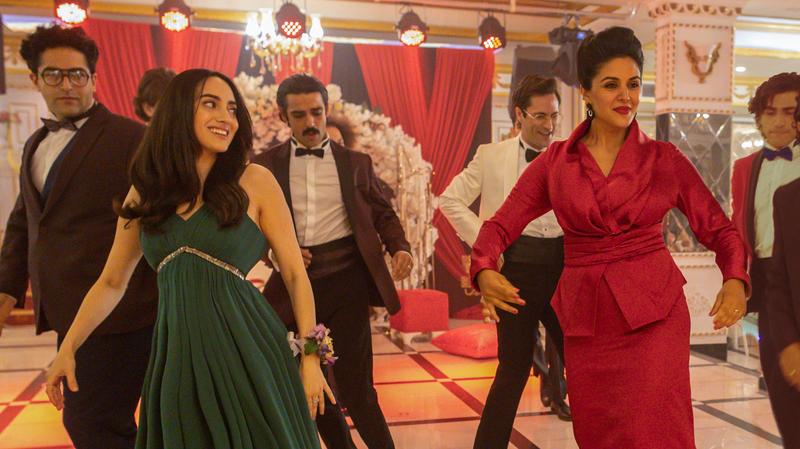
( Photo credit: Yiget Eken. Courtesy of Sony Pictures Classics )
[music]
Alison Stewart: This is All Of It. I'm Alison Stewart live from the WNYC studios in Soho. Thank you for sharing part of your day with us. The new film, The Persian Version from Maryam Keshavarz draws inspiration from her own life as an Iranian-American woman with a sometimes fraught relationship with her mother. Told through three generations of women, the film is both a comedy and a drama centered around a late 20s, 30-something queer Iranian-American screenwriter, Layla, who is often seen as the rebellious child in contrast to her eight, yes, eight brothers.
For example, there are these flashback sequences when a very young Layla smuggles cassettes of Michael Jackson and Cyndi Lauper on a flight to Iran with her mother at a time when American music wasn't allowed. The defiant attitude often causes her to clash with her mom. Plus, her mother is not all that excited that Layla is queer, they often fight. When Layla's grandmother reveals a story, a deep, hidden family secret about her parents contextualizes her family, and especially her mother's life in America, Layla begins to see her mom a little differently.
A Vulture review states that though the Director's Persian Version tells an accepting and painful story about what womanhood demands and imagines, and about how someone can step forward into a life, they sculpt for themselves at any age and in any place. The Persian Version won both the Audience Award and the Waldo Salt screening award writing at the Sundance Festival this year. It's in theaters now. Writer and director, I'm going to get it right this time. Maryam Keshavarz-
Maryam Keshavarz: Keshavarz.
Alison Stewart: -Keshavarz. Maryam Keshavarz joins us to discuss.
Maryam Keshavarz: I just go for it.
Alison Stewart: Maryam Keshavarz. There we go.
[laughter]
Maryam Keshavarz: You got it. It's a tough.
Maryam Keshavarz: A challenging to do. It's early in the morning.
Alison Stewart: Just trying to get another syllable in there, sorry about that. Maryam Keshavarz. Welcome, Maryam.
Maryam Keshavarz: Thanks so much for having me.
Alison Stewart: When did you first have dreams of making this film, because Layla in the film says she has dreams of becoming a Persian Martin Scorsese.
Maryam Keshavarz: Oh my God. Honestly, I grew up in a very Persian family in New York City, I was born in New York, but I looked to movies and learned how to be American and TV shows, but I never really saw myself reflected. I guess this is my remedy to the lack of representation. I've been dreaming about it since I was a kid, but I think the Trump era of xenophobia and anti-Muslim sentiment pushed me to look to my own family as a way to bring some comedy and levity to my community.
Alison Stewart: When did you start working on the film?
Maryam Keshavarz: During the Trump era, I only watched SNL, so it was my way out. I had really only worked in drama before, but I thought, comedy is such a great way to connect people. I felt like the entire country is so fragmented and everyone's against each other, there's not a lot of empathy. I wanted to make a film, write a film that was a challenge to me as a writer for me to look at the most difficult person in my life that I feel like the most different from me, which is my mother, and for me to be empathetic to her as my first step in my reconciliation.
Alison Stewart: How did writing the film help you empathize with your mom, maybe understand her a little better?
Maryam Keshavarz: It's funny. I grew up in an immigrant family. The next generation, we always expect our parents to understand us like we're more modern and they have to come get with the times. We never really take a moment to understand where they come from, their history, and everything they've been through. I really thought of my mom at 13 not as the adult. I cast a 13-year-old to play my mom, that's when my mom got married in Iran. It really was so disarming for me, even to cast someone the right age to play my mom. She had wanted to be a math major, she had been pulled out of school and all the things that she went through until she came to America at 20.
Just having it visualized by an actual 13-year-old actress, it just disarmed me and made me really empathize with my mom in a way I had never-- I knew the stories, but to actually direct them with a girl that's a child, really, the same age as my own daughter, I learned so much about my mom, I learned so much about myself and all the trauma that happens through the generations and how we pass it on to our kids unknowingly.
Alison Stewart: As we're going through the film, it's very funny and then we get into these more serious themes towards the end. How did you think about the pacing, because I was like, "Wait, whoa, we're going down another road."
Maryam Keshavarz: It never hit the [crosstalk], I'd like to shock you. I think my film was really a question of how to take someone on a rollercoaster ride of being with a crazy storyteller for two hours and through a big family. It really is like the ups and downs of a great oral tale we come from Iran, a country that's filled with oral history and big tales. When I think about comedy, I always feel like they always say there's a fine line between comedy and tragedy. In writing the story, I try to make sure that these moments of humor were close by to moments of very deep, dramatic, and traumatic moments.
By putting them next to each other, I think they're each heightened and you feel the deep stuff really deeply, and then you really laugh in relief. It's this idea of taking you on an unexpected rollercoaster that's life.
Alison Stewart: It's interesting because the film has all these different veins in it. There's the vein of the immigrant American experience and how immigrants are perceived by others, and then there's the young woman trying to make it on her own and forget what my family's done, I'm going to do my own thing. There's also others, you get politics in there. You have to explain some of the politics of what it means.
Alison Stewart: In a playful way, I'm not a directly political person. Making this film is political, but I wanted to filter the history of Iran in America through a comedy in lens and always using humor as a way to try to reflect on what it means to be from two countries that hate each other. I think that's my challenge as a writer.
Alison Stewart: My guest is writer and director, Maryam Keshavarz. The name of the film is The Persian Version. Was it always called The Persian Version because it's just fun to say? I have to say.
Maryam Keshavarz: It is fun to say. I love a rhyming title. It's because my name is Maryam. It's like M-A-R-Y-A-M, it's like, "Oh, that's so interesting." I'm like, "It's The Persian version," people will laugh. Also, it's a Persian version of a big immigrant tale. It's bigger than life. Persians, we like to tell tales that are a little bit taller than real life.
Alison Stewart: The story shifts from decades, '60s, '70s, '80s, '90s. As a director, how did you think about differentiating the looks in each time period?
Maryam Keshavarz: I really think of the narrative quality of how we go through these different changes. If you look through my photos, you'll see my hair changes significantly [chuckles]. There's some very big '80s, '90s hair that I used to spend all morning on. I had so much fun making the time periods. I think it's really fun for folks to see our era. Anyone in their 40s is like, I don't remember how long I used to spend on all that. It was such a hoot to then go into the '60s and all that stuff, but through it all, I'm just trying to show the continuum of this family story. Trying to make it cohesive but having fun with the era. I love period stuff. It's fun.
Alison Stewart: You have these three women, the grandmother, the mother and Layla, all seem very different, but what is something that you think they all have in common?
Maryam Keshavarz: All of my films have this in common, including these three women, is that they're women who go against the grain, they go against what society thinks they should do. Although Layla doesn't think her mother does that, she thinks her mom's so traditional because she doesn't truly know her story. Through the storytelling process, each of the three characters narrates their version of the truth, and they each get their own style of cinema also. The daughter's more '80s, '90s pop because that's where she grew up, the grandmother is like a spaghetti western because she likes to tell tall tales. The mom is more of a neorealist like Persian classical film.
They each get their own style and their own voice because I wanted to embody those women who are so bold and go against the status quo with their own style. I think people are definitely shocked because they're coming and thinking it's going to be my big Fat Creek wedding, and it is in some ways. It's really funny and it's this crazy family and there is a wedding, but they're like, "Damn you. You also got me to cry and I didn't have any waterproof mascara." I'm like, "I'm so sorry. It's sucks, [laughs] It's way deeper than you thought."
Alison Stewart: Layla talks to us a lot directly to the camera and she does this throughout the film.
Maryam Keshavarz: You could blame Ferris Bueller's Day Off as a kid, obsessed with Ferris.
[laughter]
Alison Stewart: It makes sense that she would be the one to talk to us. She talks directly to us, and I want to play a clip. In this clip, Layla's mom and dad are either on the way to the hospital. Her father has to get a heart transplant, but they get stuck in traffic on the way to the hospital. Their mom calls on Imam Zaman to come save the day. The action all stops and Layla appears as our narrator to explain to us, the audience, directly to camera, what is happening. Let's take a listen. This is from The Persian Version.
[The Persian Version theme music]
Layla: Shia Muslims
are really into this magic realist stuff? In our family, there's always someone who comes to save the day. His name is Emma-Mes-Emon. He's this amazing thing. He disappeared a few hundred years ago, like literally disappeared in thin air one day. He's a busy guy, a true believer, says his name, and he appears in times of need. He can appear in human or animal form. Oh, you're skeptical, right, I am, too. This close to getting what she wants? Of course, she pulled the favor from the big guy. My mom really believes in this stuff, and I'm not sure I do. As she's old world, I'm new world. This is my mom and I's relationship in a nutshell.
Alison Stewart: Of course, that sent me down to Google rabbit hole, because I need to know more.
Maryam Keshavarz: Also a magic realism [laughs].
Alison Stewart: Yes. What are some cultural touchstones that you knew you wanted to be in this story?
Maryam Keshavarz: It's like growing up, there's such a really negative connotation of what it meant to be Muslim. My grandfather was a Sufi poet, I grew up in a very open-minded relationship to religion. It was never forced on me. We always had this idea of this saint who could come and help you at any point. There was a story, I was drowning in Miami. "Maryam, you were drowning," and I said, "Your mum is a [unintelligible 00:11:18]," and moma Emon help me, and a dolphin came and saved you."
It was just such a comforting feeling to know as a kid that we grew up with really hard economic times and all these different things happened to my family in Brooklyn, but that we could always count on this person to help us. I think a lot of cultures have this concept. For me as a kid, I just was in, awe, that if I really needed him, he'd be there.
Alison Stewart: They're a saying that, I'm sure as a writer in fiction that the specific leads to the universal to your point, this is an all different culture. What's another example of an experience, which is very specific to growing up in a Persian immigrant household, but that you really realized is universal?
Maryam Keshavarz: We're always late.
[laughter]
Maryam Keshavarz: It's like herding cats to get people together. I think it's also, there's such a reliance on the past and respect to the elders and all these different parts of our culture that you see in the film put in very delicately. I think that's any old-world culture, we have the same as immigrants, all of my friends growing up were immigrant kids because we all shared that requirement in our family. As the youngest, there has to be an ode to the elders.
Alison Stewart: My guest is Maryam Keshavarz, the name of the film is The Persian Version, it is in theaters now. Layla is Defiant, as she said. She described her relationship with her mother in a nutshell. That's Layla's point of view. What does it that her mother Shireen wants for her daughter?
Maryam Keshavarz: In the story, she has eight brothers and she's the only girl. It's fictional, of course, because I have seven brothers. It's a far-fetch. You trace like, why did the parents-- She's the youngest, they really wanted a girl so they just kept going and going and the film traces why that is. I think the mom has had a trauma in the past and she's always wanted this daughter, but when she gets her, she's not able to communicate the things that have happened to her as a woman. She wants to have a daughter so she can have someone to talk to, to confide in, in a world that's so patriarchal.
Ironically, the moment the daughter comes, that trauma becomes so real and so raw that in fact, it has the opposite effect. It has the effect of silencing her as a way to protect who she is in her past and her identity because the mother really wants to bury the past. I think she unknowingly puts the trauma onto her daughter. The one person she always wanted in her life is the one that she can't talk to. She has so many aspirations.
I have a daughter myself, I can definitely see that. When you have a daughter, it's all the things you couldn't do, it's all the things that you want to write in your life, but of course, this is another human that has their own expectations and their own desires. My daughter hates basketball, that's the hardest thing in the world for me.
[laughter]
Maryam Keshavarz: I grew up living like a serious player. Anything I love, my daughter hates. It's just the way of the world.
Alison Stewart: You're one of eight, only girl.
Maryam Keshavarz: Yes.
Alison Stewart: Tell me you're the only girl out of eight without telling me you're the only girl out of eight.
Maryam Keshavarz: Meaning what?
Alison Stewart: How would I know that if I spent some time with you and you didn't tell me?
Maryam Keshavarz: Oh, my God. I'm really good at sports, I'm extremely direct probably in a way that's not beneficial to me sometimes. I really work in an industry that's very male-oriented. Obviously, the American film industry is super male-oriented. I find it's difficult, but it's the status quo in my house. I've been using it. I think more than anything, my incredible love of sports and my overtly direct way of speaking can disarm people.
Alison Stewart: That's good for being a director.
Maryam Keshavarz: Add to the fact that I'm also a New Yorker, it's like, I'm so sorry, and I'm just going to use a bad word, that's all that came first, I'm not a [beep]. I'm just from New York and I grew up with all brothers, so I apologize.
Alison Stewart: [laughs] My guest is Maryam Keshavarz. We're talking about her film, The Persian Version. We'll have more after a quick break. This is All Of It.
[music]
Alison Stewart: This is All Of It on WNYC. I'm Alison Stewart. My guest is writer and director, Maryam Keshavarz. The name of her film is The Persian Version in theaters now about a young woman who is an aspiring screenwriter and her relationship with her large and very spirited, shall we say, family. I want to play another clip from the film and I'm not giving too much away. Layla discovers, Layla, who I wrote protagonist, is a young woman who wants to be a screenwriter, that she's pregnant and the father is a man that she barely knows. Let's listen to a clip. This is when Layla suspects something is wrong and she goes to her doctor.
Doctor: It's like you're feeling very [unintelligible 00:16:51] lately. I have your test results back.
Layla: I have cancer, I knew it.
Doctor: Do you want to have cancer or do you want to know what's going on?
Layla: Is that a trick question?
Doctor: All right. You are pregnant.
Layla: Oh my God, I love Jack Queens.
Doctor: Very pregnant. Did you notice you missed your last two periods?
Layla: I thought I was just stressed from my film.
Doctor: At least it's not cancer, that's good news, right?
Layla: Oh, I'd prefer cancer.
Doctor: How did all this happen? I assumed this was not planned.
Layla: No, I didn't know you can get knocked up from a one-night stand.
Doctor: Layla, it just takes once. You give me the sex-ed talk. I didn't know I had to since you're a lesbian.
Alison Stewart: Yes, why is Layla so shocked? Tell our audience why Layla is shocked she's pregnant.
Maryam Keshavarz: In the film, she's had a one-night stand with an actor who's playing head wig. The most beautiful man she's ever seen dressed as a woman. Yes, she doesn't realize she really thinks she's not feeling well. She thinks she's a hypochondriac. Of course, her first thought is she has cancer. She has the opposite of cancer probably, she's pregnant and she has to decide what to do. That's the dilemma of the film.
Alison Stewart: It takes on another layer once you learned her mother's story later on.
Maryam Keshavarz: Of course, yes.
Alison Stewart: It takes on a whole other more serious and poignant layer.
Maryam Keshavarz: Right. It's like a parallel story of two women that are pregnant and what goes into decision-making and all the pressures that are on women to become a mother or not become a mother. In this film, she decides to keep the child, but I like to say that it's also a very pro-choice film because it's a woman who has a choice and she struggles with what that should be.
She decides ultimately that she thinks she wants to unexpectedly, even to herself, that she wants to try this idea of motherhood, but she wants to do it in a way that's her own version of motherhood, not what her own family expects of her. Yes, I would say it's, in some ways, a pro-choice film because she chooses to be a mother and she chooses what that means for herself.
Alison Stewart: We have been talking about how this film has a dramatic vein, it's also a very funny vein. When you were writing it, how did you think about balancing the two? There have to be times when you think, wow, I could go down the comedy road here, but maybe not, maybe that's too sensitive.
Maryam Keshavarz: Right. A lot of sensitive subjects is I did go with comedy. I think it was more intuitive. When I was telling my family I'm going to make this film and I got all their rights, I said I promised the person that would look the worst in this movie is me. I tried to also make sure that I poked fun at myself because I am the narrator
and I am taking the whole family on this journey through cinema. I think I tried to get at what felt authentic and sometimes that was comedy, sometimes that was drama. I didn't necessarily think of it in those terms. It just came out that way when I was writing. I think when I reflect on, I grew up in New York, but I would spend a lot of time in Iran.
I'd have to go from being in public school in New York City to public school in an Islamic country where I had to cover my hair. There was so much absurdity in both of these places. I reflect on that and then I poke fun at what I went through. I could cry about it, but even as a kid, I found it humorous. These two countries that have no idea about each other, and I'm put in the middle to defend myself. I just worked in an intuitive way, but sometimes the more painful stuff is comedy for me because I found that was a way to deal with being-- In New York, we faced a lot of violence in the post-hostage crisis.
Our neighbors who were our friends started to harass us, break our windows, slash our tires, beat us up. You can look at that in a way that's very dramatic or you can also make fun of it in some ways. You can poke fun at the misconception that draws people to do those things. I use comedy in many ways as a way to deal with some traumatic elements growing up. Also, the trauma of growing up with seven brothers and one bathroom in New York. I'm not joking. That is a serious trauma [laughs].
Alison Stewart: Clearly. There's a very funny moment, and I want you to tell me because you know, the internet's not always truthful if this really happened to you or not. In the film there's a scene when Lil Layla smuggles cassettes of Michael Jackson and Cyndi Lauper in her underwear so she could fly to Iran and take them--
Maryam Keshavarz: Yes. I was a smuggler of all things American. The thing is, the film is very autobiographical. When I say semi-autobiographical, it's more because the story is told from three points of view, and so it's like three different versions of the story. After the Iranian revolution, a lot of American things became banned and all of my cousins lived in Iran. It's not like now that you can download music off the internet, there was no internet. The only way was for someone to physically bring these tapes. I was the family smuggler and they wouldn't check girls' bodies because it's Islamic country.
I would stick everything in my body like tapes, I would bring magazines, everything I could fit and still walk in a straight line, I would bring them. Just like in the movie, even though the government was very oppressive in those early years and continues to be, the second that I would emerge with Cyndi Lauper and I would pull that tape out and pop it in, it really was a joyous occasion. People started dancing and rejoicing. No matter what was going on in the government there, in the home with this music, everything was possible. It was such a scene of love and joy. Music is such a big important part of the story in my film-
Alison Stewart: Exactly.
Maryam Keshavarz: -there's no national boundaries to music. I'm smuggling Cyndi Lauper from a Brooklyn Brownstone, and it's emerging into my grandparents Shira's courtyard where everyone gets to dance to it. That's the beauty of music and that's the beauty of a song, like Girls Just Want to Have Fun because it's such a call to arms for girls around the world. That is very particularly chosen because it was such an important song to me growing up.
Alison Stewart: You have to see the dance sequence that goes with this, by the way.
Maryam Keshavarz: The dance sequences are awesome and fun. Fans have been uploading videos of themselves dancing in the theater for the end credits because we rerecorded Girls Just Want to Have Fun in The Persian Version with Persian instrumentation, that's the last song of the film and really, it's so awesome. I've gotten so many videos on Instagram of people dancing to it.
Alison Stewart: That's so excellent. The name of the film is The Persian Version. My guest has been its writer and director, Maryam Keshavarz. Maryam, thank you for being with us.
Maryam Keshavarz: Thank you. I'll be in New York tomorrow.
Alison Stewart: Watch out, New York.
Copyright © 2023 New York Public Radio. All rights reserved. Visit our website terms of use at www.wnyc.org for further information.
New York Public Radio transcripts are created on a rush deadline, often by contractors. This text may not be in its final form and may be updated or revised in the future. Accuracy and availability may vary. The authoritative record of New York Public Radio’s programming is the audio record.