
Steven Soderbergh and Kurt Andersen on ‘Command Z’
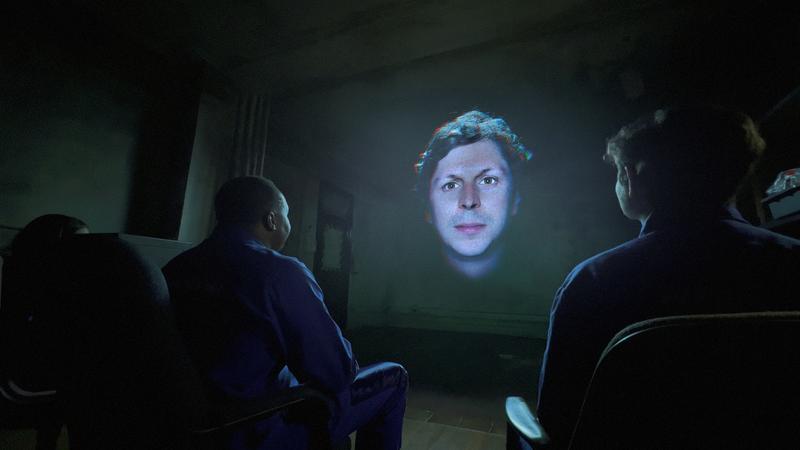
( Photo by Peter Andrews © 2023 Stage Might Inc. All Rights Reserved. )
Announcer: Listener-supported WNYC Studios.
[music]
Kousha Navidar: This is All Of It. I'm Kousha Navidar filling in for Alison Stewart. When you're typing on an Apple Mac and you make a mistake, Command Z is the shortcut that lets you undo that mistake, and now Command Z is also the name of a new series in which a time traveling task force in the mid-apocalyptic year 2053 attempts to undo mankind's mistakes from the past.
Here's a clip from the series. It's about a minute long in which the team has the mission explained to them by their leader. Their leader is the digital floating head of a billionaire, and it's played by Michael Cera. Here it is.
Kerning Fealty: "The three of you have been selected to lead an operation called Command Z. Command Z is a mission of unprecedented importance, a series of missions."
Emma: "I honestly didn't realize AI's could have manic episodes."
Kerning Fealty: "[laughs] That's funny Emma, but you won't be making jokes after you hear what you're going to spend the next 10 days urgently doing."
Sam: "Okay, so off the bat, what you're talking about sounds like a whole lot overtime."
Kerning Fealty: "Listen to what I'm telling you. This is historic, literally. It's never actually been done successfully. There'll be dipping into the past to make some critical fixes there that will in turn make the future, our present right now, more liveable, fair, and decent for everyone."
Emma: "Wow."
Kerning Fealty: "I'm absolutely serious we figured it out."
Emma: "I don't think you did. You know, changing the past and cheating history can't happen. It doesn't work. Not even in fiction."
Kerning Fealty: "Cheat and change are so rough and binary, Emma, and make people uncomfortable. I prefer reshaped history influence its path."
Jamie: "So maybe we could somehow get Molly to reconsider our breakup."
Kerning Fealty: "[chuckles] Jamie, we're going back a lot further than that."
Emma: "So even before you blow yourself up on your way to Mars?"
Sam: "Harsh."
Kousha Navidar: The year they're going back to the major inflection point, it just so happens it's 2023. Command Z was created by my next guest, director Steven Soderbergh, and co-written by my other guest, Kurt Andersen, whose book Evil Geniuses: The Unmaking of America provided the inspiration. The series is available to stream exclusively on Soderbergh's website for a fee of $7.99, the proceeds of which go to Children's Aid, and the Center for Antiracist Research at Boston University. Joining me now to talk about the series are Kurt Andersen and Steven Soderbergh. Both of you, welcome to All Of It.
Steven Soderbergh: Thanks for having us.
Kurt Andersen: Great to be here.
Kousha Navidar: Absolutely. I love listening to that clip. Steven, I'd love to start with you. According to variety, you reached out to Kurt first to work on this. What's the story behind that?
Steven Soderbergh: A lot of people, I was having that sensation of feeling overwhelmed by everything, and trying to fight this sense of nothing works, what's the point? I can't do anything to change the trajectory that we're on. I read Kurt's book, and it provided a very interesting framework of how to think about the problems that we're facing right now. My question to him was, what can we do that's creative to counter the narrative that creates despair and the apathy for people? We just started having a conversation about what that would look like.
We went through a few different iterations before settling on what became Command Z. It was fun. I think part of the goal was just to be active about pushing ideas that were positive. I think for us, just making the thing, I think people go to work and have something to show at the other end of it, instead of just complaining, that felt like the way to go.
Kousha Navidar: It sounds like maybe you felt that way as well, like, "Hey, I'm feeling like I'm a bit despair. What can I do about it? How do we reframe it?" Is that fair to say? Am I picking up on that?
Steven Soderbergh: Yes, but I also have to frame it as what is the best use of my abilities to start this conversation? I could go door-to-door for somebody running for council, but I don't think ultimately that's a great use of my time when I have the opportunity to do something that creates a larger conversation. That was just my solution for me.
Kousha Navidar: Kurt, does Steven's version of that story resonate for you anything different? What was it like from your perspective?
Kurt Andersen: It was all made up?
[laughter]
No. It was exactly right, and it was lovely to have somebody with a earnest sense of what can we do to join in on this adventure that I hadn't ever expected to be an adventure? I wrote this book, it says dance history, and I didn't expect somebody who makes movies for a living necessarily to say, "Hey, what can this be transmuted into?" That's exactly right. Because we were doing it just to create this thing that we thought would distill some of these big issues that cause the despair we're talking about, because in addition to things being bad in some general way, I think part of the sense of being overwhelmed and despairing is like, "Oh, it takes so long."
You can't really change anything quickly, nothing gets changed quickly. Especially for younger people, I think that's in my experience, a very much a problem, and yet to change things, is a long game, and much of Evil Geniuses was about the long game that the bad guys, the evil geniuses played. To shift the pendulum in the other direction, a long game must be played and yet, you want everything to be quick. That tension between instant progress and a long game is really at the heart of much of the narrative of Command Z, the show.
Kousha Navidar: So interesting that you bring up the fact about younger people and that immediate gratification. Steven, you told the factor that the first version of the story was going to be TikTok videos from the future deposited in 2023, can you tell me how that idea was going to work?
Steven Soderbergh: Well, we were imagining a world in which a lot of even more communication was transmitted through that format. We had this notion that these were-- we described them as visual leaflets, that had been dropped out of this sky from the future. They were bite-sized, as most of those videos are, but I think we discovered pretty quickly that it wasn't a format that was intuitive to us, and so, we decided to move back into a space where we felt more experienced and comfortable, which is a more traditional show-style format, with characters that you're with the entire time that you get to know a little better than through a one-minute piece.
Once we made that decision, I feel like things became much more focused. Again, the idea that was to use humor to create a conversation in the minds of a viewer, I think Kurt and I both feel that comedy is a really great delivery system, for any idea, really, that you want to put across. At the end of the day, if your job is to sit around with smart, funny people, and try to come up with something smart and funny, that's a pretty good day.
Kousha Navidar: Absolutely. I feel like the same here. I get to spend all day with smart, funny people. It's wonderful. It got asked, do you spend a lot of time on TikTok?
Steven Soderbergh: No, I did in preparation for that first version, and there's wild, fascinating stuff going on but it really does have its own grammar, and in terms of how it pushes things around for people to look at. You have very, very little time to grab someone, and it really was counter to the rhythms that I think Kurt and I are more comfortable with.
Kousha Navidar: Got it. Kurt, the characters go back in time, right? They go back in time for the audience through the minds of people who live in that time. They don't actually physically go back in time themselves. They inhabit the minds of someone close to the person in power, but not the person in power themselves. This actually goes back to what we were talking about Steven with the idea of TikTok. They call them influencers. Kurt, I'd love to know why did that make more sense for the story's sake than the alternative of just physically going back in time themselves?
Kurt Andersen: As you say, influence is really the real-world mode in which progress happens, in which change happens. You could go back and threaten and cajole them. That seemed less interesting to us. They double the arm's lengthiness of this as a comedic narrative device that you couldn't-- In one case, we do get into the head of one of our targets by accident, but in general, it was to try to convince, or threaten, or persuade, or make people do better.
That was their slightly naïve, but sometimes successful strategy. That seemed more interesting than just going back in person and say, "Look, the world gets bad." That seemed obvious and this seemed more interesting. Of course, well, we won't spoil what happens in terms of some actual physical time travel that goes on, but that was really what Shujaa does. It seemed more ripe for storytelling and comedy, frankly.
To Steven's point about how comedy being a good delivery system, I think especially in what we're trying to do, where, as they should, people are scolded, and convinced, and hectored about climate, about inequality, about financial tyranny, all these things. That's great, but it seemed that another way to do that, an additional way to do that is with comedy, even as these serious subjects are being dealt with.
Kousha Navidar: Comedy, it's a funny parallel, I think. We were talking about how to influence folks and then also how to talk about tough things, the comedy versus the influencer. There's an interesting parallel there. We just got a text from a listener that asks an interesting question. Here's what they say, "This show sounds interesting. Can you explain why they picked Command Z as the title, when the shortcut Ctrl Z is so much more well-known and already in the vernacular?" I thought that's interesting. Either one of you, do you think that's interesting? Maybe, Steven, we can start with you.
Steven Soderbergh: They've obviously thought about it a lot more than we did. That would've worked. I think Command Z is a little more active just as a thing to say and to imagine, and so I think that was probably part of its appeal. Honestly, it went through a few title iterations, actually, before we settled on Command Z. It also created really elegant, simple swag. You've got to take that into account if you're making anything.
Kousha Navidar: It's all about the marketing, right?
Steven Soderbergh: Got to have some good swag.
Kousha Navidar: Got to have some good swag. What's the swag that your favorite piece-- Oh, sorry, Kurt, go ahead.
Kurt Andersen: I was going to say, as it happens, there's also a Latin American teenage telenovela series called Control Z. We didn't know that until after we'd already named it Command Z, but that's true.
Kousha Navidar: I actually wanted to go back to your point about humor as well, Kurt. There are all kinds of silly, quirky elements in this story. The wormhole that they use is housed inside of a washing machine, which I loved. They're able to make the connection, because in the year 2020, billionaires put nanobots in hand sanitizer. In order to travel, the characters have to listen to (Do You Know Where You're Going To) Theme From Mahogany. Let's listen to that clip right now.
[MUSIC - Diana Ross: Theme From Mahogany (Do You Know Where You're Going To)]
Do you know where you're going to
Do you like the things that life is showing you
Where are you going to, do you know
Do you get what you're hoping for
Kousha Navidar: How did you land on that song?
Steven Soderbergh: I was a producer on this documentary that Elvis Mitchell made that came out last year, Is that Black Enough for You?!? Over the course of a few years we were working on this, we were both watching movie after movie to determine what film should be included in the documentary, and what Elvis should be talking about.
Mahogany was one of the films that was highlighted, and I hadn't seen it since it came out. I watched it again and was struck, as many millions of people were when it came out, by the theme song, which seemed to have a set of lyrics that work for anything. I just thought if you combine that song with a high-end appliance and some organic hallucinogens, that that would be as likely a method of time traveling as anything I've heard before in a movie or a show.
Kousha Navidar: I'm talking to Steven Soderberg and Kurt Andersen about their new series, Command Z. It's available to watch right now. I want to talk about AI for a second. Michael Cera's digital self is a kind of artificial intelligence. You filmed this series in 2022, and since then, it feels like AI has exploded into every corner of mainstream art and culture. Steven, you told Defector, "I'm not worried about AI in the context of my day job." Tell me more about that. Why not?
Steven Soderbergh: Oh, because it can't finish anything, and it's limitations are really, really obvious. That being that it has no actual experience. Nothing's ever happened to it. What we're asking the AI to do is a brute force version of what we do creatively all day, every day. For instance, I've played around with all the various apps and things that are available, so I asked it at one point, "Here's a story of these characters. Write this in the style of Harold Pinter," who's a fairly well-known playwright with a very specific style. Now, the thing that came back was not close. I realized part of the problem for it is it's never seen a Harold Pinter play. It may have ingested the text, but if you haven't seen a Harold Pinter play performed, you don't really understand what's going on.
That's just one tiny example of why this thing will never be able to bridge the last 10 feet of completing a distinctive piece of work that feels like it was created by a person. As a tool to get somewhere quickly, if I'm doing design work and I say, "Show me a creature that's a combination of a bumblebee and a dolphin." It can do that. You can just keep prompting it and turn that creature into whatever you want.
That's fun. That's helpful maybe, but the idea that it could replace creative people in any meaningful way, I think, is unfounded. I'm hoping that we'll figure out what the good uses of AI will be in this context of making a movie or a show.
Kousha Navidar: It can brute force some things, but it can't replace the real ingredients. Kurt, would you disagree with that?
Kurt Andersen: No, I agree, for now, with everything Steven has said. I'm not sure I'd say never in terms of it will never be able to do that, but certainly, in my lifetime, probably. Maybe Steven will get to where it will eliminate him when he's 90. I don't know. It's true. I find it useful. I used it actually, rather than just playing around, in a useful way for the first time the other day when I was writing something in which I had to understand what infinite regression in the epistemology philosophy sense is.
Rather than wade through lots of stuff and actually try to understand it, I'd said, "ChatGPT, tell me this in a simple way." I'm telling you, the paragraph like, "Oh, okay, I get it. Fine." That was just basically a form of advanced search, which is obviously going to be-- That's fantastic. Do that because people weren't doing that anyway.
Kousha Navidar: Steven, it sounds like you wanted to add something out to that.
Steven Soderbergh: No, I just think, like I said, the process by which you solve creative problems is so serendipitous and could be altered by you having a problem you can't solve and getting up from the table and going into the kitchen, and either being reminded by something in the refrigerator that's actually related to the problem you're trying to solve, or the phone rings, and it's a friend of yours, who you start a conversation with that ends up solving your problem.
The real world is a gigantic resource for people trying to solve creative problems. Here's a good example of it. I want to create a new version of a long running law enforcement procedural show. I want to do CSI: Barcelona. Now, you can load every episode that's ever been made into the AI. You can load anything you can think of about Barcelona into the AI, and it could probably generate some sort of basic bible for a season of CSI: Barcelona. Now, real people are going to have to come in here and make this into something worth watching. Again, as a brute force homework, generator apps, that's fantastic. That's what it's good at.
Kousha Navidar: I was talking to Steven Soderbergh and Kurt Andersen, who have created the new series, Command Z. Steven Soderbergh directed it, co-written by Kurt Andersen. It's available to stream at commandzseries.com. Just one more thing I wanted to point out, which I thought was super interesting, was that you are donating the proceeds. To watch the series, you have to pay $7.99, and those proceeds are going to charities--Children's Aid, and Boston University Center for Antiracist Research. Steven Soderbergh, Kurt Andersen, thank you so much for joining us.
Steven Soderbergh: Thank you for having us.
Kurt Andersen: Thank you.
Kousha Navidar: Absolutely.
Copyright © 2023 New York Public Radio. All rights reserved. Visit our website terms of use at www.wnyc.org for further information.
New York Public Radio transcripts are created on a rush deadline, often by contractors. This text may not be in its final form and may be updated or revised in the future. Accuracy and availability may vary. The authoritative record of New York Public Radio’s programming is the audio record.