
In the Play, ‘Sancocho,’ Tension Simmers Between Two Sisters
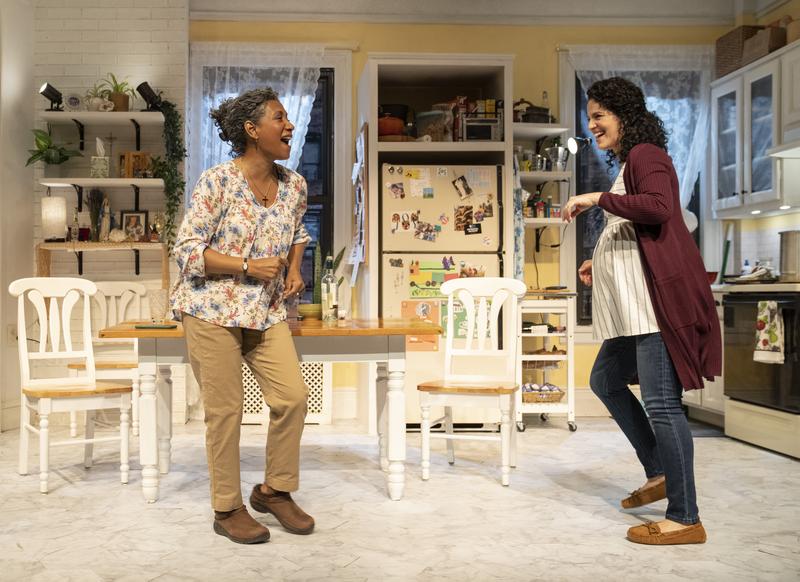
( Photo Credit: Joan Marcus )
Alison Stewart: This is All Of It. I'm Alison Stewart live from the WNYC Studios in SoHo. Thanks for listening. In just a couple of weeks, we'll be discussing our April Get Lit with All Of It book club selection. We're reading the latest novel from bestselling author Mona Simpson. It's titled Commitment and it explores the way mental illness impacts a family. The Associated Press calls it "a minimalist masterpiece."
Thanks to our partners at the New York Public Library, we have unlimited e-copies of the book available for New Yorkers. New Yorkers, head to wnyc.org/getlit to find out how to borrow an e-copy and mark your calendars for Wednesday, April 26th. That is when I will be in conversation with Mona Simpson live from the library. Tickets are free. To secure yours, go ahead to wnyc.org/getlit. That is in our future. Now, let's get this hour started with Sancocho.
[music]
Alison Stewart: In an off-Broadway play, two sisters, Renata and Caridad, negotiate how to settle their dying father's estate over a simmering pot of sancocho, which is a comforting beef stew and it's also the name of the play. In the story, Caridad invites her very pregnant younger sister, Renata, to her home for Sunday dinner. However, Renata is really interested in discussing their father's will. The night takes a turn when the conversations go to their upbringing. Caridad, who is much older than her sister, reminds Renata how sheltered she was from their father's abuse.
Renata regrets not learning family traditions from their late mother and grandmother and feels isolated as the first college graduate and lawyer of the family. The show touches on topics like grief and colorism and generational trauma as the stories and secrets of the De Jesus family unravel throughout the night as the two spend time together in the kitchen. Sancocho has been extended in its limited engagement twice and is now running at the WP Theater through April 23rd. The show's creator, Christin Eve Cato, joins us to talk about the show. Christin, nice to meet you.
Christin Eve Cato: It's great to meet you. How are you?
Alison Stewart: Good, thank you. Also, joining us is the play's director, Rebecca Martinez. Hi, Rebecca.
Rebecca Martinez: Hi. Thanks for having us.
Alison Stewart: Lastly but not leastly, [laughs] Shirley Rumierk is the lead actor who plays Renata, the younger sister. Shirley, hi.
Shirley Rumierk: Hi, pleasure to meet you.
Alison Stewart: When you describe to people, Christin, what Sancocho was about, what do you say?
Christin Eve Cato: I say Sancocho is about two sisters who are generations apart and have come together on this night to try to-- They both have motivations. One wants to heal and the other one wants to heal, but they want to heal differently. The Sancocho is a metaphor for that healing. These two sisters, they come together the night that their father is really sick. He's dying and there's important information to talk about, but with death, there's always secrets.
Alison Stewart: We won't give anything away. We won't spoiler alert this. What was the catalyst for the play?
Christin Eve Cato: I wanted to write a play that celebrated the women who raised me and who I knew growing up. I wanted to see these voices on stage. I wanted to tell a story that I haven't heard yet. It was the middle of the pandemic and I was missing my family. I was missing the women and I was just tapping into this strength that I knew was passed down to me. In having conversations with so many other women and people, because that was a time of everyone just having these solitary moments and reflections and we were all feeling the same need for collective healing, that's how this played. That's the metamorphosis of this play.
Alison Stewart: Rebecca, what did you think when you first realized, "Okay, my actors are going to be cooking on stage throughout the performance"?
Rebecca Martinez: Well, Christin and I have been working on this for a while and during the shutdown. We'd been working on it via Zoom. We had all these Zoom readings and it was like, "Oh yes, they're cooking and they're cooking and they're cooking. Great. That's easy. We'll just cook." I think it was once we started adding up the number of ingredients and started thinking about timing and how things are going to be done, oh and yes, in order to make this happen, actors are going to be using knives on stage, can't be hearing much about like, "Yes, we're going to spend some time thinking about this and planning this in a way that feels safe," but also really conveys the story because it's very important. They're very important parts of the story, the interactions with food.
Alison Stewart: Shirley, when we meet Renata, how does the character feel about her life? When we meet her, how does she feel about family?
Shirley Rumierk: Poor thing. Renata is very much stressed out. She feels alone in terms of her connection to her family roots. She's had to shed so much of herself in order to be a part of these spaces of privilege as a lawyer, having gone to college. She's a soon-to-be mother and, at the same time, has a father that's very ill in hospice. She's desperate to connect to family and tradition and her lineage so much. That's what she's seeking from Caridad, her sister.
Alison Stewart: Her sister's also like, "Hey, not so fast, fancy pants."
Shirley Rumierk: Yes.
Alison Stewart: "You don't get just waltz back in here."
Shirley Rumierk: Exactly. I don't get to just waltz in. For Renata, there's definitely a feeling of just a deep, deep need to reconnect and reconnect with family.
Alison Stewart: We're discussing the play, Sancocho, with its playwright, Christin Eve Cato, and Rebecca Martinez, the director, as well as Shirley Rumierk, who plays one of the leads, Renata. Christin, as Rebecca mentioned, you've been working on this for a while. The show was up in Chicago. How has the play evolved since you first staged it?
Christin Eve Cato: It's evolved because it's different when you're actually working with New York actors who know the life and the women specifically and the language and the choreography of the rhythm of the speech and the cadences. It's a very tough text, I have to admit. As a playwright, I really put some artwork into this text. I think that to have just people, to have these creatives in the room who just understand the lyrics, the lyrical way that these women speak and move, and how those two things complement each other, including the food, including the rhythm of the kitchen.
I think having that space and also working with an all-Latina cast and creative team and having all of these producers in the room too, just making everything happen that we needed to happen, it was just a smooth process that I was really able to dig into the text. I was really able to find more of the colors and the layers that are in the story. I think that because I was in the room because, unfortunately, for the Chicago production, I couldn't be there in person. There's nothing like being in the room in the workshop process and the table process to really dig into these characters in the world.
Alison Stewart: Rebecca, so the script has this intricate timeline and the family tree. Some stuff's gone down in this family before we meet these two sisters on stage. If you could describe a little bit how you talk to your actors about physically letting us know through their physicality, the history in this family, whether it be difficult moments, whether it be affection. How did you talk about two sisters in a small space together?
Rebecca Martinez: That's so critical to the storytelling. Knowing that most New York kitchens are very, very tiny, we actually allowed just with our scenic designer, Raul Abrego, to expand the kitchen just a little bit so that it still felt like a New York kitchen. It gave these two an opportunity to hide from each other when they need to and how to tell the story of like, "Once we're in it, we're together." What does it mean and look like for people to be in close proximity?
When are the moments when they feel comfortable enough to be able to open up and share? Then what are those moments when they actually have to take a break from each other or be separated from each other and not making eye contact or anything because what they're talking about is so out of their normal relationship? That's what this play is really about. It's like how two people negotiate a new way of relating to each other. They're both in their very specific ways. They don't always have the skills to do this effectively, but they're both willing to do it.
Alison Stewart: Shirley, as an actor, what are the challenges of working in a small space with another actor and then what are the opportunities?
Shirley Rumierk: To be honest, not many challenges at all. I have to say that the entire process has been devoid of ego and in full service to the script when we would all work in the room together. With that joy and passion, at least it helped navigate me through the space. The one challenge is 90 minutes on stage is sometimes in the technical rehearsal process wondering, going, "Wait, did I just stand here already?" Oh, there's only so many places that I can stand in this kitchen when we would stop and start.
However, once we would kick off the play and run through its entirety, then it became very clear, the rhythm. There's a rhythm. The language is a rhythm in the blocking. There's a rhythm in our bodies. I have a rhythm that Zuleyma Guevara, who plays Caridad, has. There's this rhythm and that's what guides me through the kitchen. Honestly, I've known Zuleyma many, many, many, many years. There was an automatic shorthand when we started rehearsing. I 100% fully trust her on stage. That gave me freedom to play in the space that I have in the kitchen.
Alison Stewart: Christin, I'm going to ask you to explain to our audience. For people who don't know, what ingredients do you need for a good sancocho?
Christin Eve Cato: [chuckles] Sancocho is, you need all the root vegetables, right? You need your starch. You need potatoes, your cassava, which is yuca. This is the Puerto Rican version, by the way, because sancocho exists in many Latin American countries. In Puerto Rico specifically, we have yautia. We have potatoes. We have nyame. We have platanos in there, corn, carrots, and the usual peppers and onions. In Puerto Rico, the special ingredient we use is the oxtail.
Alison Stewart: There's two things that made me think about this. There's a recipe for sancocho in the playbill, but there's no measurements?
Christin Eve Cato: There's no measurements.
[laughter]
Alison Stewart: I feel like that's in conversation with your script and your story.
Christin Eve Cato: It's about intuition. It's about allowing the ancestors to work through you as you prepare this food. Because when you are peeling these root vegetables, it's like the skin that you're peeling off, getting down to the root, all of that metaphor. That stuff is transferred through your hands. I was making it as I was writing this play just to understand it myself, what was happening to me, this really, and how to transfer that to the script. There's two processes. It was the cooking process that I was doing on my own, and also how it relates to the sisters in the moment.
Alison Stewart: We're discussing the play, Sancocho, with its playwright, Christin Eve Cato, and Rebecca Martinez, who's the director, and Shirley Rumierk, who is one of the leads. We'll have more about the play, Sancocho, after a quick break. This is All Of It.
[music]
Alison Stewart: You're listening to All Of It on WNYC. I'm Alison Stewart. We are discussing the play, Sancocho, which has been extended twice and is running through April 23rd at WP Theater, talking with Christin Eve Cato, the playwright, Rebecca Martinez, the director, and one of the lead actors, Shirley Rumierk. Shirley, in the play, Renata, your character, mentioned that she never really actually learned to cook properly and cook family meals in certain traditional foods properly. Why didn't she learn?
Shirley Rumierk: Well, she didn't learn because her mother would kick her out of the kitchen whenever she was there and would send her off to read a book to busy herself doing something else. Then my sister in the play also says that my dad also said that I was too good to be in the kitchen, that I should be reading books and busying myself with that. As much as I yearned to have that connection with my mother in the play and that desire to bond with her in that way, that was not available to me because I was pushed in a certain direction. It was pushed to achieve and succeed in a very specific way that my parents had in mind.
Alison Stewart: What tension does that create between the two sisters?
Shirley Rumierk: It creates a lot of tension because my older sister was pushed in a very different way by same parents, 25 years apart in terms of age. 25 years earlier, my parents were pushing her to basically fill in the domestic cracks to cook, to clean, to do all of that, and, unfortunately, didn't give her the space to allow her to explore her desires for academic learning.
Alison Stewart: Christin, this is where the play starts to take in issues and starts to explore issues of classism and colorism and even favoritism within families. Without giving anything away, what did you want to show about what happens when we don't talk about these things and when we keep secrets and hold onto deep feelings about these things and not share them in families?
Christin Eve Cato: I think what happens is that you internalize these emotions, these feelings, and then you either dissociate from them or you pretend that it's not happening, or you just bury them inside and you just continue focusing on the next thing at hand. That trauma gets internalized. Then that's when Renata has this beautiful moment when she's talking to Caridad about generational trauma and how PTSD can be passed down in your lineage. It could be passed down genetically. This is why we need to talk about these things. The only way for people to heal is by talking about those things even with each other like healing relationships too. Many strange relationships happen because they don't have that communication.
Alison Stewart: Rebecca, there are a lot of reveals throughout the show. What were your conversations like around pacing about how to ramp up to those reveals, how to get your actors out of those reveals so the story can go on?
Rebecca Martinez: We had a lot of conversations about that. The one thing that's so beautiful about this cast like what Christin was talking about before, they came in knowing who these people were, which is so helpful in terms of performance. One of the things that we talked about a lot was, what does it do? When does it slow you down? When do you need time to process? When do you actually need to push it away?
I've been here for a bit. It is uncomfortable. Now, the place of safety, which is where Caridad goes to a lot, is activity. This is safe. This is love. I show love through food. I don't know how to show love by speaking, but I know this is a place where I can show you love by teaching you something that you want to know that I have. Whereas Renata comes across with things very differently as in, "I need to speak and speaking is a way I find health."
I think it's the tension between the two of those and finding where that always lives, finding who's pushing, who's pulling at what point. That helps us understand what are the times when we actually can take a little breath and what are the times when we just have to go and just keep going. Since there's also a lot of humor, pacing is something that you need for humor to keep that clipping along. Fortunately, these two are brilliant comedians.
Christin Eve Cato: It's funny by the way. It's funny too.
Alison Stewart: Christin, what's the process for writing a bilingual script? The script is in both English and Spanish.
Christin Eve Cato: Well, I grew up speaking Spanglish. That was one of the languages spoken predominantly in my home growing up. It became very natural to dialogue.
Alison Stewart: What about for you, Shirley, as an actor?
Shirley Rumierk: Very easy for me. I grew up speaking Spanish at home and Spanglish with friends. Jumping into this was very easy. Renata interestingly tends to veer more towards English, whereas her sister will use more Spanish.
Alison Stewart: To a point you made earlier or in your answer, Rebecca, you said, "My actors came in knowing these people." Is that part of the idea of having an entirely Latin cast and behind-the-scenes folks, it adds to the specificity of the production that you're able to have somewhat of a shorthand maybe?
Rebecca Martinez: 100%. It makes such a difference. It makes such a difference to have folks who understand culturally and geographically who folks are in the room. Because we can all approach the play from a place of, we don't have to break down as much information. We already come in with a certain level as a team.
I'm talking as the whole team, and then can just build from there, so we were able to-- and also because our two actors have such a close relationship and know each other. They came in with chemistry and they came in with a relationship. We didn't have to spend the time developing that relationship because it was already there. That's just kismet. That's just the universe telling us this is how we need to tell this story in this time.
Christin Eve Cato: Which gave us that extra time to really work on the story, work on the script in a way that we haven't been able to work on it before.
Rebecca Martinez: Chop them vegetables.
[laughter]
Alison Stewart: Christin, what kind of conversations do you hope the audience will have with their families after seeing the show?
Christin Eve Cato: I hope that they have those difficult conversations that they've been meaning to have. I hope that some people seek therapy and understand that therapy's not a bad thing and understand that we all need it, at least one time in our lives, and that to destigmatize all of those things for us and our community and to really pay attention to how we function in the world and how we want to create healthy relationships and set that example up for our future generations.
Alison Stewart: Shirley, how about for you? What do you hope people are having conversations about or even just with themselves, things that they think about after seeing this play?
Shirley Rumierk: What has been wonderful has been the immediate audience response, how there are elements of nostalgia. Most importantly, how it leads to action. Many people have either said, "You know what? I'm going to call my sister," or "I'm going to call my mom," or "You know what? I've been meaning to talk about such and such thing with this relative." That, I think, as an actor, as an artist, as someone who sees her career as that of healing through the arts is just the best thing.
Alison Stewart: Rebecca, final word on that?
Rebecca Martinez: I would say that one of the things that is so moving is when we have audience members reach out to us, folks we know and folks we don't know talking about how much this story has impacted them, how they've been thinking about it, and how they are inviting their family members to come back, which is such an invitation for community. We want people to come in there feeling like they're home and feeling like they're part of a community. It feels like that is happening and continues to happen. It's such an honor to be able to host a space where audiences can come in and have that feeling and have those moments of little transformation. It's like a dream theater.
Alison Stewart: Sancocho is running through April 23rd at the WP Theater. I've been speaking with playwright Christin Eve Cato, Rebecca Martinez, the director, and Shirley Rumierk, a lead in the play. Thank you so much for being with us.
Christin Eve Cato: Thank you for having us.
Shirley Rumierk: Thank you very much. Thank you for having us.
Alison Stewart: Thank you.
Rebecca Martinez: Come see Sancocho.
[laughter]
Copyright © 2023 New York Public Radio. All rights reserved. Visit our website terms of use at www.wnyc.org for further information.
New York Public Radio transcripts are created on a rush deadline, often by contractors. This text may not be in its final form and may be updated or revised in the future. Accuracy and availability may vary. The authoritative record of New York Public Radio’s programming is the audio record.