
A New Exhibition Presents a Multigenerational Saga of a Wealthy Jewish Family
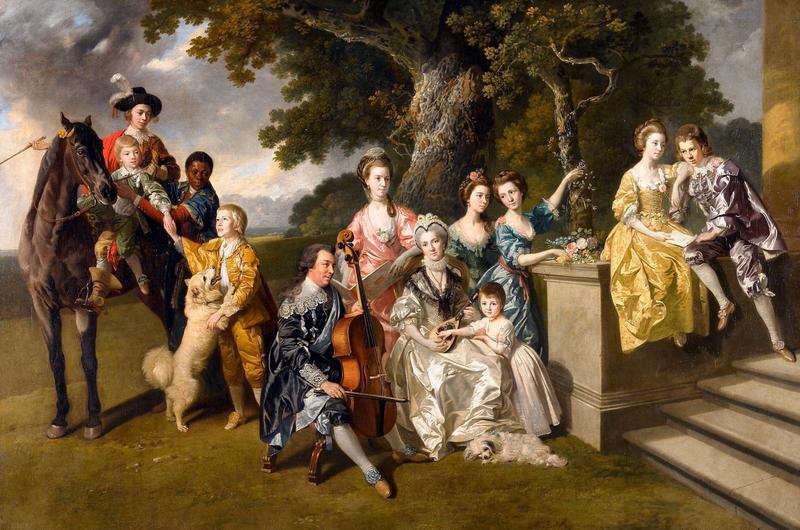
( Johan Zoffany )
Kerry Nolan: Welcome back to the second hour of All Of It on WNYC. I'm Kerry Nolan, in for Alison Stewart. A new exhibition at the Jewish Museum looks at a Jewish family from Baghdad, that over the course of a few generations created a business empire. The Sassoon family could trace their lineage all the way back to the era of King David. In 1830, David Sassoon, the leader of the family was forced to relocate to India to escape persecution. It was that move that began the Sassoons' rise to fame and fortune.
David Sassoon expanded his trading business, employing his sons and other Baghdad Jews, and established connections from Karachi, to Hong Kong, Shanghai, and even as far away as the UK. At the Jewish Museum, this exhibition called the The Sassoons' pieces together the family's modern history with a family tree, archival objects, and portraits of family members. The Sassoons' is on view until August 13th. With me now are the show's curators. Claudia Nahson, and Esther da Costa Meyer. Hi, Claudia and Esther, welcome to the show.
Claudia: Hi.
Esther: Thank you.
Claudia: Thanks for having us.
Kerry Nolan: Our pleasure. Now, the exhibition begins in the 1800s with the story of David Sassoon. Why did you decide to begin the story with him?
Claudia: Because David Sassoon really sets the narrative in motion in terms of the global expansion of the family. After being forced to flee Baghdad due to persecution, he settles in Mumbai, and basically, within a few years, he's trading so actively that he decides to deploy his sons. He has eight sons, and really a major asset for him at that time. Deploys the sons widely to China, and eventually also to England and even back Baghdad because after persecution subsides with a change of ruler, they re-initiate a contact with Baghdad, which was their mother community.
Kerry Nolan: Now, what other history does this exhibition explore about the history of Jewish people in Baghdad?
Claudia: Well, Esther, you want to-- [chuckles] I was going to say that, basically, despite the fact that they settle in Mumbai, and they live there for a number of decades, the reference is always to Baghdad. Spiritually, the community is always turning to Baghdad as a source of nurturing, as a source of spiritual guidance. The first and second generation basically are very much anchored on that community. The way they dress, the way that they practice is very much grounded in Baghdad, and they also bring young Baghdadi Jewish men to work for the firm.
It becomes a family enterprise and also supplemented by this young men who also speak Judeo-Arabic and who also practice in the same fashion.
Kerry Nolan: Now, as you mentioned, about 1830, the Sassoons fled Baghdad, and they settled in Mumbai. Once they got settled, how did the family begin to build its empire? We know he used his many sons in his business, but how else did he begin to build that empire?
Esther: David Sassoon was by all accounts, perhaps a brilliant man who spoke several languages: Hebrew, Arabic, Turkish, Persian, the language of freedom, he learned Hindustani, though never English. He was a major trader and began trading in pearl, spices, pieces, and eventually opium. That became an important part of the family business until it was outlawed in the 20th century.
Kerry Nolan: Now, as we said, he included his sons and he had several sons. How did he include his overall family in that business structure?
Esther: Well, the sons were deployed as Claudia just said, in the many cities where they had business, which included not just the Middle East, but several ports in Asia, Hong Kong, Shanghai, but also Kobe in Japan, other cities, Karachi, Kolkata. They had businesses everywhere, and they had a large network of Baghdadi-Jewish co-religionists, and also family members, close near family members. They were all working for the Sassoon firm and eventually the two Sassoon firms that came out of David Sassoon's empire.
Kerry Nolan: Why did they set their sites on China?
Esther: Because China was where the opium was being sold.
Kerry Nolan: Okay.
Esther: The British had enriched themselves with the Industrial Revolution, they needed enormous amounts of silk and tea from China. What did the Chinese want from Britain? Absolutely nothing so the British waged war on China. First Opium War, '39 to '42. What they got out of that war was, first of all, they got Hong Kong, and five ports where it was legal to sell opium to China. Opium was illegal in Europe, in the United States, in India, and it became legal in the treaty ports.
Kerry Nolan: This trading in opium must have complicated their legacy, did it?
Claudia: Well, yes. I think that as Esther explains the fact that it was a widespread commodity, and legalized throughout the West. I think looking from our own perspective, yes, we are wrestling with the legacy of colonialism, and the opium trade is part of that history and so that's why we wanted to address it front and center in the exhibition and in the exhibition catalog. We always have to bear that in mind that a lot of the welfare mass is due to the trade. By 1917, opium was outlawed basically. As we enter the 20th century, basically they're diversifying mostly into textiles. They have textile mills in India, and also real estate in China and hotels in China, as well.
Kerry Nolan: Around this time, as we've been discussing, another branch of the Sassoon family ended up in the UK, which members wound up going to England?
Claudia: One of the sons of David Sassoon, in 1858, he sent out to London to open an office there. Amazingly, he was a young man, already had been sent to Baghdad, already had trained in Shanghai, comes to London, opens a new office, and dies by the age of 35. This man had been all over the globe at that time. His health wasn't very good, and eventually he dies in England, but the other brothers follow up and continue to work for the office. Eventually, most of the sons will gravitate towards England and most of their family will end up settling there.
Kerry Nolan: We're speaking about the exhibition, The Sassoons' on view at the Jewish Museum, now through August 13th. My guests, if you're just joining us, are Claudia Nahson, and Esther da Costa Meyer, who are the co-creators of this exhibition. I'm really curious about how the Sassoons manage to make themselves part of British society. British society is not well known for being so welcoming to outsiders.
Esther: You're absolutely right, but they were a stateless minority when they arrived in Bombay, now, Mumbai. In no time at all, they did enormous services to the Raj, because they had this network all over, a great part of Asia. They had the language skills, and they were ideal partners. As a result of their philanthropy, their partnering with many local and British firms, they were eventually knighted where Albert was knighted, the son. Then when they start going to Britain, as Claudia pointed out, they slowly become, because of their wealth, very prominent. They eventually get others become also knighted, and they marry. Certainly the grandson of David Sassoon marries a Rothschild and they become within, generation and a half, they become part of the aristocracy.
Kerry Nolan: Ah. It's clear from the exhibition that the Sassoon business empire expanded and contracted, depending on the success of the British Empire and its colonial interests. How were those intertwined?
Claudia: Well, deeply intertwined. I would say that the fact, as Esther was saying, that they were already tied to the colonial interests of Britain in India paved the way for their entrance into society in Britain. They're really tied together. They did see, as the opium trade ceased, that they had other opportunities and they stayed in China really and in India until the partition of India in '47, until communism took over in China in '49. They did-- Even if Britain was leaving the scene they were trying to still stay on and invest in their businesses there. Eventually, England became their ultimate home.
Kerry Nolan: Now, we're into the 20th century now, and clearly both World Wars affected parts of The Sassoon family very deeply. How so?
Esther: Well, that's a very interesting point. David Sassoon had 14 grandsons fighting for Britain. That's an amazing number. They distinguished themselves, including the poet Siegfried Sassoon, the war poet. In fact, the one who died of those 14 was his brother Hamo. The Sassoons were deep devout patriots. After all, Britain was the nation that had given them citizenship after they lost their Ottoman citizenship in Baghdad. They gave everything. The same thing would be true in World War II, both the men and the women. We want to underscore that the Sassoon women also worked for the war effort in both wars.
Kerry Nolan: You bring up a good point because the exhibition makes an effort to point out the contributions that the Sassoon women made in the family history and the business. Rachel Sassoons, who was the first woman in the UK to edit two newspapers.
Claudia: Absolutely.
Kerry Nolan: Let's talk a bit about what is known about Rachel and why you made this choice to include the stories of the Sassoon women?
Claudia: Well, as Esther and I were researching, it was like we were open doors and more worlds opened up within the wider world of the Sassoons. The women, We were really keen on highlighting because many of these women for one thing the women of the second generation the wives of the sons. Many of them stayed in India for long periods of time while their husbands were doing long stints in China in England.
They really held a fort at home, and they had a philanthropic spirit. They also believe in social justice. One of the women Flora Sassoon became also-- she was a deeply devowed and also became a businesswoman. She actually took over the office of the David Sassoon and company firm in Bombay for a few years which was unprecedented.
Now, Rachel, whom you asked about Rachel Sassoon she was the daughter of the first son who settled in England, the one who died at the age of 35 that we were talking about earlier.
She was born in Mumbai and was taken as a baby to England, so basically she grew up in London. She was a very independent-minded woman which was unusual in those days. Her mother wanted her to marry within the Baghdadi Jewish community. None of that was what she was going to go for. She was a musical person. She was an intellectual and she was an art lover. She met Friedrich Bayer who was actually a descendant of a major, a very important Jewish family from Frankfurt. He and his sister had been converted to Christianity to Anglicanism when they were young.
The marriage of Rachel to Friedrich Bayer caused quite a rift with her mother who basically raised her [unintelligible 00:13:39]. She was a young girl when her father had died. The two of them, it was really a good match. They didn't have children and they really dedicated their lives to journalism. He already owned the Observer, one of the two Sunday newspapers in England, and then acquired the Sunday Times. She became the editor of both. She really played a seminal role in the covering of the Dreyfuss affair in England. She found out that Esterhazy, who was the real culprit in the affair.
The Dreyfus affair, Alfred Dreyfus, who was the captain in the French Army had been accused of selling military secrets to the Germans and had been imprisoned. She really somehow got this journalistic scoop of knowing that Esterhazy had fled to London because they were onto him that he actually was the true culprit of the affair. She interviewed him and she published two editorial pieces in the Observer. This was a major journalistic breakthrough. Although Dreyfus will continue to be imprison for eight more years until 1906 when [unintelligible 00:14:54].
Kerry Nolan: I think it's very interesting that within these religious and cultural constraints that these strong and independent women thrived, it's not something that you would normally expect when you're looking at that time period.
Esther: That's exactly it. You put your finger on it. This was one of our goals. This has always been presented in the Sassoon's story as the triumphant male story. David Sassoon, Siegfried Sassoon, the war hero, war poet, Phillip Sassoon, a great tastemaker, member of Parliament Victor Sassoon. We wanted to show that the women could be scholars like Flora could be brilliant journalists like Rachel, as Claudia was saying, but we wanted to call attention to the other younger women, Hannah Goby and her cousin Mozelle Sassoon, two cousins and sisters-in-law, of which almost nothing is written and were major collectors, lenders, connoisseurs, curators, and major philanthropists.
Hannah Gaby left her collection of 450 decorative arts to Britain. Tragically they housed it in a beautiful [unintelligible 00:16:10] Villa which burned in 2015. Her cousin Mozelle was a major benefactor, and she helped Britain restore St. Paul's Cathedral after the damages of the war. When the National Gallery wanted to raise money to buy Leonardo's Burlington House Cartoon which shows the Virgin St. Anne, the Christ Child, and St. John, she stepped in.
It shows these women exceed, they were Jewish, but they also saw themselves as British, as cultural philanthropists. They went beyond their roles. This is a characteristic of the Sassoons. They were at home in many languages, in many continents, and many cultures. They contributed to all these cultures in a very grand way. The women did so as much as the men.
Kerry Nolan: You mentioned, all the collecting they did, and the 450 objects that were collected, some of the items in this exhibition were loaned from Sassoon family members. Why were they so big on collecting?
Claudia: Well, it actually started, we write in the catalog that they first were commissioners and then collectors in a certain way. First, the love of art really started with Jewish ceremonial art. It's a tendency to beautify the Torah and its ornaments, it's part of Jewish tradition. They started commission when they were in India and even in Baghdad, not much of which is extent of those objects that they commissioned.
They would commission beautiful artifacts for the synagogue and for their private liturgical use. Then as they make that transition to England collecting really becomes part of their identity. They funnel a lot of that they reinvent themselves through their collecting if you wish. They collect Jude, a Jewish ceremonial art, not only because it's Baghdadi Jewish, but also they start being interested in Ashkenazi, in European, in Italian Jewish ceremonial art.
They broadened their scope and their collections start to being shown on public stage. Then they start collecting 18th-century art which is a quintessential mark of British society. Esther did a lot of research on that aspect. Also, of all the exhibitions that Philip Sassoon, who was a member of Parliament whom she was just mentioning, he was a major collector and a curator together with Hannah Gaby, the woman who donated all those works to the National Trust, and sadly, many were destroyed in the fire. They just really collecting became part of their identity. Esther, you can add some more because we're very thrilled about all-- the more we progress in our research and more collections we discovered.
Esther: Can I add to that?
Kerry Nolan: Please?
Esther: Claudia, you mentioned, one of the things we wanted to point out is in addition to Hannah Gaby's 450 things that she did. Victor Sassoon left 500 Ivory which are now in the British Museum. His cousin Percival Sassoon David left about 1,500 exquisite pieces of Chinese porcelain, Chinese ceramics also to the British Museum. They enriched the collections of Britain in a very very big way.
Kerry Nolan: We only have about a minute left. Why is it important for us to know the Sassoon story?
Esther: They're a modern family. They were in Quest of a homeland for a hundred years. They acquired all these different cultures. What is exciting for us and moving is that they were friends with the Muslims, they were friends with the Parsis, with the Hindus, with the Buddhists. It was the contrary of identity politics, they were of course involved in other things that are reprehensible to us, but in their heyday, they stood for this cosmopolitan global world that we all inhabit today with all its problems.
Kerry Nolan: Did you want to add to that, Claudia?
Claudia: Sure. I would say also that it's a story that started and ended almost a century ago. What it feels, is resonates so deeply because there's so many subjects here that we grapple with today. Discrimination, immigration, the global trade. I think that it's an intricate story, They live through a very complex time in history.
Kerry Nolan: I'm so afraid we are going to have to leave it there. We ran out the clock. I'm so sorry. Claudia Nahson and Esther da Costa Meyer, the Co-curators of the exhibition, The Sassoons on view at the Jewish Museum through August 13th. This is all of it on WNYC.
Copyright © 2023 New York Public Radio. All rights reserved. Visit our website terms of use at www.wnyc.org for further information.
New York Public Radio transcripts are created on a rush deadline, often by contractors. This text may not be in its final form and may be updated or revised in the future. Accuracy and availability may vary. The authoritative record of New York Public Radio’s programming is the audio record.