
A New Exhibition Celebrates the Artistic Legacy of Women Designers
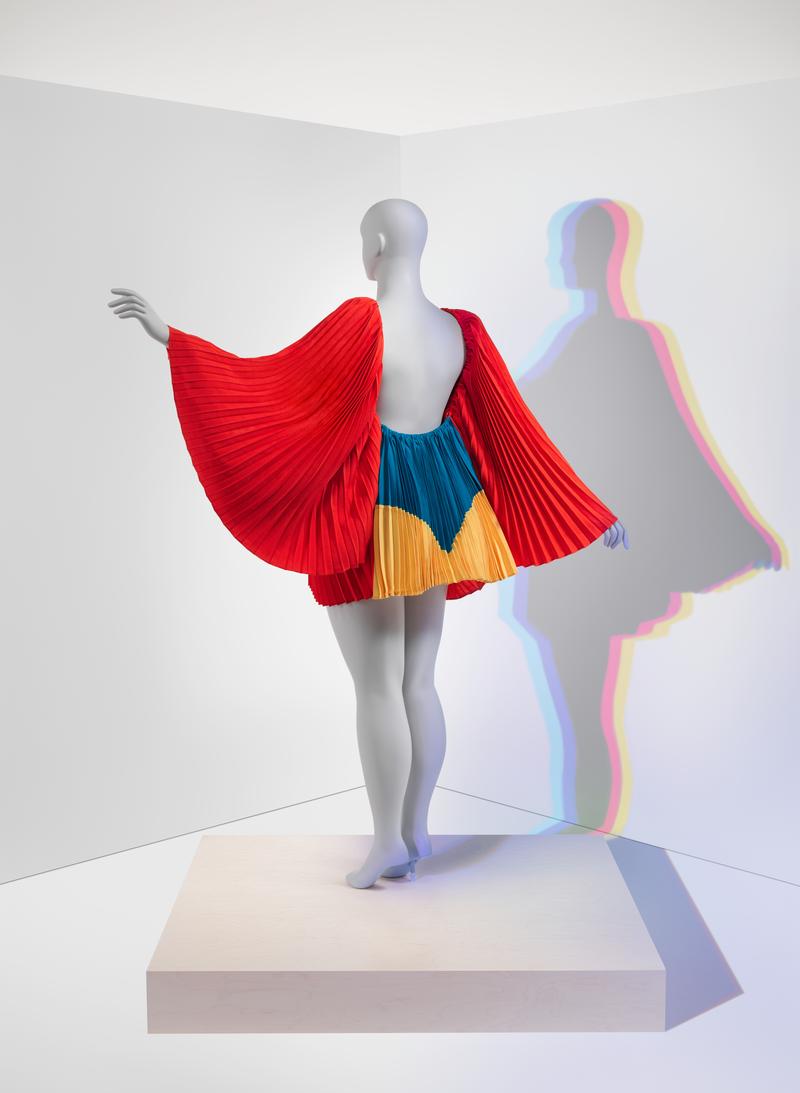
( Photo by Anna- Marie Kellen © The Metropolitan Museum of Art )
[music]
Alison Stewart: This is All Of It on WNYC. I'm Alison Stewart. A brand new exhibition at the Metropolitan Museum of Art is called Women Dressing Women. Housed in the Anna Wintour Costume Center, the show opens with two tall columns featuring a white goddess gown by Madame Grès and a distressed black sweater and skirt by Rei Kawakubo. Then as you descend, the show explores four key themes: anonymity, visibility, agency, and absence/omission. Highlighting approximately 80 ensembles from more than 70 designers, some well-known such as Vivienne Westwood and Isabel Toledo, but it also highlights the seamstresses behind the scenes and seams.
It also features work from up-and-coming artists such as Ester Manas founded just four years ago. The show is titled Women Dressing Women, and it's on display at the Met through March 3rd, 2024. Joining us now to talk about the show is Mellissa Huber. She is an associate curator at the Costume Institute at the Met and co-curator of the exhibition. Mellissa, welcome to All Of It.
Mellissa Huber: Hi, Alison. Thank you so much for having me today.
Alison Stewart: Listeners, we'd love for you to participate in this conversation. Whose name comes to mind when you think of female designers in the fashion industry? Have you seen Women Dressing Women at The Met? What did you think? Are you a woman interested in designing clothes, or you have your own brand already? Who are some of the women that you look up to in fashion design? You can call us at 212-433-9692. 212-433-WNYC. You can call in, join us on air. You can also text us at that number 212-433-96922, 212-433-WNYC, or reach out to us on social media @allofitwnyc. Why did you all think it was important to honor the contributions of women in fashion?
Mellissa Huber: That's a great question and one that Karen and myself have been receiving quite frequently. I think one of the things that we really hope that our visitors take away from the show is not only the incredible contributions that women designers have made to fashion, some of which have been forgotten with time, but in turn, how fashion has served as a really important space for women as well providing them unprecedented forms of creative, social, and financial autonomy.
Alison Stewart: When we think about how we enter the exhibition, I mentioned those two pieces of work that are placed on top of a pedestal. Can you describe them for our audience a little bit and why that was the way you wanted to introduce the show?
Mellissa Huber: Yes, absolutely. The exhibition is multi-layered. It's generally an assessment of the broader fashion historical canon, but also looks at our own permanent collection at the Costume Institute as a collection-based show that provided Karen and I some very helpful parameters in which to refine the subject matter with so many makers who potentially merit inclusion in the show. We wanted to start with both title walls in fact utilizing them as a way to signal this multi-layered approach to looking at women's work.
The first two pieces that visitors will see are this beautifully draped classically inspired gown by the French couturier Germaine Émilie Krebs, who was well-known by the name Madame Grès or Madame Alix at various points in her life. Grès was actually the first woman designer who was ever granted a monographic show in the Costume Institute's history. It was an exhibition that Diana Vreeland, the former special consultant to the Costume Institute, had been advocating for many years, beginning around circa 1980. The show was actually realized about 14 years later in 1994 when it was curated by her former curators in charge, Richard Martin and Harold Koda.
We have this gray piece juxtaposed with an ensemble from a much later moment, which was included in Rei Kawakubo's Holes collection from autumn–winter 1982–'83. Kawakubo is a Japanese designer. The sweater, as the collection title suggests, has integral holes throughout it, which were created by programming the knitting machines to drop stitches, and it's paired with this padded quilted skirt with a white T-shirt layered beneath. It was introduced by Kawakubo in this somewhat controversial, much lauded, but also questioned collection, like much of her work does, challenges, conventional notions of what fashion is, what's beautiful, and what isn't.
At the surface, both designers may not appear to have much in common, but Kawakubo was the second woman designer in our history ever granted a monographic exhibition, which is a great honor, and in fact, was the first living woman designer to be granted the show. Both of them have been deeply influential on the fashion industry during their various periods in which they worked.
Grès served as the president of the Chambre Syndicale de la Couture, which is one of the governing bodies for fashion in France. Kawakubo similarly under her label Comme des Garçons has nurtured a wide stable of emerging designers helping them in their careers too. It's sort of an interesting juxtaposition to us, which also signals the variety and breadth of objects that visitors can expect to encounter within our galleries.
Alison Stewart: We got a text that says, "Elsa Schiaparelli, not only a fashionista but an artist echoing surrealism". It just so happens one of the first pieces you see is a Scapparelli piece along with a Coco Chanel piece. Just for context, will you explain what kind of reverence Elsa Schiaparelli has within the history of fashion?
Mellissa Huber: Yes, absolutely. I would say that following that first title wall, the second title wall that you encounter includes the work of Elsa Schiaparelli, Gabrielle Chanel, and Madeleine Vionnet, and we have them placed within this v-shaped configuration with a mirror behind them. We really wanted to create this breathtaking moment showing the beauty of some of the work that women have created throughout time with three designers who very much symbolize the canon of fashion history and who are greatly revered.
Schiaparelli is certainly one of them. She opened her Paris house around 1927, and as you mentioned, she was especially known for her engagement with fine art. She often collaborated with fine artists such as Salvador Dalí and Pablo Picasso. She was known really for introducing or rather amplifying the conceptual potential of fashion, creating witty, playful garments. She had one of the first early boutiques if you will, and she's perhaps one of the designers from the early 20th century that were working that's very widely known today still by modern audiences.
Alison Stewart: We're discussing Women Dressing Women, which just opened at the Met last week. My guest is its co-curator Mellissa Huber. Listeners, we'd love for you to participate in this conversation. Whose name comes to mind when you think of female designers in the fashion industry? Anyone who you think is a true icon. Maybe you've seen Women Dressing Women at the Met, what did you think? Or maybe you're a woman who's designing clothes or interested in designing clothes and you want to shout out your brand. Our number is 212-433-WNYC, 212-433-9692. You can call in and join us on air, or you can text to us at that number as well, our social media's open too, @allofitwnyc.
Something I noticed right away. After we encountered those icons, I saw something out of the corner of my eye. I turned around and there were two different display cases and I thought they were really interesting and also that they are right behind you when you first come in. The first one was Ann Lowe. It's a white, very '60s gown from 1968, white cotton organdy trimmed with pink silk organza and green silk taffeta carnations all over it and it was designed by Ann Lowe and you learn, I learned, I was this many days old when I learned that she, this Black woman designer designed Jackie Bouvier's wedding dress. Obviously Jackie Kennedy's wedding dress. How did Ann Lowe navigate a career in fashion when she clearly [unintelligible 00:09:00] during segregation?
Mellissa Huber: Like so many of the women featured in the show that we're working in the early 20th century, Lowe began designing and learned to sew at a very young age. She was taught actually by a family of seamstresses that she was born into. Her grandmother, Georgia Thompkins, had been a formerly enslaved dressmaker, and her mother also was a dressmaker. She learned to sew from both of them. They had an incredibly successful business that they ran in Montgomery, Alabama. From a very young age, there's anecdotes about her taking scraps of fabric and crafting beautiful flowers, which became a really important characteristic of her design later in life.
When her mother passed away at a young age around 1914, Lowe had to step in and finish some orders for the dressmaking business, which initially launched her career, although her first husband didn't want her to work, so she stepped away from designing for a couple of years. There's a great anecdote. She ran into a woman who was a very wealthy woman that lived in Florida in a department store. She loved the clothing that Lowe was wearing because she continued to design for herself, even though she wasn't working professionally during this time. She asked Lowe if she would move with her to her home outside of Tampa and create for her and her four daughters.
That really became the new starting point for Lowe's business. She became really well known for creating her gorgeously crafted debutante gowns and special occasion dresses which you can imagine how that led to commissions like Jacqueline Kennedy's wedding dress because she became known within these very influential social circles for her, just beautifully constructed and meticulously made garments.
Around 1928, she moved to New York, which is where she spent the majority of her later career working up until her retirement in 1972. Throughout that time, her business underwent a variety of different permutations. She worked on her own. She collaborated with others. The dress that you described that's featured in Women Dressing Women was part of a business that was established around 1965 and collaboration with Florence Cowell Gessner, who actually specialized in suits and day wear, so her partnership with Lowe was really beneficial because Lowe could create those gorgeous gowns where Florence could focus more on day wear together.
Alison Stewart: Then slightly across from it, diagonally from it, is a display with a dress from 2022. It's noticeable because the form that the dress is on, it's likely a size 16 or an 18, but the dress is called a single-sized garment. Tell us a little bit about the designer of this dress. What's her philosophy, the materials that are being used, and why you wanted to include it?
Mellissa Huber: Absolutely. That's a dress that's created by the young Belgian design house named Ester Manas, which is a collaboration between Manas and her now husband, Balthazar Delepierre. In fact, they were just married within the last year, and they came for the opening of Women Dressing Women as part of their honeymoon, which was such an incredible thing to learn.
Manas is a larger-sized woman, and she believes very much in representation and body inclusivity. We've displayed their garment on a mannequin which is a size 18. I think it's such a beautiful curvy body, and the dress looks amazing on it. The dress is comprised of a lot of ruching and stretch net fabric, which can fit a variety of different body types, as you pointed out, without the need for sizing.
One of the things that I especially love about Ester Manas, in addition to the body inclusivity that they focus on, is that they also are really dedicated to producing ethically and thinking about their broader practices as well. They aspire to create about 80% of their collections using recycled or deadstock textiles. They often work with a variety of different places on production.
One of which is an organization called [unintelligible 00:13:42] Atelier Mulheres, which is Latin of the woman, which serves as a social and professional reintegration program that provides training to immigrants and women coming from situations of financial insecurity. I think it's just a really exciting and an incredible piece. We have it juxtaposed with the Fortuny Delphos gown, which is another interesting example of a couple working together and also creating sizeless garments, albeit in a very different moment in context.
Alison Stewart: The way that the show, Women Dressing Women at the Met, is organized is there are these four themes: anonymity, visibility, agency, and absence/omission. How do these four notions reflect the trajectory of women working in fashion?
Mellissa Huber: Karen and I have been considering this idea of anonymity as a prologue to the show if you will. We wanted to focus on the early history of women's essentially right to create fashion for women, which would seem like it was a natural thing but historically wasn't always granted to them. We talk about the establishment of the first guild for women dressmakers in France around 1675 and talk about how the end of the guild system essentially opened up the field for so many other women, seamstresses, designers, milliners working within the industry.
Another important element of this, of course, is the idea of the collective nature of design. In addition to looking at the early field and the inherent anonymity to work as a dressmaker prior to the emergence of the [unintelligible 00:15:31] couture house in the mid-19th century and this practice of including names on a garment label, we also wanted to continue to look at the anonymous hands, the seamstresses, the textile makers, all of those that are involved in the production of fashion. We've represented that with an image slideshow that shows a lot of these women at work within the various ateliers and factories.
The next section of the show focuses on notions of visibility, and that's contained within our Carl and Iris Barrel Apfel Gallery. That moment focuses on the hegemony of French haute couture, which was certainly a bias during the time period that's reflected in our own collection, and that really looks at French designers or designers who trained in France within the highly stratified and regulated French haute couture industry.
That's been a really interesting moment for us in terms of being able to include not only well-known and celebrated designers, but also many designers whose work is lesser known to other audiences. As Karen and I went through our permanent collection and holdings, we often found that the history or trajectory of one designer would lead us to discover the work of another. That element of discovery and research and digging for what lies beyond the surface was a really rewarding element of the show.
The next section focused on agency is the largest section of the exhibition, and that traverses the perimeter of our largest Lizzie and Jonathan Tisch Gallery. Within the agency section, we have essentially seven different subsections that emerged, which objects in the section I should note, span from the turn of the 20th century, also with some early pieces, all the way through the present moment in time.
Within that section, we have themes looking at this idea of liminal spaces of fashion, exploring how women, in opposition to the stratified French haute couture industry, how many women entered fashion from analogous fields, such as craft or fine art, or even theater, for example. We have a section looking at American women, unlike in France, again, where designers were really known by their name and revered for their artistry and expertise. In America, the system didn't often elevate the work of individual makers for quite some time. Some of the first names that were in fact recognized were women.
We have a section that looks at notions of appropriating men's wear and looking at how women have borrowed both from tailoring traditions and also elements of the male wardrobe.
That leads us into the boutique generation, which examines how designers started to really introduce democracy through ready-to-wear clothing that could be bought off the rack that was more affordably priced, but also how these spaces became really important for gathering like-minded people together, creating community and even sometimes becoming sites for political action.
This leads into a section focused on reclaiming the body, which again, brings in up the work of designers like Rei Kawakubo, Georgina Godley, the more contemporary designer Melitta Baumeister, who are challenging conventional notions of beauty and expectations of the female body. Which leads us nicely into another subsection focused on notions of bodily agency and looking at the ways in which designers have sometimes addressed, overlooked body types or experiences, and also how they have often empowered the wearer through elements such as drawstrings and chords and things that allow the wearer to modify to their body.
Then the very last subsection within agency focuses on notions of empowerment through practice. That's the most contemporary section of the show by far. It really looks at the ways in which designers working today are finding ways to imbue their work with their ethos and value systems. Not only is it about the aesthetics of what they're creating, but similar to Ester Manas the way that they are bringing their belief systems into their practices and thinking about their larger place within the world.
Then the very-- [crosstalk] Oh, sorry about that.
Alison Stewart: No, please.
Mellissa Huber: I was just going to say the very last section is focused on notions of absence or omission, and that includes those intergenerational juxtapositions, that includes the Ester Manas piece and the Fortuny Delphos, for example. That's really an opportunity for us to consider notions of inclusion and belonging and acknowledgement from a museological perspective also considering the relationship between the body and garment, and also the material level of fashion. Cumulatively, the show also functions as this reassessment of the canon in many ways.
Alison Stewart: What are some of the questions you hope this show, Women Dressing Women, brings up? What do you hope people have conversations about after they see it?
Mellissa Huber: A lot of people have asked us, do we think that women designers create differently than male designers? One of the things that I think is very important to Karen and I is that we don't intend for the show to focus on differencing or essentialism. In fact, we hope more than anything that our visitors are struck by the magnitude and the sheer breadth of women's contributions to fashion, that they see their ingenuity and their aesthetic and conceptual innovations, and also recognize that there's no one way of working regardless of gender and that their contributions to the field have been just so broad-ranging.
In relation to that too, we think that lived experience is really important too. There's no one way to be a woman and everyone's life experiences, education, training, all of these personal attributes, things like ability, size, age, all inform our understanding of the world. We just hope to really illuminate and celebrate the diversity and breadth of women's contributions to the field.
Alison Stewart: Women Dressing Women just opened at the Metropolitan Museum of Art. It is up until March 3rd, 2024. I've been speaking with its co-curator, associate curator for the Met, Mellissa Huber. Mellissa, thank you so much for walking us through the show.
Mellissa Huber: Thank you so much for having me, it's been a pleasure.
[background music]
Alison Stewart: We go from fashion to sneaker style and culture and the sport of basketball all are intertwined. We'll talk about a new book, A History of Basketball in Fifteen Sneakers, that's right after the break.
Copyright © 2024 New York Public Radio. All rights reserved. Visit our website terms of use at www.wnyc.org for further information.
New York Public Radio transcripts are created on a rush deadline, often by contractors. This text may not be in its final form and may be updated or revised in the future. Accuracy and availability may vary. The authoritative record of New York Public Radio’s programming is the audio record.