'The New Brownies' Book' Celebrates the First American Magazine for Black Children
( Courtesy of Chronicle Books )
[MUSIC - Luscious Jackson: Citysong]
Alison: This is All Of It from WNYC. I'm Alison Stewart. We continue our Black History Month conversations with two people who will be at the Schomburg on February 12th. Emory University professor, Dr. Karida L. Brown, and artist, Charly Palmer. You may have seen some news about Palmer recently. He is the artist behind this year's USPS Black Heritage series stamp. The stamp features Palmer's portrait of Civil Rights Lawyer, Constance Baker Motley, known for helping draft Brown v. Board of Education, and she was a federal judge here in New York City, as well as Manhattan borough president.
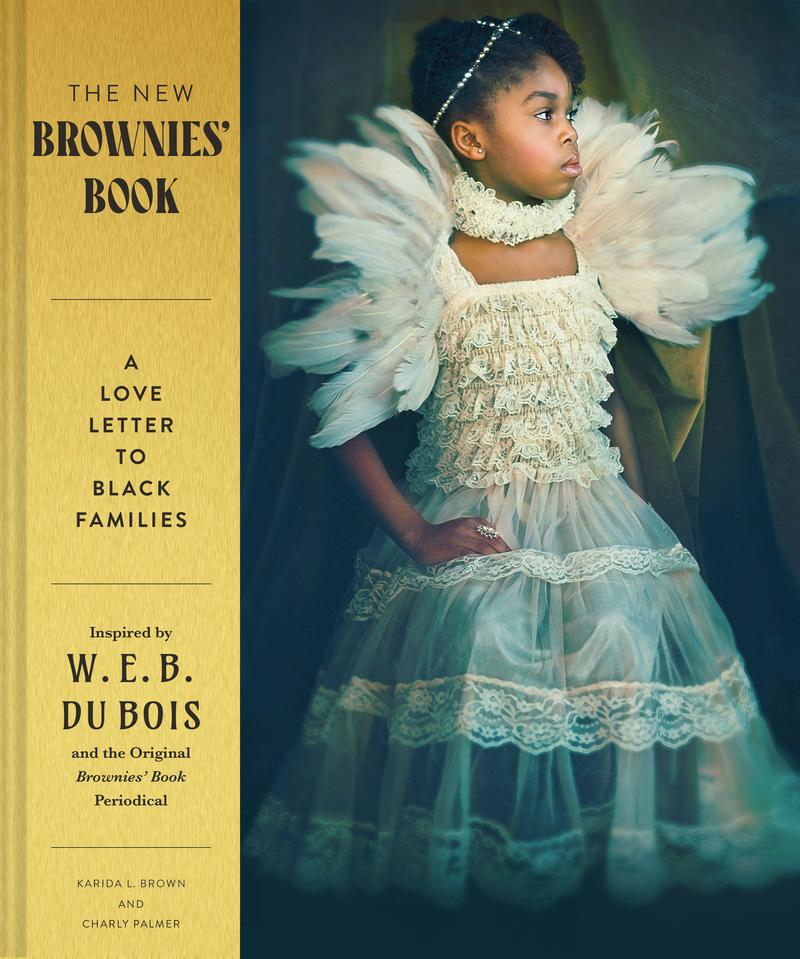
Charly Palmer's work is also seen throughout the book. He and his wife, Professor Brown, will be discussing at the Schomburg next week. It's called The New Brownies' Book, A Love Letter to Black Families. The book looks back at the work of W.E.B. Du Bois, specifically when he launched a children's magazine called The Brownies' Book in 1920. It featured photos, plays, stories, and including the first-ever published poem by a young Langston Hughes. Now, Brown and Palmer have reimagined the magazine and celebrated its history with a book.
They write in the book, like Du Bois. We invited some of the most talented Black artists and writers of our time to contribute original works from short stories, artwork, and poetry to plays, as a personal expression of the resounding love for you, The Children of the Sun. When we spoke with Brown and Palmer about The New Brownies' Book, I asked Karida Brown how she first came across W.E.B. Du Bois' original magazine.
Karida: Oh my goodness. I've been researching Du Bois' sociology for over a decade because I am a tried-and-true academic, and I was working on a book about W.E.B. Du Bois' sociological works. That was a book that was five years in the making. While in his archives, I found these letters where Du Bois was reaching out to literati of the Harlem Renaissance, and pretty much begging for work. He would reach out to Nella Larsen, Hilderu Wilkerson, and Zora Neale Hurston saying, "I need a piece of your original work, some of your best work so that our children may know that they are thought about and loved for The Brownies' Book."
It was there that I said, "What's this Brownies' Book?" It took me down this rabbit hole, and I found out about this publication that ran for a year and a half, that was just an American treasure.
Alison: Charly, you're an artist, you're someone who deals in images and aesthetics. What struck you about the aesthetic and the artistic vision of the original?
Charly: Once you have a chance, and we've only had a chance to see actual cover that is actually on exhibit right now in New York Central Library. It was breathtaking because it was still in quality, as far as the quality of it, reproduction. Looking at it through a glass case, it still was breathtaking. What we, from the very beginning, has thought about was stay true to the mission of Du Bois. It was one of those things that we realized sitting down and talking, meaning Karida and I, we knew a lot of artists. We knew a lot of writers.
We knew a lot of Black folks doing amazing things out there. Let's bring this back. Because when the boys walked away from this project because he could no longer afford it, he thought about it for years after. There's evidence, there are actual letters where he's addressing that he wished he could have continued it or that he's thinking about revisiting it.
Alison: Karida, in the book, in the magazines and the issues, there's a declaration. What kind of things did Du Bois want to instill in Black children and all children, but specifically ours, as he says in the 1920s?
Karida: Oh, well, he said that he wanted The Brownies' Book to be a thing of beauty, love, and joy. He wanted to instill in all children, but especially Black children. That Black people have done things of note and contributed greatly, not only to this country, but to the world. He wanted to instill in them pride in themselves and joy. Also, a sense of honor and dignity, not only in dealing with themselves, but in interactions with others. The book was truly rooted in joy. He wanted to celebrate that, but also cultivated within the young spirits of Black children.
This was revolutionary at the time. Why? Because again, it was the first periodical to feature Black children in a positive light. You can imagine what the media representation of Black people was at that time. I dare say we can revisit that now, and it's still an issue which is why we decided to revive this book. It was so important for Black children to be able to see themselves in a positive light, but also in a broad range so that they understood, "You're not in a box, you can be anything."
Alison: Charly, when you all decided to revive this and to rethink it, and bring it into 2023, what was your pitch to other contributors? We mentioned that, that Du Bois had to pitch like, "Hey, Langston Hughes, give me some work."
Charly: Karida said it again, I was like, "Don't do that." She always talks about the boys begging. I can imagine this, if Obama reached out to me and said, "Charly, I'm going to need your best painting for this thing." You think I'm going to say no? It's like this idea he did, and he made it very clear, "I'm going to need your very best, and I need you to contribute, so these children know that they're loved." What we discovered and what touched my heart the most is quite honestly, Alison, I was a little nervous about this, asking a favor.
We did compensate each artist and write it a little bit. It was like, I'm just afraid of the rejection, but let me do it anyway because this is important to me, and I've since learned that there've been a couple of artists that I really admire who came back with, " If you're going to ask, Charly Palmer's going to ask me for this, I'm going to give you my very best." That really almost-- When we did our book launch, I literally I was in tears because I didn't know artists felt that way about me. I didn't know that the friends and writers felt that way about me.
Alison: That's lovely to know. Karida, I jumped over the asking people to do things. What was the origin of your book? You found this great piece of information, that's a big jump from this beautiful book that I have on my desk.
Karida: Yes. While in Du Bois' archive again, my co-author and I, José Itzigsohn, we published this book, The Sociology of W.E.B. Du Bois. I was working on a chapter on Du Bois' public sociology. All of his works that fell out of academia and out of his editorial work with The Crisis magazine. I found out that he was a poet, that Du Bois wrote pageants and plays that he started a theater group, a Black theater group right here in Harlem in the 1930s. I also found the original Brownies' Books, and Library of Congress had the full run, the year and a half run of the original Brownies' Books at the Library of Congress.
That's how I was able to start the research on how the original Brownies' Book was comprised. Who was in it, what was the structure, the flow, the spirit of the text. We carried all of that legacy into The New Brownies' Book. We, Charly and I, very much feel like, we are not the creators of this. We do not own this book. We were just the stewards. Our ancestor, the great Dr. W.E.B. Du Bois wanted us to do this. Our job was really to just stay true to the spirit of the original, and to incorporate that into this new Brownies' Book.
Alison, you'll see mostly do contributions, but there are also some pieces from the original Brownies' Book republished in this new book.
Alison: My guest are Dr. Karida Brown, she's professor at Emory University; and Charly Palmer as an artist. They're a couple. They are the stewards of the new book, The New Brownies' Book: A Love Letter to Black Families, which is out now. There are sections in the book that really address being seen. The one that made me chuckle a little bit was there's a story called the Lactose Intolerance Club for Picky Eaters by UC Santa Barbara professor named Waverly Duck. It's about a kid who gets called a picky eater because he just can't do dairy and a large portion of Black folks are lactose intolerant.
What did you think when you got that submission? That one just made me laugh out loud. I was like, "This is the modern version of what--"
Charly: The beautiful thing, Alison, and Karida can address it because Waverly is more of her friend. Waverly as funny as it is, not no one. We approached everyone with no true expectations and no direction. We wanted to give their expression of thought feeling love. Waverly, as I literally, and no joke. Every day I start my day by reading Dr. Marcus Anthony Hunter's Children of the Sun poem. As I read it, every time it means something different to me, there's a new revelation in it, but it's like Karida will say, again, a very close friend of hers is Marcus.
It's like, she didn't expect that from him. She's like, "I didn't know you wrote poetry." That's what happened over and over again. People gave us love and however they chose to express it.
Karida: With Waverly Duck's piece, same thing. He's a professor, a serious business sociologist. He writes very serious books. I expected Waverly to contribute some sort of history lesson for children. When he came through with that lactose intolerance story, I fell out of my seat. I could not believe that he wrote that. It was so much fun, so relatable. When he starts talking about being up at night worrying that the tapeworm was moving through his belly, it's just hilarious.
To Charly's point, all the pieces were low Christmas gifts because we were surprised every time a new submission came through and we're like, "I didn't know that you could do this."
Alison: All right. We've been joking about how Langston Hughes was this young guy, Langston Hughes, this nice poet. This was the first place that his work was published. Is that true, Karida?
Karida: That is absolutely true. As a young man, Langston was just finishing high school, and he sent a few samples of his work to Dr. Du Bois. He thought enough of himself that he thought one of the greatest intellectuals of his time and the editor of The Crisis magazine at the time, should read his work, and Du Bois did. He published young Langston's first poems, a short play, and several short stories in The Brownies' Book. In that way, this book, and again, it is an American treasure and an heirloom to all of us. It was also this launchpad for so many young artists and authors.
We wanted to also continue that legacy through The New Brownies' Book. We have republished all of Langston Hughes' original pieces from the old Brownies' Book in The New Brownies' Book. Alison, we've also ourselves made sure to publish some young authors and artists too for their first publications in The New Brownies' Book.
Alison: Let me read a quick Langston Hughes poem, and then we can talk about some of the artists in your book. This is from The Brownies' Book, April, 1921, an April Rain Song.
Let the rain kiss you.
Let the rain beat upon your head
With silver liquid drops.
Let the rain sing you a lullaby
With its pitty-pat.
The rain makes still pools on the sidewalk.
The rain makes running pools in the gutter.
The rain plays a little sleep-tune
On our roof at night,
And I love the rain.
It's a beautiful poem, but simple. Beautiful in its simplicity.
Karida: It shows that we all get our start somewhere, and it hopefully will encourage our young readers to know, "Hey, try your hand at something." We all have to start somewhere.
Charly: One of the things I love is that our youngest writer or author is Zoe Jones. She was four years old at the time. When the book arrived at her house and she saw Zoe Jones, she pointed to her mom, she's six now, and she says, "Look, someone has my name." It's like, "No, that's you." What I love about the poem, is the poem really represents what this book's about because it doesn't have a sad ending, but it has an honest ending. It's a very short and simple poem.
Alison: I'm going to have somebody figure out, but do you know what page that's on, the Zoe Jones? Now, I want to read Zoe Jones' poem.
Karida: [laughs] It's the one about kisses. I'm going to look it up and find it for you.
Alison: I'm going to say your names. I'll introduce really slowly, by a minute. We're talking about the new book, The New Brownies' Book: A Love Letter to Black Families. It's out now. I'm speaking with Dr. Karida L. Brown and Charly Palmer. We were just talking about a little girl, Zoe, who is the youngest contributor to the book. Did we find her poem?
Karida: Page 19.
Alison: Would you read it?
Karida: I will. Zoe Jones' poem is called Kisses Make Things Better (but Sometimes They Don't)
Kisses make bad dreams better,
But they don't make hard things feel soft.
They make our cheese feel better,
But kisses don't make cuts stop hurting.
They don't make water safer,
But they do make swimming fun.
Kisses make things better that are sad,
But not everything that is bad,
Because sometimes kisses make things better,
But sometimes they don't.
Alison: That's by Zoe Jones, age five. Now, on the same page is one of your pieces of work, Charly. It's called Her World. It's one of your paintings. Would you describe it for us, the origins of this painting?
Charly: I'm indicating because we're in separate rooms.
Karida: It's the T-shirt.
Charly: The T-shirt. Breathtaking image done by a photographer. I reached out to the photographer, said, "I love this image and I have this idea." Her world has the globe behind her head, which is an Afro, but in it is a landscape of a river in a valley, and it's this whole idea that our children should know that the world is your oyster, and that you should and could have it all, but go for it. That's what it's really about. It's really saying, "This is your world and make the best of it."
Alison: There's a great painting. You have a lot of paintings of small ones, of wee ones, of our youngest people. This one is a crack up to me. It's a picture of a little girl in a Debbil's outfit on Halloween, and she has her hands on her hips in the Superman pose, as a lot of people know about the Superman pose, and her little brother's behind her and like a Winnie-the-Pooh outfit, just looking like, "Oh, please give us a treat."
Charly: Alison, excuse me for it like--
Alison: Sure.
Charly: That is a short story that I wrote. That's a true story because this child was really dressed up just like that. As we're going trick or treating, her brother or my other friend's child is dressed as Winnie-the-Pooh, and everybody loved the Winnie-the-Pooh and no one had anything to say about the Debbil. This child is like, "I'm done. I want to go home." Then she finally says that line that everybody loves Winnie-the-Pooh but nobody loves the Debbil, and I just broke out laughing.
Alison: It's D-E-B-B-I-L. Nobody loves the Debbil, right?
Charly: Debbil. The Debbil. Right.
Alison: Charly, what do you like about painting children?
Charly: There's an innocence there. I was talking to Karida this morning about, I'm going back these days to old Rock & Roll love songs because there's an innocence there that we don't see enough of today, as we don't see when we come to our environment as a whole. There's a story in the book called I Don't Want to Be Black Anymore. It's like, when I heard a friend of mine share that story, Keith Cross and his wife, it was like our youth should not be worried anymore.
They should be walking and moving safely in this world, but there's a target or seem like, on Black people. For her to say that, I completely, solely understand that because I've experienced that since I was born and I'm sadly still experiencing in 2021.
Alison: There is a section dedicated to HBCUs, Karida. What went to that decision?
Karida: HBCUs are phenomenal, first of all, historically Black colleges and universities. W.E.B. Du Bois, his alma mater is Fisk University. Charly and I had the great opportunity to serve at Fisk for one academic year. It was the year that we were producing The Brownies' Book. We took that opportunity to put together a Fisk University editorial internship. Five interns worked with us all year to review every piece that came in for The Brownies' Book. We read the works together. That's how we ended up formulating the chapters thematically.
The students were so wonderful and so inspired by The Brownies' Book that they each contributed an original work also to The Brownies' Book, so you'll see their publications in this book. There's a chapter about HBCUs because we just think that every Black family should know about them and it's a great discussion piece. We've put forward a call to action in that section, we list 10, we want you to list 10 more, and then we have a selection of pieces by our HBCU students currently and from Du Bois' own daughter, Yolande Du Bois, who also is a Fisk alumni who talked about her experience in the 20s at Fisk.
There's a lot going on there, but we just really want to encourage that conversation and excitement and instill the importance and value of HBCUs.
Alison: Now Charly, I don't want to tell tales on you, but you got a little gray in your beard. What did some of these students say that may have surprised you or opened your eyes in the editorial process or maybe you all had to have some conversations about things because you didn't necessarily agree?
Charly: You know what, it's really fascinating. One of my favorite stories in here is written by my very best friend. Her name is Ida Harris. It's called Mama Sick. It was fascinating just to watch these students respond to it because it's so vague in the end what happened to Mama. I can tell you my personal experience because knowing Ida, as long as I've known her and her talking about wanting to be a writer, and so as I'm reading this short story, I couldn't make it through. I kept breaking down, I kept crying.
I lost my mom-- She saw Obama get elected, but she didn't see him going to office. She passed to cancer. I'm not sure if it's a pain of watching someone trying to go through the struggle of cancer or is it that my friend had a dream of being a writer, or is it that this is very good writing, but every time-- Then I revisited recently and cried again. It's that kind of thing. It's like we watch these students' interpretations and get inspired and say, "I want to be a part of this."
Alison: Karida, what was something the students said or brought up that was interesting or you hadn't thought about?
Karida: You know what, it was one student who checked Charly a little bit, Chase Malone. She was an intern who worked with us for one summer, Spelman student. She was working with us at the very end of the production of the book. We thought we were all finished, and Chase reviewed all the material and said, "There needs to be something in this book that really acknowledges the contributions of Black women because they're too often erased from history. I don't see enough representation in this book." I said, "Oh, man, I thought we were finished with our work."
Chase took the initiative to cultivate that list of 26 Black women who we should all know. There is a game at the end of that chapter that does some trivia around them. Charly created original line work for each woman. Her challenge to us ended up becoming a whole new chapter in The Brownies' book. We are incredibly grateful to our HBCU interns, not only for pouring into this work but also pushing back on us and challenging us to take it up a notch because the book is better because of them.
Alison: You've mentioned the activities and some of the games and the calls to action. Charly, how do you hope families use this book?
Charly: One of the things when you read the introduction, you read a statement about the meaning of the original Brownies' Book. I really want to reiterate that this Brownies' book is for all families, but especially us. I think it's for the generations because there's a little bit in here for everyone. There's also, there's joy, there's pain. There is examining self retrospective-- it's a broad range of things. We hope that it's something there representing everyone. Then on some level, everyone will be able to make some connection to this book.
Alison: The name of the book.
Karida: Even--
Alison: Oh, please go ahead.
Karida: I was just going to say even our elders, because Alison, you, me, Charly, everybody out there, we were once little people at one point, and that inner child still lives. Again, this book is for everybody. It's to tap into and celebrate youth, childhood, and the fullness of the human experience through that perspective.
Alison: That was my conversation with Emory University professor, Karida L. Brown; and artist, Charly Palmer about The New Brownies' Book: A Love Letter to Black Families. They'll be in town talking about the book at the Schomburg on February 12th, and also at the Village Preservation Society on February 13th. One more note about the New York Public Library, our partners for our Get Lit with All Of It book club event, if you haven't already, you should dive into our February choice Tananarive Due's The Reformatory.
Because of our partners at the New York Public Library, New Yorkers can get their E-copy to read along with us. Don't forget to mark your calendars for February 28th when I'll be in conversation with Tananarive Due about The Reformatory. Of course, we have a musical guest. We'll let you know who that is tomorrow. That is All Of It from WNYC. I'm Alison Stewart. I appreciate you listening. I appreciate you. I will meet you back here tomorrow.
Copyright © 2024 New York Public Radio. All rights reserved. Visit our website terms of use at www.wnyc.org for further information.
New York Public Radio transcripts are created on a rush deadline, often by contractors. This text may not be in its final form and may be updated or revised in the future. Accuracy and availability may vary. The authoritative record of New York Public Radio’s programming is the audio record.