
A New Book Offers A Guide Into the Emotional Lives of Teenagers
( Courtesy of Penguin Random House )
Alison Stewart: Yesterday, New York Governor Kathy Hochul announced she will hold a series of listening sessions with New York teenagers to learn more about their mental health challenges. The governor said, "The era of ignoring mental health is over. We are going to lean hard into this." You've likely seen the news that a recent CDC report found that nearly three in five teenage girls felt persistent sadness in 2021, double the rate of boys, a trend that has increased among all teens, even before the onset of COVID-19. For girls, the expectations of how to handle emotions starts early and gendered assumptions influence how we respond to the young people in our lives.
Now, across the board for teenagers, studies show contributors to young Americans' current mental health issues include lack of independence, social and political climate, and cyberbullying. A new book offers caretakers guidance on how to help kids navigate their emotions effectively. One big reminder, she wants us all to remember, it's okay not to be okay sometimes. The book is titled The Emotional Lives of Teenagers, the latest from psychologist Lisa Damour. Dr. Lisa Damour is a clinical psychologist and author of New York Times bestsellers Untangled: Guiding Teenage Girls Through the Seven Transitions into Adulthood and Under Pressure: Confronting the Epidemic of Stress and Anxiety in Girls. She's also co-host of the Ask Lisa podcast. The book, The Emotional Lives of Teenagers, is out now. Lisa, welcome back to the show.
Lisa Damour: Thanks so much for having me. Really happy to be with you.
Alison Stewart: Listeners, are you the parent or guardian of a teenager? What questions do you have for our guest, Dr. Lisa Damour, or are you a teacher or maybe someone who works with young people? What have you noticed about teens in 2023 when it comes to their mental health? How have you been able to connect with the teenagers in your life while they're dealing with challenges? What guidance do you have for your fellow listeners? Give us a call. 212-433-9692, 212-433-WNYC. You can always reach out on Twitter or Instagram @AllOfItWNYC. You can DM us on Instagram if you want to remain anonymous. Our phone lines are open and we are taking your calls. 212-433-9692, 212-433-WNYC.
Lisa, for the last few years we've heard numerous reports about all the ways that the pandemic has had an effect on adolescents mental health. What are your primary concerns you have as a clinician?
Lisa Damour: The pandemic was incredibly hard on teenagers. There's no getting around it. Everybody suffered through the pandemic. It landed on teenagers in a very specific way. Teenagers have two jobs. They are supposed to become increasingly independent and to spend as much time with their friends as absolutely possible. The pandemic got in the way of their ability to do either of those things.
We saw tremendous suffering for adolescents during the pandemic, and we're now dealing with the aftermath, trying to figure out how we support them now, trying to identify kids who need ongoing support, but we're also seeing that a lot of kids who are now back in the regular swing of things seem to have returned to the developmental trajectories we would expect. It's a mixed picture and we're waiting on new data to let us know what we're really looking at.
Alison Stewart: I want to take that first one. Lack of independence. How does the lack of independence affect teens' mental health? Because, obviously, they couldn't be independent during that period. They had to be at home, they had to be tethered to mom and dad. They couldn't go read some of those developmental milestones, going to the movies by yourself, going on public transportation by yourself.
Lisa Damour: Absolutely. The nature of adolescence is that you start to spread your wings and you do it a little bit more all the time. You practice being more and more adult as you go, and that helps you get ready to do things like leave home eventually. Teenagers were robbed of those opportunities and we're seeing a lot of teenagers who continue to struggle with feeling that they can go out and do things on their own. We're seeing incredibly high rates of school truancy across districts, across every socioeconomic group, across regions.
Kids who feel very anxious about going to school, returning to school, we saw that, but the other thing that happens when kids were stuck at home is they're robbed of the contact with their peers and also other adults that they would normally spend time with. So much of what helps teenagers grow and thrive is being in contact with great teachers, great coaches, great mentors, great bosses. It's really the community around adolescents, the community of adults around adolescents who contribute so much to their growth in that phase, and so teenagers missed out on that too.
Alison Stewart: I'm curious about the idea of teenagers missing out on conflict with their peers. Part of growing up is learning to negotiate conflict.
Lisa Damour: It's true, and I can tell you I practiced for more than 20 years before the pandemic. Kids weren't always great at handling conflict before the pandemic, and part of that is because adults are not always great at handling conflict, and we're not always great at showing them how it's done, but one thing that I'm hearing consistently from my colleagues who are in education is that there is definitely a delay for a lot of kids in how they are handling peer interactions, especially when things are not going well. People will usually hang a couple of years there. They'll say, "The ninth graders, they kind of look like seventh graders in terms of how they're handling their disagreements."
The solution to this is to be incredibly clear with young people about how we want them to handle conflicts, to presume that the conflicts are going to happen because they will. To really say there are healthy ways to manage conflict. There are less healthy ways to manage conflict. Healthy is to be assertive and forthright or decide to let it go. Unhealthy is to be aggressive or way too passive or passive-aggressive, which is often what we see.
The thing that has been very clear to me, and I think a lot of people who take care of teenagers as we work to find our way out of the pandemic and deal with its aftermath, is that we just have to be very, very explicit with young people about what the developmental targets are and what we're looking for, and so often with kids and teenagers if you tell them what you would like them to do instead, they can usually get there. We just haven't had to do that as much in the past because we had the atmospheric pressure of them coming up through school together that was doing it for us.
Alison Stewart: Let's talk to a teacher who was called in on her lunch break. It's Terry calling in from Montclair. Hi, Terry. Thank you so much for taking time during your lunch to call in.
Terry: Thank you so much. I'm a teacher, I teach ninth-grade, social studies teacher and language arts. I will tell you, I really think that a lot of people don't want to really admit if they're in the school system, that these kids are addicted to telephones. I can tell you right now that all of the teachers know this and we're trying our best. We know that COVID has had a hit, a really hard hit on the children. A lot of what your guest is saying is true, but there's something further I can tell you from being there since COVID, before COVID for 15 years. That is the children are addicted to the telephones. These cell phones and this social media is literally killing the kids.
If I tell you how many children are talking about ending their lives, you would not believe it. Parents don't want to see it. They're too busy with their jobs. I'll say it. They're using us as babysitters. We see children in trouble. The counselors don't even have enough time or energy to deal with it all. If I tell you that I'm talking to children that are so stressed out and don't want to go on anymore, that it is absolutely heartbreaking, and no one is discussing it. I think there's a fear. What I think is happening, I think there's a fear of people speaking up, just like the journalists who are going to name and call out social media. I think they're afraid of being targets. All right. I've got to go, I've got to get back to school.
Alison Stewart: Terry, thank you so much for calling in, clearly passionate. We are going to get to this, but Terry brought it up earlier, so we can dive in now. The idea of how parents can discern between someone having a hard time and someone being genuinely in crisis. Can you talk to us a little bit about the language difference, Lisa? A little bit about the signifiers, what the difference between the two are? Because I think a lot of parents get very confused about that.
Lisa Damour: Absolutely. It's a very scary time. There are very frightening headlines and it's hard to know how to make the distinction. Here's how we think about it as psychologists. Mental health is not about feeling good. It's not about feeling calm or relaxed or even happy. It's about two things. One, having feelings that match the situation you're in, even if those are painful emotions. If your kid gets into a fight with a really dear friend, we would expect sadness and distress. We would not on its own, consider that to be signs of a mental health concern. Two, and this is really where the rubber hits the road, what we're interested in is how painful feelings are managed.
The kid who's in a fight with their friend, what we would want to see in terms of handling is that maybe he talks with adults who are helpful about it, maybe reaches out to the friend, finds adaptive ways to manage that distress, tries to sort through the problem. What we don't want to see is that he decides he's going to smoke marijuana until the feeling dies down and that's going to be his management system, or he goes after the kid in an unpleasant way, or he's miserable to live with at home. As psychologists, we are not all that concerned about the presence of distress within limits. We fully expect it in the course of a day and certainly in the course of a teenager's day.
What we are always training our attention on is how it gets managed and whether it's managed in ways that bring relief and do no harm or gets managed in ways that ultimately come with a price tag.
Alison Stewart: I wanted to ask about Terry's point about social media and phones. They're not synonymous, [chuckles] so maybe we can tease out one and then the other. Social media is its own set of conversations. Also, the phone is another set of conversations because it really is, especially during the pandemic, I watched it, I have a teenager. It was how they were able to communicate with one another.
Lisa Damour: Absolutely. We're working through the science on this. There's some controversy about the interpretation of the findings, but there are some things that we can say. Number one, when kids have phones in their rooms overnight, their sleep is disrupted for any variety of reasons. We have so much good data on the impact of sleep loss and mental health. A simple thing, which actually is not so simple, I know, if you've already got a kid who's got a phone in their room overnight, is to not have phones in our rooms or their rooms when we're supposed to be sleeping. That rule alone can promote sleep and sleep always promotes mental health. That's just a place to start.
Then there is the issue of social media, and you are right, it is complex. It collapses a lot of things and we want to talk with young people about it, and we want to have parameters around it. There's two things that I want to focus on when we think about social media. First is, there's not a kid I know for whom social media is not simultaneously pleasant and unpleasant. If we're going to have good conversations with teenagers about social media, we need to acknowledge that reality or the conversation's over before it's started. The second thing that we really need to acknowledge, and I think Terry used the term addiction. The social media platforms are designed by the people who create them to be irresistible.
We do not, I think, talk nearly enough about the algorithms that are driving these and what they do. I think some people know this, but I don't know that it's detailed enough in our understanding. Social media platforms are constantly collecting data on what anyone who uses them, adults or kids, looks at, likes, spends time on, comments on, throws that into a giant powerful equation that determines what will be seen next. The whole force of that equation is to make the social media totally irresistible. When we see teenagers able to pull themselves away from their phones, it is often not about interactions they're having with peers, it is about being at the mercy of unbelievably powerful algorithms. We want to acknowledge that, that it's something much bigger and more powerful than their peer group often at work in this.
Alison Stewart: One journalist or analyst said there's a reason they call them users in Silicon Valley, that it's very much like addiction. Let's talk to, I hope I pronounce your name correctly, Yufasaha.
Yufasaha: Hi. Yes, thank you. This is Yufasaha calling from Brooklyn. I wanted to share that I have a 15.5-year-old daughter. When the pandemic started, she was coming into her adolescence in her teenage years, and I definitely saw a slow progression of the challenges that she had emotionally. She was very distant. She stayed out a lot. I did not keep her away from her friends because I thought that was very important. She would go past her curfew, not answer phone calls, wearing dark makeup, those types of things, secretly piercing. I decided to really confront that honestly with her and the fear that we had, and it really broke the ice.
As a consequence, I really committed to just being more present and in her presence more as much as I can. Making my work hours so that I am here in the morning when she leaves for school. I'm home at night when she comes home from school. Just being here, I feel like improved her mood a great, great deal. What I wanted to say though is I know that she's exposed to marijuana. I know that she has used it on occasion. I see that her moods are much lighter. She's talking to me. She's happier. She comes home on time. She spends more time at home. What more might I do as a 15-year-old who wants her independence and her privacy, but to make sure that she has the safety and security emotionally with me and at home.
Alison Stewart: What a good question. Lisa, any guidance?
Lisa Damour: What you're describing about just being more available and making a material difference in your daughter's mental health, we see that in the research, we see that clinically. Years ago I wrote a piece for the New York Times called What Do Teenagers Want? Potted Plant Parents. They like for us to be around. They don't want us to have a big agenda, they just want us present. It does indeed seem to confer a real benefit just of them knowing where we are and knowing that they can come to us when they need. In terms of marijuana, it's a really interesting time in the culture as this becomes legalized and its impact on young people.
Here's what we know. Marijuana is not great for the developing brain. We know that the brain is remodeling quite substantially through adolescence. We know that's also a very vulnerable period of brain development. We know that extends at least till age 24, 25. One of the real challenges of parenting teenagers right now is that there's a lot of normalization of marijuana use. There's a lot of legalization of marijuana use, which on that I'm agnostic. I'm like, adults can make choices about their brains. We do want young people to continue to have good information from us about the potential long-term harms of using marijuana before their brain has reached full maturity.
You also brought up something else that I think we should just hit head-on, which is that your daughter started to seem very dark in the way she was presenting herself, and it was scary. Terry brought this up too, which is worries about adolescent suicide, which are prominent and real. Here's what we know, and this is actually what was reflected in your beautiful question. If you are concerned about a teenager safety, it is better to just ask, to just say to them, and then fill in the blank the way you've been carrying yourself or you haven't left your room for a couple of days. Tell them why you're asking, "I need to ask you, have you had thoughts of harming yourself or ending your life?" Just ask.
The reason people don't ask is they worry they're going to give the kid the idea. What we know from research is you're not going to give the kid the idea, but we also know from research that if a young person is thinking about it, they're very glad you asked. I just want people to know that this is something you can address in a very head-on way and there's no downside if you've got grounds for concern.
Alison Stewart: Listeners, are you the parent or guardian of a teenager? Do you have a question for our guest, Dr. Lisa Damour? Maybe you're a teacher or someone who works with young people. What have you seen are the issues around teenagers in 2023? Our phone lines are open, 212-433-WNYC, 212-433-9692. You can reach out on Twitter or Instagram @AllOfItWNYC. After the break we'll talk about some of the myths that Lisa wants to address as well as we have a call about group chats. We'll get to it after the break.
[music]
Alison Stewart: This is All Of It on WNYC. I'm Alison Stewart, my guest this hour is Dr. Lisa Damour. The name of her new book is The Emotional Lives of Teenagers. She's also the host of the Ask Lisa podcast. We're talking about teenage mental health. There are three myths you address in your book. I'm going to name all three and we'll try to hit all. One is emotion is the enemy of reason, difficult emotions are bad for teens, and with their amped-up emotions teens are psychologically fragile, which [unintelligible 00:18:45] to the trope of the moody teen. Let's talk about emotion is the enemy of reason. How does this myth lead to disservice in helping teens when they're decision-making? Because a lot of this is about teen decision-making as well.
Lisa Damour: It's true. For all of these myths, I work in the book to disabuse people of these myths, and then for every one of them I'm like, "Except for when it's true." Here is what we know. Emotions inform our reasoning. They help us make decisions, they guide our thinking, and they should contribute to decision-making. I talk in the book about a colleague of mine, Terry, who gave me a great metaphor, which is that emotions, we should see them as one member of our personal board of directors. That they sit with other forces in our lives, such as our obligations to others, our wishes, our wants, our logistical constraints to inform decision-making.
In this metaphor, emotions don't chair the board and they very rarely have a deciding vote, but they contribute to good reasoning. Now, for teenagers, here's the exception. When teenagers are in very socially or emotionally charged situations, they can make pretty bad decisions. One of the things that we like to think through as psychologists is what we call hot and cold reasoning. Hot reasoning is the lesser reasoning that happens when teenagers are pretty stirred up like at a party or doing stuff with friends. Cold reasoning is the wise thinking that we will get at home with our kid at four o'clock in the afternoon. It's helpful for adults to know the teenagers thinking can shift, quality of their reasoning can shift.
The bottom line is under cold cognition moments when we're just having a low-key conversation with them, help them make good plans for if they find themselves in a hot cognition situation.
Alison Stewart: You also talk about teens sometimes will export their difficulty to you and then move on and then you're left with it. I'm really curious about a parent who their kid says something that seems really disturbing and then goes to practice.
Lisa Damour: This is something teenagers have done for decades. It's part of being a teenager. We call it externalization. It's probably best referred to as dumping the emotional garbage. That when a teen has something upsetting they will often share it with a parent or a loving adult in a way that is suddenly greatly relieving to the teenager. They're not so upset anymore, but now the parent is upset or the adult is upset. The general advice on this is if the teenager feels better having dumped the garbage, the adult should feel comfortable just disposing of it. Does not need to carry it around and hang onto it and try to have a conversation with the teenager about it.
It is very much the nature of being in a strong, loving connection with a teenager that sometimes we walk away from the conversations feeling quite a bit worse, that the kid walks away feeling quite a bit better.
Alison Stewart: The other thing I thought was so interesting was this idea of emotional granularity. That if your teen comes to you, you should help the teen try to get specific about what's really going on.
Lisa Damour: It's true. Emotions are often relieved by the sheer act of talking about them. Naming a feeling actually brings its own relief. One thing that is true of all of us, but can be especially true of teenagers, is that we can quickly go to pretty generic terms to describe how we're feeling. For example, today's teenagers will often say they feel anxiety or anxious. In my experience, what they're often describing is that they don't feel calm, that there's a sense of feeling kind of stirred up. Now, the not calm category is very big with lots of things in it. When a teenager says to me, "I feel really anxious," I'll say, "Okay, what's going on?"
If they describe a fight with a friend, I'll say, "Okay, so maybe you're anxious, but also maybe angry or frustrated." Or if they describe a big game coming up, I'll say, "Okay, so maybe you're anxious, but maybe you're also excited or have some apprehension." What we find is that the more specific the terminology can be for what is actually happening internally, the more relief is gained from talking about that feeling.
Alison Stewart: We've got many calls. Let's try to get to as many as we can. Elizabeth is calling from Somerset, New Jersey. Elizabeth, I know you pulled over. Thank you so much for holding. You're on the air.
Elizabeth: Hi. Thank you for taking my call. I have two 17-year-old teenagers, a boy and a girl. My daughter was hospitalized during COVID. She has done very well. She is now, unfortunately back in a partial hospitalization program. A couple of comments I want to make. My question is, it's so difficult when they're in this emotional state and for them to take accountability for their actions. That is one question I have. My comment is, and I've been trying to think of who would be the appropriate person to go to with this idea, but I have been speaking with a pretty well-known psychiatrist from the summit area. His name is Joshua Braun.
I was searching for a psychiatrist for my daughter, and he and I hit upon the same thing, a commonality that it would be really tremendous if DBT skills were taught in schools at a very early level to teach children, students how to cope as they move along during their journey in their educational years. My daughter has been bullied. Both my children have severe anxiety. They have severe ADHD. They're very young emotionally for their age. They're extremely sensitive. My daughter is gay, so a lot of issues making them targets. You are trying to pull them through this entire journey of their educational experience. We've had psychiatrists, we've had psychologists, we've had support groups.
We've had a lot going on, but yet she still is in this partial hospitalization program. She was doing very well. I apologize for taking a lot of time, but she was doing very well, ended up getting sick, and then physically, and then started going downhill because she couldn't keep up with her academics.
Alison Stewart: Elizabeth, I want to dive in for a second. Thank you so much for holding. I know you have a lot on your plate, a lot going on with your family. Was there anything that you heard in Elizabeth's comment and everything that's going on with her family that you can pull out that might be universal for other people listening as well?
Lisa Damour: Absolutely. She referred to DBT therapy, which is dialectical behavioral therapy, which is a specialized form of treatment that can be summed up as really helping with emotion regulation. The ability to find one's way through a painful emotion in adaptive as opposed to self-destructive ways. It is something that is actually very powerful and it does show up in schools increasingly in various forms or emotion regulation training shows up in schools. For example, the ruler program out of the Yale Center for Emotional-- I'm going to get it wrong. Yale's Emotional Education Center, something like that. It's Marc Brackett's work.
It's beautiful work, is a beautiful example of emotion regulation programming for younger kids. I will say that the main reason I wrote this book was to give adults toolkits on how to help adolescents regulate emotions that is exactly what they need to do when they're distressed. There's incredible science on both helping kids express emotions and then tame emotions. There is a lot we can do, but we do need to treat it as something that needs to be taught.
Alison Stewart: Let's talk to Deborah from Scarsdale who had a question about group texting. Hi, Deborah. Thank you so much for calling in.
Deborah: Hi. Thanks for taking my call. First, I just want to say my daughter, unlike these other callers, started out COVID in fourth grade. Fourth and fifth grade was where things were seriously disrupted. We live in a pretty intimate community. We know all the kids who were in the school with her, so we were able a bunch of parents to, we thought, do a really wonderful thing. We would have the kids after their half day of school come and play in someone's backyard. We were very, very lucky that we had that opportunity. The kids were always still connecting. We thought, okay, so we pulled them through the worst and now they're back in school, but what's happening is--
I had two older kids, so this is very different, who experienced COVID differently. They were in high school at the time. The children in my daughter's grade, she was seventh grader, they don't seem to be able to connect on an intimate level, especially when they have conflicts. Meaning when there are issues, my husband and I say, "Why don't you call her? Why don't you have a conversation?" It's all about group texting. It's what you say on the text. You can only seem to respond on the text. There's this artificial boundary in their mind that they can't connect one-on-one to discuss things.
I feel like my older daughters they weren't very different, but they were a little bit more capable at this point of sending an individual text to a friend or reaching out to a friend. I'm just wondering what your expert has to say about that, how I can help her because this comes up very often. Friendships are shifting, there's lots of group texts between the camp friends and the school friends, and the besties. It's so hard to coordinate. That's my question. I just don't know how to manage.
Alison Stewart: Deborah, Lisa looks like she's got some advice for you.
Lisa Damour: What you're describing, I'm hearing lots of places and I think, again, back to what we were saying about just give kids really clear targets. One of the ways to do that is to say, okay, the nature of healthy conflict is that it doesn't involve third parties. If you have a disagreement with someone, you're going to want to do it one-on-one. Texting is often not the great place for that because so much of it is controlled by tone. Use group texting when you just want to talk with everybody about everything. If you have something that you've run into friction with a peer, a one-on-one conversation is what healthy conflict looks like and unhealthy conflict looks like involving other parties.
You've already started that process. I would continue to go down that line. I think what's really important is just that we call it a delay. I think it's better to just name it for what it is. There is delay in understanding these skills. Kids need very clear instruction. They need a lot of coaching and support. They will over time, catch up to where they should be. There is a meaningful impact on not being in school for a year and a half to two years. We are seeing that. I think we all wish it would be over, but I think we need to bear with it and not be surprised that we are continuing to see some effects from that.
Alison Stewart: Someone anonymously on Instagram wanted to know, and this is a difficult subject is cutting. If you see that your child is cutting.
Lisa Damour: The way to think about cutting is to recognize that it is coping, that that young person is trying to feel better. Again, like I said, psychologists, we think about the world in two categories. Coping that brings relief and does no harm, coping that brings relief becomes at a cost. Clearly, that's in the second category and the way to approach it with a young person, however, disturbing or alarming it may be to the adult, and I understand that it is, but the way to approach it is to say, "Look, you're doing this to try to cope with something painful, and here's what we're going to do. We're going to figure out ways for you to cope that work for you and where you don't get hurt. Either, we're going to figure that out at home or we're going to get you to a pro who can help you figure that out, but you're coping and you just need better-coping strategies than this one."
Alison Stewart: We've got a grandparent calling in. Bruce from Long Branch, New Jersey. Hi, Bruce. Thank you so much for calling.
Bruce: Hi, thanks. I'm a grandparent. My days of true parenting are over, but I do have a lot of interaction with the grandchildren. I hear a lot of terms that are confusing to me, so if I do use the wrong term, I apologize. It's founded in AI in its various forms. It concerns me that my grandchildren may get involved online texting or whatever with, I believe it's called an avatar in this meta-universe, and them not realizing that it's not a real entity, but it's a constructed entity and how the people designing that entity would influence their thought. This goes anything from buying things, even political influence. Is there a fear of that developing in psychology?
Alison Stewart: That idea of can psychology keep up with technology and how has child psychology kept up with technology?
Lisa Damour: We're usually a couple of steps behind. Parents are, to be honest. Technology's moving very, very quickly. I think we're just starting to try to wrap our minds around what this means for young people. What I would say as we confront all of this is to really remember that teenagers are on the receiving end of very, very powerful technologies, companies, money to be made. They are often being manipulated. One of the best things about teenagers, there's so much to like, is that they are inherently cynical. When you show them how they're being manipulated, whether it's by advertisers or social media marketing, they become far more resistant to it.
As you are raising a teenager and we are coming up against all sorts of new technologies that are coming at us faster than we can often really metabolize ourselves, one of the best things you can do is to encourage your teenager to call the question of who is benefiting from their involvement with these technologies and bluntly, who's making money from their involvement with these technologies because teenagers are ready to have those conversations and put their cynicism to good work.
Alison Stewart: Before I let you go, if you could just identify one or two, either code words or behaviors that, say, parents can look for that really signify crisis versus your kids having a really hard time and you're going to have to get your kid through just a really hard time.
Lisa Damour: One thing to look for is does mood go up and down. What we expect is if a teenager's had a very bad day, if something nice happens or if they're able to get a good night's sleep, they will often feel better the next day. What we do not expect to see and we are concerned about is if they become distressed and stay distressed and things getting better doesn't change their mood. That's something to watch for. I think the other thing that will sometimes happen in terms of phrases or code words, teenagers will sometimes say very scary things. They will say like, "I want to kill myself," or, "I don't want to be here anymore," or, "I wish I were gone forever."
If your teenager does this, one way to respond is to say to them, "Okay, I heard what you said and I need to ask, is that something you're really thinking about or is that your way of letting me know how upset you are right now?" Teenagers will tell you, and then you work with whatever response you get. Even when they say the most frightening things, the thing that we can do is to engage, try to be a steady presence, try to be specific about what they're telling us, and then respond accordingly.
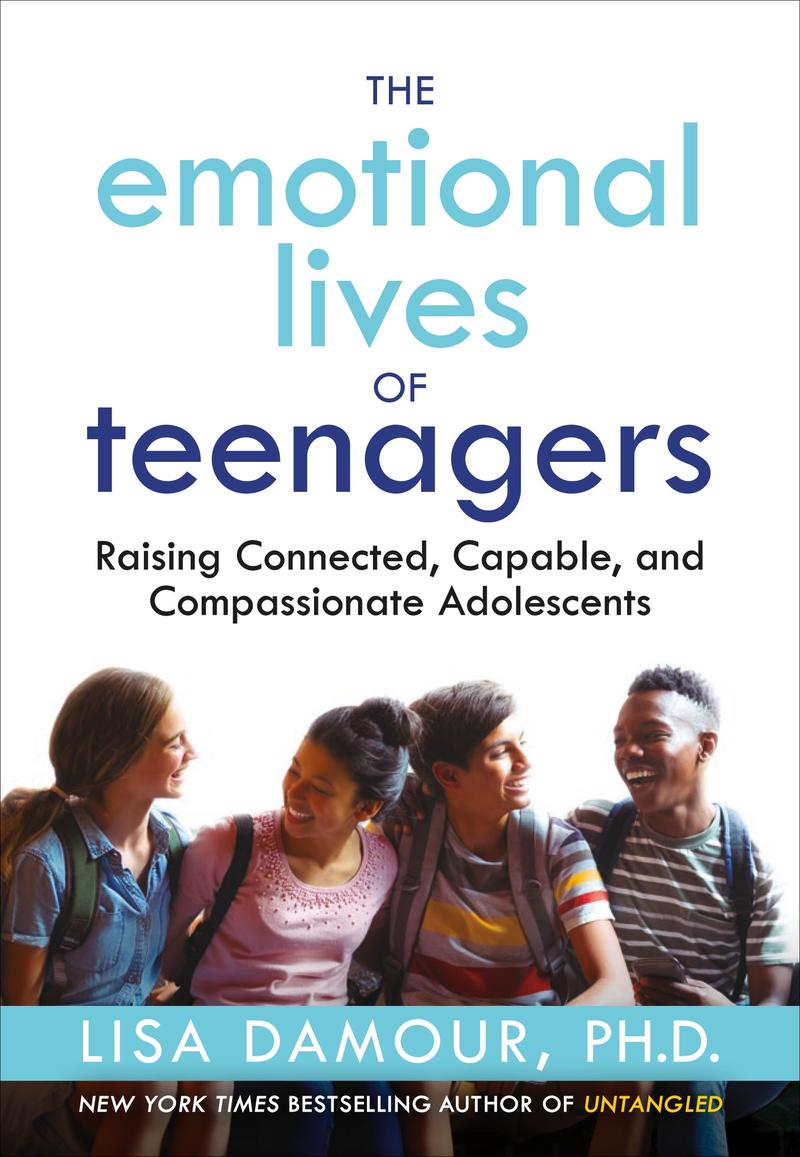
Alison Stewart: The name of the book is The Emotional Lives of Teenagers: Raising Connected, Capable, and Compassionate Adolescents. It's by Lisa Damour. Thank you so much for taking listeners' calls and for all your guidance.
Lisa Damour: Thank you so much for having me.
Copyright © 2023 New York Public Radio. All rights reserved. Visit our website terms of use at www.wnyc.org for further information.
New York Public Radio transcripts are created on a rush deadline, often by contractors. This text may not be in its final form and may be updated or revised in the future. Accuracy and availability may vary. The authoritative record of New York Public Radio’s programming is the audio record.