
A Met Exhibit Spotlights the Fraught Relationship Between Manet and Degas
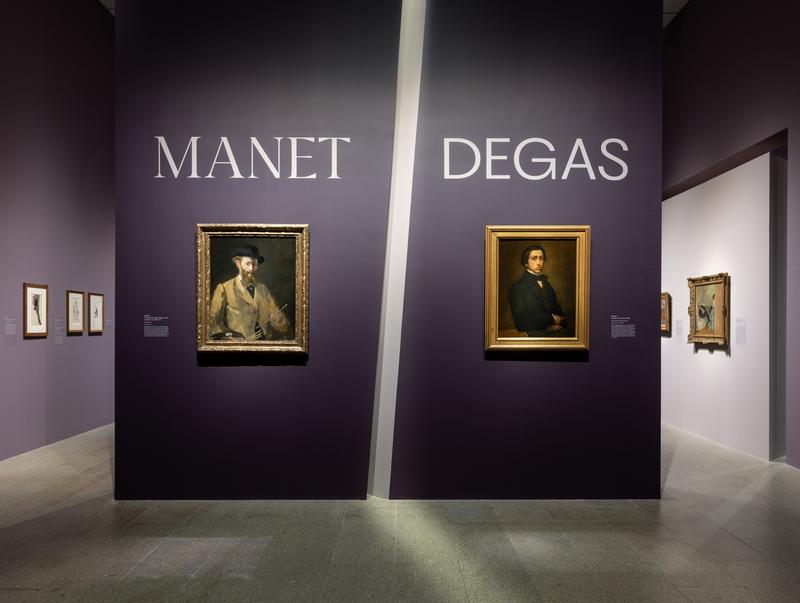
( Photo by Anna-Marie Kellen, Courtesy of The Met )
Alison Stewart: This is All Of It. I'm Alison Stewart, live from the WNYC Studios in SoHo. Thank you for sharing part of your day with us. It is Tuesday, but we're already thinking about the weekend. On tomorrow's show, we're going to preview the Coney Island Maker Faire. It's an interactive event where inventors and creators of all kinds can go and get inspired. Then on Thursday we'll be joined by author Ta-Nehisi Coates. He is the artist-in-residence at the Apollo, and this weekend he'll be curating his first event there; a weekend-long festival of ideas celebrating Black creativity. That is later in the week. Let's get this hour going with two big art shows.
The new Manet/Degas exhibit at the Metropolitan Museum begins and ends with a torn painting. In the first room, we see a portrait of Edgar Degas painted of his friend Édouard Manet watching his wife Suzanne play the piano. But at some point, Manet, unhappy with the painting's depiction of his wife, ripped it to remove the offending image, and then his friend Degas was offended. In the final room, we see a painting by Manet of a war scene that had been cut apart and sold separately. After Manet's death, his old friend Degas worked to find all the different pieces and reunite them on one canvas.
The two torn paintings, one never repaired, the other painstakingly put back together, are a fitting metaphor for the at times tumultuous friendship between the two French painters. Born just two years apart into upper-middle-class families, Manet and Degas were sources of inspiration, fellow soldiers, and artistic rivals. They often painted the same locations, sometimes even used the same models. By displaying their work side by side, the exhibit draws out the comparisons between the two artists and demonstrates how each of these men may have pushed each other to be better.
Manet/Degas is running now at the Metropolitan Museum of Art through January 7. It is a big exhibit, so when you go, make sure you give yourself enough time to admire the work and the work of my guest, Stephan Wolohojian, who is the John Pope-Hennessy Curator in Charge of the Department of European Paintings.
Stephan, welcome.
Stephan Wolohojian: Hello.
Alison Stewart: Hello. And Ashley Dunn, an Associate Curator who works specifically with 19th century French drawings and prints. Ashley, thank you for being here as well.
Ashley Dunn: Thank you for having us.
Alison Stewart: Ashley, what do we know about how Manet and Degas first met?
Ashley Dunn: Well, the story of their first meeting is one that puts works on paper right at the heart of things. The two artists met in the galleries of the Louvre. The story, as it's been relayed by early 20th century historians, goes that Degas was standing in front of a work attributed at the time to the Spanish 17th century painter Diego Velázquez. He was copying it in etching, so working on a copper plate, when Manet came upon him and made a statement along the lines of, how bold of you to make this print directly in front of the work without any sort of preparatory drawing. I would never dare do the same.
It's an even more interesting story in that Manet does also make an etching after the same painting. We don't know whether it was before Degas or after, but he does take that intermediary step of making a drawing first. His print ends up in the same orientation as the painting; versus Degas', which is in reverse.
Alison Stewart: Stephan, what sources remain that helps us understand the relationship between these two men? Are there letters? How do we know the timbre of their relationship?
Stephan Wolohojian: Such a great question. What remains for us as art historians is the works they left behind, obviously, and the rich dialogue that that exchange allows us to witness and be part of and to even frame in various ways through different narratives. We've distributed the exhibition around 13 galleries, each looking at a different question, each trying to deal with certain shared interests as well as certain questions that each artist engages in on their own.
The question of letters and other records is actually fascinating because Degas was actually quite a prolific letter writer. By letters, I mean small notes. "What a lovely evening that was yesterday for supper. Thank you so much," or, "Herewith, I return this copy of the latest book that came out that I enjoyed reading." I mean, just little exchanges like that, that would include a little scrap of paper and a few words. In all of the correspondence from Degas, there isn't one scrap germane that exists. Why is that? We don't know, but what we do have is this incredible visual record that allows us to try to have some access to it.
Alison Stewart: Ashley, artists often paint one another. It seems Degas drew Manet a few times. What can we glean about how Degas viewed Manet from these drawings and these paintings?
Ashley Dunn: Yes. It is one of the strange imbalances in their relationship, that Manet never made a recognizable portrait of Degas, but we have this great series of drawings and etchings that Degas made of Manet. They all date from the late 1860s when the artists were particularly close, and they show two intimate friends. They show Manet relaxed, in postures at ease, sitting sideways on a chair, leaning against a table. He's not presenting himself in a sort of professional manner. There's no indication necessarily that he's an artist, except in the back of one of the etchings, we get an indication of the back of a stretcher. We see two people who are really at ease in each other's company.
Alison Stewart: Stephan, when it comes to artistic style, what are some of the similarities between the artists, and then where do they diverge?
Stephan Wolohojian: Style is a complicated thing. I think interest is something that really sparks us here. Each artist is trying to frame their time and their moment and find their voice within it. In this case, it's with their pen or with their brush on paper or in paint. I often try to remind people thinking about this question about what it would be to be, say, a writer and trying to capture our moment, to try to write a modern novel that truly does look at the world around us and frame it for the reader. You have to think of Manet and Degas in the same light.
These are two artists working in a very extraordinary time in the middle of the 19th century where the world is shifting, both in terms of its societal elasticity, new forms of government, economic change, whole economies that are shifting, and Paris is one of the urban engines to all of that. The city as a new site to be explored, to be looked at and to be framed. That's their pursuit. It's the people in that city, it's work, it's pleasure, it's collective experience, it's personal experience. To see these two artists trying to shape that, to see these two artists looking at the world around them and using their art to express it, I think is really saying quite a bit and really helping us understand this important moment better.
Alison Stewart: Stephan, I have read, and please correct me if I'm wrong, that Manet was considered progressive at the time, and Degas a bit more conservative.
Stephan Wolohojian: Those are always good umbrellas to look at things with. Each artist, if we're talking about their artistic pursuit, is very much grounded in history. Alison, this is a great thing to just be mindful of for our own instances. The very notion of modernity being new, breaking from something, needs to have something old to break from. There has to be some sense of establishment.
In one of the galleries in the exhibition, we look at this marvelous space of the Louvre's galleries where history was brought right to the heart of Paris in living color through the work not only of European painters, but of artists from different geographies and different periods. The museum was such a generative space for this generation. In fact, one of the great things to even imagine the museum as is a social stage. Manet met Berthe Morisot and her sister in the galleries of the Louvre through his friend Fantin-Latour, or through their friend, Fantin-Latour, another artist. History, being a bracket and a framework for so much of their work, makes each of their responses to it.
Back to your question about progressive or more traditional or more conservative, more resonant, where do you draw and where do you return to that from? Both of them are very proud Parisians. I think we can't take that for granted enough. Paris is going through a lot of flux. There's a war in the '70s with Prussia, the Franco-Prussian War. Both of them stay in the city to serve in what we would call the National Guard or the National Reserve. They're fighting for something very important to them; their city, as well as their national identity. I think in many ways that frames, moving forward, very much the way they commit themselves politically to their art and to their lives as well.
Alison Stewart: We're discussing Manet/Degas at the Metropolitan Museum of Art. My guests are Stephan Wolohojian, as well as Ashley Dunn. Ashley, what were their views on the relationship with the Salon, each man?
Ashley Dunn: Sure. Manet was extremely committed to the Salon. It was an important stage for both artists, that has to be said, first of all. Starting out, it was the place where they needed to prove themselves, and they were both working toward exhibiting there. Manet had very early success. His very first submissions, one of which is the Spanish Singer in the Met's collection, earned him an honorable mention. He remained loyal to the Salon throughout his career, continuing to submit works every year. They weren't always accepted, but that was always his ambition to exhibit there. In 1865, he created a real stir with his Olympia that caused outrage among critics and the public alike.
That Salon was the one in which Degas made his debut in 1865 with a history painting, the Scene of War in the Middle Ages, which is a really strange kind of unidentifiable subject that Degas had been working on for a long time. It's amazing to think that from-- he was in Paris from 1860, working away, and didn't exhibit anything publicly for five years. We have all of these letters from his brother saying, he's working, he's working, but he has nothing to show for it. Anyway, he was working up to this strange canvas that really ended up falling flat in terms of there was no critical reception to it whatsoever. From that moment, he abandons any ambition of painting history subjects.
Alison Stewart: There's drama, Stephan, in this exhibit. I did not necessarily expect so much drama. The painting that has been torn across [chuckles] his wife's face. I'm talking about this part of the exhibit titled Monsieur and Madame Édouard Manet. It's a Degas painting of Manet lounging on a couch. His wife Suzanne is playing the piano, except it's torn vertically across her face. What do we know about what happened here? This is drama.
Stephan Wolohojian: Yes. This is violence. Let's call it what it is. This is an act of defacement in the very notion of the tense of the word. It's an extraordinary thing, and something whose violence is even more jarring and unsettling when you think about the painting itself, Alison; this moment of such peace and such satisfaction and such enjoyment of listening to music. Manet reclining with ease on a sofa, his whole being just in reverie as he hears the notes coming from the piano, and this friendship that's being recorded in it. Degas, a bachelor, very much taken in the '60s by his friend's union and recording that, imagining that when he goes back to his studio, as a kind of note, back to our earlier thing about trying to look at these works of art as records of experience. Then sending this as a gift to this couple, only to return and find that his friend had taken a knife to it, a straight edge, and just sliced it.
For Ashley and for me, it's been such a resonant thing. Because not only does it remind us of these moments of fracture, of breaking in any relationship, that relationships have great moments and then there are those moments where you just say, I'm never speaking to that person again. You repair things and often more strongly than they were to begin with, but they're still fractured somehow, they're still ruptured in an odd way. But he kept it this way. He kept it in his personal apartment, which we show in the last gallery in a photograph that he took of himself in front of it.
Degas has a biting sense of humor. It's one of the things that made him a bit of a menace in public spaces. He was, I would imagine, that person who sat and listened and then occasionally just dropped a really zinger line about someone at the table. Here, he has the great wit of putting a painting by Manet that he acquired of a sliced ham next to it and showing the slice right through the shank of the ham, and then a very shiny knife right at the edge of the painting that Manet painted that was the knife that sliced the ham. The edge of that knife is facing or indicating the painting that was slashed three decades earlier.
Clearly, it was something that resonated for years and years after in Degas' mind, but we've also considered that fabulously strange cropping that resulted in it. The fact that something that was much more centered becomes decentered, something that was much more focused becomes less clear as being so much a part of Degas' painting and his maturity. One could even maybe argue that Manet let him see something that he didn't yet at that time in his career recognize.
Alison Stewart: It also sets it up that they're humans.
Stephan Wolohojian: Aren't we all? Yes. [chuckles]
Alison Stewart: That they're humans, you know? They're not two people we read about in art history courses and that we see in the great museums around the world. These are two humans, one who'd get mad enough to grab a knife and slice a piece of art.
Stephan Wolohojian: Who would do that?
[laughter]
Alison Stewart: We're discussing Manet/Degas running at the Met. We'll have more after a quick break. This is All Of It. You're listening to All Of It on WNYC. I'm Alison Stewart. We are discussing Manet/Degas, which is running at the Met through January 7th. My guests are Stephan Wolohojian, he is the John Pope-Hennessy Curator in Charge of the Department of European Paintings; and Ashley Dunn, Associate Curator specializing in 19th century French drawing and prints.
Ashley, we must discuss Olympia. It's a centerpiece painted from 1863 to '65. It features a lounging woman on bed looking at the viewer, nude except for some accessories and shoes. Behind her is a Black servant offering her some flowers to look at. You had mentioned earlier, it was scandalous. Why was it scandalous?
Ashley Dunn: It was scandalous not for the fact that it is a painting of a nude woman, because nude women were all over the walls of the Salon, but most often they were shown as subjects from history and mythology as goddesses. Olympia is certainly not a goddess. She is a contemporary Parisian woman and she is a courtesan, a sex worker. She engages very directly and confrontationally with the viewer looking out. The contemporaneity of this subject and the subject itself was something that upset Parisian viewers.
It wasn't just the subject, but it was also the manner in which she was painted. It was perceived to be very coarsely painted, very rough, and lacking modeling, so looking very flat. Even her body looked dirty, according to some critics. This was all very upsetting to contemporary audiences.
Alison Stewart: Stephan, what about the woman, the Black servant behind her? What do we know about Manet's feelings of people of color?
Stephan Wolohojian: Well, thanks to recent scholarship and a closer focus on the painting and this figure, we have a name. Her name is Laure. We don't know her last name still, but it's wonderful to have her identified. It's wonderful to recognize that she was certainly a model that Manet could hire and work with, and a professional at that in that way. She's part of staging this tableau, this fiction, just the way the figure of Olympia herself was a hired model as well. There's a parody there that's actually really important to recognize. I think it's very important with greater clarity to understand both figures as equals in presenting this important story. My colleague here at the museum, Denise Murrell, has done a tremendous amount of work to restore our focus on that and to really restore her importance in the painting.
I think it says a lot for Manet, although this is one of only three depictions of her in his work. It's not that he continues to expand the profile of the figures that he observes, but it does indeed reflect a shifting society in Paris in the 19th century, and a shifting place in the public's imagination of populations in their world. There's equally an image of a park scene in the Tuileries, where a nanny appears, who's working, obviously, in a household, there in this moment of leisure in a park; and some marvelous small painting by Manet, very different from the large tableau of Olympia.
Alison Stewart: We mentioned the Franco-Prussian War earlier, but both of these artists were engaged and invested in the American Civil War. It comes across differently in their work. Ashley, how did each artist, Manet and Degas, engage with the Civil War in their work?
Ashley Dunn: Manet observes an event of the Civil War-- well, he didn't observe it firsthand, but he depicts it in two paintings, that we included in the exhibition, based on news reports of this battle that took place off the coast of France, in which a Southern ship was sunk by a Northern vessel, the Kearsarge. Manet, based on a reporting, makes this grand, large-scale, historic history painting of contemporary history, and later travels to the coast of France to see the ship as it had been moored to make yet another version.
Then Degas had more close ties to the events of the Civil War in that his mother was American from New Orleans, and so Degas travels to New Orleans in the 1870s. He spends about six months there and observes the life of his relatives who were still living in that city, his uncle, and in addition, his brothers who went and started businesses in the cotton trade. His family history was very much wrapped up in the events of the Civil War. His mother's family were enslavers, and they continued to work in the cotton industry even after the war.
Alison Stewart: Stephan, if someone is looking for Degas' ballerinas, they will find one small painting, one small ballerina in this exhibit. Why is that?
Stephan Wolohojian: And what a great small ballet picture it is. It's there to remind us of a really important shift in public presentation of artists' work in Paris in the non-juried exhibitions, which we now call the Impressionist exhibitions. In 1874, the first one, Degas presents that painting to a public. It's a really important moment for us to remind people that exhibition strategy is as important as the work that's presented in those exhibitions.
As you and Ashley were just saying earlier, Manet's commitment to the Salon, to the official arm, the state arm, let's say, of exhibiting painting, never wavers, never wanes. We think of him, if we can make everything paternalistic, as the father of Impressionism or whatever people imagine him to be, but he never shows with the Impressionists. He actually resists even Degas' many invitations to join.
On the other hand, Degas finds this new exhibition possibility a very fruitful one. It engages artists with each other. Degas was able to select, to curate, and to curate in the sense of exhibiting, to make selections of where things would be placed, as well as even to make considerations about their lighting. It's a really extraordinary thing. It was irresistible not to bring that one ballet rehearsal scene in because it is just such a fantastic painting at that, but also to remind people of a whole new strategy of exhibiting that distinguishes these two artists' work.
Alison Stewart: This may sound like an odd question, Stephan, or actually whoever wants to take it. The walls are plum. Oh, it's a deep plump is the backdrop for the work. What went into that choice, the wall color, the paint color?
Ashley Dunn: I'll take this one. This was a collaborative choice we made with our exhibition designers. We had a great design team working on this project. The two works that are on the banner for the exhibition, Degas' Absinthe Drinker and Manet's Plum Brandy, were the source of inspiration that our graphic designer drew from in identifying this palette of purples. We considered various options and we're very happy to have landed where we did it. It was not an obvious choice and it maybe have been a bold one, but we were delighted to discover, as we were installing the exhibition, that really every work that we hung on the wall seemed to look really great against this plum, so we're very happy that we went with that color.
Alison Stewart: Manet/Degas is running at the Met through January 7th. I have been speaking with Stephan Wolohojian, as well as Ashley Dunn from the Met. Thank you so much for your time today.
Ashley Dunn: Oh, it's been a pleasure. Thank you, Alison.
Copyright © 2023 New York Public Radio. All rights reserved. Visit our website terms of use at www.wnyc.org for further information.
New York Public Radio transcripts are created on a rush deadline, often by contractors. This text may not be in its final form and may be updated or revised in the future. Accuracy and availability may vary. The authoritative record of New York Public Radio’s programming is the audio record.
