
Black Art History: The Legacy of Black Models in Western Art
( Courtesy of Harper Collins )
[music]
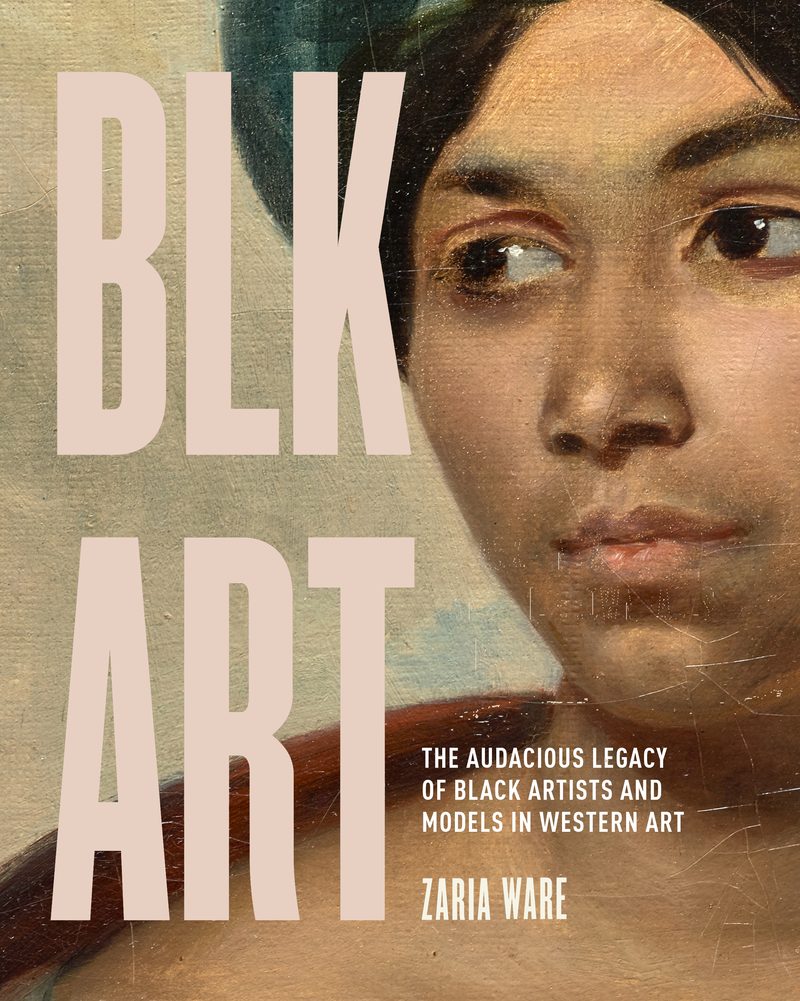
Alison: You are listening to All of It on WNYC. I'm Alison Stewart. For Black History Month, we are dedicating every Wednesday on the show to Black art. We are calling the series Black Art History. We're doing other days too but Wednesdays, for sure. A new book tells the lesser-known stories of some of the Black models and artists who are foundational to Western art movements but whose contributions have been forgotten or systemically erased. BLK ART: The Audacious Legacy of Black Artists and Models in Western Art presents examples of beautiful paintings of Black models ranging from Rome to Amsterdam, London, Paris, New Orleans, Cincinnati, and more. The book also challenges us to consider the power of the image, how museums fall short when it comes to representing Blackness on their walls, and to question our associations of art and race. Writer, poet, and self-possessed art and history nerd, Zaria Ware, is the author of the book which is out now. Zaria, nice to meet you.
Zaria: Hi, nice to meet you as well.
Alison: I'd love to begin by having you read from the intro of your book, page 16 and 17.
Zaria: Okay. All right. Buckle up. This is Black history like you've never seen before. In the hush corridors of royal palaces, in tiny art studios and bustling city shops, at the rise and fall of empires, on voyages to discover distant lands, and on the building sites of ancient pyramids, people of color have been there hidden just out of reach in marriage licenses, land deeds, baptismal certificates, and oil paintings. They have always been there. They have been adventurers, warriors and inventors, composers, musicians, and royals. They have been fine artists but judging by the lack of representation and historical television series, movies, novels, academic curricula, and textbooks, it would seem as if Black people didn't exist until appearing out of thin air for the transatlantic slave trade to begin. As any neutral deep dive into history will show you that couldn't be further from the truth. Explicit racial color lines are a modern construct.
Instead of the color of your skin, an ancient Roman citizen will be way more concerned about your loyalty to the empire and whether you spoke at Latin. Instead of inciting shock and horror, St. John Blanke, the new Black trumpeter in King Henry the seventh Royal Court might at best have stirred up curiosity. Humankind has always collaborated despite the 10-month-long sea adventures around the world with no Netflix in search of money, fame, food, and sweet new digs. Even individuals who had never personally seen another race were often still very aware of other cultures' existences through stories and art. Depicted on an ancient Christian faces as mighty warriors or starring and religious scenes as kings from distant lands, modeling for elegant portraits with scary good eye contact and appearing in backgrounds next to Europe's [inaudible 00:02:46] aristocrats or posing as desired [unintelligible 00:02:48] for 19th-century artists obsessed with the exotic. People of color have been integral parts of the Western art world since its beginnings, leaving behind clues of a past far more diverse than ever appreciated, hundreds of images remain in our modern world that are patiently waiting for consideration.
In 1935, the founder of Negro History Week, soon to be February's Black History Month, Carter G. Woodson wrote, if a race has no history, if it has no worthful tradition, it becomes a negligible factor in the thought of the world. It stands in danger of being exterminated. Until now, the majority of the figures and faces within this section have been completely forgotten. Their legacies have been boughted out but soon, on the next page soon, you'll see Black and brown faces from across the globe; musicians, wealthy ladies sitting for portraits, and saucy ambassadors. While many liked agency in choosing how they were portrayed in the art world. As the century flew by, many others were in full control of how they were painted. Staring right back at you with all the pride and joy of someone undeniably human.
Alison: That was Zaria Ware, reading from her book, BLK ART: The Audacious Legacy of Black Artists and Models in Western Art. You know the book how you collected art files as part of your research almost obsessively, including paintings from all over the world. How did you go about identifying which works you knew you wanted to research more and to dig into?
Zaria: Oh, it was so difficult because there are literally hundreds and thousands of these beautiful artworks online on different various museum websites, like with the Mets Museum's website, the Smithsonian Museum's website. Literally, it was really looking up by African, using words like African Black and really just doing a little bit of detective work looking through the hundreds of different art files that came up and seeing if you could see and localize which one was Black, which one was not Black and then really just trying to decide what parts of the art world I wanted to focus on for Black art.
Alison: It was interesting, the use of the word clues because you have to do a little bit of detective work in order to figure out where this painting originate from. What was the original intent of the painting? When you looked for clues, what's an example of a clue that you had to look for and you thought about and it led you to something else or it led you to a conclusion?
Zaria: Well, for instance, I would find a certain artwork that I really loved and then sometimes you would have to use Google image search, and try to copy and paste that. and see if you could find something else that would give you clue as to which museum it was in. A lot of times someone will post it on their blog but there will be no information about where to find the original file. A lot of times it was in that way. Then, also sometimes just reading blogs, reading comments, and seeing what people were saying about some of the artworks, and then using those comments to find rare books really that were talking about these artworks, trying to just find the background of some of the paintings or the sitters who were in the portraits throughout the book.
Alison: You write about one of the first Black figures to be represented in Western art Balthazar one of the three kings who arrived on epiphany. When he was depicted in imagery in Western art, how was he depicted, Balthazar?
Zaria: Well, Balthazar in The Adoration of the Magi, which was an extremely popular art theme in medieval times and Renaissance times. It really depicted three kings, majestic kings who were coming to see the baby Jesus. Balthazar was depicted as a very regal, elegant African man, which was a very amazing thing for us today as a modern viewer because we're so used to seeing a Black male figure in a degraded image. To see literally hundreds of these images of African kings wearing turbines, wearing gold and silver and pearls really is just an amazing trope that we see in art history. I love just going through every museum really from Europe to the US to Canada, have at least one or two of these because it was just such a prolific theme throughout art history, especially during the medieval times and the Renaissance.
Alison: Another example of looking for clues and this one's really interesting, portrait of two women. It's an undated painting by Stephen Slaughter, which until recently had a different name. It said Young Woman with Servant. I'm going to ask you to describe the painting and what are the context clues that led to the change in the name of the painting.
Zaria: Well, the painting is so remarkable because in Europe, especially in England when you see a Black sitter who's with another white sitter, usually it's in a subservient position, usually in the right margin, the left margin but they're always considered subservient, usually in the place of where an animal would be or a dog, so to see this beautiful painting where you see a white sitter who is sitting in a beautiful chair holding a fruit in her apron and then you see a woman standing right next to her a Black woman who is really decked out with beautiful jewelry, beautiful embroidery on her gown, who was actually affectionately touching the woman's shoulder, which is also very different from most paintings of the time. It was showing some intimacy or affection, whether that means they were friends, whether that means they had a familial connection.
It's just a beautiful portrait showing how the Black sitter is looking actually at the viewer with a defia-- not a defiant gaze but a confident gaze that we usually don't see also with Black sitters. The name was changed in more recent times because it really isn't possible when you look at it from a neutral position with no bias to really point out who would be the servant and who would not be the servant. In reality, these two women really were equals it seemed from the portrayal and also from their clothing. This fashion historian, [unintelligible 00:08:52] actually did a deep dive into this which was really amazing on the internet, everyone should read her article about how both of them were wearing clothing styles that were very popular at the time for rich women to portray with orientalism and pastoralism. It's just a beautiful picture and it really is one of the main paintings that really inspired my entire book. It was one of the first ones that I was able to find. It was just amazing to me to see this. I just love this portrait. It's amazing and everyone has to see this one at the Wadsworth Atheneum.
Alison: You also include a story about the painting Creole in a Red Headdress captured by a French painter. It's a free Black woman in New Orleans, but there's a deeper context to the way she has her hair wrapped. Tell us a little bit more about why we should pay attention to that head wrap, what it means?
Zaria: Well, what is so funny about this is the tignon law, which was enacted in New Orleans by Governor Esteban Miro in the 1800s because a lot of free women in New Orleans, it was a very diverse city and there were a lot of free Black men and women. Many of the women were dressing and adorning their hair in beautiful styles. They were looking very beautiful. It was starting to offend some of the white men and women who were living there at the time because they were seen as being at least equal, if not better. They felt threatened. This governor actually enacted a law saying that all free Black women, had to cover their hair with turbans so that they would be reminded really, of their status in society.
Usually, of course, the head wrap was associated with something negative, associated with a working woman or an enslaved woman. It was so funny because these Black women, they followed the law, but then they just started to adore the turbans with feathers and jewelry. It became such a huge fashion statement that even white women started to do it as well. Really they turned the law, or they turned the injustice into something very fun and cool, which we see even happening today.
Alison: My guest, Zaria Ware. The name of her book is BLK ART: The Audacious Legacy of Black Artists and Models in Western Art. Amsterdam was the center of Western art in the 16th and 17th hundreds. A new style emerged alongside a large Black community in the city. At the same time, the Dutch were heavily engaged in the slave trade. How was Amsterdam's Black community central to a new emerging artistic movement in that city?
Zaria: Well, the Dutch Golden Age is one of the most popular art forms I would say today. Everyone loves Vermeer, Girl with a Pearl Earring, and Rembrandt. What's so interesting is that you see during the Dutch Golden Age, this localized Black community who are living in Amsterdam, near [unintelligible 00:11:44] which was really central to the city. They were neighbors with Rembrandt and some of the artists who were living at the time, like Judith Leister or Clara Peeters. They were trying to live a normal life. Some did arrive enslaved, some arrived free, arrived free as soldiers. They worked as models. We see in one of the paintings, Two African Men by Rembrandt is one of the only paintings portraying two Black men in such an intimate way, showing them as humans, as equals.
We see when you look and do a deep dive into some of the historical records that they witnessed the baptisms of each other in the Black community. They also married one another and also engaged in interracial relationships. We see one Black man named [unintelligible 00:12:30] who married a Dutch woman. It's just an amazing moment in time where we see Black men and women being portrayed in a very nice way and a very positive way, despite the fact that the Dutch had a huge hand in the slave trade at the same time.
Alison: You do also point out in the book that there's, I think it's, you call it the Where's Waldo effect.
Zaria: Oh, yes [chuckles].
Alison: [chuckles] The idea of Black images being marginalized, being pushed to the side. Tell me a little bit about the Where's Waldo Factor.
Zaria: Well, I thought it would be very funny to title it that because in reality it really was like that when I was searching for paintings. When you see in the 17th century and 18th century, at the height of the transatlantic slave trade, most rich and wealthy white men and women, they all wanted a Black servant, usually a little boy, because it was seen as something very fashionable. It was a sign that you were very rich, you were doing very well. To go to someone's home in London or in Paris and to not see a Black servant would've been a little strange. Everyone wanted one. They would not leave their house without one. There are different accounts of that it was really a huge trend or a huge fad.
When you look throughout art, they usually are in the margins. You see a little Black boy on the side or the right, sometimes a female, a young woman, and then also Indian young men. Indian young men at the top or in the back. I argued in this art, this section of the book rather, that academics usually push them to the side. Even though they were there, they never were discussed in artistic discussions. Instead of actually starting to focus a little bit more on them about imagining their lives, what they could have been doing, what their lives are like, not writing them off completely as just being a servant, just being a slave, because they also were humans as well and deserve to have equal representation and treatment as much as the white sitters that hired them.
Alison: Zaria, you also include a few artists who are pre-Harlem Renaissance artists that you think people should know a little bit about. Robert Seldon Duncanson, Edward Mitchell Bannister, Edmonia Lewis, and Henry Ossawa Tanner. Robert Seldon Duncanson, you describe him as the house painter turned master artist.
Zaria: Yes.
Alison: Tell us a little bit about he always dreamed of becoming an artist.
Zaria: Yes. He always dreamed of becoming an artist from a young age. His father was a house painter, that was family trade. Eventually, at some point in his late teens, he decided, "You know what? I'm going to strike out. I'm going to be an artist." He ended up focusing on landscape painting. What's so amazing about this is that despite the racial tension at the time that he was growing up in, which was early 1800, he ended up at the end of his life. He was selling paintings for a large amount as much as $15,000, which today would've been about 300,000. He was sitting with the Lords and Ladies of Europe. Queen Victoria actually purchased one of his paintings. Robert, really, he was one of the first huge international superstars when it comes to Black artists.
Alison: Edward Mitchell Bannister among his many accolades. He's a founding board member of RISD, Rhode Island School of Design. What style did he explore?
Zaria: Well, he explored landscape painting. He just loved nature. He was a huge fan of nature. He actually spent most of his time sailing on his little yacht and finding inspiration for all of his artworks. What's so amazing about him is that he decided, he grew up in Canada, that he was going to move to the US and he ended up becoming one of the first really Black man or Black artist to win a national art award at the Philadelphia International Centennial Exhibition, which is so amazing in his life story.
What's so amazing also about that award is that he entered his winning painting under just his name. He didn't mention his race, of course. Then ended up when he won the award showing up and shocking everyone when he said, "That's mine." Everyone said, oh my gosh, no. They couldn't believe that they had awarded a Black man. His story was amazing as well because his wife was just an also amazing, a businesswoman who owned all of her own hair studios. They really were a Black power couple in the 19th century. His story is just really cool. I really adored a lot learning about his life.
Alison: Edmonia Lewis, the work is extraordinary.
Zaria: It is.
Alison: I understand she was self-taught.
Zaria: Yes. We know that she did have an instructor towards the beginning of her work who helped her at the beginning, but she largely learned a lot of it by herself. She had helped when she first joined and came to Italy. Harriet Hosmer helped find her studio, Charlotte Kushman and the group of women who were living there who were trying to break out on their own helped her a little bit. In reality, she didn't want anyone to take credit for her work. Any instruction that she had was very limited, so most of it really was her talent, which is so amazing.
She really lived up to her name that her parents gave her, which was in full Maria, Mary Edmonia Wildfire Louis because her mother was half Ojibwa. That was a nod to her Native American heritage. She really was a fire starter going around Europe and selling her sculptures in a man's field, which sculpting even for just a woman, not just a Black woman, but a woman in general was unheard of. The fact that she decided I'm moving to Rome, she was only barely 22, I'm going to learn Italian and start selling sculptures, was just amazing. It was incredible. Her life story really is just, it's movie worthy for sure.
Alison: If you go Google the work, it's stunning. Finally, Henry Ossawa Tanner, what would you want? One thing we're going to run out of time, but one thing you want people to know about him,
Zaria: Henry was this superstar in the 19th century who really inspired many of the young men and women artists of the 1920s. He bridged the gap between Edmon and Edwards's time and all of the Black artists that came up in the 20s that we know today such as Hell, Woodruff for Palmer Hayden,
Alison: The name of the book, you will learn a lot by reading it, Black Art, the Audacious Legacy of Black Artists and Models in Western Art. It is by Zaria aware it is out now. Zaria, thank you so much for being with us.
Zaria: Thank you so much.
Copyright © 2023 New York Public Radio. All rights reserved. Visit our website terms of use at www.wnyc.org for further information.
New York Public Radio transcripts are created on a rush deadline, often by contractors. This text may not be in its final form and may be updated or revised in the future. Accuracy and availability may vary. The authoritative record of New York Public Radio’s programming is the audio record.