
Ke Huy Quan and James Hong on Oscar-Winning Film, 'Everything Everywhere All At Once'
[music]
Alison Stewart: This is All Of It. I'm Alison Stewart, and we continue our post-Oscar coverage with a conversation with one of the big winners. As we just discussed, the film Everything Everywhere All At Once earned six awards. The movie stars Michelle Yeoh, who just became the first Asian woman to win Best Lead Actress, as a worn down laundromat owner with a not so great relationship with her queer daughter, who learns to access other versions of herself in other dimensions and must use her new ability to save the multiverse. The movie is genre defying and layered with imagery, soundscapes, but most importantly, human emotions.
The use of time and space jumping, martial arts fighting, and lots of pop culture references to explore the dynamics of love and free will, comes from the writing and directing team and now Oscar winners, Daniel Scheinert and Daniel Kwan, a directing duo known as the Daniels. Alongside Michelle Yeoh, the film stars Ke Huy Quan as Evelyn's deeply sweet and sometimes bumbling husband, Waymond, and James Hong, who plays Gong Gong, Evelyn's not quite as supportive father. When the film first came out, and we were all so into it, we spoke to Ke Huy Quan and James Hong.
Today, we'd like to revisit that conversation with now Oscar winner, Quan, and living legend, 94-year-old James Hong, stars of the Best Picture winner. We talked about Asian representation in Hollywood, Quan's stunt choreography, and the film's genre bending. I began our conversation by asking Ke how the pitch was first described to him.
Ke Huy Quan: Well, I remember reading the script for the first time, I laughed really hard, and I cried as well too. I cried for many reason, not only was it a beautifully written script with amazing characters that featured a Chinese American family, but I also cried because this was a script that I wanted to read for many, many, many years, and it just didn't exist before. That was one of the reasons why I left acting, because it was just difficult to be an Asian actor. When I first started, opportunities were very few, and at the time, it wasn't fun. When I got a hold of the script, I loved it so much and I felt the role Waymond was written for me.
I called my agent and I said, "Please, please, let me know what I need to do to land this role." When I went in, auditioned for the Daniels, I was so excited to meet them. I was so happy when I got the call. It was actually the happiest call I got in the last 10 years when they told me that I got the role. It was just incredible.
Alison Stewart: I can hear you sound very passionate about this.
Ke Huy Quan: Yes, I am. Absolutely. I'm so grateful to the Daniels for giving me this opportunity, for taking what was once merely a distant dream of mine, and turned that into a reality. I'm still processing everything that's going on and I cannot believe I'm here talking to you about this movie, and acting alongside James Hong, this is incredible, with Michelle Yeoh, and Jamie Lee Curtis, what an incredible opportunity this is.
Alison Stewart: James, you have been in hundreds of movies, you've read hundreds of scripts, when you first read this script, or heard about this idea, what was the thing that hooked you?
James Hong: Well, to tell you the truth, I'm still reading it because I can't quite all of it, it's everything everywhere all at once, I'm throwing in the kitchen sink, and you just don't know what to expect to this day. I am looking at the movie once, twice, and I'm not getting all of it. Maybe it's because I am 93, but I don't think so. I think these Daniel boys created something from their nightmare. It's crazy. I never thought I would live to see a script like this. It's just so fascinating. It is subconscious, keeps working in and out.
In fact, when I read that script, and it says the character of the grandfather or father is in a science fiction suit, I said, "Oh, wow. Finally, I get to wear a so-called science fiction type of movie suit." I was looking forward to it. When I stepped on the set that day we were going to shoot that scene, they brought in the suit, and you'll have to see the movie, you will never see a science fiction suit made out of material that you will see, just cans, I could hardly move around. I said, "Oh no, not another Daniel dream, a nightmare." It's been that kind of thing all the way through the whole shoot. These guys are crazy. I would have to say it's the craziest set, and direction, and movie I've ever been in. [laughs]
Alison Stewart: That is saying something with your long career. Let's talk about your characters a little bit. Evelyn is our main character with Michelle Yeoh, and Waymond is her husband, Gong Gong is the Father. Ke, what does Waymond think of Gong Gong?
Ke Huy Quan: Well, throughout the movie, he's constantly seeking his approval because he's the one that didn't approve of this relationship. He was constantly-- in fact, they grew apart because Evelyn's character decided to move with me to America. The relationship between Gong Gong and Evelyn soured because of that. In the beginning of the movie, when he came to visit us, I was really nervous and I wanted his love more than anything else. Waymond is a character that truly believes in empathy and love and respect for one another. That was also what he was seeking to Gong Gong when he spent time with the family.
Alison Stewart: James, why would Gong Gong not approve of Waymond?
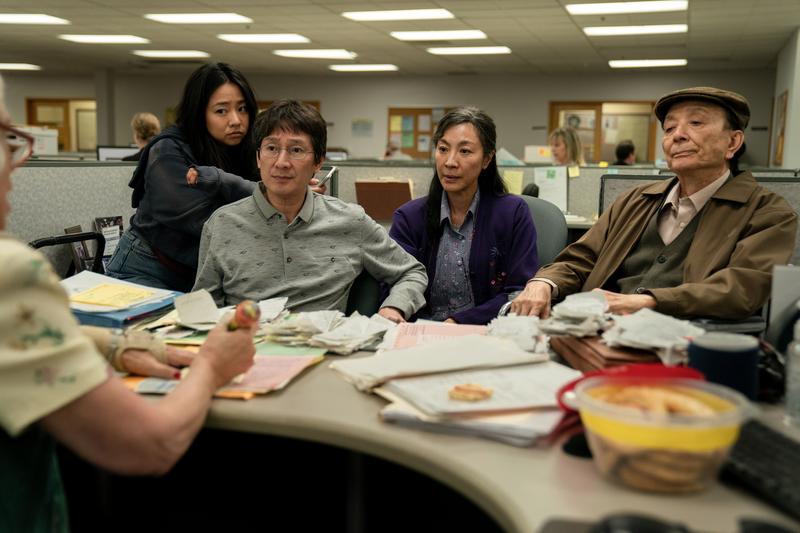
James Hong: Well, actually, Gong Gong, or the father, he really wanted a boy, just like in all Chinese families, old fashioned, they want a boy to carry on the business. Here's a girl, and well, she just runs this laundromat. There's no super pride in having a girl running a laundromat. That's in the lower rung of professions. Anyway, and then here's a husband that is so goofy, oh, everything is thumbs down, things are getting worse. In the whole movie, I'm always father and bewildered, what's going on. On top of it, this Evelyn is being audited by the IRS, oh my goodness, I'm sure some of you know what that means.
Here's all this paperwork, and we're going crazy in this movie. On top of it, my daughter is having some kind of nightmare dreams. I give up, I just give up in this movie as far as a role, or how to deal with this modern generation.
Alison Stewart: It is a generational film. Ke, that says something I think that isn't discussed as much as it should be when talking about this film, that it is about generations trying to understand each other.
Ke Huy Quan: No, that's what's so great about this story and this script, is because when you put an Asian cast up in a movie, it doesn't have to be about identity. What the story is about is very relatable issues, regardless of your race, your social status, or where you come from, but it is intergenerational traumas, and that's the beauty of it. It's just an incredible written script that we all love with these amazing characters that's been treated with authenticity and integrity.
Even though it is a big science fiction, action, drama, with a lot of big action sequences, and it's a comedy as well, too, but at the core of it, it's really about this family, and how they are disconnected with each other, and how they have to travel into the multiverse to find themselves again, and to find each other again, and always wonder what would life have been like had they chose a different path or make different decisions along the way.
Alison Stewart: James, we're jumping through these different universes and multiverses. You both play versions of the same person in these different multiverses. What is something, James, that you discussed with the Daniels about how to play the same character in different multiverses? I hope that sentence makes sense.
James Hong: Well, let me tell you, the Daniels are the easiest and most creative people I've worked with, because constantly, there's two of them, and they're buzzing and they're talking, and then they turn to you with some kind of a constructive comment. You have to think in their terms. Now, that's difficult, because their minds are way out there somewhere, and they're young guys, they're going to be one of the best directors or two of the best directors in the whole business.
It's something I've never experienced before, but it's funny how the audience that were there to see this movie when I was there, and I heard, one viewer said it's the best movie he has ever seen in his whole life. People are identifying with the feelings of this Chinese family. Now, that's an oddity right there. In spite of all this hatred for Asians, this movie tells the people that we are all one people, we all have the same dreams and desires and we suffer the same things.
Alison Stewart: I did want to ask you about Dan Kwan and Dan Scheinert, the Daniels that we've been talking about. If people, I think they heard that name before, they may have seen Swiss Army Men, which was another cool, weird movie they did. What was the experience like for you, working with the Daniels?
James Hong: It's different. The Daniels were very receptive and they can dig into your mind as an actor and then react to you, which is very different from, for instance, let's say if I worked in the old movies when I was working with Robert Wise or some of the old movies like Soldier of Fortune, with the big-time directors. They don't allow you to say anything. If you say something, like I said to Gene Wilder, "How about this or that in the scene." They say, "We've done this before."
They don't pay any attention to you, what you as an actor can contribute to that role, but the Daniels are different. They are part of you when you are acting. I think that's why the film turned out as it is, because you not only see us, but you see the Daniels' brains and creativity all rolled up in one.
Alison Stewart: Ke, what was that like for you, working with these two directors?
Ke Huy Quan: I had the pleasure of working with some really famous directors like Steven Spielberg and George Lucas and [unintelligible 00:12:08] but the Daniels, oh my God, they are so freaking talented. Being on the set, we had a really tight shooting schedule, but they never forget to pause and take everybody and give out awards to crew members. In fact, if you look at our credits, the end credits, our production assistants' names in the credits come before everybody else. That is a testament to what kind of person they are.
James Hong: Before I used to see Michelle doing all her martial arts in the martial arts movies, but when she acts, she's also like three dimension of what's hidden in her being. She just carries that movie and they cut most of my part out but put hers in, and they should, because she is so wonderful.
Ke Huy Quan: By the way, I want to add a little bit because it's always been a dream of mine to work not only with Michelle, but James as well too. I want to give a special shout-out because James has the most credits on IMDb. He's been in the business, and a lot of people has come to me and say I'm the OG, but James is the OG, OG and he's getting his star on the Walk of Fame. Oh my God, I'm so happy for you, James.
James Hong: Like Ke said, it took me 70 years to get a star on the Walk of Fame. Now people will step on me and I'll be so happy.
Alison Stewart: Ke, during your hiatus from acting, you worked as a stunt choreographer in a couple of movies, including X-Men, and you get to do some great fight work in this film, but how did you get into that? How did you get into stunt choreography?
Ke Huy Quan: I studied martial arts for a long time, a style called Taekwondo. When I stepped away from acting and went to film school, after I graduated, I got a call from one of the biggest Hong Kong action directors named [unintelligible 00:14:05] He said, "Hey, do you want to come to Toronto and have some fun with me?" This is right after graduation. I got there, I walked on set and it was the X-Men. Then after that movie, he took me under his wings and taught me everything about action sequences, how to choreograph it, how to shoot it, how to edit it. I had the best of time working with him. I learned so much, and that's why for this movie, I had a fanny pack fight sequence.
Alison Stewart: I want to stop you one minute, for people [unintelligible 00:14:43] understand. It's a fanny pack sequence. You just said that quickly. [laughs]
Ke Huy Quan: As a lethal weapon. A fanny pack as a lethal weapon.
Alison Stewart: Continue on.
Ke Huy Quan: I had the luxury of not only knowing what action sequence is, so when they choreographed, and when they showed it to me, I understand it. I understand how to do it, how it all works. Honestly too, I don't think I could have played this role had it been offered to me 10, 15 years ago. I think everything happened and has to happen in the order it did. Starting out as a child actor and then going to film school and working behind the camera for [unintelligible 00:15:35] I pour my entire life into these three characters that I play. It was an incredible journey for me.
Alison Stewart: I have to follow up on the fanny pack. One good thing about seeing it [unintelligible 00:15:50] is I watched that segment four times. I watched that fight sequence, I called my kid over. I was like, "You've never seen anything like this sequence." There's something funny about it that it fits the weapon of choice would be a fanny pack. It just feels like it's a detail that makes sense for this movie and I'm not sure what it is. Why is it so right on for this movie?
Ke Huy Quan: That's what's so incredible about the Daniels. It's like, "Oh my gosh, nobody thought of using a fanny pack in a fight sequence." What's so great about that sequence is it really sets the tone for the rest of the movie.
Alison Stewart: Yes, that's it.
Ke Huy Quan: It's like getting on the roller coaster and you take that first dip, and it just doesn't relent, it doesn't stop. It really takes the audience for a ride far, far into the multiverse. Yes, they're really geniuses, the Daniels.
Alison Stewart: James, was there something in your character or in the script that your character got to do that you thought, "In my decades as an actor, I've not done that before."
James Hong: I'd like to remark on Ke's expertise on fanny belt because I do wear a fanny pack belt quite often. If somebody approaches me, I'd like to use it as a weapon, so I begged Ke to teach me the fanny belt Kung Fu. I know some of the other type of Kung Fu but never with a fanny belt, and I'll certainly from now on carry something heavy inside of the fanny belt so that it'll swing around and knock the guy, attacker to pieces. That was one. I never dreamt that you could do that much Kung Fu, Ke, and from that child actor with that squeaky voice. Of course, the voice hasn't changed too much, but from that, and then you said you retired for-- or out of the picture for 20 years.
Being an actor, I don't understand how you could escape from that early career and then pick it up again. It doesn't quite make sense, but it does. Now you have a new series called American Born Chinese, which I am doing an episode, thank goodness, but you all speak Mandarin in this set. That's another thing, I've got to find out what this is all about, but I don't even know what your question is. As far as doing something I've never done before, not really, because I'm in the wheelchair again. [unintelligible 00:18:31] Little China is open, wheeling myself around.
There's one scene, I'm not going to give it entirely, but really, I'm going crazy doing a very heavy scene with Michelle. She's my daughter and I'm pleading with her. My nose is running and my eyes are crying, and she takes-- I'll just give you a fast description. She takes her hand and wipes my nose and makes me swallow it. Oh, God, that wasn't in this script. I'm going to have to see her about that. That's the way it was, all kinds of surprises happening. There's not enough of James Hong in this movie. I wish there was.
[laughter]
Alison Stewart: They'll be a director's cut, if we know the Daniels. I'm sure. I'm sure.
Ke Huy Quan: By the way, for all the listeners, I don't know if you know this or not. James Hong is 93 years old. He's been in the business for 70 years and his passion for acting, it's still burning bright and strong. Watching him on set, watching him giving that performance, it's really inspiring. This man is incredible. He's a legend. He's the GOAT. It's incredible, James.
James Hong: Are you saying I'm too old?
[laughter]
Ke Huy Quan: No. I just said, oh my God, it's incredible how-- We had a lot of a really interesting conversation on set, and James, when he started out in the '50s, it was really tough. When I started out in the '80s, it was tough. He said he waited 70 years, and I waited 35 years for this movie to come along. It's a really special movie for us.
James Hong: That's true. Looking back when I started, there was nothing but cliché roles. When there's an important role, they would give it to the white people. I had to bear with that. I started the East-West players, that started a movement, and now I can't believe it. After 70 years, there's directors winning Academy Awards, there's multi actors who are doing leading roles from that.
No Asians doing leading roles to what it is now after 70 years. It does my heart good. To see Ke pull it off the bag and do what he did, he is so talented. You watch. I can't believe he's doing what he does on the screen, because I haven't seen him since 20 years ago. I don't think he should have hibernated that long.
Ke Huy Quan: Oh my God. I'm blushing getting that praise from James. Oh my God, I'm speechless. Thank you, James. I love you, man.
Alison Stewart: James, what kept you going? What kept you going as an actor, especially when you've been very candid about, and I think a lot of people from underrepresented groups of your age had to deal with some really serious racism.
James Hong: That's a very deep-thinking question, because a lot of my colleagues like Robert Etoll and [unintelligible 00:21:44] they're very good actors. Now I don't see them on the screen anymore. It's because-- Sure, we made advances, but still, there's not enough consideration for the Asian American talent. We should be out there more as doctors, as detectives, as politicians.
We are all those things in real life, but I don't see enough on television now. In a way, even at 93, I'm striving to put more Asians on the screen somehow, some way. I hope I'm doing my little bit and I hope all the people listening to me give it a boost. Give that goal a boost to put more Asians on the screen, because now you can see the talent there, so let's use it. Otherwise, America's losing a great part of its history.
Alison Stewart: Ke, James gave you a little set-me-up for American Born Chinese, [laughs] your series. Tell us a little bit more about that.
Ke Huy Quan: I'm in it with Michelle Yeoh, and we have an amazing cast. I'm so happy that James will also be in it with us as well. It's based on a graphic novel of the same name by Gen Yang. It's produced by Melvin Mar, Jake Kasdan, Kelvin Yu, and Destin Daniel Cretton, who directed Shang-Chi and the Legend of the Ten Rings.
Alison Stewart: He's great.
Ke Huy Quan: It's with Disney+, it's incredible. It's a really cool concept based on the mythical [unintelligible 00:23:28] of the Monkey King. It's got comedy, it's got great action sequences in it. It's a really fun series and I can't wait for the world to see it.
James Hong: Why is it in Mandarin? My Mandarin isn't that great, so I have to study like crazy.
[laughter]
Ke Huy Quan: I don't want to give it away too much, but James is going to be-- his character is incredible in this. I don't know how to go into it without spoiling [crosstalk]
Alison Stewart: You don't want to spoil it.
Ke Huy Quan: Yes, it's going to be amazing.
Alison Stewart: James, what's a project you've either worked on already that's coming out or that you have in your future that you're very excited about?
James Hong: I have my own film, my own production called Patsy Lee & The 5 Kingdoms that soon will be released. It's in the final stages of post-production. As you can see, I'm-- and I shouldn't be like my wife's saying, "You've got too many projects." That's true. I do have too many projects. I might be going to Spain to do another movie and into Canada. All of a sudden I think it is because of the times, Ke.
I'm getting more roles all of a sudden, maybe because COVID has been over. Now all those two years of projects that people wanted me in is now coming to me again. You can imagine trying to do this and then the publicity and two other movies going foreign. [chuckles] I don't know. I have to create a James Hong duplicate here, or whatever you call it, another robot to do my work, but it's fun.
Alison Stewart: Call in the other James Hong from one of the Multiverses. [laughs]
James Hong: There you go.
[laughter]
Alison Stewart: That's what you need. That was my conversation with Oscar winner, Ke Huy Quan, and James Hong, about the Oscar-winning film, Everything Everywhere All At Once.
Copyright © 2023 New York Public Radio. All rights reserved. Visit our website terms of use at www.wnyc.org for further information.
New York Public Radio transcripts are created on a rush deadline, often by contractors. This text may not be in its final form and may be updated or revised in the future. Accuracy and availability may vary. The authoritative record of New York Public Radio’s programming is the audio record.