
Get Lit: Marlon James's African Fantasy Novel 'Black Leopard, Red Wolf'
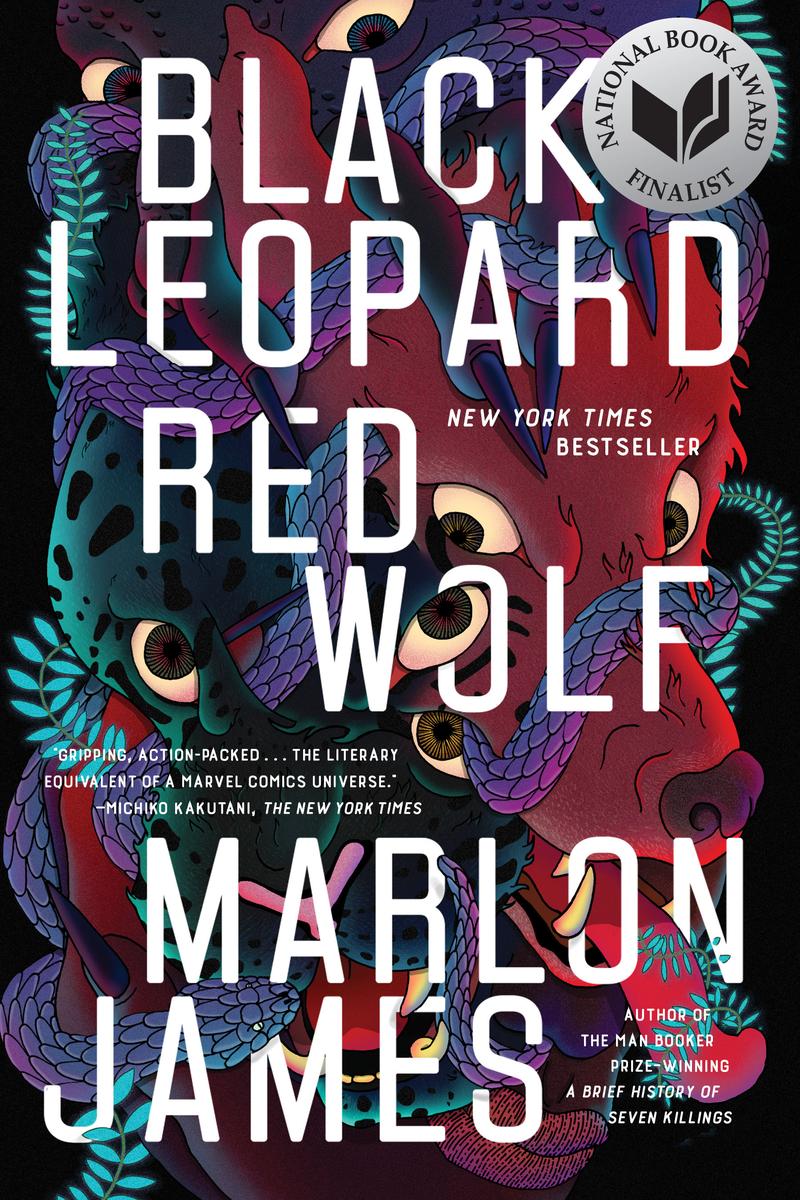
( Courtesy of Riverhead Books )
[music]
Alison Stewart: You are listening to All Of It on WNYC. I'm Alison Stewart. Booker Prize-winning author Marlon James was not known for fantasy writing before beginning his acclaimed Dark Star Trilogy. In fact, he was known for more historical fiction with novels like A Brief History of Seven Killings and The Book of Night Women, but With his novel Black Leopard, Red Wolf, James combines his ability to bring history to life with his expansive imagination, drawing on African mythology and folklore to create an ancient world where vampires, witches, and shapeshifting hyenas are very real.
Our protagonist is Tracker, a man with nearly a supernatural ability to hunt down anyone once he's gotten a whiff of their scent. He severed his ties to family and community. His one real friend in the world seems to be Leopard, a man who can shapeshift between being a man and a leopard. Together, Leopard and Tracker are hired to join a mysterious mission, finding a missing boy dead or alive. Different backstories are given as to who this boy is and how he came to be missing. As the hunt begins, Tracker begins to suspect that the boy is key to a battle over succession to the Southern throne currently occupied by the Spider King.
Tracker and his companions, including a very kind, very large man named Sadogo, a witch with ulterior motives named Sogolon, and a man who once betrayed him, travel across the continent in search of this boy encountering all kinds of terrifying and deadly creatures along the way. What will really happen once this boy is found and does he even want to be discovered? Black Leopard, Red Wolf was our February Get Lit with All Of It Book Club selection, and the sequel Moon Witch, Spider King was published last year.
Marlon James joined us for a live in-person Get Lit event at the SNFL Rooftop Event Center. Thanks to everyone who came out. It was really great to see you. I began our conversation by asking Marlon what his initial pitch was for this book.
Marlon James: For this, I came to her around 2015. This was actually before the Booker. No, it was right after actually. I said, "I have two ideas. I have an idea that makes perfect sense. It's the exact type of people who win a prize should follow up with. Something in that same vein, but different. Then I have this really crazy thing that I think nobody would ever read. I almost don't even want to tell you about it." One hour later, she's like, "I think you should probably go with the crazy idea." Which was this.
Alison Stewart: That's somebody you want to keep around, I think.
Marlon James: Yes. I could have written something practical and sensible and the really boring book people call acutely observed. [laughter] I can't even say it right, observed. My fourth novel, but anyway.
Alison Stewart: What fun would that have been? Once you made this call and you thought, "Okay, I'm going to go do this," when did you realize it was going to be a trilogy?
Marlon James: I think I realized pretty early on, one, because I'm a nerd and if I'm want to write sci-fi, I have to write a trilogy. [laughter] That's a totally legit answer. I think when I realized that, I really wanted to spend considerable time with other characters. Usually, I have a very weird relationship with characters. I'm totally promiscuous to the characters and I will cheat. My second novel was pretty much an affair with another character. The original narrator is still waiting on her book. She just came in and stole it and it became a story about something else. The same thing with this novel as well.
Alison Stewart: What changed about your writing process once you realized it was going to be a trilogy?
Marlon James: That's an easier thing to answer with the second book because for the second book, I basically have to forget everything in the first book. Otherwise, I would've just written a response, which is fine, but technically, if character A hasn't heard a single word character B has said, then he can't be responding to it. It's hard to shut up and stop being an author and go back to being this eavesdropper. That was one thing; to realize that if I'm going to step into a narrator's shoes, I have to believe them. When I wrote Black Leopard, I totally believed them. When I wrote the second one, I totally believe her as well. I think that's certainly something.
Alison Stewart: That's interesting. We did an Instagram poll. We do polls in between, and we asked, "Do you believe Tracker?" 100% said yes.
Marlon James: I believe them and I think it's important that I believe them. With the second novel and eventually the third, I will believe them as well.
Alison Stewart: What were some of your valuable resources when you were researching?
Marlon James: Valuable resources, a lot of African folklore and myth, honestly. I think that a lot of translated [unintelligible 00:05:44] stories and so on. I think that in a lot of ways gave me a better picture of Africa than, say, a history book. I clarify that because African history and African historical research is on power and it's great and a lot of the stuff I read were contemporary sources. Honestly, if it's an African history book written before 1975, it's useless. It's almost like reading old books on African myth written by Europeans. They make it very clear, "This is about Jesus, but we're going to talk about Shango."
Half of the research was being careful with the research and realizing there's some books you could trust or some things or some you read in the context of when it was written, so there's a lot of presently researched, a lot of the, I said the folklore because I'm writing a fantasy novel, but I'm also writing a world where a lot of those things were considered real. It says something that every mythology has a dragon. We all thought dragons were real. Almost every mythology has a great flood because we thought that was real.
Alison Stewart: I spent a lot of time googling-
Marlon James: Oh, really? [laughs]
Alison Stewart: - when I was reading this book. I thought, "Is this real or is this Marlon?" I looked up in impundulu and yes, the lightning bird of African lore. What's an example of something that is real? Then what is an example of something that is purely of your imagination?
Marlon James: Something that was real is the bultungin, the shape-shifting hyenas, who have quite the scene in this book. You could call them a non-binary because they decide on their features and that's totally part of the legend. The bultungin, the shapeshifting hyenas, which I think is fantastic. In a lot of African mythologies, the shapeshifters are the cats or cat adjacent. Hyena is closer to cat than dog despite how they look. There were lions, there were leopards, there were cheetahs. There's no werewolf. One that I made up, God. The mythology was so rich I didn't really have to make anything up.
The closest I came to making a character up was the shapeshifter river spirit Bunshi, but then I didn't because as I steered up Wangechi Mutu's sculptures all day and that's basically an animated one. For me, I was discovering so much that the line between creation and just reusing the actual myth available to me was pretty blurred. Tracker I think I made up. [laughs]
Alison Stewart: You brought the canine versus the feline. What did you want to explore about the canine versus the feline?
Marlon James: Because there are wolves in the book. Tracker, he's also called Wolf Eye. There is that. Also, part of it was a corrective against-- I remember somebody I was telling the name of the book and he was like, "There are no wolves in Africa," and I was like, "There are no lions in England which you haven't done here. [unintelligible 00:09:24] don't you?" [laughter] Then I go, "Also, here are six wolves and a jackal who got reclassified as a wolf." I don't know if I saw a divide or a conflict there. Especially since basically the wolf and the leopard have become best friends. Certainly, for me, I didn't think about it when I was writing it, that these friendships and these bonds are always so unlikely.
It's a very queer book, but the whole idea that families who we find and who you invent wasn't something I thought of before writing the book. It was basically in the midst of writing and then realizing as Tracker did that he was surrounded by family and didn't even know it and that's how a lot of that happened.
Alison Stewart: There's a lot of maps in the book and you drew some of these maps.
Marlon James: I drew all of them, yes.
Alison Stewart: Did you have an interest in cartography? Did you study it at all?
Marlon James: No, but I was a graphic designer for a few years. Well, more like 20.
[laughter]
Alison Stewart: Tell us how that came in handy.
Marlon James: In a way, it didn't. It turns out Photoshop has changed in 10 years. It turns out Adobe Premiere is not a thing. [laughter] When I left college back in the stone age, I was writing and I was drawing. I was always drawing. In fact, if you run into any of my friends from high school, they'll assume I was an artist or some graphic designer, which wasn't false. The thing I really liked was illustrating. The thing I like about drawing maps is that maps become evidence that your world exists in a way. You write about setting differently when you think it's established.
If you live in New York, you're not going to write about New York the way you'd write about Middle-earth, but at the same time, you have to get to the point where Middle-earth feels like a New York to you and that's what maps did. I reminiscing, Edith Wharton said setting is a definer and a confiner. It's a great line and it's true that once I had the maps, I had to follow the maps rules. My characters can't simply go away for six weeks to that territory. I had to change it. Either they go somewhere shorter or it changes the two years.
A character couldn't go south suddenly or I'd had to go north. Just realizing that I had a world and street numbers and so on, that made me feel more like I was in a real-world as opposed to a fantasy novel.
Alison Stewart: It's scaffolding in some way. Where do you start with your world-building?
Marlon James: Damn, that's a good question because I don't have a good answer. Where do I start? The thing is, you know where I start? I always start with characters, so I just follow them where they go. Wherever they go, I realize, "Oh, I'm going to have to invent that," or, "Wow, that club is going to need a name. All right, he's going north and that tree is going to need a whatever." Even if I don't draw a map, I still do one in my head.
Alison Stewart: How do you keep all the locations and characters straight for yourself? I counted, there's about 75 characters in this book.
Marlon James: I have a lot of notes on my wall and pictures and diagrams and so on. I've been doing it since my second novel because I do seem to write novels with tons of characters in them. I will sometimes have a chart up on the wall and each character has a column just so I know where they are and what they're doing. Even if it never appears in a book, I need to know what they're doing. That's what the worry is for me when I'm writing. When people talk about how long my books are, I'm like, "You got away with murder. Imagine the book in my head is twice as long."
[laughter]
Alison Stewart: Is it organized or is it like Carrie in Homeland?
Marlon James: Definitely more organized than Carrie in Homeland. The thing is I make notes endlessly and I jot down things and I plan out books to the very last scene, and then I promptly ignore all of it because that's not how real people behave. For me, I think one of the reasons also why most of my novels are in first person is that I really just feel I'm hanging along for the ride. For me writing, I just basically throw the book to the character and they can do whatever the hell they want. I just make sure I have a book I can sell to my editor afterwards.
The great thing about that is then characters start to do things you don't expect people to do but they do. People surprise you and people disappoint you. My characters do that all the time. I'm really not proud of any of them really and their actions. They're good people-ish.
[laughter]
Alison Stewart: I had this conversation with somebody. I said, "There's no real villains. There's no real villain in this," which I found interesting.
Marlon James: Yes, it's funny and I'm somebody who really do believe in evil. In fact, I actually teach a class on evil in my writing class.
Alison Stewart: What's the syllabus like?
[laughter]
Marlon James: It's only one class, not the whole semester. I couldn't have a whole semester on evil. I'd have to go back to my old job. I was existing in another life, so I have to go back to that. Now I've completely forgotten the question because I brought up my past.
Alison Stewart: We were talking about villains, we were talking about living in the gray area.
Marlon James: Yes. For example, the Aesi, I think anybody who knows anything about African mythology and religion, particularly Yoruba and the Hausas know Esu or Eshu and Aesi is based on him. It's very lazy when people compare Eshu to Satan, which people a lot of times do. That's not an Eshu at all. Honestly, [unintelligible 00:15:59] is saying he's an agent of chaos than saying he's a devil. Again, the whole idea of good and bad, evil and righters is it's not that it's debatable, it's that a lot of it is perception.
That's why I said I believe Tracker, even though Tracker becomes the villain of book two and Sogolon was the villain of book one, but when I read the second one, I believe her because this is just not black and white. There are a lot of good people who do terrible things and a lot of people who make terrible choices and there are people who, for the most part, do wicked things, and then you realize why they're doing it and you have this always complicated relationship with them. I think that's ultimately what it is, that you're not going to end up with an easy relationship in any character even a hero.
Alison Stewart: Tracker learns early on the book that his family is not what he thought. He thought his father is actually his grandfather. His father died avenging the death of Tracker's brother when he was younger. How does this information affect the way Tracker moves through the world and interacts with others?
Marlon James: It totally affects the way he moves in the world, but I don't think he realizes it. Tracker ultimately was looking for family and I don't think he realizes, as I said before, until he was in the middle of it. Yes, to realize, one, he's in a family where there is contempt abuse, denial of who was what. He didn't realize what a source of the resentment was to realize that your father is actually your grandfather. I go, but that's definitely my mom and my grandfather, what is going on in that room? It throws him off and it throws him off as to what exactly is family. The thing about Tracker is he doesn't name any of this.
I think the reader picks up on it that he's rootless. The first time he comes across a substitute father is a person who says, "Call me beloved uncle." I'm like the fact he says you have to call him beloved uncle all the time should have tipped you off. [laughs] Tracker is a person if you had asked him that he was searching for a father figure, he would said, "Absolutely not." Later on, if you said, "Are you a father now?" he'd go, "Absolutely not," but he is.
Alison Stewart: We're experiencing the world through Tracker's eyes, but also through his nose because he's got this sense of smell where he can find anybody through his nose. You write a lot about smells. Did you do any research into the way the olfactory system works and the way it affects behavior and what's the key to getting a smell on the page?
Marlon James: [laughs] One, I got to say, I'm interested in smell. I taught a class once , it's a 9/11 novels and the first thing I asked the class when I went in is, "What do you think 9/11 smelled like?"
Alison Stewart: I can tell you. The smell, I remember it. I was a reporter.
Marlon James: Yes. Then before I bring it up, realize that smell is something very subtle, but smell is also something quite visceral. Smell is sometimes how you realize you're in a 3D situation. Scent also evokes nostalgia. Scent for Tracker is a way of identifying. I think part of this also happened once. Back in 2015, this was still the Booker and people wanted to talk to me. I had a great visit from one of the directors of the Royal Society for the Blind, and he wanted to commend me on the book because he liked that there were so many other senses in there other than sight. It never occurred to me, one, that I had a blind readership, that visually impaired people depend a lot on audiobooks.
A lot of times audiobooks is read by a librarian and they go home, like I said, or whatever. I don't think I ever thought about it deliberately before he pointed it out that the world he experiences is not the world sighted people experience. I think it's very easy to just go for visual when you're writing. He was a remainder for me that there is more and that these different senses can tell you different things and different sound and so on. I became more and more conscious of that, honestly, after talking to him.
Alison Stewart: We'll have more of my conversation with Marlon James plus questions from our audience after a quick break. This is All Of It.
[music]
You are listening to All Of It on WNYC. I'm Alison Stewart. Let's continue my conversation with Booker Prize winning-author Marlon James about his novel Black Leopard, Red Wolf. It was our February Get Lit with All Of It Book Club selection. As always, our readers and audience members had some great questions for Marlon. You'll hear that in just a bit, but first, here's more of my interview with Marlon James.
[music]
One of the most complicated relationships in the book is between Tracker and Leopard. Sometimes they seem like friends. Tracker might sometimes feel like might have love for Leopard, at times they're enemies. Why is that relationship so complicated?
Marlon James: Because relationships are complicated. I knew I wanted a complicated relationship. Mind you, there was a part of it where Leopard was a little bewitched, and I won't tell the way in which he was. I knew I wanted, if it's going to be that long a book, that that relationship would go through all sorts of revolutions and devolution and so on. I knew they'd fall out and get back together and it wouldn't be the same as it was before, and so on. Because, again, I think even with fantasy novels, you have to ground yourself in reality, I think, and ground yourself sometimes in real lived emotions.
One of the reasons why I worship an altar of Buffy the Vampire Slayer is because of Buffy's fantastical premise. They had to ground that thing in God truth. That's one of the things I had to remember writing fantasy. You have to ground this in real experience, and real people fall out. Sometimes the friendship is rekindled and it's the same, a lot of time it's not. I had to remember that even though it's a world with dragons and so on and it's fantasy for me, it's not fantasy for the characters. It's just their world. That's their reality and I had to remind myself of that.
Alison Stewart: Of all the creatures that you create in this book, which one would you be most terrified to face?
Marlon James: Oh my God. I never want to face any of them.
Alison Stewart: Those Ceiling Walkers, man.
Marlon James: Yes, the Omoluso, yes, they're pretty bad.
[laughter]
Alison Stewart: They're pretty bad.
Marlon James: They're also one of the first ones I created, I think. Aesi to me is probably the worst. The interesting thing about African vampires, two things I love. One, unlike wussy European vampires, they have no problem with daylight. [laughter] If that's your grand plan to run out into the sun, got news for you because we're African, we don't do that bullshit. They also draw blood in different ways. The thing about Aesi that particularly grossed me out when I was writing it is as it turns into a swarm of bugs, and then the bugs burrow into your skin and drink everything and then fly off and reform. I'm like, "Dracula eat your heart. Oh." [laughter] We definitely have the vampire thing.
One of the things about writing this, and forgetting Europeanness, which is hard because most of my friends are European, is even the way in which I associate and the way in which words of connotations had to change. For example, in some of the midst of the Sahara region, midnight is just called the noon of the dead. When I said the noon of the dead, most people you have immediately attached certain things to it, even if you think it's a good thing. You never think it's good in a sexy New Orleans kind of way, but you're still thinking it's a sexy vampire or whatever. None of that actually applies.
Midnight is a great time for me because that's when my ancestors come out and instead of my mom who keep saying, "Go into my room," my cooler grandpa is now in the room and I can go, "Dude." It's all the things that we associate with, say, 12:00 midnight don't apply. At the same time, 12:00 noon is a terrifying time of day because vampires see you clearer. 12:00 noon is when some people would lock up and hide. Just remember, for me, one of the things while writing this we got to remember I had to also completely change the mythological viewpoint that I have about even just what is real and what we should feel about certain things.
Alison Stewart: Let's get some microphones into the audience while I ask a few more questions.
Marlon James: All right.
Alison Stewart: My favorite character in the book is Ogo. The very, very large man who you do not call a giant, that's impolite, but this gentle giant, we see it a lot in literature. I hope you take this as a compliment, I went to Chewbacca for a minute. Why do you think that Tracker can be very tender with Ogo when he is not necessarily able to be that tender with other people?
Marlon James: I think because Tracker is always thinking somebody wants something or wants something from him. Why wouldn't he? He's a mercenary. [laughs] Part of that is his fault. Ogo really doesn't want anything. The thing also I like about Ogo is usually in fantasy, the gentle giant is a person of few or no words so I knew my character would not shut up.
Alison Stewart: If you haven't read it yet, there's about three pages of Ogo talking and there's no space. There's no paragraphs. It just keeps going. [laughs]
Marlon James: I knew from when I saw Ogo in my head that this was not going to be, "I am Ogo." [laughter] He's the person who you do not ask, "How was your day?" [laughter] Tracker makes a mistake of asking him that and it takes him all night before Ogo finally shuts up. That's when I fell in love with him when I knew he was this big 10, 15-foot whatever chowder box.
Alison Stewart: Love that guy. I love that guy. Let's see. Are our mics in the audience? Let's see if we have some questions from the audience.
Participant 1: You mentioned the audiobook, which is how I consumed this novel. I missed the part about how Ogo talked. I was wondering how much input you have into the choice and the selection of the narrator because for me, his voice really allowed me, I think, to inhabit Tracker far more than my internal voice would have if I had read it on the page. I was wondering about the process of that.
Marlon James: One thing I do, I'm sure I'm the only person, every time I say I do it, people look at me weird. I actually read along to audiobooks. See? Because that way, I can finish a book in a week and still retain it as opposed to when I go off and read on my own and I'll take four months to read a book or I listen to an audio and forget what's important. That's why. For pretty much all the audiobooks I've done, they've sent me a bunch of tapes, basically an audition really. I go through all of them and decide on who. I know it's not going to be me. It is a process. It is go through a bunch and pick one or so. So far they've been great.
Participant 2: I have a question about the artwork. How did you choose the artwork and did you decide it or did your team decide the artwork or how did you choose?
Marlon James: The cover artwork you mean?
Participant 2: Yes.
Marlon James: Actually, the team decided and hoped I would like it. It's this artist, Pedro Camacho, who also does, oh my God, what is her name? Things We Lost in the Fire author. Mariana Enrique. He also does Mariana Enrique's paperbacks as well. I saw it and I just fell in love with it because one thing I was very weary of is somebody send me one of these stereotypical African covers. I don't want to see a lion in the background. I don't want to call that tree that I completely blanked out now, but it's on every single movie about Africa. What's that tree they always use?
Participant 3: Acacia.
Marlon James: The acacia.
Alison Stewart: Thank you.
Marlon James: It's like no acacia, no sunsets, [laughter] absolutely nothing Binyavanga Wainaina warned us about. When I saw that, it plays with a fantastical without being too fantastical. I also like that it looks sort of like the cover for a graphic novel. I saw and fell in love and he's going to do all three. He's done two so far.
Participant 4: Just really quick, I just wanted to say as a queer Black person, thank you for this story.
Marlon James: Thank you.
Participant 4: It reminded me how much I love to read, but my question really quick. You did say earlier that you just throw the story to the character. My question is, what character surprised you the most and why?
Marlon James: God. Certainly, Tracker surprised me because I didn't really know a lot. I was talking before about characters usually seizing control of the book. When I started writing Black Leopard, Tracker was not the main character. He showed up, and again, because I have no moral standards and I'm totally promiscuous, I cheated on the character this book was about and went off with Tracker. A lot of Tracker surprised me. Actually, Tracker's queerness actually surprise me. I didn't think about that when I was writing and it didn't make perfect sense. I was also doing a lot of research on queerness in Africa at the time.
I said to sometimes the Black American regime, notice sometimes without thinking you address a single person as them? We've been calling single people plural forever. Where do you think that comes from? Honestly doing some of that research, that's where I saw it come from. That queerness and otherness and identity and whatever want to call these things. It's funny that we've always had that until a bunch of TV preachers told us that we didn't, but I'm not going to preach on this pulpit here. To go back to answering the question. A lot of Tracker's stuff surprised me. Tracker's bad habits and stuff surprised me. Who else?
Sogolon also because I thought she was going to be just the typical old-wise woman and talk about agent of chaos and these things. To an extent, all the characters surprised me. As I said, it's not as like going to writing a book with a blank slate. I will plot the crap out of anything. I'm censoring myself for the radio audience.
[laughter]
Alison Stewart: We have a bleep button, it's okay.
[laughter]
Marlon James: I completely lost track of what I was about to say. I was just saying that I leave a lot of leeway for my characters to surprise me. In a way, they really all did. A good writing there for me is when I go, "I didn't see that coming."
Alison Stewart: The sequel, Moon Witch, Spider King, was Sogolon always going to be the narrator always?
Marlon James: Yes.
Alison Stewart: Can you set this up for us?
Marlon James: In this story, Sogolon, the Moon Witch in the title tells her version of the story. The first thing about her version of the story is that for her, Tracker's version is just a blip because Tracker doesn't understand what's going on. Sogolon's story for a huge part starts in a royal court and it's me trying to do some fantastical Wolf Hall because I'm obsessed with that novel. In Black Leopard, Red Wolf, Sogolon is the first character to enter with an agenda in Black Leopard, Red Wolf. In Moon Witch, Spider King, you see how much of that was not the case and how she fell into it and how what really was driving her all this time was not finding a boy, it was vengence.
Her vengeance was going on for nearly two centuries. It's about that. It's about a woman who refuses to be anything anybody call her. Incidentally, she doesn't call herself Moon Witch. She's like, "You know what? I don't feel like killing the people who calling me this this time." It's a name, it's stolen or it's not the one she calls herself. That's what it's about. The actual events of Black Leopard don't even happen until the last fifth of the novel, which just shows what kind of stakes Sogolon was playing with.
Alison Stewart: That was my conversation with Booker Prize-winning author Marlon James. His novel Black Leopard, Red Wolf was our February Get Lit with All Of It Book Club selection. The sequel titled Moon Witch Spider King is out now.
Copyright © 2023 New York Public Radio. All rights reserved. Visit our website terms of use at www.wnyc.org for further information.
New York Public Radio transcripts are created on a rush deadline, often by contractors. This text may not be in its final form and may be updated or revised in the future. Accuracy and availability may vary. The authoritative record of New York Public Radio’s programming is the audio record.