
'Days of Wine and Roses' Off-Broadway Musical
( Photo Credit: Ahron R. Foster )
[MUSIC- Luscious Jackson: Citysong]
Alison Stewart: This is All Of It. I'm Alison Stewart live from the WNYC studio in SoHo. Thank you for sharing part of your day with us. Whether you're listening on the radio or you're live streaming or listening on demand, I'm really grateful you're here. A programming note, we're having an All Of It watch party for the series finale of Succession. That's when we all watch a show or a movie and get together to discuss it. Joining us next Tuesday for our watch party will be none other than J. Smith-Cameron, who plays corporate attorney Gerri Kellman. She will be taking your calls about the end of Succession.
On today's show, we'll speak with the curator of the new exhibit, This is New York, 100 years of the City in art and pop culture. We'll also hear from this month's Get Lit With All Of It author, Victor LaValle, about his novel, Lone Women, as well as hear from musical guest, Kaia Kater. That is our plan. Let's get this all started with Days of Wine and Roses.
[music]
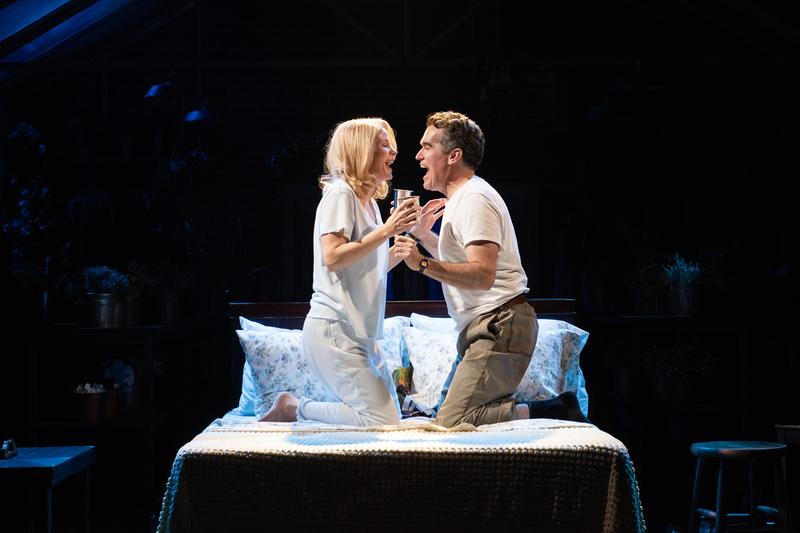
In the new musical, Days of Wine and Roses, Joe and Kirsten are a married 1950s couple trapped in a toxic spiral. It's based on the acclaimed 1962 film of the same name. Joe, played by tour-Time Tony Nominee, Brian d’Arcy James, is a charming public relations man who loves to have a good time along with his good friend, Jack- Jack Daniels. Joe is instantly smitten by Kirsten, a teetotaling secretary, a curious reader who can talk about anything. She's a straight arrow, maybe a little chilly, a trait she's picked up from her stoic Nordic father. She's played by Tony-winning actor Kelli O'Hara. Kirsten has never had a drink until she meets Joe, and she warms up to both the man and the booze.
Kirsten and Joe marry, drink, begin their life together, drink, have a daughter named Lila, and drink. They're drinking spirals out of control, threatening their relationship, and even their lives. Days of Wine and Roses features a score from composer and lyricist, Adam Guette, of Light in the Piazza fame. Is directed by four-time Tony nominee, Michael Greif, who of course directed both Rent and Dear Evan Hansen. This show is being produced by the Atlantic Theater Company, is running now at the Linda Gross Theater on West 20th, that is through July 9th. Joining us now to discuss is director Michael Greif, Kelli O'Hara, and Brian d’Arcy James. Welcome to all of you.
Kelli O'Hara: Thank you.
Brian d’Arcy James: Thank you.
Alison Stewart: Brian, what was your familiarity with the movie before this project?
Brian d’Arcy James: I'd seen it in college I think in a film class I was in. I was always a fan of Jack Lemmon, and so that was my introduction to it. I revisited again, among the many iterations of this production that we've- as it's evolved. That's been some time, but so the film was in the back of my head, and then I revisited it.
Alison Stewart: Kelli, what attracted you to the role of Kirsten?
Kelli O'Hara: I think it was the story. My parents raised me on these types of films, and I watched it somewhere in high school. I haven't really revisited the film, but the character and the story are very personal to me. I also like telling these types of stories and just the human condition and finding the human qualities in someone that you might not necessarily understand and trying to find ways to give them sympathetic qualities, and so this is exactly what I was looking for.
Alison Stewart: Michael, I was googling around to look for the trailer for the film, and the trailer is really interesting that you'll see online because it's a little bit of the film, but it's Jack Lemmon who spends a good minute or two addressing the audience about the seriousness of the subject matter. Although he never really says it, I think that is indicative of the times exactly what's happening. I'm wondering what you think is still relevant about this story, given this was set in the '50s, released in the '60s? Here we are in 2023.
Michael Greif: I think everything about it is sadly still very relevant. I think problems of addiction are very much with us. I think stories about family dysfunction, about lonely, lonely people trying to find a way to be seen and to create a fulfilling life and ways in which we all strive to be better parents and better partners, I think everything about it is still extremely relevant.
Alison Stewart: When you're adapting something like this, Michael, there's with legends like Jack Lemmon in it, and there's of course that famous scene where Joe is drunkenly destroying the greenhouse. Michael, how did you approach some of these more famous moments in the film and translating to the stage? What were your guidelines for yourself?
Michael Greif: Before I need to translate those things, I'm very much dependent on the rest of the creative team, my creative partners, the incredible Adam Guettel and the incredible Craig Lucas, who did such an extraordinary job of distilling down both the screenplay from 1962 and the teleplay. That was earlier. I'm sure Craig also looked very much at the play that Miller wrote after the teleplay, although I haven't seen that.
My job was really to interpret or create some bridge to an audience, a bridge from the way in which Adam and Craig already chose to distill that material. I think you'll find like an amazing set piece like that episode in the film when Joe destroys that greenhouse is extraordinarily depicted in the musical through Adam's extraordinary song that he gives Joe at that key moment in his development/dissent.
Alison Stewart: It's such a beautiful set that it's heartbreaking on many levels seeing somebody in such pain that they're searching for alcohol in that way, and they're destroying beautiful living things, and destroying this beautiful set. It's just on a couple of many different levels. It really gets you right here when you watch that one particular scene.
Michael Greif: It was the very first thing that the set designer, Lizzie Clack and I talked about was how we could actually evoke that setting fulfilling me on stage.
Alison Stewart: Brian, what's something that you've come to understand about alcoholism and addiction that has helped you understand this character of Joe better?
Brian d’Arcy James: Well, boy, a lot. I think that, I guess the first thing that comes to mind is grace. In terms of trying to find one's own path and one's own relationship with addiction and trying to fight it and overcome it and finding the strength on a daily basis to allow oneself to feel successful or to recognize their deficiency and not see it as the totality of themselves, but rather one step in hopefully a positive direction. The minuscule dots of a progression of events that make up this path, this struggle, this fight, this life.
I certainly have albeit through an imaginative process and a means by which I've been able to try to understand this disease and this particular character who's struggling with it, I certainly have a different view on what it's perhaps like.
Alison Stewart: Kelli, because the show is set in the '50s, we have a different understanding of a few different things on different levels. One is the difference. We think about alcoholism as a disease now, A, it was only founded 15, 20 years before the time that this takes place, and not to mention the role of women at that time. For your character, how does this time period impact her, impact her choices, and impact the way you chose to bring her to life?
Kelli O'Hara: I always am very cognizant of that of understanding that lens and where she was and who she was and what her opportunities might have been, how she and Joe meet in a business where he's one of the top players, and I'm a secretary of course, and what that might do to a woman at the time who has a lot to give and probably didn't have the opportunity to go to college and things like that.
One of the things that is so human to me about this character and the way our writers have written her is that it's really timeless to me. The way I feel about her being a mother myself, being a career person myself, I put the two things together, but at some point, the era disappears. That's an unfortunate thing to say as well because it should feel like a very ancient thing to think that this woman wouldn't have gone to school and that she would've been a little bit depleted in her potential, in her opportunities.
I feel like she had a fire then, and she would now, and that wasn't always stoked, and so there are-- The thing about addiction and alcoholism to me, especially for her character, is I don't blame it on just the circumstances of her life and the era that she's living. I don't blame it on anything, except to say that this was probably always- this is who she is. I like to think about what she might do in the future, past our show. I like to think about what she might have experienced as a child. That all to me feels like it's of a world that is today as much as it was then.
Then I put all those things together, of course, yes, but the era isn't as much a part of my journey.
Alison Stewart: We're discussing Days of Wine and Roses, playing at the Linda Gross Theater through July 9th. My guests are actors, Brian d’Arcy James, and Kelli O'Hara, as well as director Michael Greif. This is a question for all three of you, but I'll start with you, Michael.
I was interviewing Director Thomas Vent Berg. He came to talk to us about his movie, Another Round, which is also about a group of men who become alcoholics. He was talking about the challenges of helping his actors play drunk in the various stages of being drunk.
Michael, tell us a little bit about the direction you gave your actors in the beginning of the play when they're socially drinking, and as their drinking progressed, how you talked to 'em about physicality, and then Kelli and Brian, you can add in.
Michael Greif: I didn't have to say very much to the very exquisite Kelli O'Hara or Brian d'Arcy James. My job is much easier when I'm working with extraordinary talents and when we're all working with extraordinary material. I think both Kelli and Brian brought some real history and some real instincts about what alcohol did for their relationship at various points along the story.
I got to be an editor. I got to shape things slightly. I got to point out what an audience needs to see in terms of an arc or a process, but this was an unbelievable feast for me. It really was an extraordinary three-week little incubator period where we were rehearsing this play in a small room. Just watching the way both Kelli and Brian approached this material was really- it was a great lesson for me as what not to do as a director, how to stay out of the way, how to become helpful at appropriate times, and really be patient and let the actors illuminate me.
Alison Stewart: Kelli, how did you approach it? How did you approach Kirsten's the way alcohol affects her in the beginning of the show, and then as it progresses?
Kelli O'Hara: I think it's to talk about it and to put too much technical aspect on it, for me, gets in the way because I feel like it's more about just taking a breath, and dropping into something that you know well, that you've seen, that you've experienced. I think we all are touched by this. I think we all have something that we go to. If you just go to the back of your mind, and we never, Brian and I don't think ever wanted to be caricatures of some comedic or humiliating, or caricaturist version of a drunk person.
I think when my relationship to this behavior is brought to top of my mind, it never feels funny. The freedom of dropping into something very human and something very sincere is always my goal. To be honest, it's probably very different every night, or at least in my mind because it's just about blowing the breath out and just sitting in something that might be more real than technically produced.
Alison Stewart: How are you feeling about that, Brian, the idea of the way that Joe is physically in the beginning? It's very noticeable as an audience member [inaudible 00:14:26].
Brian d’Arcy James: Well, that's good. I think that there's definitely an outside-in and an inside-out approach to these characters in terms of capturing those things that you recognize when someone is- their trajectories are off or their ballistics are off in terms of how they move, et cetera. There's an interesting balance of theatricality and naturalism that is required, I think, to tell this story.
I go back to what Michael's saying about the editing quality. I did have a big fear of appearing like playing drunk. All you can really do is explore and experiment with what that means to you in terms of your own experience, your own observations, et cetera. Then trust that your exceptional, very skilled, incredible director is going to say, "Hey, let's come back over here for this moment," or, "let's accelerate here for this moment. Yes, that's good. That's maybe not so good."
That's where the collaboration is so key and so I'm so grateful for-- I guess ultimately story to me, in this particular version of this tale of a love story and addiction, the story supersedes and informs how not only the characters are feeling it, but also how the audience I think is watching and investing in and digesting what these characters are going through.
Alison Stewart: Brian, why does Joe want her to have a drink so very badly at the very top of the show?
Brian d’Arcy James: Well, the outset it's just his reflexive way of connecting. It is just a natural way of making some connection which ultimately I think is the underlying story here of just wanting to love and be loved, and seeing a spark and recognizing something in Kirsten that blossoms into this incredible, beautiful love story. Alcohol, for him, is the way to ignite that flame, and just to see what kind of fun with a capital F they can have together with his assistant, his assistant being alcohol, not his assistant.
Alison Stewart: Right. Kelli, why does Kristen? I get why she takes the first drink. Why does she take the second one?
Kelli O'Hara: She likes it. She likes it, and she likes danger. I've thought a lot about why she hasn't taken that drink yet, but there's been other things that have satisfied certain desires in herself. She also is leaning toward this man in a way that is different than she has before. Honestly, I think she's not afraid of taking a drink. She hasn't needed to until this moment, or she hasn't chosen to at this moment, until this moment.
She does, she likes it, and then she likes it even more. Then it actually accompanies the falling in love with this man too. It accompanies it and then it feeds it and the two feed each other. I think that's a very typical process when relationships happen. They start to be the third-- the alcohol becomes the third member of the relationship. This is what they know together. That's sometimes why it's so difficult to remove that element.
It's fascinating. I've done a lot of thinking about the quick fall, but I also find that we're in very safe hands with these writers and the knowledge that we all have in this room. You might have questions of, well, then somebody would never do that this way, but human beings are all different. We're not monolith of the same behavior. We do things differently. This particular woman, she leaps quickly and falls quickly.
Alison Stewart: We're discussing Days of Wine and Roses, which is playing at the Linda Gross Theater through July 9th. My guests are actors, Brian d'Arcy James and Kelli O'Hara in the lead roles as Joe and Kirsten, Michael Greif, the director, joining us as well. We should talk about the score, Adam Guettel's score. Michael, what is something in this score that you haven't seen before or you haven't heard before, that when you heard it, or you discussed it with him, you thought, "Oh, wow, that's unusual. That's new to me"?
Michael Greif: What's very new to me is the range of expression. Honestly, spending time with Brian and Kelli, it's changed my ears and it's made me hungry for sounds and singing that I haven't been hungry for before. Adam's score and the range of that score and the way it tests these incredible actor-singers constantly is very exciting.
Something I've been more familiar with is lyrics, and how the story is told through lyrics. I've always found Adam's lyrics to be so specific and so extraordinary and get to the heart of a metaphor or an emotion in the most unexpected but also the most authentic ways. Then I've always been so impressed with how Craig has provided a foundation, something that happens in dialogue before that lyric is introduced.
There's a seamlessness between the book and the score in this musical that I just find very, very, very thrilling and satisfying.
Alison Stewart: There's a refrain that comes up again, "Two people stranded at sea, two people stranded are we." Sometimes it's sung very sadly, sometimes it's upbeat. We actually pulled a clip of a demo recorded by Adam Guettel of the song Evanescence so you can get a sense of it. Let's take a listen.
[MUSIC- Adam Guettel: Evanescence]
Company: [unintelligible 00:20:44] Two people stranded at sea, two people stranded are we, are we are.
Sometimes I feel like I'm [unintelligible 00:20:58] in the desert with all this water everywhere, with all this water everywhere.
I [unintelligible 00:21:03] in the ocean, I swim in the air [unintelligible 00:21:06] in the desert and I don't what to care.
I don't care 'cause I have you know you are all I need. Two dolphins breaking away, two dolphins [unintelligible 00:21:23].
Alison Stewart: Kelli, what's something you admire about this score?
Kelli O'Hara: Oh my goodness. What do I not admire about it? My first real home in this business after moving here was doing Light in the Piazza with Adam and I wanted more of it, and Craig, both of them. I wanted more of that book to lyric-to-melody communicative relationship that just seemed so freeing and naturalistic. I come from a classical background so for me, the challenging music feels really right.
The way Adam does it and the way he sets things, an emotional word might come with such an emotional note. What you feel is this great connect with your actual body, this great power in that. It was the same for Piazza and his other things that I've done, Migratory V and things from Myths and Hymns. To just have more of that is what I wanted.
Here we are, he definitely is respecting the era. You have a very jazzy element to this. Then you go into a just heartbreaking, more classic element of certain moments. You have lullaby moments to bring in the family, the child, the heart, the warmth, this wonderful edition of a song called Water-- What is the name of it? Water in the Stone, the actual title, Brian?
Brian d’Arcy James: Yes, that's it.
Kelli O'Hara: What you have is you have these singular moments throughout the show that match the emotion. For me, it is the greatest type of storytelling because it flows as if the heart flows. The emotions rise and that whole break-into-song element feels like a totally elevated version of that. No one writes like Adam Guettel. I have waited for a long time to get back to him. It is like I was born to sing his music and I am forever grateful for that. It feels very, very at home for me.
Alison Stewart: Brian--
Brian d’Arcy James: Can I just add one thing?
Alison Stewart: Oh, please, go ahead.
Brian d’Arcy James: I'm so excited. Just real quickly, I wanted to say that the phrase that comes to mind for me with Adam's score is in his lyric, secret language that these two characters share, and it's repeated a couple of times. I feel like the score is a representation of this. You're peering into this language that these two people are speaking that is just unto themselves and somehow universal at the same time.
There's something really wildly evocative about it because it's oftentimes you don't quite understand this language that they share and only they share. Yet I think it's thrilling to see that union of sorts through the score and the music.
Alison Stewart: Michael, this is the second conversation this week that I've had about a musical that has a hard or challenging story. We spoke to Ben Platt and Michael Arden yesterday about Parade. What do you think a musical can do with really distressing or upsetting subject matter that maybe a play can't?
Michael Greif: I think music unlocks an access to the emotions. I think we're all aware that a song or a piece of music can take us someplace emotionally that even the most beautiful poetry doesn't. I feel it's that emotional access that's most beneficial, that's most unique in telling these kinds of stories in a musical form. I think opera figured that out a long time ago. We're just beginning to see the best ways in which we can unite the beauty of operatic music and really good storytelling.
Alison Stewart: Days of Wine and Roses, is playing at the Linda Gross Theater through July 9th. My guests have been actors, Brian d’Arcy James and Kelli O'Hara, as well director, Michael Greif. Thanks for making time today.
Kelli O'Hara: Thanks, Alison.
Michael Greif: Thanks, Alison.
Brian d’Arcy James: Thank you.
Copyright © 2023 New York Public Radio. All rights reserved. Visit our website terms of use at www.wnyc.org for further information.
New York Public Radio transcripts are created on a rush deadline, often by contractors. This text may not be in its final form and may be updated or revised in the future. Accuracy and availability may vary. The authoritative record of New York Public Radio’s programming is the audio record.