
'Asian American '80s' with the Criterion Channel
( Courtesy of Criterion )
[music]
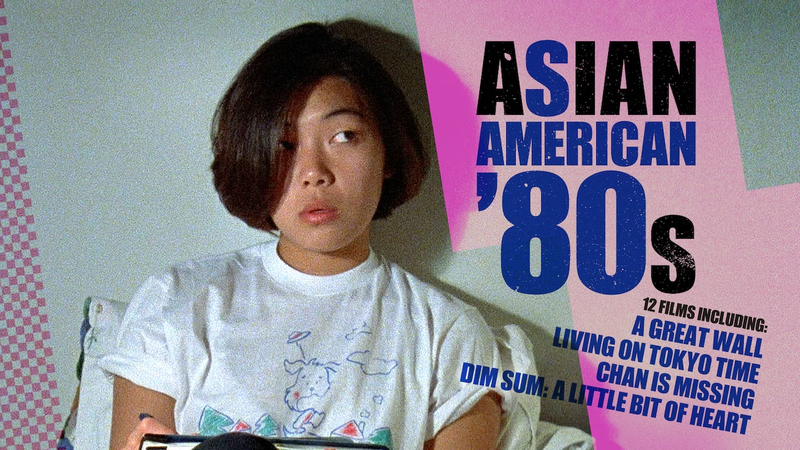
Alison Stewart: This is All Of It on WNYC. I'm Alison Stewart. May is Asian American and Pacific Islander Heritage Month. Right now the Criterion Channel is presenting a series called Asian American '80s. The series features 12 feature-length films and four shorts released between 1982 and 1990 from Asian and Asian American filmmakers of the era. One of them is director Wayne Wang, who's 1982 Indie film Chan Is Missing is considered the first movie by an Asian American director to receive a mainstream theatrical release. At the time, The New York Times called it "A Matchless Delight". Criterion's Asian American '80s series was curated by Brian Hu, who is a professor of film and television at San Diego State University, and artistic director of the Pacific Arts Movement, an organization that focuses on Asian and Asian American filmmaking. Brian, welcome to All Of It.
Brian Hu: Thanks for having me.
Alison Stewart: The Criterion page for this collection opens with, the 1980s marked the first decade of Asian American feature filmmaking but obviously Asian actors have been in films for a long before then. What changed in the '80s?
Brian Hu: You're right. We've had Asian Americans who were actors who are sometimes leading roles, sometimes usually supporting roles but so rarely behind the director's chair. There were little one-offs here and there but something happened in the '80s where you got a wave of filmmakers who were not only happened to be Asian Americans but were calling themselves Asian Americans. They were very conscious that what they were doing was representing a community or at least representing a worldview that hadn't been on screen before.
It was a lot of things. You mentioned Chan Is Missing, this is the rise of indie cinema in the 1980s when Hollywood just went the direction of the blockbuster, but the Art House Theater said, "We need to take on this alternative voice." You had the NEA coming in, so you had funding for independent films. You had television and cable, so many opportunities for new kinds of voices to enter, and amongst them were Asian Americans.
Alison Stewart: We talk about The Joy Luck Club being the first major American studio movie film with an all-Asian American cast. That was in 1993. From what I'm hearing you saying, the indie films, the cable, that all laid the groundwork?
Brian Hu: Absolutely. In fact, the director of Chan Is Missing, Wayne Wang would end up being the director of The Joy Luck Club. He was really just testing out what does it even mean to be telling Asian American stories for 90 minutes, 2 hours at a time. It was really in the independence side where people were taking the chances of seeing what actors would be interested in something like this? Is there an audience? This is also the decade of the rise of Asian American film festivals from New York City to San Francisco to Los Angeles, and building an audience so that even if the "mainstream society" doesn't watch it at least we know we've built an audience that understands the importance of these films. Really laying the groundwork of not just the production side but also the audience side.
Alison Stewart: Let's talk about Wayne Wang for a little bit. I was listening to an interview with him. He was named for John Wayne. His father was a huge film buff. That's where he got his sort of love of film from his dad. When we think about Chan Is Missing from 1982, how does this film fit in with the rest of the films coming out in the '80s?
Brian Hu: It is the inspiration but it also doesn't resemble anything else at that time. It's a weird movie. It barely has any story. It just wanders around Chinatown interviewing people on the streets. Some of it feels a little bit documentary-esque. Asian American filmmakers were making great documentaries in the 1970s, mostly in short films, in student films. Maybe it wasn't surprising that the first big Asian American film to get any success was one that had a lot of influence of documentary. It's sort of a transitional film. Then to prove that, there was an audience for a longer piece.
Then later on in the decade, you have filmmakers who are inspired by Wayne Wang's, "Let's just make up something that no one has ever seen before" spirit but then also saying that maybe we could take his success and then do something a little bit more conventional. Let's actually have a normal story with characters, with an ending that feels like an ending. Both are exemplary of its time but also the weird exception.
Alison Stewart: What's an example of one of those movies that you said took sort of like, "Let's be weird over here closer to the mainstream?"
Brian Hu: Steven Okazaki, for instance, made a film called Living on Tokyo Time. It feels very indie of its time, very Jim Jarmusch kind of. It imagines an Asian American as something of a loser [chuckles]. He wants to be in the punk band but it has a beginning, middle, and end. Someone from Japan comes and it disrupts his sense of normalcy but he has to reconcile that and figure out, "All right, who exactly do I want to be at this moment?" It has that raggedness to it that is very exemplary of indie films of this time.
Alison Stewart: My guest is Brian Hu, associate professor of film and television at San Diego State University. He's curator of the Criterion Channel's Asian American '80s series. Wayne Wang was interviewed by The New York Times last year, I believe he's in his early 70s, and he was very critical of Asian American filmmakers today and filmmaking in general. This is a quote from that piece. "I don't see anybody trying to do something in a more brave way. They're still trying to please executives and then to please an audience more rather than going out there with whatever budget they have to do something that's challenging." How does this mesh with your own experience and research into the trajectory in Hollywood of Asian American directors and filmmakers?
Brian Hu: First of all, when you read that quote I just want to applaud him. I totally agree with him actually. Back in the '70s and '80s, Asian American filmmakers, even those who were trying to make feature films, the prospect of Hollywood was a long ways away. It was all about making the most of what you have and just get it out there and find an audience, and it won't be a huge audience. I think Wayne Wang has talked about how Chan Is Missing, he was just hoping it'd be playing at film festivals and maybe some campus screenings or something but once the stakes get higher, the compromises are made. In terms of who gets cast, you need someone who's bankable. How is this going to play not just to Asian American audiences but beyond?
There's something nice about the idea that you can make a film just for "our own audience", our own community, and or just doing something just for yourself. Some of these films in the program, you just wonder like, "Who is this made for other than you and your friends?" I don't mean that in a negative way but just in a way that's the authenticity that's on display here. As we get to this current moment where we're celebrating films because Asian-American representation in A24 films, we're on Netflix, it's great because it's unprecedented but it also makes us wonder what do we lose and looking back in the 1980s, you get to see a sense of what we lost.
Alison Stewart: One of the films in this series is They Call Me Bruce. It seems that's slapstick and a little goofy. Tell us a little bit about, They Call Me Bruce.
Brian Hu: Oh, it's goofy. Interestingly, it came out the same year as Chan Is Missing, and both of them were semi-mainstream hits. Chan Is Missing broke out in the art house world. They Call Me Bruce was more in the straight-to-video TV-like cult movie world. I always wonder, "What if Asian American cinema had gone in that direction instead and just made semi-problematic, ridiculous movies that we saw a lot of in the 1970s?" More of the Cheech & Chong style of comedy. It's a film about this Korean American guy, everyone thinks he's Bruce Lee, and somehow he gets hitched along on some misadventures and he's carrying drugs across the country. It's a road film, it's a comedy, and it too doesn't resemble anything else that came on later on because as Asian American cinema started to get a sense of what the stakes were. I think a lot of filmmakers were thinking about, "What is good for our community," and They Call Me Bruce wasn't exactly that, but it still remains this interesting what if. I know so many Asian American filmmakers who cite that film even more than Chan Is Missing actually as that film they grew up with that they remember that when the rare times they saw themselves on screen as ridiculous as it was.
Alison Stewart: Which brings me to a question of you must have been very, very young 1980s [chuckles]. Were you around?
Brian Hu: I was also born in 1982. I didn't grow up watching these films but I like to think that we emerged to the world at the same time.
Alison Stewart: How did you discover them? When and where did you first see them?
Brian Hu: My interest in Asian American cinema happened as with many people, in college. That's when Justin Lynn made his film Better Luck Tomorrow, which was a big Sundance hit, the film that launched his career, and now he makes Fast and Furious movies. That got me thinking first of all about what does it mean to see Asian representation, but that was also a film that people were really debating especially in the Asian American community. They're like, "Is this good for us?" Our breakthrough film is a film about how we are all a bunch of bad criminals, and it spawned this great conversation that I wanted to know more about kind of the backstory of Asian-American cinema.
Then as I started covering Asian-American cinema as a journalist in the 2000s, I heard a lot of people just talking about things as if they were the first to make these kinds of films. "I want to be the first Asian American comedy, the first Asian American rom-com." I thought, "This can't be the first." As I went back into the '90s, and further back into the '80s, I realized so many of the conversations that we were having to 2000s were happening back then. Of course in different kinds of circumstances of the market and of the demographics at the time. I didn't want this filmmaking community to just keep reinventing the wheel. How do we learn from what we did in the past, and how do we be inspired by, again, at this time in which he had nothing to lose?
That got me digging into the archives, in some cases, looking for films that were only on VHS or only in libraries that you wouldn't expect them to be at. Or in some cases, having to email the directors themselves, and they're telling me, "You want to watch what? I haven't thought about that movie in years." Yes, it's that kind of work. As a film scholar, I love that kind of historical work.
Alison Stewart: Directors represented include Wayne Wang, Peter Wang, Elliott Hong, Steve Okazaki, an Indie director, David Rathod. Where are the women? What is this about?
Brian Hu: Great question. In the 1980s, the women were making documentaries, and they were making quite good documentaries. We had to make a decision about this series about whether to include documentary or to just stick to the narrative films. There was one documentary that we really, really wanted, that was probably possibly the most important film of the '80s, but we couldn't get it.
Alison Stewart: Okay, shout it now then.
Brian Hu: Okay. It's a film called Who Killed Vincent Chin? We were like, "If we can't get that film, let's not pretend that we're including the documentaries-
Alison Stewart: Fair.
Brian Hu: -and maybe let's save it for another series or something when that film becomes available." Once we made that decision, unfortunately, cut out a lot of the women who were making feature films. That was also another reason we really wanted to include short films in the program.
Alison Stewart: Brian, we have to dive in in a minute, we have about 30 seconds.
Brian Hu: Okay, yes. Some of the great films in our program are actually the short films and they were being made in film schools, and that's where this new voice was coming out and many of those filmmakers were women.
Alison Stewart: Brian Hu, is associate professor of film and television at San Diego State University, he curated the Criterion Channel's current programming, Asian American '80s. Thank you so much for being with us.
Brian Hu: Thank you.
Copyright © 2023 New York Public Radio. All rights reserved. Visit our website terms of use at www.wnyc.org for further information.
New York Public Radio transcripts are created on a rush deadline, often by contractors. This text may not be in its final form and may be updated or revised in the future. Accuracy and availability may vary. The authoritative record of New York Public Radio’s programming is the audio record.