
The American Folk Art Museum Explores 'Black Presence and Absence in the Early American North'
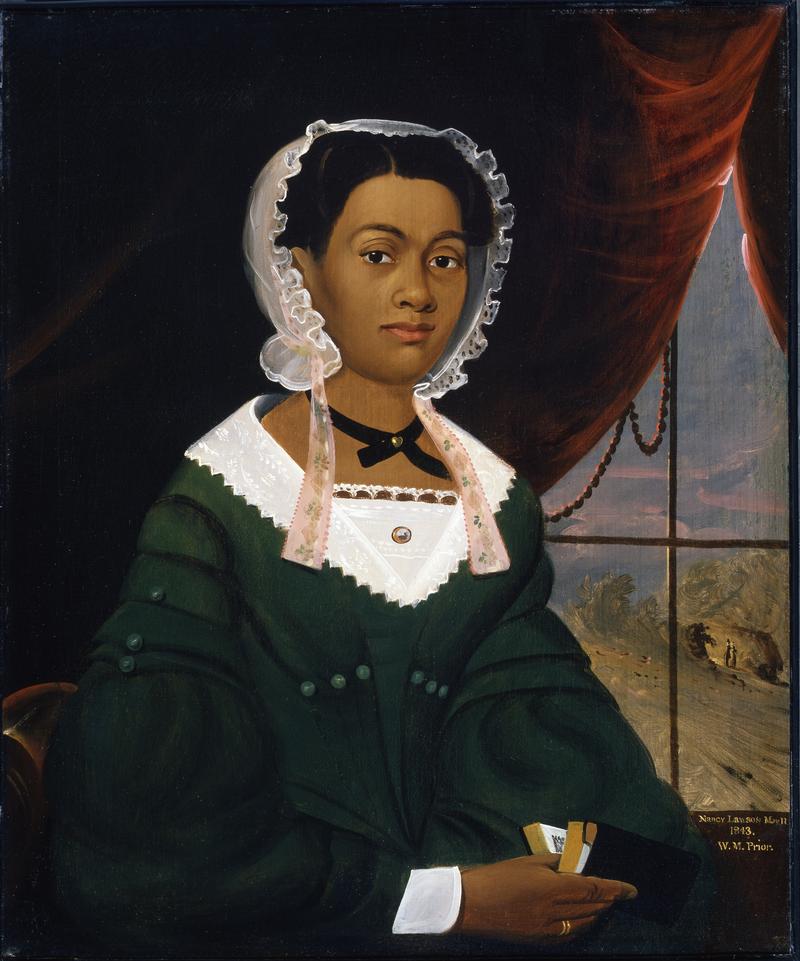
( Shelburne Museum, Vermont, museum purchase, acquired from Maxim Karolik, 1959-265.34 )
[music]
Alison Stewart: This is All of It on WNYC, I'm Alison Stewart. A new exhibition at the American Folk Art Museum uses art to examine the presence, and in many ways, the structurally designed absence of Black people in the Northeast. Titled The Unnamed Figures: Black Presence and Absence in the Early American North, it features 125 works. Displays of paintings, needlework, objects, and photographs all from within a roughly 200-year period. There are portraits of prominent white figures posed with enslaved Black people looking up in admiration and landscape paintings that, if you look closely, reveal a lot about the racial hierarchy of Northern society.
There are also extraordinary work on view of and by Black people who are often left out of art history, like portraits of two prominent free Black Bostonians, needlework made by Black students tracing back their family history, paintings by Joshua Johnson, one of the first widely recognized African-American artists as well as a portrait of an unsung American Revolutionary patriot, a free Black man, Agrippa Hull, the right-hand to one Tadeusz Kościuszko, yes, as in the bridge. Unnamed Figures: Black Presence and Absence in the Early American North is on view at the American Folk Art Museum through March 24th. That's on the Upper West Side. Admission of the museum is free.
Joining me now are two of the show's curators, Emelie Gevalt. Hi, Emelie.
Emelie Gevalt: Hi. Great to be here.
Alison Stewart: And RL Watson. RL, nice to meet you.
RL Watson: Nice to meet you. Thank you for having us.
Alison Stewart: RL, the show focuses on Black presence and absence in art history in the American North, geographically, roughly from Maryland to Maine. As a team, what were you trying to examine about Black representation specifically when it comes to this area?
RL Watson: One of the things that we find when we talk about Black experience and Black history in the United States, there is an emphasis on examples of Black experience coming from the American South. Very much in the front of our minds is this idea of the plantation. We see, again and again and again, representations of plantation life and what it would mean for folks who were fleeing North. Coinciding with this, and I think it really takes wings in the period after slavery, is this idea of the North as a promised land of sorts, and as a place where there was not the same level of racism or there was not the same level of exclusion as there would be found in the South.
Of course, the South later becomes the location where we see Jim Crow legislated and enacted racial segregation enforced. There can be an assumption made, I think highly erroneously made, that the North was just so anti-racist and so wonderful, and we don't have racism here. We don't have a problem, that is something that stretches all the way back to the earliest moments of colonization in what is now the United States. This collection of works and this discussion, this conversation coming out of collecting these works was also a way of challenging that narrative with the actual documented history that we could find.
I have said before, and I'll say again now, that the American Folks Art Museum is, in fact, the perfect place for this kind of inquiry because of the ways in which the archive has been bruised. In some cases, absolutely brutalized to remove tales of Black presence and Black participation in the building of the nation. I see that as one of the, I think, most obvious aims and hopefully fruits of this kind of scholarship. It is also an opportunity to reconnect and reconstruct stories that have been lost. Some of the ways in which we've been able to do this is by looking at how we look at artifacts from the past. What kinds of questions are we asking?
Are we in a passive position and just accepting the archive as though it is complete or are we wrestling with the fact that the archive is in quite a state? Think moth-eaten if the moths were invited to come to the party.
Alison Stewart: [laughs] Oh, no. Let's not think about that, actually.
RL Watson: Oh, God, yes. I mean, hey.
Alison Stewart: I wanted to bring Emelie in. A lot of these paintings say a lot about power and privilege, and they have insights into history and even how we interpret the smallest details. If a listener is saying, "Oh, I want to go check this out, Emelie," what are some suggestions of ways people can take in the work, ways that they can think about and what they're looking at, some questions they can ask themselves as they're experiencing this exhibition?
Emelie Gevalt: That's a great question, Alison, because it really gets at the heart of what we are hoping will come out of the show. We're really asking visitors to do perhaps more work than they're used to in the museum space because we're asking them to look in ways that don't necessarily align with the original intentions of the artist or the patron who commissioned a certain work of art. We actually have a key case study for this in the introductory gallery which we hope will guide viewers in terms of introducing some of those questions. We have this incredible suite of landscape pictures memorializing a plantation just north of Baltimore.
This is an art historical convention of creating these house portraits which were designed to elevate the prominence and the refinement of a white family. We look at this, we know the names of all of the white family members in the picture, strolling leisurely through their land, and gazing over their property. At the same time, we know that there were many Black residents who were actually constructing and maintaining and stewarding the same landscape, most of whom are absented from the picture entirely. Occasionally, they appear. We also have really interesting and important cues in the history of ownership of these works of art.
One of these landscapes was actually descended not in the white family that commissioned it, but in the family of formerly enslaved or descendants of formerly enslaved people at Perry Hall. In an example like that, we actually see an active subversion of the original attention of the picture to glorify this white family because we can imagine it hanging in the home of a Black family in Baltimore in the 19th century where members of this family became prominent in their community, becoming lawyers and teachers. We actually have photographs of those family members, the Cummings.
By hanging all of these works together, we encourage looking at these, how we might think about these as emblems of Black heritage rather than the white heritage that was at the original intention of the artist.
Alison Stewart: We're discussing, Unnamed Figures: Black Presence and Absence in the Early American North at the American Folk Art Museum. I'm speaking with two of its curators, Emelie Gevalt and RL Watson. RL, I'm curious about the paintings that we see where there's a white sitter and an enslaved person, and they're in the background or looking up because of hierarchical differences in the paintings. When did this style become a custom? What did these portraits demonstrate about the messages of the paintings of that time?
RL Watson: One of the things that we notice, and this is not just something we noticed in visual art, but in a lot of cultural production that is happening in the colonies, is that it is heavily influenced by European trends. This is one of those things that is imported but reset. It's an opportunity for a white sitter to say, "Look at everything that I have. I have all of my needs met. I'm sumptuously dressed. This is wonderful, beautiful, rich depiction of me, but also I want my servants to be portrayed as well, to show that I have folks here to wait on me as a sign of my power, a sign of my access, a sign of prestige."
When we get into the moment at which slavery becomes almost exclusively, and we see we're going through developments in terms of how slavery becomes highly racialized from the 17th century moving forward, that those characters who would be white in a circumstance-- in a European setting would almost always be replaced by those who were serving in the new world and in a new setting. We see a variety of things in the trope of the page that comes about as a result of an inherited form. Also, we see some signs of particularity.
In this case, a particularity that will be shown in the expression on the face of the Black page who is looking up adoringly very much seeming pleased to be there, at least feeling elevated by the entire situation. There is a messaging there. Not only do I have someone here who will wait upon me hand and foot to elevate me, but also they are going to be depicted as, at the very least, complicit in their enslavement, if not thankful for it. That creates some representational problems, obviously. We also have, on display in the show, images that are a bit more sinister. They're in a similar mode, but yet the stories that they're telling are about anything ranging from Black inferiority and all the way to Black criminality and Black mal-intent. We see those represented.
I will also defer to my colleague as well in this. We spend a lot of time talking about it, and I know Emelie, you're giving me that lovely art historian delightful, detailed genealogy as well.
Emelie Gevalt: Yes. I think one of the really interesting things we see about these works begin as a compositional trope in Europe, as RL said, but they shift in important ways in the British American colonies. We actually don't have that many examples, which I think in itself is an interesting shift. Scholars have suggested this may be the result of a bit of a sense that is not how colonists want to be represented in association with slavery perhaps because they're so close to it, and then they know what the realities are. We also have examples where expectations of what enslavement was like are upended.
There's a really interesting and important example of a portrait of a late 17th-century Bostonian who, of course, as we expect places himself front and center, but the enactment of the trope in this picture is very distinct. We have almost as an afterthought, the depiction of a Black figure way in the background, in the shadows very far away from the frontal subject. We get a strong sense of the physical marginalization of enslaved people in these households, even as they were central to the operation of the household because remarkably, we see this youth standing at a desk stacked with account books, pens, and paper, so the tools of literacy.
When we are engaging with this picture, I think more than we're just engaging with histories on a page, we're actually forced to reckon with and rethink the very presence of Black residents in early New England, but also the kinds of work that these enslaved people were doing. In fact, this picture may be the very first depiction of a Black New Englander, which in itself holds an incredible symbolic power.
Alison Stewart: That one's wild. You have to get really close. I remember I took my camera saying I got a really close-up and put him on my Instagram, the little man. [laughs] I wanted to have his moment. [laughs]
Emelie Gevalt: I saw that. It's wonderful that the owner of the painting, the Massachusetts Historical Society, actually cleaned the painting in advance of the show. We have an even more access to this image than ever before in its display.
RL Watson: I'll just quickly add on this, Alison, that there is in connection with what I mentioned earlier about the tales of Black experience in the South taking precedent and in fact, sometimes obliterating other representations. Telling the tale of Black experience in the North gives us such a diversity of occupation, diversity of movement, diversity of access, and we see even in this potentially earliest image, something that belies the stereotype about Black folks having to fight anti-literacy laws. The way that I look at it now is, "Well, what is the literacy for? Is the literacy for you? Well, then it's illegal. Is the literacy for me? Well, then we can talk about it." Diversifying our idea of what kind of labor Black folk were doing during this period, I think is also a very important departure.
Alison Stewart: I want to ask you about Agrippa Hull, Emelie. There's this beautiful portrait in the back of a distinguished-looking older gentleman. It is a gorgeous, very formal portrait. What's the origin of the portrait, and why don't we all know more about this man?
Emelie Gevalt: This is a really interesting one. I do not know why we don't know more about this man. I am ashamed to say I grew up in Massachusetts myself, and I only became exposed to this story as part of the research for this project, which I think, again, is a really humbling realization. We've seen already in the response to the show how much folks are learning from walking through the galleries. Agrippa Hull is a Black Revolutionary War veteran who has been really startlingly under-recognized, but he was born in rural Massachusetts. He became an orderly for General Kościuszko and actually served for such a long time that he was awarded a special badge of honor.
He returns to his hometown of Stockbridge, Massachusetts, where he's living as a neighbor of another Black icon, Elizabeth Freeman, of course, whose lawsuit against the state of Massachusetts becomes an incredibly important victory in the history of abolition. What's really interesting about this particular portrait, I think, is that it's not an original composition. It very clearly copies a daguerreotype that was made of Hull. I think this, to me, tells an important story. We don't know exactly when the portrait was made. It may well have been made after Hull died. That would've actually been an appropriate time to commemorate him in that way, but we have this daguerreotype, so we know he sat for that.
We know he was in the room when a photograph was made of him. I think it's really important to think about how few painted portraits, how few oils on canvas we have of importance and indeed quite well off Black Northeasterners at this time. I don't think it's just about financial access. I think it's also about oil on canvas persisting as a medium that was coded as white that would've had all kinds of class and race barriers in addition to just the financial barrier. I think when we see portraits like the incredible William and Nancy Lawson portraits that we also have on view, we understand there were a lot of stars that had to align to make those possible.
They were working with a white portraitist, but a white portraitist who was known to be sympathetic. He portrayed a number of different Black subjects, including some who were neighbors of the Lawsons. We see this convergence of favorable circumstances in making those possible. For Hull, it may well be, it never occurred to him to to sit for a portrait in this white mode, it was photography that he gravitated towards. Photography, really, as we see also in the show, opened up all kinds of possibilities for Black subjects in the 19th century to make their own choices about how they were represented.
Frederick Douglass, of course, famously speaks to the importance and the value of photography as a new medium that can represent Black subjects without the bias of a white portraitist. I think that beyond, of course, the remarkable story of Agrippa Hull as well, there's a really important commentary within that painting paired with the daguerreotype that we have a copy of on view that explains a lot about the absence of Black portraiture.
Alison Stewart: RL, I want to get one more question in. I hope people go see this show, and when they come to the show, and maybe they've lived in the North a long time, how would you hope they reflect on the history of Black representation in the New York in history? We've got about a minute, minute and a half.
RL Watson: Okay. One of the things that I hope folks reflect on is that the relationship that you have as a viewer with a work of art does not need to be a one-way street where you are only receiving and you are not engaging the more critical aspects of your thought to engage it. If you see something, allow yourself to be also authority in a dialogue, and permitting yourself also, therefore, to ask some of the questions. Why do we not have representation of Black revolutionaries from the American Revolution when we know that scholars are saying anywhere between 10 and 15% of Revolutionary War soldiers were Black? If that is the case and then they are not pictured, we can begin to ask a question about what is the purpose of this image.
We have, in the show, also a small section that is dedicated to the development of visual vocabularies of racism. When we think about what my colleague Emelie has just spoken on in terms of the daguerreotype and how attractive photography was, we can also see that, especially in the end of the 19th century, we are developing all kinds of grotesque and untruthful ways of representing Black life and Black people. That stance of what Bell Hooks would call an oppositional gaze is one of the ways we can protect against perpetuating that kind of reading.
Alison Stewart: The name of the show is Unnamed Figures: Black Presence and Absence in the Early American North. My guests have been Emelie Gevalt and RL Watson, the curators. Thank you so much for being with us.
Emelie Gevalt: Thanks for having me.
RL Watson: Thank you for having us.
Alison Stewart: That is All Of It for today. I'll meet you back here tomorrow.
[music]
Copyright © 2023 New York Public Radio. All rights reserved. Visit our website terms of use at www.wnyc.org for further information.
New York Public Radio transcripts are created on a rush deadline, often by contractors. This text may not be in its final form and may be updated or revised in the future. Accuracy and availability may vary. The authoritative record of New York Public Radio’s programming is the audio record.