
Actor Bill Nighy and Writer Kazuo Ishiguro on 'Living'
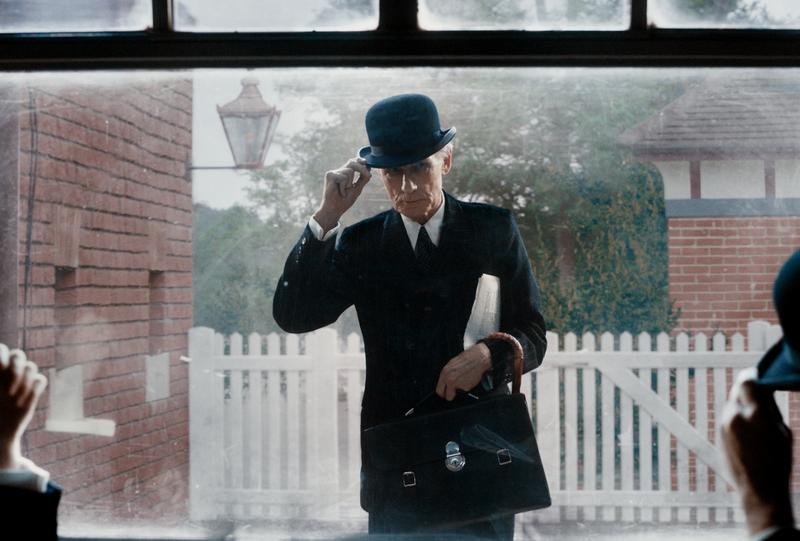
( Photo by Jamie D. Ramsay. Courtesy of Number 9 films / Sony Pictures Classics. )
Alison Stewart: This is All Of It. I'm Alison Stewart. The Oscars are just four days away, and Nobel Prize Laureate, Kazuo Ishiguro's film Living is nominated for an Oscar for Best Adapted Screenplay. The star of the film, Bill Nighy, is also up for an Academy Award for Best Actor, and his role is compelling. The script is based on a 1959 Japanese film, Ikiru, by Akira Kurosawa. Ishiguro adapted the film specifically for Bill Nighy. Set in 1950s England, the story follows a longtime widower, Mr. Williams, who has a stagnant town planning department unable to get much done in the aftermath of World War II. Mr. Williams is stagnant too with little enthusiasm for anything. His young colleagues call him Mr. Zombie. Then a shocking terminal diagnosis jolts Mr. Williams into action. He drinks, he spends money, he befriends a former younger female colleague and wonders if he can spend his final days doing something good, building a playground some locals have long wanted. The Guardian says Living is "a gentle exquisitely sad film." Actor Bill Nighy and screenwriter and executive producer, Kazuo Ishiguro, join me in studio to talk about the film just before it was released. I began our conversation by asking Bill how the idea for this movie was conceived over dinner and drinks. Let's take a listen to the conversation.
Bill Nighy: That's correct. I went for dinner with Stephen Woolley, the great English film producer, and his wife, Elizabeth Karlsen, equally distinguished, and the other guests were Ish and his wife, Lorna, and at the end of dinner, they suggested that they knew what my next film should be. I said, "When you're ready, let me know." It turned out to be this project, so maybe I was very good in a previous life.
Alison Stewart: Ish, you decided that you were only going to watch the original one time, is that correct, and then write the script? When did you decide this was going to be the best approach for you?
Kazuo Ishiguro: Well, I should make clear that, when you say that, it's kind of true, but I had grown up with this movie. From around the age of 10 or 11, this movie had obsessed me, but I hadn't actually seen it for about maybe 30 years when this whole thing came up again. I thought, "Okay, I'll watch it just once and then whatever is in my head, whatever is in my heart is what I'll use. I'm not going to do a thing where I just refer very closely to the original movie." It was very important for me that on the one hand, it was going to be a pretty faithful adaptation of something I had always treasured, but on the other hand, I wanted it to be our movie. We were going to bring something fresh to it. For me, the idea that Bill Nighy will be at the center of it was really the key in what way it will become different. Bill was going to be the gateway into this whole other world of Englishness in which this old Japanese story would now take place.
Alison Stewart: That's interesting that you had the muscle memory of the film from when you just loved it as a viewer versus someone who is about to engage with it creatively. Could you tell what was different about the two ways you thought about the film versus the way you watch it as a fan, as a young person in the now, as a screenwriter?
Kazuo Ishiguro: Well, I don't usually adapt things. This was my first real experience of adapting things. Of course, some people spend their whole lives adapting books to films or a film to another film. I've never done it before. It's a very schizoid experience. You're split into two. There's an instinct to just revere the original and more or less do it exactly the same, but then there's no point. Artistically, that's a completely redundant thing to do. Then there's another part of you that becomes like something very ruthless and rather chilly that looks at this material you loved and you say, "Look, all of that would have to go. That just isn't good enough. That has to change," which is weird because as I say, this is a movie that I have loved. Not only loved, but I think it shaped the way I looked at the world as I was growing up. It was that deep in me, and yet, that's what you have to do to create something that's worth creating again.
Alison Stewart: Bill, what was your relationship with the original film?
Bill Nighy: I had no relationship with the original film until this project was suggested. I did then watch the film, and I admired it tremendously. I suppose in retrospect, I should have been more daunted by the idea, but in fact, I don't think I was, partly because the central performance, although marvelous, was not something I identified with in terms of anything I might deliver. I figured we were in a different area, and I was not oppressed by it, but it was a fascinating idea.
Alison Stewart: Ish, and then Bill, you can answer this as well. The film is set in the aftermath of World War II. How is that context important for understanding Mr. Williams?
Kazuo Ishiguro: Should I go first?
Bill Nighy: Yes.
Alison Stewart: You go first.
Kazuo Ishiguro: Well, I suppose somebody else might have said, "Oh, let's set it in the present," but I thought it was very much, the original movie, the Kurosawa, was very much about rebuilding a new society after it's been smashed to pieces by World War II. Not just smashed to pieces in terms of infrastructure and economically, but just socially. All the values that people had held dear in Japan have been shown to be, in many cases, just downright, not just wrong, but evil. Not in quite such drastic way, but on a parallel way. Britain had reached the point in its history as the center of this huge world colonial empire when that was all going out of date. There was a class system that everyone felt had to be at least moderated if not abandoned.
The Second World War came at a point when-- Now people say, "Look, we're going to have to rebuild. Everything is broken and smashed up, and we're impoverished. Let's build a better society." That dimension is important for me, and I felt it was important to show just ordinary people, just ordinary guys working in offices who had this terrible burden of expectation and responsibility placed on their shoulders. They had to actually rebuild the country, fulfill people's dreams about what a post-war world would be. For me, that is an important aspect of the story.
Alison Stewart: Bill, how about for you, for your creation of Mr. Williams?
Bill Nighy: Well, I don't know about for the creation of the character. Well, I do. It was certainly informed by that, and the fact that I was born into that time, I would have been one of those kids in the playground, and my parents, like everybody else's parents, were coming out of a dreadful period of trauma. I was born into that atmosphere, and I'm very familiar with the way in which people interacted in that time in a very formal, and what is now called repressed manner. I find it fascinating.
That period, it preceded a very progressive time in England. Some of the most wonderful developments came out of that time when people were rebuilding, and they included the National Health Service and the education of the sons and daughters of the working class, and the class system was exposed to some degree. I came of age into a wave of feminism. There are now forces at work trying to drag us back to an imaginary time when apparently everything was fabulous. You know what I'm talking about, but anyway.
As for the character, I knew men of that kind, and I went to work with people of that kind when I was young. When I say of that kind, I mean people who were still operating under that very strict formality, and it's fascinating to me.
Alison Stewart: My guests are Bill Nighy and Kazuo Ishiguro. We're talking about their film, Living, which will be in theaters on December 23rd. Bill, I was curious about your work with your director on finding Mr. Williams' speaking voice, and also finding the way he physically moves through the world.
Bill Nighy: That's a very good question, which I don't really know the answer. I did work very closely with Oliver Hermanus, our terrific director, who's done an incredible job on this movie. Can I just say The Guardian remark or rather review which says exquisitely sad. It's not untrue, but also the film has been released back home in the UK for a while now, for three or four weeks, and my phone has been on fire from people who've been to see it. You know you're in a hit when you hear from people that you haven't heard from for 25 years, or people you were at school with. Their response is almost uniform, which is that they come out of the cinema and they are galvanized. It's inspiring. They want to get things done. They look at the clock. They don't want to waste any more time. It's an inspirational film, as well as being obviously a tragic. Basically a tragedy.
Kazuo Ishiguro: I'd underline that. Yes, absolutely. I think it's relatively easy to make sad films, or to tell sad stories. I could make one up right now in front of you about a family dog that defends the family when they're attacked by burglers and spent 90 minutes dying.
Bill Nighy: What's my part?
Alison Stewart: Your agent is writing this down.
Kazuo Ishiguro: As you say, Bill, to create a movie and a performance, Bill creates a performance. Bill is at the center of this to do something where people are moved in this very complex way. They don't know if they're sad or if they're exhilarated by the sheer celebration of humanity. It's a triumphant film, while at the same time being sad. I think that's a very difficult thing to achieve, to move people to tears and they don't quite know why. I think Oliver did a fantastic job directing, and I think Bill's performance does that. You don't quite know why you are in tears at the end, but you are.
Alison Stewart: Or maybe you do know why, because you recognize yourself having wasted a moment or wasted of time or just, I'm going to kill half an hour as opposed to I could do something with this half an hour of time.
Bill Nighy: Yes. I think that seems to be the case, that everyone, young or old, they do, and from whatever background, they do identify in a big way, and they are, as I say, galvanized by it.
Alison Stewart: Ish, when we're first introduced to Mr. Williams, it's not from his point of view, we're introduced to him through the eyes of his colleagues who ride with him in the train every morning and they sit behind giant stacks of paper at their office. Why did you want to introduce Mr. Williams to the audience this way?
Kazuo Ishiguro: For me, it's important that there's a sense of the younger generation. The original Kurosawa doesn't have such an emphasis on the next generation that could possibly potentially inherit something from any good examples that Mr. Williams's generation might set forth. That's one of the big differences between probably the original one and our movie. I introduced some young characters and had a kind of a love story. There's maybe a sense that, all right, Mr. Williams ends up with maybe a modest but really significant triumph. Is that going to go somewhere? Would that inspire people or not? Probably it's not going to change an institution. It's not going to turn around a stagnant stifled institution around, just one man's contribution like that. Maybe there'll be a few individuals who remember that, and they'll take that with them in into their careers and their lives. That aspect was important. I framed the story with this kind of younger people who are working in that bureaucracy.
Alison Stewart: After Mr. Williams gets his diagnosis, Bill, he is drawn to one of these younger former colleagues, this young woman named Margaret, and they start spending time together. What does Mr. Williams see in Margaret that keeps drawing him to her?
Bill Nighy: I think that her vivacity, her vibrancy-- Excuse me. [coughs]
Alison Stewart: Do you need a glass of water?
Bill Nighy: I'm fine, thank you. No. Is deeply attractive to him, and she's straightforward and frank and honest and plain speaking. She is kind of the opposite. She operates in the opposite way that he does. The combination of a disastrous diagnosis, and then meeting this incredibly vibrant young person who has an uncomplicated response to the world, is what triggers him to eventually to try and find some meaning in his life. Also, it's that thing I think of what we pay therapists not to be a member of our family, or not to be in our close circle, and you can confide in a stranger in a way that you can't. There's an element of that as well.
Alison Stewart: Let's listen to a clip from the film, Living. This is from when Mr. Williams and Margaret are having lunch together.
Margaret: Mr. Williams, if you promise, and I mean really promise to not get angry, I'll tell you my secret nickname for you.
Mr. Williams: I promise.
Margaret: You really mustn't get cross. It's not just you, have them for everyone. Only I know about them and my cousin, Rosemary, who I share rooms with. For instance, Mr. Rose Bridger, we call him Nahover man, because he just hovers his pen over the page with the intention of doing work but never actually doing work. Mr. Hart, well, I call him the confused chimney because he's constantly smoking and constantly bewildered. Have you seen his eyebrows? Mr. Rose Bridger on my desk doesn't have a clue.
Mr. Williams: It's very good.
Margaret: All right. This time I'll say the name and you have to guess who it is. He's on the fourth floor. Julius Caesar.
Mr. Williams: Julius Caesar. Wow. I suppose that would be Mr. Brown in accounts.
Margaret: Correct.
Alison Stewart: That is from the film, Living.
Bill, what does Mr. Williams learn from the members of this younger generation? From Margaret, to Mr. Wakeling, to the gentleman he has the night out with.
Bill Nighy: I think the thing I always considered him to be somebody who was institutionalized in grief, having lost his wife at a very early stage. His whole response to the world is personality. His behavior has formed around that. It's like coral forming around a floor in the rock. He's become isolated by it. I think he learns from Ms. Harris he's emboldened. She gives him the courage to open up, and he actually talks to someone plainly for probably for the first time for years and years. He doesn't seem to have that relationship with his son, and his son has been kind of estranged from him due to his marriage to some degree, and that there's no evidence that he can confide in his son.
I think she's the first person he's probably ever spoken to, honestly, for a long time. He's learned to be courageous, and to think positively, and to defy the restrictions that he's placed upon himself, and that the world has placed upon him in the context of the institution, and he's prepared to defy his boss, for instance, and to push through and make something happen, having dedicated his life to an institution which is designed to prevent things from happening.
Alison Stewart: You said the word courageous, and that's interesting. Was he, Mr. Williams, isolated and out of fear?
Bill Nighy: Out of fear and grief, and I should imagine there's a degree of anger having lost his wife. As he says to Ms. Harris, I wasn't always like this, which is a very common and plaintiff remark. That there was a time, in other words when his wife was alive, there was a time when he wasn't what she describes as Mr. Zombie, and that he had a normal and healthy response to the world around him, but he'd become estranged from himself.
Kazuo Ishiguro: Yes. Can I just say that in that extract you just played, we never got to probably the punchline here. She was about to tell Mr. Williams what his nickname was, and that's Bill's setting devastatingly for him. He discovers that his office nickname is Mr. Zombie. I think suddenly it strikes him that maybe there is some justification for this.
In addition to what Bill just said, I'd say that it is very much a movie and a story about work and the workplace. Along with all those things like grief for his beloved wife who is gone and all these other things, I think there's also just a daily grind of this kind of office life where people aren't sure anymore, nobody in those offices can make what they do day by day connect with anything in the real world or with real people. They're just overwhelmed with paper and bureaucracy. They take things to something down the corridor. It comes back. They've lost track a long time ago about how their little contribution fits into anything bigger in the real world, and how it touches real human lives. That's also what day after day, year after year of this has actually helped to make Mr. Zombie Mr. Zombie, I guess. That's one of the things that he identifies as something that he's got to reverse.
Alison Stewart: Listening to you both talk about it, I thought for a moment, "Okay, if he did live life in color beforehand, and then he's been living life in black and white since the death of his wife, it's probably about half his life in each camp, and then he gets to decide in the last bit of it what he's going to do with that last little quarter of his life, and he decides to engage."
Bill Nighy: Well, I think there's a crucial difference in our story between our story, on the one hand, and say Christmas Carol on the other, where Christmas Carol tends to say, "Look, if you realize that your life is just pathetically empty, you have to change yourself overnight into somebody else completely different." Now, that's very inspirational in some kind of way, but, quite honestly, it's not really going to happen to most people. It's not a practical suggestion.
What I loved about the original Kurosawa, and this is, I think Bill and Oliver and the rest of the team expressed this so well in our movie, it basically says something I think more profound. It says, look, all right, you've been dealt a fairly humble hand by life, and you're not going to change yourself now. You are who you are, and you live in the world that you do, which might be a stifling limiting world, but you can still look around this tiny world and make a supreme effort. Just by making that effort, it's possible, maybe it's possible to flip it and to turn a shallow empty life into something heroic and magnificent and fulfilled.
That's the kind of, if you like, I hate this word message, but if you like, that's the kind of message of living, and that's why the movie is called Living. I think that's why, as Bill was saying earlier, why the reaction has been, "Oh, I'm really moved and I'm really crying about something. Not quite sure why, because it's not a straightforward sadness."
Alison Stewart: There's been so much discussion in the film industry about the small movie, which has got to compete against the big blockbuster, the Marvel. Some of these are quite fabulous and great to watch on the big screen. If you could encourage someone to see the smaller, quieter films on the big screen instead of, say, waiting to watch it at Home, Bill, what would you say? Why would you tell someone it's really good to see small, quiet films in the theater?
Bill Nighy: Well, I probably, with all due respect, wouldn't use the word quiet, only because words like gentle and quiet, I'm not going to go, if you know what I mean. The other word is el-- What's that word? Elegiac?
Alison Stewart: Elegiac, yes.
Bill Nighy: I'm not going. I'm not going to go. I'm going to probably wait for that to come on Netflix.
Alison Stewart: Oh, you're funny.
Bill Nighy: I wouldn't say those. Nobody carries a gun in this movie. Nobody takes their top off. I did offer to take my top off but they said, "Please, can you put it back on?" I can't promise you any of those kind of thrills, but it's a powerful film. All films are the same size. The budget is no one's concern. The publicity machine, obviously, is an important factor. That's why independent films depend so largely on awards because that's free publicity, but they are all the same size. This is a powerful film, and it is inspirational.
I don't want to put myself in the position where I'm trying to sell you something. I am here to sell you something, but I don't want to do any hard selling. The film sells itself. There's room for everybody, and there's plenty of room for films that tell you how bad things can get and how bad people can be. I like all kinds of movies, particularly sports movies that go into slow motion at the end, but this is not one of those. It was number one across the nation in the so-called United Kingdom for a while, so that's not bad for a film about this old guy that apparently is going to die soon.
Kazuo Ishiguro: I think people love spectacle and big wide screen. I do too.
Alison Stewart: Me too.
Kazuo Ishiguro: I love these big movies, but there are times when what I want to get in the cinema is a huge ton of emotion hitting me. I guess what you call quieter movies, I agree, they're not quiet. There's nothing quiet about having a ton of emotion hit you, and you're embarrassed in case the person next to you sees that you're crying, but that's also something I crave when I watch a movie.
Bill Nighy: I've had rational, educated people say stuff like--
Copyright © 2023 New York Public Radio. All rights reserved. Visit our website terms of use at www.wnyc.org for further information.
New York Public Radio transcripts are created on a rush deadline, often by contractors. This text may not be in its final form and may be updated or revised in the future. Accuracy and availability may vary. The authoritative record of New York Public Radio’s programming is the audio record.