
'You Got Older' Stars Alia Shawkat as a Woman in Limbo
Alison Stewart: This is All Of It. I'm Alison Stewart live from the WNYC studios in SoHo. Thank you for sharing part of your day with us. I'm really grateful that you're here. On today's show, we'll talk about a new exhibit at the Museum of Modern Art that looks at the artistic and romantic partnership between Frieda Kahlo and Diego Rivera. It's the 50th anniversary of the VHS. We'll celebrate with the folks at the Criterion Channel. That's the plan. Let's get this started with the play You Got Older.
[music]
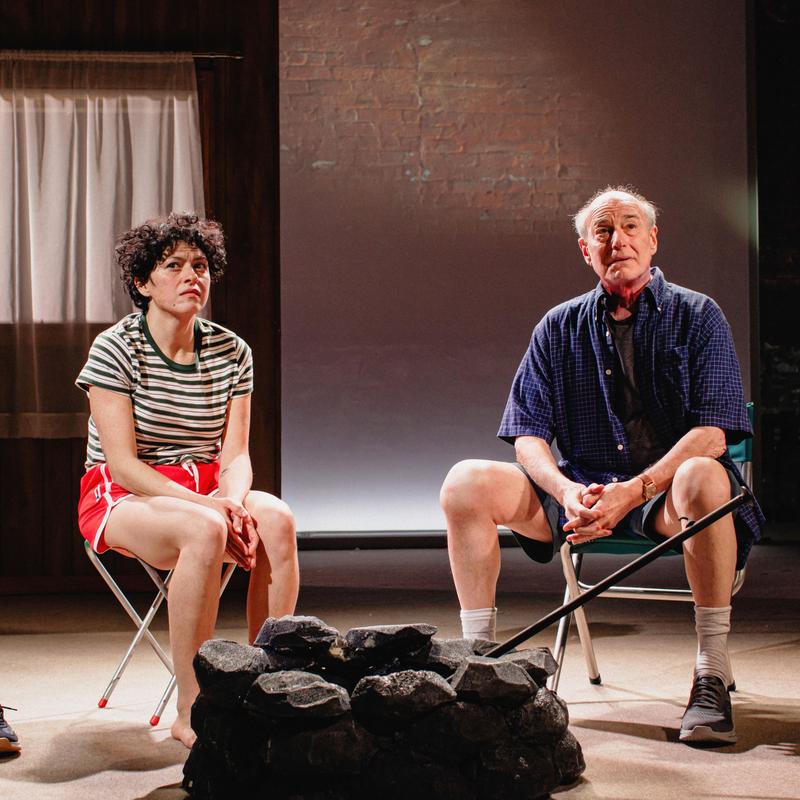
In the Off Broadway revival of Clare Barron's play, You Got Older, Alia Shawkat stars as a woman in limbo. When we first meet Mae, she's lost her boyfriend, and because her boyfriend is also her boss, she's lost her job, too. She's moved home to Washington State to live with her dad, who is grappling with cancer. He is played by Peter Friedman. The play follows Mae as she tries to find her footing and figure out what's next amidst her father's illness, some graphic sexual fantasies, and a mysterious rash.
You Got Older is directed by Anne Kauffman, who directed the production when it last ran in New York in 2014. Alia Shawkat is making her New York stage debut in this production. The New York Times says You Got Older is "a gorgeous play and a sharp revival." It's running now at the Cherry Lane Theater. I'm joined now by actor Alia Shawkat. Nice to meet you.
Alia Shawkat: Hi. You, too.
Alison Stewart: Director Anne Kauffman. Hi, Anne.
Anne Kauffman: Hello.
Alison Stewart: Joining us by Zoom is playwright Clare Barron. Hey, Clare.
Clare Barron: Hi.
Alison Stewart: Clare, what's going on with you in your life when you wrote this play?
Clare Barron: The given circumstances of the play were very personal. My dad was diagnosed with stage 4 cancer of the head and neck. I was dating my boss, and we did break up, and he did fire me within 30 seconds of breaking up. [laughs] That is true. Those are the true facts. Then there's, of course, in the writing of the play, lots of transformation that takes it away from my personal life.
Alison Stewart: Was it cathartic for you to write it down?
Clare Barron: It was very cathartic. I was writing it in real time. I was literally in the hospital with my dad at Ronald McDonald Housing in Seattle as I was writing the play. Everyone kept telling me, "Just write whatever you need to write. It takes a million years for plays to be produced. No one will ever see this. You'll be like five years older before it ever comes out." Then the first production ended up happening like six months after I wrote the play. It was-
Alison Stewart: Oh, my gosh.
Clare Barron: -very surprising. Yes.
Alison Stewart: Wow. Just six months after?
Clare Barron: Yes. I think I had my first public reading of the play in June, and then we were in front of an audience by October, so it was very expedited.
Alison Stewart: Alia, what drew you to the role of Mae?
Alia Shawkat: I just really responded to the piece. I haven't done theater before like this. I was like, it's going to have to take something that I'm really drawn to for the idea to work on it for so long and to do it over and over and over again. I always like to quote Clare when she said, "A play is like a spell." I was like, this is the perfect spell that I wanted to cast every night.
Alison Stewart: Doing it over and over again, what have you learned?
Alia Shawkat: Imagine, I was like, nothing. Not one thing.
Clare Barron: Not a darn thing.
Alia Shawkat: All kinds of stuff. I don't know, how to be in my body, how to be not so hard on yourself and know you can do it again, those kind of things. It worked for life.
Alison Stewart: Anne, as you directed this production in 2014, and it's a decade-plus, you're directing it again, what did you get from the first experience directing this play that was helpful to you this time around?
Anne Kauffman: Well, it's such an interesting question because I, too, was going through-- Actually, Clare and I were talking about this last night. I was also going through it. I was getting divorced, and my mother had just passed away.
Alison Stewart: Oh gosh.
Anne Kauffman: [chuckles] We were both in a moment of crisis. I wasn't going to work for a while because I was suffering such grief. This play came across my table, and I had to do it. I had to do it because of the family in it. My family is very similar. Clare and I both come from big families. It was a way of working through my grief. It's so wild doing it again. When I'm not in the middle of all of that, I feel clear-headed. I feel a little bit more-- I have distance on it.
What really, I think, helped the first time around is the impact that it's had on audiences. It was super helpful for me to be working on it, cathartic for me to be working on it, to work through all of that. What I realized when it was playing is how it is so personal for so many people. I knew we had the gold. We just needed to cast it with gold, and we did. We did.
Alison Stewart: What did you want to change or correct this time around when you were directing?
Anne Kauffman: Oh, that's such a-- It's so funny because I think when I was in that state in 2014, I was-- I can't remember a lot of it, actually. It was a little bit of a fever dream, both in my life, and the play is also a fever dream. It's Mae's fever dream. I don't think I had that conscience about me. I think I was really, really looking forward to seeing what Alia would do with it. She was the top of our list.
We didn't think she was going to say yes. When she did, we just-- I was really, really thrilled to be in collaboration with her. I've totally admired her work and admired the choices that she's made with her work. It also gave us a little bit of a bump saying, "I guess we're pretty cool because Alia Shawkat's going to do it." Anyway.
Alison Stewart: Alia, what have you learned from Anne?
Alia Shawkat: Never doing a play before, seeing what a director actually does really blew my mind. Starting from rehearsals, it was more similar, where we were talking and Clare and Anne and I every day, breaking apart everything. It was so fun to rehearse so much because normally you don't get nearly that much time. Then when we actually got onto the stage, I was like, "What? How is she doing all these things at once?" Being like, "This needs to come up five seconds later, and then this needs to move."
The thing I learned the most, I think, overall, which we talked about a lot, was there would be a problem, as there was every day, many. I'd just be like, "Well, that's it. We're never going to figure it out." I was like, "How are we ever going to get the outfit to get into the thing?" She was like, "No, no, we'll build a drawer, and we'll figure something." There was just always a problem-solving because everything is so practical. I think I was really like, "Wow, there's never--" She was like, "No, there's always going to be a way that's going to make it smoother, faster, better, and more cohesive." It was really so satisfying to see it happen in real time. I was like, "Wow, she just solved all the problems right in front of us."
Alison Stewart: We're talking about the new play, You Got Older, a new production of the play You Got Older with actor Alia Shawkat, director Anne Kauffman, and playwright Clare Barron. It's about a young woman who returns home to care for her father with cancer. It's running now at the Cherry Lane Theater. Clare, when you were writing Mae, what qualities did you want Mae to have?
Clare Barron: Gosh, I was having her speak-- It was almost like all of the taboo thoughts, especially, I'm sure people can relate to this, around illness and having a parent who's sick and parent-child relationships and her own yearning for her life when you're in your late 20s, early 30s, and you're trying to launch, and it's so hard to launch. I wanted her to be emotionally raw. I wanted to have access to her id, if that-- I wanted to be inside her.
It's also a little bit based on my personality and moments where I am saying things that I shouldn't be saying, or you're maybe revealing more than I realize I'm revealing. I wanted her to be resilient, but I also-- it is like a moment of weakness in her life where she's feeling really on her back. I was interested in being really honest about what that feels like when really the rug pulls out from under you and you're just so raw and vulnerable and with your parents.
Alison Stewart: How is Mae feeling about herself when she's living at her dad's house, Alia? What is she thinking about?
Alia Shawkat: What is she thinking about? [chuckles] I think desire. Clare and I talked about that a lot, this idea of what you want and what you feel like you can get, and what you feel like you can't. She's trying to escape into fantasy, anything to not really be present with the reality of where her life's at. I think that's something I was drawn to so much in this piece was these beautifully simply written scenes with the dad, and yet they're so layered.
It's like how it's so hard to be present with your family, especially when you're like, "Time's running out," and you feel there's more pressure. I do that all the time. I'm annoyed with my parents when I'm with them, and then I leave, and then I'm heartbroken because I miss them and I know they'll be gone one day. It's such a vicious cycle.
Alison Stewart: It's funny when you start the play. You're just standing over a green plant, a green, just want to taste? Okay. There's so much subtext in that, even that little section of the play.
Alia Shawkat: Totally, yes. That's another thing, too. Working with Anne and Clare, reading it, I love the dialogues. It's so funny and real and human. Then Anne being like, everything has these seven layers under it, and it's such a guidepost, where I was like, "Oh, of course. It all means so much more." I think theater definitely allows you to-- you have to reach those levels more than even on camera in some ways.
Alison Stewart: Anne, I want to talk about Peter Friedman. He's amazing in this show. People know him from Succession, they know him from Job, was off at SoHo House recently. He's been in theater for a really long time. What does he bring to the role of the father?
Anne Kauffman: First of all, can I just say that I have asked this man to do this role three times, and he finally said yes. I'm going to say that, first of all. I just have to preface it with this, because I'm so overjoyed. I'm just so thrilled that he's finally doing it. Peter doesn't understand what it is to manufacture an emotion. He just doesn't do it. He won't do it. I feel like Peter is someone who can maybe go in the wrong direction, that I have to steer him in a certain direction, but it's always going to be so honest, and so, I almost want to say, guileless, because I feel like, I know this is going to sound so weird, but there's some playful innocence that Peter has in the room and in all of his characters.
Even if he's playing someone who has a malevolent intention, even if-- There's always this really pure core at the very center of him that just exudes honesty. Clare and I were talking about this last night. I think Alia has it, too. I'm just going to say one other thing about-- sorry, I don't mean to embarrass you, but I think the other thing that's amazing about the two of them is that Peter is someone who is-- he's a theater animal, and he works in television. Alia is a TV and film animal, but has, and I was talking about this with Peter last night, somehow understands theater, and that does not-- I want everyone to understand how rare that is. That is not--
Alison Stewart: It's a big deal.
Anne Kauffman: It's a huge deal. Of course, I could give a lecture on what that is, but I won't. Peter is-- he just has that pure spirit. He also has a can-do. He's going to just jump in with both feet. I don't know. The lack of self consciousness, I think, is one of his magic elements.
Alison Stewart: Alia, how would you describe Mae's relationship with her dad?
Alia Shawkat: Mae's relationship with her dad? I thought you were going to be like, "What's your relationship like with Peter Friedman?" I was like, "That I could talk about."
Alison Stewart: That'll be next.
Alia Shawkat: That'll be next, yes.
[laughter]
Alia Shawkat: There was this really beautiful article that Anne sent us that was in The New Yorker that was talking about how the character of dad, as he's written in the play, is a rare character of a good dad.
Alison Stewart: He's a good dad.
Alia Shawkat: He's just a good dad. Something that we've talked about is, the mother passed away, and this idea that the mother was maybe the more physical, nurturing one, and he was always a good dad, but maybe not there to-- I couldn't cry on his shoulder, and he wouldn't hold me if I had a breakup, or he wouldn't know how to-- I didn't have to talk to him about my period, whatever. That was what mom's job was. Ten with her gone and now this, he can see I'm struggling, but he's trying to help, but he just doesn't know how. That's why it's so beautiful at the end, this moment where she asks her father to touch this lump in her neck. It's something so simple, but it's so profound, I think.
I think they have a good relationship on the surface, where it's like, "Yes, I talked to my dad. He's a good guy. He's always been there for me. He doesn't yell that much." He's like, we don't fight a lot. He's a simple, sweet guy, but does he really know who I am? I don't know. Does he know the layers of the complexity of what I'm processing? No. Does he know how kinky I am? No.
All these things that we hide from our family is shame. I think Mae is holding a lot and doesn't think he can understand it. Then just at the end, she opens the door just a little to be like, maybe he can, and he does. He holds that space. I think it's a really beautiful relationship, actually, even if it's trying to grow, like the little pepper.
[laughter]
Alison Stewart: How about your relationship with Peter Friedman?
Alia Shawkat: [chuckles] No comment. He's the greatest. Everything that Anne said, plus million. He's so kind and giving and it's not an easy schedule. It's new for me. We're doing eight shows a week, and he's just there, always. So much energy, so present, so kind, and playful with everybody. If one little thing goes wrong backstage, I'll be like, "Oh, well, just throw it off. Keep moving," because I think sometimes if one thing went wrong, I was like, "No, but what happened?" He's like, "It's okay. We got it. Keep going."
Anytime I'm out of my head or a little too-- if I'm nervous or just trying thinking ahead too far, I just look in the eyes, and he drops me in, instantly. He's just like, "I'm here." I'm like, "Whoa, okay. Now I'm present." It's like playing not present, but I'm so present. That's how I'm able to do it.
Alison Stewart: We used to see him every day when we leave here, when he's doing job around the corner, sitting on the bench, having coffee. He was on the show for weeks after. Like, "Hey, Peter. How you doing?" He's like, "I'm good."
Anne Kauffman: Oh, really?
[laughter]
Clare Barron: Oh, my God.
Alia Shawkat: Yes, he's the best.
Alison Stewart: We're talking about the play, You Got Older. We'll have more after a quick break. This is All Of It.
[music]
You're listening to All Of It on WNYC. I'm Alison Stewart. I'm talking to actor Alia Shawkat, director Andy Kauffman, and Clare Barron. We're talking about their play, You Got Older. Clare, were you interested in writing about how illness affects a family?
Clare Barron: Yes. I think something that is painful about the play is that illness in your family truly is a universal experience. You might experience in childhood, you might experience in your 20s, 30s, 40s, but at some point, it's coming for every family. It's so traumatic, but it's so common. For me, I guess I was 27 when my dad got sick, and we were told he had two months to live. He's still with us today, which is amazing. He's actually in Sicily right now on a vacation with my mom, not seeing the play.
[laughter]
Clare Barron: I'm happy for them. Our story has a happy ending. When we were in the tunnel, and I didn't know if he was going to make it or not, I remember I would do these little rituals. I was living in New York. My family lives in rural Washington State. I remember every night before I slept, I'd send like 100 healing breaths to my dad. I would just breathe in and breathe out and just think of him. I used to go run the track. I have six people in my family, and I used to run six laps on lane six. You're so powerless, but you're just almost trying to come up with magic rituals to try to help him be okay.
It's so painful to be so out of control, and it's so painful to lose a parent, I think, at any age. I lost my grandmother when she was 98, and she was a very important person to me. Even though she lived such a long life, and I'm so grateful for that, it didn't change the fact that when we finally lost her, it was still just incredibly difficult. This was one of my first major experiences with illness, and it really impacted me.
Alison Stewart: Alia in the play, Mae doesn't talk a whole lot in the beginning. Then she goes to the spa, and she meets Mac, and she just unloads. What is it about meeting this sort of a stranger that causes her to open up?
Alia Shawkat: Yes. I think a stranger is a welcoming kind. Stranger is the perfect place to unload your baggage. I think it's a perfect storm. She snuck out of the house, and she has a beer in her, and someone just needed to go high. She's like [sound] all over the place. If she doesn't talk, she's going to die, I think Anne said to me at one point. It's the perfect place to-- Mac is such a lovable character, especially played by Caleb. He's such an amazing actor. It's just this perfect-- He's unaware of what he fell into.
Alison Stewart: Yes. I wanted to ask you, Anne, about directing the character of Mac. When you talked to the actor about it, is it Caleb?
Anne Kauffman: Yes.
Alison Stewart: What did you tell him was his role? What was his purpose?
Anne Kauffman: Oh, that's so-- I feel I approached it more like who he is in this town, and what it is that he does, and why he's here. I did say at some point that I think he can be overwhelmed by the stuff that's coming at him from her. Also, he's a little bit of the audience. We're all hearing this for the very first time.
If some people walk into the show having read nothing and aren't privy to what's happening on Peter's neck in the first couple of scenes, they don't know what's going on. They don't know that he's sick. They don't know what's what's happening with Mae. He's learning a lot of the stuff at the same time we're learning it, and that he can actually absorb all of that and actually respond is just as a testament to who he is as a character and as an actor. Caleb is astonishing.
Alison Stewart: Let's talk about sexual fantasies. Clare, you're up first. A big part of the stories are these sexual fantasies that Mae has. It's involving a cowboy, and we see them acted out on stage. Why did you want erotic fantasies to play such a big role in this story?
Clare Barron: Some of it is just, I'm a very impulsive writer. When I was in my dad's hospital room, I was writing these very grounded, naturalistic scenes with my dad. Then I was also writing these crazy sex fantasies with a cowboy. I have a little bit of a witchy sensibility. I was like, "They have to go together somehow. Somehow these have to be part of the same piece." I do think it's a divide. I'm really close with my parents, but never talk to them about dating, never talk to them about my sex life. I'm a very sexual person, so it feels like almost a symbol for the ways in which we have this little chasm between us of the things I would never say to them.
I just couldn't imagine sharing with my father. The iconography of the fantasy, it's very like romance novel, but darker and more twisted, maybe a little more human. I grew up reading all those books. We used to go to the library with my sisters when we were in middle school, and we'd check out these romance novels. The librarian would be like, "Ooh, that's a good one." We'd always be like, "Okay."
[laughter]
Clare Barron: There's something about-- even that. I grew up in a very conservative town, so something between the tension of not being supposed to talk about these things and then having, like Alia said, the desire, having the impulse. There's something in that relationship that really fascinates me.
Alison Stewart: I like that the librarian read the romance novels.
Alia Shawkat: Yes.
Clare Barron: He did, yes.
Alison Stewart: Anne, how did you want those scenes to feel different from the rest of the play, the fantasy scenes?
Anne Kauffman: Again, good writing and good acting, it does happen, but I'm just going to step back for a second and then answer that question. I also feel like-- I think that you'd have to come and watch a bunch of times, but on the set, there is a bunch of romance, cowboy romance novels that are in the bedroom. I think a big part of this book also is what is it like to go back home and be in-- even though it's not Mae's bedroom per se, it is the childhood experience. What are the things that you're thrown back into in terms of what your desires are? What are the things that you used to masturbate to when you were younger? Also just the way that we watch Mae turn into a child with her dad a bit.
I think in terms of the sexual fantasies, it's a little bit of a game. Tonally, we were really experimenting, I think. The first scene, I like the idea that you don't know what's going on, and that it's not until a certain point that you start to realize there are a couple of points that are-- the big one being dad interrupting, but that you realize what's going on. Once you understand what's going on, when the cowboy comes back, you want to be able to play with those tropes, you know what I mean? Then it turns ugly. We're actually watching Mae's own journey through those sexual fantasies. We're watching an arc of how she's dealing with all of her trauma.
Alison Stewart: The family comes into the play about-- was it a third, halfway through? Alia, what is it like for you? You've been on stage, it's been you on stage, and all of a sudden, there's the whole family, brothers, sisters, your dad's in the hospital, and suddenly becomes an ensemble.
Alia Shawkat: It's amazing. It's such a fun part of the show. Also, when I go out on stage, I say goodbye to my sisters in the dressing room, and I'm like, "I'll see you out there." Such amazing actors, everybody. Nadine Malouf and Nina White and Misha Brooks, too, really amazing actors. I feel so held, not to sound cheesy, but it's it's such a-- Everyone who's seen the show says, "You guys seem like a real family." Everyone's like, "You really seem like siblings," because there's something that's tapped into. Also now, later in the run, we're now doing all these little things where we're looking at each other, where we're like, "Oh, my God, Hannah," making eyes. She's driving us crazy.
Just all these things. I have two brothers, and we're just really picking up these real sibling things now. I think it's the casting, but also when we were doing the rehearsal, I was also like, "Wow, this is such a long scene." There's so much overlap and timing. It's very orchestra. It's like reading it, so fun. I was like, "How are we going to do it?" Now, we're just really-- it's like a rhythm. We're like a jazz band. We're speaking over each other, back forth, over. It's so fun because there's subtleties and difference every night, but just getting to fold into that, it's really fun. Yes, it's so fun.
Alison Stewart: Anne, to ask you about directing at the Cherry Lane. It just reopened.
Anne Kauffman: I know.
Alison Stewart: Tell us a little bit about the intimacy of the space, what it's like to work there.
Anne Kauffman: I've loved that space forever. It's really an historical place, and the stuff that's gone on in there in the past decades is just their cultural phenoms. I directed there, but not in the main space. I directed where the restaurant is now. There was a program called Cherry Lane Mentorship Program, and it was established playwrights working with younger playwrights. Anne Washburn and I did our first show together in that space, and I've seen incredible work there over the years. I think a lot of us were a little bit worried about what was going to happen, what they were going to do, what A24 was going to do, what Dani Rait, and Eloise Linton were going to do.
What was so brilliant on their part is that they really, really maintained the bones of that theater, the playing space, and the relationship the audience has to the playing space, which is everything. To me, it's a jewel box of a space. To be honest, I prefer working in that kind of space over really large spaces, because a play like this that has so much detail and you have to see the whites of the actor's eyes to really-- it just allows for that catharsis that theater is so good at doing.
I love it. I love the whole deal around it. I love what they have done with it. I love the social aspects of it. I love what they're hoping to do with their programming and they are doing with their programming. It's a very, very vibrant community space for art. They've maintained it, and then risen above it.
Alison Stewart: Clare, what do you hope people leave the theater thinking about or talking about?
Clare Barron: Oh, gosh, I guess maybe two things. I hope people call their parents or their loved ones or their siblings or whoever in their life represents that. I hope there's the impulse to reach out and say, "I love you." Also that stuff we were talking about with desire, I hope people maybe get a little inspired by some of those cowboy scenes, not in the bad way but to lift the rock up and see what's under there when they think about being playful with what excites them. Two very, very different. Not at the same time. Don't do those two things at the same time. Call your dad, and then separately, privately lift up the rock.
Alia Shawkat: Yes, lift up the rock.
Alison Stewart: Alia, what's changed for you as an actor? now that you are-- now you're a veteran of stage?
Alia Shawkat: Oh, no. Honestly, I had some friends come through other actors, friends who've done plays, friends who haven't. I think the thing I keep talking about, I was like, "I feel like I'm in the best shape as an actor physically," and so-so. I just feel like I'm getting really worked, and it's such a nice feeling because when you're doing film stuff or TV, whatever, you're like-- You're not shooting for a while, when you're about to start, you feel so rusty. Then even after you film, you're done, and you do a scene, and you're like, "Oh, I'm never doing that again."
Whereas, this, it's like working on the same muscle. When you're actually in a gym, you actually-- to do it properly, you have to build and do the same thing over and over again to build it. I feel like I'm really building actor muscles in a way that I'm proud of myself because there was so many things where I was like, "What if I can't remember the words?" I'm like, "The words? What are you talking about?" It's nice to see to see the difference of from when we started. I have this groundedness in me now that I'm like, "Oh, this has changed me forever, for sure, as an actor."
Alison Stewart: The play is You Got Older. It's running now at the Cherry Lane Theater. I have been speaking with Alia Shawkat, director Anne Kauffman, and playwright Clare Barron. Thanks for being with us.
Alia Shawkat: Thank you, Alison.
Anne Kauffman: Thank you so much, Alison.
Copyright © 2026 New York Public Radio. All rights reserved. Visit our website terms of use at www.wnyc.org for further information.
New York Public Radio transcripts are created on a rush deadline, often by contractors. This text may not be in its final form and may be updated or revised in the future. Accuracy and availability may vary. The authoritative record of programming is the audio record.