
Yo Yo Ma Seeks 'Our Common Nature' Through Music
( Courtesy of "Our Common Nature" )
Alison Stewart: This is All Of It on WNYC. I'm Alison Stewart. We turn now to a new podcast series called Our Common Nature that uses music as a tool to explore and deepen the relationship between humanity and the natural world. Over the course of seven episodes, world-renowned cellist Yo Yo Ma and WNYC producer Ana Gonzalez present musical performances in key times and locations.
From the sunrise on the east coast to the humpback whales in the west, from the caves of Kentucky to the salmon-filled streams of Alaska. The music is in conversation with the setting of the performances. Let's hear more about it. WNYC producer Ana Gonzalez is here to talk about Our Common Nature. It's her debut as a host, but you might recognize her from the Radiolab's spinoff series for kids, Terrestrials. Hi, Anna.
Ana Gonzalez: Hi, Alison. Good to be here. Thanks for having me.
Alison Stewart: All right. What's the thesis statement? What is the guiding principle for this podcast?
Ana Gonzalez: [chuckles] Well, it is pretty abstract, but if I had to essentialize it, it would be using music to connect with nature. Somehow Yo Yo Ma is involved. That compliment complicates everything.
Alison Stewart: [laughs] Well, how is Yo Yo Ma involved in this project?
Ana Gonzalez: Well, he is the catalyst. He is the reason. He's, as someone described it, the Pied Piper. When he plays, people come. He spent his entire career, which is almost his entire life, and he just turned 70 yesterday. Happy birthday, Yo Yo. He's spent that whole time playing music and gathering people, and he played for John F. Kennedy. His career is so expansive, and so many people all over the world really pay attention to what he is doing. That includes musicians and other artists.
He and his team are extremely thoughtful and intentional about where they go and what cultural experiences that they want to learn about and learn from. Because for him as an artist, it's really important to just continue learning about other art forms, but also about humanity as a whole. He's the reason everyone came together. Then it was my job to just show up with a microphone, record what happened, and then turn that into a series.
Alison Stewart: Does Yo Yo Ma, does he have a particular interest in nature?
Ana Gonzalez: I think he realized at a certain point that he had no relationship with nature, a very minimal-
Alison Stewart: Interesting.
Ana Gonzalez: -relationship with nature. He spent his whole life traveling and playing cello, mostly inside. He's a city guy. He explains it as he spent so much time traveling the world. But when you're a musician, it's oftentimes to urban centers. You go to the same cities in the same places, you stay in hotels, you have fancy dinners, and that's your experience. This was his way of being like, "I want to get outside. I want to meet people. I want to go places that don't often get put under the spotlight, and I want to learn and become a better human being and musician from it."
Alison Stewart: What excited you about exploring this intersection of the music and nature, and humanity?
Ana Gonzalez: What would not exc-- That's all of existence to me, I think. It's such an expansive topic. I grew up playing music. I'm a jazz bassist by training, and I also married a gardener, a landscaper who spends his days planting trees. [chuckles] I've spent a lot of time in the dirt and soil, especially since the pandemic. just going out into the garden and seeing how ecosystems work. Also, my other work with terrestrials really gets me curious about the strangeness here on Earth. I've just been cultivating all these separate passions in my life, and this was an experience where I could bring all of them together.
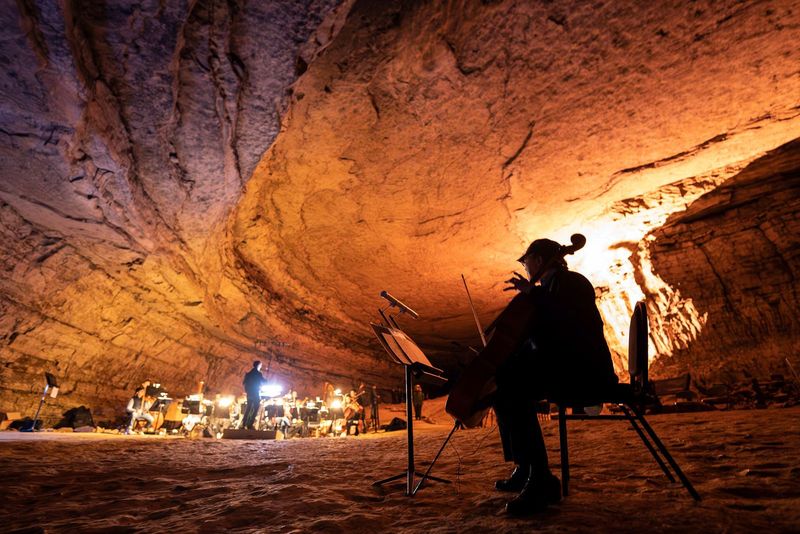
Alison Stewart: My guest is Ana Gonzalez, host of Our Common Nature podcast. She's a senior producer here at WNYC. Let's talk about an episode. It's inside Mammoth Cave. This is so cool. It's in Kentucky, and a local composer's piece performed inside of the cave. Can you describe the cave for us?
Ana Gonzalez: If you live in cave country, you know what caves are like. Not everybody knows what caves are like. Most of Kentucky is on top of a cave, like the entire state. It's hundreds and hundreds of miles of cave. It's an underground world. These are enormous, expansive caverns that people have been going to for. Since time immemorial. Native peoples. Before written history, you have people-- It became a tourist attraction in the 1800s.
There was a train that went there, and at one point, local landowners wanted to make it like one of the wonders of the world and invite people, and they hired or enslaved people to work as cave guides. It has this very complicated human history and also natural history. The cave itself is the longest-- I have to make sure I say it correctly, the longest cave system in the world. It's in Kentucky. It's really hard to explain with words. You have to listen to how cavernous the music is, but also visit if you get a chance. Mammoth Cave National Park.
Alison Stewart: If you look on our Instagram stories right now, you'll get to see a picture of the cave, of what it was like. To your point, let's hear a little bit. This is in Mammoth. It's composed by Teddy Abrams, musical director of the Louisville Orchestra, and performed in Mammoth Cave. The voice that you will hear is Davóne Tines.
[MUSIC - Teddy Abrams: Mammoth]
Alison Stewart: Beautiful. What qualities of the cave were brought out by the performance?
Ana Gonzalez: Just how expansive it was. It was so at once humongous, but also cozy. It felt protected. It felt like this moment-- There were multiple performances of this enormous piece. It was over an hour long. It had a full orchestra, two harps, full percussion section, Yo Yo, strings, the whole nine yards, plus a choir, plus Davóne as a soloist, and some spoken word parts. It was absolutely complicated.
We were going to different places to experience these different sonic moments. In that piece in particular, you hear both the reverberations from the cave walls, but you also hear this human element, where Davóne is a vessel for this song that represents so many different histories. Deep river. It's written. It's spiritual, but it's being sung in this context about the Ohio River, which forms a border between the South and the North during the Civil War. Crossing it would have meant freedom for the people singing it. At that moment, you hear just the hugeness of both the voice and the history that it's representing.
Alison Stewart: I understood it's somewhat risky to take instruments into the cave. Why is that?
Ana Gonzalez: Oh, yes. The cave is 54 degrees Fahrenheit, day in, day out, which is cold for an instrument which is made out of metal or wood, which usually classical instruments; they generally have no-- like, very many screws. This is all tension and body warmth. It's also humid, which is also bad for instruments. We don't like that. There was this process of bringing the instruments in and bringing the instruments out.
It was deep. It was like at least a quarter mile down, down into the cave. It was a real operation every single day. It speaks to the creative integrity and tenacity of Teddy Abrams and the Louisville Orchestra to be down to do that. There are probably some musicians who are like, "I'm not bringing my instrument down there."
Alison Stewart: [laughs] We're talking to Ana Gonzalez, host of Our Common Nature podcast. Listen to something else. This is from the first episode, and we hear a piece of music composed to welcome the dawn. Tell us a little more about this before we hear it.
Ana Gonzalez: Sure. This first episode, which is out today, it focuses on Yo Yo's travels up to Maine, where he met with Wabanaki musicians, including Chris Newell and Lauren Stevens. They explained their cultural tradition of not just welcoming the dawn, but using music to pull the sun onto the continent. It was their duty as Wabanaki people, is what Chris Newell says, to welcome the sun, to greet the sun, but to pull the beams of light for the rest of the continent to experience every single day.
This was a performance. It was not a ceremony, but it was using some of those traditional musical pieces and moments to create some musical collaboration that really focused on bringing the people there to the present and understanding how grateful we could and should be every single day to see the sun.
Alison Stewart: Let's listen.
[music]
Ana Gonzalez: Chris started looking through old tapes of powwow performances that he'd done, and he found this recording of his old bandmate Kenny singing an original piece.
Chris Newell: Listening to him sing it, and I was like, "You know that melody, the way he's singing it, I bet you could pull that off on a cello."
Ana Gonzalez: This was the first time I had ever heard our traditional music with a non-traditional instrument. To hear the welcome song played by Yo Yo on the cello, it resonated internally. I could feel it in my body. It vibrated my soul.
Alison Stewart: That's very beautiful. Ana, real deal, you're a radio person. You deal with audio.
Ana Gonzalez: Yes.
Alison Stewart: Do you have any advice for people who want to tune their ears in to listen for that interplay between a physical space and the sound and the music?
Ana Gonzalez: My first bit of advice would be to take your AirPods out on your walks. Tune into your body and how it exists in the space, no matter where you are. It doesn't matter if you're in a city, walking down the street. The overarching kind of another thesis from this podcast, which is also indigenous wisdom, is that we are part of nature. There is no separation. We are innately part of nature. Human beings are part of the earth. Any noise that you make is part of the Earth's noise is part of nature's noise.
Being present in your body is number one. That requires you to stop taking in other information that might cloud that perception and then just tune into the sounds of the birds, the sounds of the leaves and the wind, and the water. No matter what body of water you're by it, I assure you, it's making a sound. All of that is part of your experience on this planet. If you can start doing that and make it a practice in your life, you'll begin hearing things that you never heard before.
Alison Stewart: A number of the performances include some relationship with climate change. A birch forest decimated by melting permafrost, for example. How did climate change factor into the way you and your team were thinking about these episodes?
Ana Gonzalez: Well, it's even risky to say climate change in this day and age, unfortunately. There was sometimes a hesitation, truthfully, like, should we say this? Should we say this is climate change? At a certain point, you're just like, how else are we going to describe what's going on? It was really through talking with people who are experiencing the changes in their homelands and hearing how it affected them and how it continues to affect them.
That was incredibly clear everywhere, but nowhere clearer than Alaska when we went up there. Like you said, there's melting permafrost, but there's also melting glaciers, which warms the waters, which affects the fish populations, and the fish populations are keystone species. Without migratory salmon, the entire ecosystem of the Arctic would collapse. These are things that are already playing out in the lives of people.
If someone's saying, "This is my experience," and I'm recording them and they're showing me, "Hey, there's no salmon in this river. There used to be thousands of salmon in this river, and there's not a single one." How can I say, "Well, that's not climate change." Then backing it up with research and reporting, and science that is out there, and people who are speaking truth about these things just based on numbers and based on things that are happening in front of us.
Alison Stewart: Tell us about some episodes we might hear coming up.
Ana Gonzalez: Today, we got the Acadia Sunrise. Beautiful, amazing. Great way to start the series. Next week, we go to Mammoth Cave in Kentucky with the Louisville Orchestra. Then we're going to go to the Smoky Mountains, which is super exciting for me because I am, as I said, a jazz bassist by training. Part of that episode is we go to Mingus Mill, which the historic home of the Mingus family.
If that name is ringing a bell, it's Charles Mingus, the bassist. It's where his family was once enslaved. We go there with Charles Mingus's son, Eric Mingus, who's a musician in his own right and a poet. He wrote a piece based on the Mill, and he performed it at a cemetery that was recently uncovered that is an enslaved cemetery by the Mill, that he believes he has family in.
It's a beautiful-- I'm goosebumps just thinking about Eric's performance of this piece. That is in the Smokies episode. We go to Hawaii. We learn about two different places on two different islands, and Yo Yo goes on a traditional Polynesian canoe called Hokulea and plays for the humpback whales. It really travels the planet quite a bit. I'm very excited for people to finally hear these stories.
Alison Stewart: The name of the podcast is Our Common Nature. It features Yo Yo Ma and Ana Gonzalez. Thanks so much.
Ana Gonzalez: Thank you, Alison.