
Witnessing Humanity: The Art of John Wilson' at the Met
( Photo by Hyla Skopitz , Courtesy of The Met )
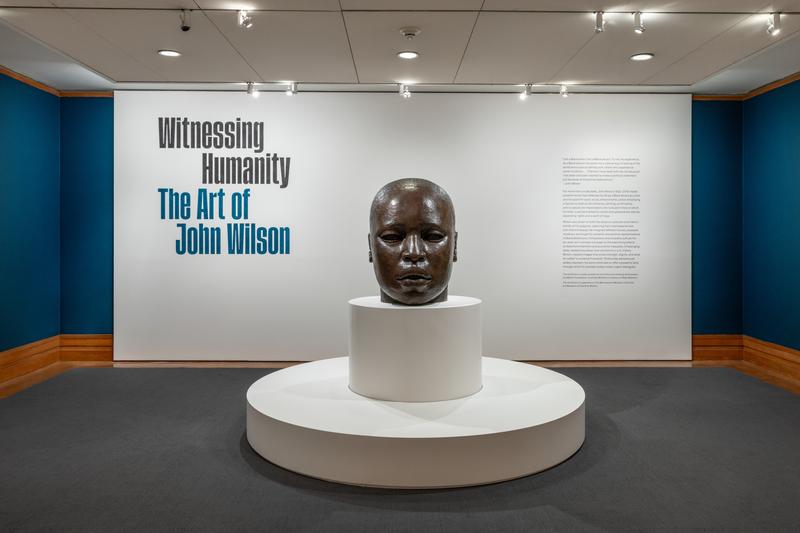
Alison Stewart: Born in 1922, the late artist John Wilson dedicated his life and career to capturing the Black American experience. Of course, there isn't one Black American experience, but there are hypocrisies that are universal that Wilson captured, like the double standard during the wars. He also created art around other moments, like a father and son sharing a book. Now, an exhibit at the Metropolitan Museum of Art showcases that work spanning six decades. It's titled Witnessing Humanity: The Art of John Wilson. Born in Roxbury neighborhood of Boston, he studied at the School of the Museum of Fine Arts before traveling the world studying in Paris and Mexico, but his artistic roots were here in the States.
As Wilson himself once said, "I am a Black artist. I am a Black person. To me, my experience as a Black person has given me a special way of looking at the world and a special identity with others who experience some injustices." Witnessing Humanity: The Art of John Wilson is a collaboration between the Museum of Fine Arts in Boston and the Met here in the city. It started in Boston before coming to the Met. It's open now through February 8th, 2026. I am joined now by co-curators from the Met, Jennifer Farrell. Nice to see you, Jennifer.
Jennifer Farrell: Thank you.
Alison Stewart: Also, Leslie King Hammond, founding director for the Center of Race and Culture at the Maryland Institute College of Art. It is nice to meet you as well.
Leslie King Hammond: Delighter.
Alison Stewart: I wanted to ask you, Jennifer, this show started in Boston at a great museum. Why did you want to bring this show to the Met?
Jennifer Farrell: Well, it's actually very funny because the curators from Boston and I had separately proposed the show to our respective directors. We hadn't known about the other show because it wasn't official. We were probably around the same month or so, Edward said, maybe even the same week, that we proposed our exhibitions. I remember telling Max, "If we don't do it, someone else will." Then we found out about each other, and we decided to join forces.
We decided that Boston was really able to delve into Wilson's relationship with the city. Being born in Roxbury and living for many decades in Brookline and studying at the School of the Museum of Fine Arts, as you mentioned, at Tufts, and then later teaching at Boston University. Whereas for people in New York, it might be more of an introduction or an in-depth look at an artist for whom maybe they only know one section of his work and not the full range over the course of over six decades. It's a little bit different focus in the two venues. We overlap a lot on the works that were included, but there are some different works in this show.
Alison Stewart: We'll talk about those in a minute. Leslie, the wall text of this exhibit has so many quotes from the artist himself. Why was that important?
Leslie King Hammond: The vice of the artist has been, especially of late, my concentration. For too long within the genre of art history and criticism, we've depended on other intellects, poets, writers, whomever, historians, scholars. I felt that this was the time where here we have this artist who was eclipsed or slipped through the fault lines of American art. We had an opportunity to hear him and see him in his totality with intentionality.
We made sure that as we put this exhibition together, we not only used as many of the voices that he had at different points in his career, but we also drew on a number of other individuals who actually knew him, worked with him, exhibited with him, he taught, so that we understood the totality of the community out of which he came and which were also the muses and the catalysts for his work.
Alison Stewart: I enjoyed the exhibit immensely yesterday. I had such a good time at it, and I learned so much, so thanks to both of you.
Jennifer Farrell: Thank you.
Alison Stewart: What connection did he have with New York, Jennifer?
Jennifer Farrell: He actually lived in New York for over six years, and he taught in the New York City public school system. He lived in the Bronx, and he lived in Queens. He taught in junior high and high school. He took some classes at City University of New York, and he visited New York. New York is where he met his wife, Julie, before they moved down to Mexico.
He had thought of relocating to New York before he won the fellowship to go down to Mexico. He also was very close to some New York artists, such as Robert Blackburn, who was the best man at his wedding and with whom he made prints throughout his life. He was definitely connected to the city, even though he is a Boston-based artist and so rooted in the Boston community.
Leslie King Hammond: Can I also add that he also knew and was deeply respectful of the work of Jacob Lawrence and Romare Bearden at the time. We had wonderful correspondence that we found from his dealer in Boston, Martha Richardson, where they were in communication, sharing and reinforcing each other. While he was living in Boston, he was well aware of what was going on in the art world.
Jennifer Farrell: In fact, Oracle is based on a scene for a famous bookstore on 125th Street. We have Malcolm X with views of Harlem. I think it's very similar to the Bronx landscape, which is in the show also.
Alison Stewart: Leslie, how did Roxbury shape John Wilson?
Leslie King Hammond: John Wilson was very grounded in family. There's an African proverb about the village. You need a village to teach the children. Roxbury was his village. Between the intimacy of his family living and working in the same house where he had his studio and the top floor, and working with the people in the community where he drew relentlessly, he would keep little sketchbooks in his pocket.
As he was taking the children to their checkups with their physicians, as he was doing all the domestic things that we do, he would be waiting, watching, witnessing. The interesting thing is that Roxbury became very comfortable with him in their midst because he was paying homage to them. Back in the days, early in art history, when you had your portrait or your image recorded, that was a high honor because not everyone could want to afford for it to happen.
After a while, artists were not just seeking to do portraits for the wealthy and the esteemed and the bourgeois classes. John Wilson was really committed to seeing the extraordinary in ordinary working-class people, to extrapolating that energy, that power, that beauty, that dignity. Roxbury had special love for him. When we had the opening in Boston, all of Roxbury and Boston showed up. Trust me, it was live.
Jennifer Farrell: That was their tagline, right? "Roxbury Artist Comes Home," that was on their website.
Leslie King Hammond: Absolutely. Absolutely. In Boston, one of the pieces that he did was a huge sculpture called Eternal Presence. After it was done and after John Wilson passed, the community comes together every spring to watch wash. Literally, wash, rub, scrub, and polish. The piece is called Universal Presence. The community calls it Big Head. Okay, it's time to go out, and let's get Big Head ready for the world.
Alison Stewart: Jennifer, do you want to add anything about how he portrayed his community?
Jennifer Farrell: Oh, yes, it's incredibly important. As Leslie said, he really looked around him at Roxbury and within his family. The first wall we have is self-portraits. The idea of also presenting himself. He talks about being a student at the School of the Museum of Fine Arts, where he studied, and going through the museum and really seeing no one that looked like him, no one that spoke to his experience, no Black artists represented, and also these incredibly hurtful and negative caricatures in popular culture.
He really made a mission to portray the Black community, his own experiences as he talks about, and to show the humanity, the dignity, and also, as Leslie mentions, of work of the laborers of the working class. That was incredibly important to John Wilson was to show people who maybe aren't traditionally featured and certainly not featured in a respectful, dignified way, or, as Leslie has brought up, their humanity portrayed was a key mission.
It was something that governed his art for over six decades. He famously wrote that he didn't feel he could do abstraction. He could. He made three or four really wonderful abstract paintings, but he felt he had a mission. He felt it was very, very important to create representation, to speak to experiences, especially American experiences. That's why he returned from Mexico.
Alison Stewart: We're talking about the art exhibit, Witnessing Humanity: The Art of John Wilson, which is up now at the Metropolitan Museum of Art. My guests are co-curators Jennifer Farrell and Leslie King Hammond. I want to ask about Streetcar Scene, which is from 1945. It shows a streetcar in Boston, mainly full of white people. Sitting amongst them is one man.
The women give each other the side eye. They're looking behind him. He's almost looking directly at the viewer in this picture. If you look at him closely, he's got a badge that says he works at the naval yard. You can see it on our Instagram. It's my picture. I'm sorry if you see it, but it's a good example of it, and several more of his work as well. Our Instagram is @AllOfItWNYC. Leslie, what is important for the viewer to notice in this particular work, Streetcar Scene?
Leslie King Hammond: Streetcar Scene was part of an exhibition I did many, many years ago. I'm not going to count.
[laughter]
Leslie King Hammond: I was looking at the printmakers during the WPA era. The interesting thing about the WPA era and Black artists, or all artists at that time, was that the primary mission was to record images of America. This streetcar is a moment that lasted for far too long during the Jim Crow era, where individuals of color, any color other than white Euro Americans, had to sit in designated locations in public transportation.
This was a precursor to also the experiences that he would have later on as he and his wife, who was Jewish, would have to travel in different railroad cars. What he is doing in this portrait, which was very problematic at the first time I did this exhibition, because it was seen as he intended to be confrontational in the way, asking the question to the public about his right to be sitting, one, next to a white woman, two, in the front of the bus, all right?
We know later on after that period, Rosa Parks makes her iconic move. He was always thinking in very clear and focused and determined ways how to tell stories within stories within the figurative compositions that he created of a working-class individual, because there he was. I think that that also might have been slightly-- What do you think, Jennifer? Autobiographical?
Jennifer Farrell: Yes, he often used a figure. He talks about the young teenager and adolescents as a stand-in for him. He talks about the meaning of self-portrait, so I agree with you.
Leslie King Hammond: Yes, so that was one of the pivotal pieces in that exhibition that I did at that time. I was so happy to see that it was included. We finally made it part of the totality, the magnificent scope of his understanding the social injustices that were continuous and relentless at the time.
Alison Stewart: Wilson also made a lot of art about parents and their children, fathers and sons, mothers and daughters, Black families. Jennifer, why do you think this was an important subject for him?
Jennifer Farrell: Well, his father had a key role in his life. He came from a very supportive, very tight-knit family. A lot of portraits in the first room are of his brothers, of his sister, as well as of himself, and Roxbury, which he describes as a portrait of a neighborhood. Family was really foundation. He, as Leslie said, would use his family as subjects. He would often tell them to stop what they're doing and pose.
It was, I think, really a challenge to this kind of representation in art, where so often, it's mother and child. So often, it's the white mother and the white child. Here, he's showing not only Black parents, such as in The Incident and with Mother and Child, but he's also showing fatherhood. That was on the cover of The Reporter, one of the father and children. He made it in sculpture. He made images in drawing.
He made them very large. Father and child reading, which is outside of the public library at the Roxbury. We only have a small maquette in the show. It really is showing this incredible connection within his family and within his community. He also wrote, or he also did illustrations rather, for children's books that speak about families as these incredibly strong units within the Black American family.
Leslie King Hammond: Can I add something to that?
Alison Stewart: Sure.
Leslie King Hammond: This is really critical. America has still yet to deal with the legacy of slavery. The whole idea of the plantation system was to break down the Black family, to sell off the children as they were born and move them to different locales so that there was not this connectivity. The thing that has come through the history is that the Black family is one of the most remarkable, resilient, resistant institutions that have survived that period. These images that he created talk about that with passion, with love, with the kind of sensitivity and sensibility and responsibility to correct the historical inadequacies about the misinformation about the Black family.
Jennifer Farrell: To your point, I always wondered if it was also in response to things, such as the Moynihan Report, for what he was showing, the timeline.
Leslie King Hammond: Exactly.
Jennifer Farrell: Showing the strength of the family.
Leslie King Hammond: Absolutely, that in spite of everything, we prevailed. We prevailed.
Alison Stewart: We're talking about the art exhibit, Witnessing Humanity: The Art of John Wilson, which is now on view at the Met. My guests are co-curators Jennifer Farrell and Leslie King Hammond. John Wilson also made quite a bit of art about labor and about labor unions. Jennifer, how did this become a subject of interest to him?
Jennifer Farrell: He spoke about or wrote about his own father, his family, that his father found it very difficult to find employment. He came from a middle-class background, and so did his mother. He talked about how people in his community, especially Black men in Roxbury, were really the first to feel the effects of the Depression. There's great discrimination. Then he even later wrote about, when factories desegregated due to World War II, how everyone was aware it was only because there was a labor shortage. It wasn't by choice. They wouldn't have done that if they hadn't.
Then he also talks about another form of labor serving in the military, of his brother having to work in a base in Georgia and suffer under Jim Crow laws, and also Black soldiers going to fight for freedoms they didn't have in their own country. Labor is a very important thing. In Paris, he works with Fernand Léger. Of course, a famous communist, who also really focused on labor, in Léger's case, as a utopian vision of a socialist society where labor will give more free time and create better working and living conditions.
Then he also continues that with Mexico, looking at, really, the construction, the great expansion of Mexico City while he was there, and the workers who made it possible, who were then priced out of their own neighborhoods. Of course, he made works for The Reporter, such as the Steel Worker, which is on the cover of the journal, as well as a beautiful drawing. Labor and respect for manual work, for physical work, for unions is something that's critically important for Wilson.
Alison Stewart: Something that was interesting, I thought, in Paris. It takes a slight cubist tone.
Leslie King Hammond: Sure.
Alison Stewart: Then, when he goes to Mexico, it reminds me of Elizabeth Catlett.
Leslie King Hammond: Totally.
Alison Stewart: Yes.
Leslie King Hammond: Also too, within the concept of this focus on labor, he was also making the statement that the whole middle passage in slavery was about labor, and the fact that the people who came from Africa, involuntary immigrants, were the backbone and the foundation of the labor and the skills and the technologies they had to build. Yet, still in this era of modernism, this modernist era, here, again, they were struggling to have agency, identity, purpose, meaning, respect, and acknowledgment.
Alison Stewart: Let's talk about The Incident. It was a mural. It depicts a lynching. It is so powerful because you have a small picture of it. It is lost. You can't really understand the size of it until you see the man standing there, because you have a picture of it, and then you have this photograph of how enormous this must have been. Tell us a little bit more about it.
Leslie King Hammond: Well, I tell you, The Incident was a point in our curatorial process where we had, at least I had, an epiphany. We wanted to have that particular incident where it is a Ku Klux Klan intervention, where a Black man is on the other side of the house. There is a mother and child on the inside of the house looking through the window at the atrocities that occurred in our history. One of the things that I think is so fascinating and in the voices in the text panels that we had, we had two scholars, sisters, Leslie and Lisa Farrington.
Leslie Farrington was an OB-GYN by profession, and her sister was a PhD in art history. We got them to write an essay that talked about what it was like because they were from a biracial family, just like the children of John Wilson, what that fear factor, that terror, that trauma that they had to live through. I tell everybody all the time when they get the catalog, "Read that essay first. Read that essay first to get it all in context." This mural, which was only up for-- Jennifer, was it a few-- a very short time.
Jennifer Farrell: It was a few months. I don't know if it was a few months, but it was extended because Siqueiros got involved and extended it. It was never supposed to be permanent.
Alison Stewart: It was never supposed to be permanent.
Jennifer Farrell: It was never supposed to be permanent. It was a student work.
Leslie King Hammond: Yes.
Alison Stewart: Oh, that's extraordinary.
Leslie King Hammond: Absolutely. His work as a youth, he was gifted. Early on, his talents were recognized. His parents encouraged him. He went to the Boston museum school, and he was nurtured from his career. It was divine. It was cosmic. Somewhere in the universe, this was what he was supposed to do. He committed his life to it completely, totally, without expecting all of the hoopla that usually comes with becoming an art star, but for you to understand the essence and the importance of the humanity that is being contested, resisted, and not being recognized in this country.
Jennifer Farrell: You mentioned the photograph. That's him in the photograph. You can see, he's very dressed up. He has on a jacket. The great pride murals were incredibly important to him. To go back to your idea about art and labor, as he was very connected with the Mexican muralists, very inspired by them, and the idea of having public art murals, you could argue sculpture. Certainly, he has public sculpture, and then printmaking as a form of public art because it is more democratic. It's less expensive. It's more widely accessible. This was really the mission that drove him to make art and connect with people.
Alison Stewart: All right. If there's one piece of art, one piece in the show that you'd like people to spend five extra seconds in front of, not your favorite, but one that you think maybe you should take in a little longer, what piece would that be?
Leslie King Hammond: I am just driven by the fact that he is one of the few, especially African American artists, whoever did father and son. Rare, rare, gifted. Just I stand in front of it, and I get palpitations every time because it reminds me of him talking about reading, sitting on his father's lap when he's a young boy and sharing that moment. That's why we have those images in sculpture, in prints. While I love everything, that one emotionally resonates with me.
Alison Stewart: How about for you?
Jennifer Farrell: I would say Adolescence. We have both the drawing and the print, so you see his technical process, but of the young boy, both alienated and connected to his environment, with the books under his arm, as Leslie said, the importance of education. John was also a teacher for many decades at Boston University, in addition to the work at the high school and middle schools in New York City, but that idea, the way he addresses a viewer, the fact he refers to it as a self-portrait.
I think that resonates with so many feelings people have today within their community. Also, as you talked about labor of the inequities that are present in certain communities, and that all comes through in that piece for me. It actually was incredibly successful. Shortly after he made it, he sold it to Smith College, who also purchased and displayed My Brother, which is our signature image, while he was still in school. MoMA also bought the print for Adolescence. It really struck a lot of people at the time it was made, but I think it continues to be an incredibly relevant piece.
Alison Stewart: The name of the show is Witnessing Humanity: The Art of John Wilson. I've been speaking with its co-curators, Jennifer Farrell and Leslie King Hammond. It's at the Metropolitan Museum of Art, I should say. Thank you again for joining us in studio.
Jennifer Farrell: Thank you.
Leslie King Hammond: Thank you for having us.