
Why Some Concert Merch Becomes Priceless
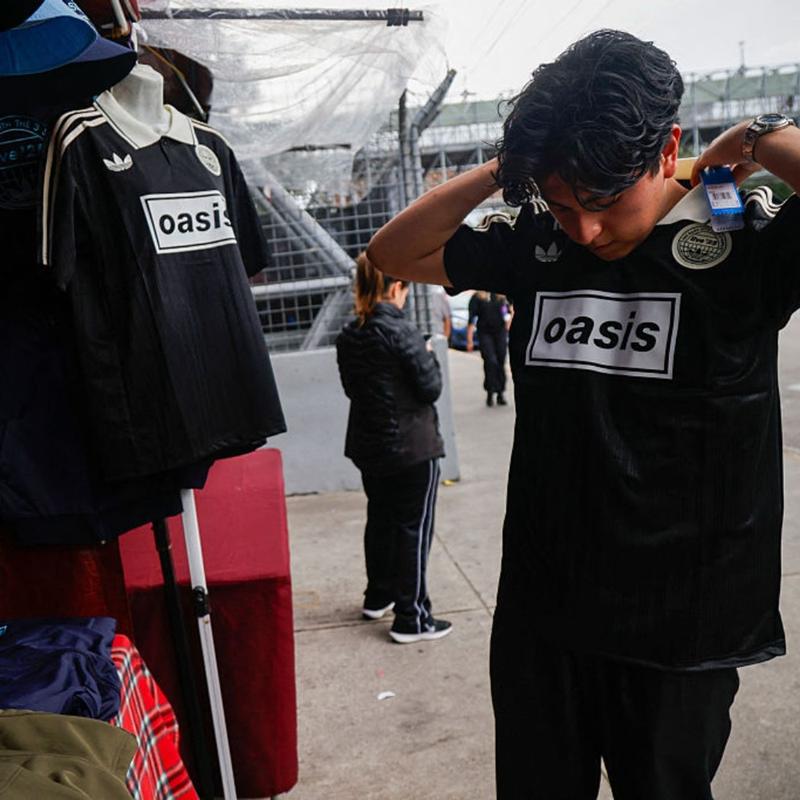
Alison Stewart: Once upon a time, concert merch was something you bought on your way out of the venue. A tour T-shirt, a poster, maybe a hoodie if it was cold outside, but these days, merch is a whole lot more than a souvenir. From limited edition drops at sold-out arena tours to pop-up shops and online exclusives, concert merch has become a major revenue stream for artists and a status symbol for fans. Then there's a second life of merch. Vintage tour tees and rare pieces that can sell for hundreds, even thousands of dollars on the resale market.
Last year, a vintage shop in Bangkok posted a clip on Instagram of a buyer who paid $27,000 for a faded Nas shirt with the lyrics from If I Ruled the World. To help us understand what makes a simple piece of merch iconic and how the business of concert merch has changed, music industry strategist and consultant Tatiana Cirisano-- Hi, Tatiana.
Tatiana Cirisano: Hi. How's it going?
Alison Stewart: It's going well. She was a former business reporter at Billboard, and she's now the vice president of an entertainment market company. We are also joined by Nick Adler, the co-founder of Mntage, a digital fashion brand built around vintage clothing. Hey, Nick.
Nick Adler: Hey. Morning.
Alison Stewart: Listeners, get in on this conversation. Tell us about that T-shirt, hoodie, or poster that you are most proud of. What concert was it? How much did you pay for it, and how long have you held onto it? Our phone number is 212-433-9692, 212-433-WNYC. Tatiana, concert merch has always been a way for a band to make a buck. Why did concert merch shift from a souvenir concert goers, something you would pick up and take home, into a serious stream of revenue?
Tatiana Cirisano: It's so interesting because I actually think that the impetus for this was really the pandemic, which is interesting because it's a time when artists weren't touring at all. Of course, now, the boom in merchandise is so tied to the live music boom. So many artists these days earn the majority of their revenue through live music. At that time, obviously, they couldn't tour. They lost this really critical revenue source. Many of them really doubled down on merchandise to try to plug that gap.
That was when everyone started to think more about, "Well, what types of merch can we do that we haven't done before?" Because you no longer had to carry all this stuff on the road, people were getting really creative with candles, jewelry, big things, small things, figurines. I think that really led to this explosion in terms of what is possible, in what merch can be, and this view that it can really be anything.
Of course, now that we're back on the road and there's shows going on all the time and huge demand for it, that has just coalesced into this really massive market where, as you said, you can go to a show now and not just get a plain T-shirt with the band's name plastered on it, but you can walk away with something much more unique and is a status symbol and a thing to say that 'I was there'.
Alison Stewart: Nick, what role does fandom and identity play in why people buy merch?
Nick Adler: The truth of it is, I think that these artists, especially artists like, I'd say Travis Scott or people like Connie over the years, who have really doubled down on building their brand beyond just the tour, they have this long connection with their fans who have grown up listening to them and just want to continue to own them and continue to take these pieces home with them. The more time that they have spent with these artists growing up, they really, really find a connection to them.
When I see some of these vintage items that come across my desk on a daily basis, I look at some of these pieces and it brings me back to a moment in time when I was driving around in high school listening to a certain artist, and I remember going to that concert, and all of a sudden that T-shirt is back in the market, and I want to buy it and spend top dollar for it. It's just a connection we have established over many, many years with these artists. You want to own a piece of that legacy, and you want to reminisce and feel that nostalgia.
Alison Stewart: Nick, is it about fashion as well?
Nick Adler: It is about fashion. The vintage side of it is really, really, really connected in terms of current fashion. People right now want to wear these pieces that are one of a kind, one of one, really well built, really well tailored, or good, strong cottons, great tags. They basically can look like they're part of a movement, but still have that individuality to it. I believe that a lot of it is truly about fashion, and some of it's about collectibility.
Alison Stewart: Tatiana, how has merch become part of an artist brand for storytelling?
Tatiana Cirisano: As I was saying, we've evolved so much farther beyond the standard tour shirt with the band's name on it, to where artists can really personalize what they're doing. There's so many more boutique merch agencies that have opened up that do this sort of thing. There's examples ranging from-- the band Japanese Breakfast came out with chopsticks as part of their merchandise. When Lady Gaga had that song Rain On Me, she sold rain boots. It's become another way for artists to really bring fans into their story.
That's a really critical way to break through in today's super-competitive attention economy. It's no longer enough to have a song that connects with people. Unfortunately, you often need to have more than that to break through and to get people's attention coming back again and again. That's why storytelling is so important. I totally think that merch has evolved to help with that as well.
Alison Stewart: We're talking about the business of concert merch with music industry strategist and consultant Tatiana Cirisano and Mntage co-founder Nick Adler. All right, listeners, going to go to you. Let's talk to Mike in Sparta. Hi, Mike. Tell us about what you got.
Mike: Hey, Alison, how you doing? I love the topic today. Just had me reminiscing as I was recently cleaning out my closet. I was coming of age in the early mid-'90s. The first concert I actually got to go to alone, my dad drove me and a friend to Roseland Ballroom, RIP, 1995—I know you were probably reporting MTV News at the time—Weezer's first tour as they were coming up and dropped us off inside there and went to the merch table. There certainly wasn't the plethora that there is now, but I got two great vintage shirts from that tour. That was taken out recently.
The issue is that at the time, bad gear was definitely more in. I know it's come back a little bit, but my personal style right now is not to wear this like double XL shirt that I bought in 1995 as a 13-year-old. Just some other tours over the years, some parking lot tees, too. Saw Green Day, I think in '95 in Nassau Coliseum and bought something in the parking lot there [unintelligible 00:07:23] got to see some great shows. Kept some of them. Luckily, I'm a bit of a pack rat, despite my wife's--
Alison Stewart: Thanks so much for calling. Richard is calling from Jersey City. Hey, Richard, thanks for calling All Of It.
Richard: Oh, thank you. I enjoy your show.
Alison Stewart: Thank you.
Richard: I wanted to tell you about the Bruce Weber T-shirt. My friend Phyllis, I gave her a Chet Baker Let's Get Lost T-shirt from Bruce Weber's film. I worked briefly in the '80s, freelanced at Calvin Klein, and these were available in the storage room. I sent two of them to friends in Virginia, and I sent one to my friend Phyllis. She damaged hers with bleach or some laundry accident, and I managed to get the other one given to her by the other friend. She wore it all the time. She loved that shirt. I've got photos of her in that shirt. When she died, she asked to be buried in it.
Alison Stewart: Whoa. Oh, that's a sweet and sad story at the same time. Thank you so much for calling in, Richard. Nick, some artists and teams are putting more effort into the design of their products. Tell us about a piece of merchandise that you thought was pretty great, that was unforgettable.
Nick Adler: There's so many. I've spent most of my career working alongside Snoop Dogg, whether it's been on the brand management side or on the touring side. I've traveled the world and seen so many different shows where we build merch out and then we get there and there's bootleggers out front. We used to do our best to kick out all the bootleggers. Flash forward to actually during COVID, I walk into a small vintage shop in LA and on the wall is a Snoop Dogg tee. I asked Sean Witherspoon whose shop it was. I said, "How much for that T-shirt?" He said, $2,000. My jaw dropped, and I said, "Why is that T-shirt $2,000?"
He pulled it off the wall, and he started to talk to me about the fade and the fact that it was a black shirt and it had become this off-green and the fact that the print looked like it was photocopied from The Source Magazine. It had curse words on it. It was this wild shirt that would have never made it through the actual checks and balances of the management team in the merch company. It was a bootleg tee.
It was that moment that I learned that a bootleg could become more valuable than an actual produced piece of true merch. My mind was blown because I hadn't seen where the bootleg was now more valuable than the original. I said, "You have to take that T-shirt off the wall. I want it." It actually was the impetus for starting this whole brand based around vintage.
Alison Stewart: Let's talk to Mark in the West Village. Hey, Mark, thanks for calling All Of It. What do you have?
Mark: Hey, how's it going?
Alison Stewart: It's going well.
Mark: I've been going to shows since 1981/'82 concerts and whatnot. I still go out to see music. One precious thing for me is in 1987, I bought a Sonic Youth shirt. I've been seeing them since 1986. I still have the shirt. I thought about selling it because it's worth a bunch of money. It still fits me. Since then, I've gotten to hang out with the band sometimes. I've had a couple of mutual friends of the band. I ran into Lee Ranaldo on the street just last week. That shirt is something that's very precious to me. I could probably get a few hundred bucks selling it at this point. It's a Sister album tour shirt, but it just means too much to me. I just can't let it go.
Nick Adler: Sonic Youth shirts are grails. Is it the blue T-shirt? The blue one?
Mark: I bought actually two. They probably are worth the money, but, you know.
Alison Stewart: Oh-oh. Oh-oh. I feel a deal happening on the air right now. [laughs] We're going to go to break. We're talking about music industry concert merch. This is All Of It, you guys, you talk during the break.
[music]
Alison Stewart: You're listening to All Of It on WNYC. I'm Alison Stewart. My guests are music industry strategist and consultant Tatiana Cirisano, and Mntage Clothing co-founder Nick Adler. We're talking about the business of concert merch. Tatiana, products sometimes at concert venues don't always end up being sold, and sometimes they end up in landfills. Artists like Billie Eilish have been pushing to label upcycle merchandise. How important is sustainability and ethical production in the industry today?
Tatiana Cirisano: I think it's becoming more and more important. It's definitely becoming more of a conversation with people like you mentioned with Billy, especially as vinyl becomes this really interesting new merch product for younger generations, many of whom don't even own record players and are buying these records, which we've surveyed about and found that to be true. Obviously, that has a big impact on the environment, as does physical merch, meaning T-shirts and things like that. I think it's with vinyl that we've really heard that conversation come to the fore and end with artists like Billy.
I know that there's a lot of companies that are trying to solve this challenge, but especially with vinyl, it's interesting because this boom was so unexpected. A lot of vinyl producers haven't updated their technology in a really long time. Some of the people who work on these machines and really know the intricacies of them are no longer in the business, and things like that. There's challenges to it, but I would say it's definitely something that is coming up more and more, and I'm glad to see it.
Alison Stewart: Let's talk to James, who's calling from North Brunswick. Hi, James. What do you have?
James: Hey. Good afternoon. We have a cabin in the Delaware Valley, Catskills. There's a small shop called the Unique Fashion Outlet. Man, they got great stuff. My wife has a 1981 hoodie from the Stones' Tattoo You tour that has aged beautifully. It looks fantastic. It is truly a unique piece of clothing, and she loves it.
Alison Stewart: Thanks for calling in. Let's talk to Michael, who is calling us from Seoul, Korea. Hi, Michael. Thanks for calling All Of It.
Michael: Hey, Alison. Hey, Tatiana, Nick. Kind of a funny story that I'm hearing this topic because I am in Seoul. I was just visiting. Blackpink Jennie is having her first photo exhibition here so I thought to check it out. I wasn't able to get in, but I was able to shop at the merch store and happened to pick up 1 of 3,000 of her photo books. It's quite a beautiful coffee table book. Just to put a spin on it, I'm speaking with AI, I'm on eBay, Mercari, trying to figure out what to do with it. Really beautiful. I'd like to flip through it, but I can't open the package. You know how that goes.
Alison Stewart: Thanks for calling in. Nick, do you have any advice for this person who has this potentially worthwhile piece of merch?
Nick Adler: Yes. No, I love that. I think you're right. I think your instinct is if you want to flip it, you got to leave it untouched and hold on to it for a little while. Obviously, you got to check the market, because sometimes these things are better to sell fast than to hold too long. I will say, some of these things, they start out as something you want to collect and trade, and ultimately they become something that enters your own catalog and you look back on and you keep. If you open it up and you start to look through it and you feel passionately about it, don't feel so obligated to sell it. Maybe just save it, and in 10 years to 20 years-- 20 years, really, the mark of vintage. 20 years is when something really becomes collectible.
Alison Stewart: This says, "I was a bookkeeper for a firm that managed hip hop artists back in the early '90s. I have a bunch of unworn promo T-shirts sitting in a box in my basement. Could they be worth anything?"
Nick Adler: That is gold. I will take them all. Let me know. Look me up. Hit me on Instagram. I will take them.
Alison Stewart: [laughs] Tatiana, how do newer artists approach merch differently than legacy acts?
Tatiana Cirisano: That's a great question. I think that there's so much more accessibility for newer artists to make merch these days that there really wasn't even 10 years ago, where you would really need someone to hook you up with a designer, and you would need to have someone handle fulfillment and all of these things. Often, the merchandise that resulted was, like we were saying, just a plain thing with your name on it.
Whereas these days, there's so many new direct shipment services. I know even companies like Amazon have them, where artists who are in their system can upload their design and have it printed only when it's ordered, rather than needing to get all this stock and then sell it. I think that there's a lot more accessibility to selling merch. I think that newer artists are thinking bigger about and more out of the box, I guess, about what that could look like. Like those examples we were talking about earlier of chopsticks, jewelry, rain boots, and all these things, I think the new generation is thinking beyond it.
Also, in terms of the fashion brand element that Nick was talking about earlier, the fashion of it all, we do see that not just for new artists, but also, new generations of fans. Something that they value in our surveys is actually subtlety, which is interesting. They like merch that's sort of 'if you know, you know', and not necessarily blasting the name of the artist. I think that's also feeding into some of the new merch designs we're seeing as well.
Alison Stewart: Let's talk to Dennis in Newfoundland. Hey, Dennis, what do you have?
Dennis: Oh, my God, have I got stuff. I'm going to show my age because my merch collecting began in 1973 at the Nassau Coliseum out on Long Island. My sister realized that I was playing her Thick as a Brick album vinyl to death, so she took me to see Jethro Tull. Since then, back in the '80s, I became editor and publisher of a fan magazine in the States called Living in the Past. We started doing conventions, late '80s, early '90s, all the way up until 2014. Of course, we were selling merch that was blessed by the band themselves. Ian Anderson was always very supportive. He kind of frowned on the bootlegging, so I don't do much of that.
Alison Stewart: We're going to stop right there because we have one woman who's called. Kathy, you're on the air.
Kathy: Oh, hey. Hey. Hi. How are you?
Alison Stewart: Doing okay. Got about a minute.
Kathy: Okay. I have a No Nukes T-shirt from a concert. I guess it was 1979, which I gave to my son-in-law, and he framed it and has it hanging up in his office. I got a Grateful Dead 1977, Madison Square Garden T-shirt that I have in a Ziploc bag in my drawer, hanging onto it just for sentimental reasons. It was a great time in my life and just a lot of fun.
Alison Stewart: Thanks so much for calling in. Nick, how do you see concert merch evolving over the next five years? You got about a minute.
Nick Adler: I think concert merch and lifestyle brands for artists, they're merging. What Justin Bieber's done with Skylrk is really interesting. Pop-up shops in Japan and people waiting in line just to get that, even though they're not going to see a show. I think that with artists who are really brand-friendly and innovative, the concert is just one part of the overall brand strategy. I think it'll continue to evolve and just become something that we wear and people just like, to Tatiana's point, it's if you know, you know, but they look good.
Alison Stewart: Talking about the business of concert merch and the music industry with Tatiana Cirisano and Nick Adler. Thanks for joining us. We really appreciate your experience and your thoughts.
Nick Adler: Thank you so much for having us.