
What Do You Call Your Neighborhood Amid 'Rebrandings' (Small Stakes Big Opinions)
David: You're listening to All Of It on WNYC. I'm David Furst in for Alison Stewart. Coming up on the show today, we mark climate week with two conversations. We'll speak with Rollie Williams and Nicole Conlan, hosts of the podcast, The Climate Denier's Playbook, which uses humor to talk about what is basically a really unfunny catastrophe. New York Times columnist Ron Lieber and reporter Tara Siegel Bernard are here to talk about their article titled "How to Shop for a Home that Won't Be Upended by Climate Change." Plus, a major new exhibit opens at the Whitney Museum today and will be joined by the curators of Sixties Surreal. That's the plan, so let's get things started with a conversation about New York City neighborhoods.
[music]
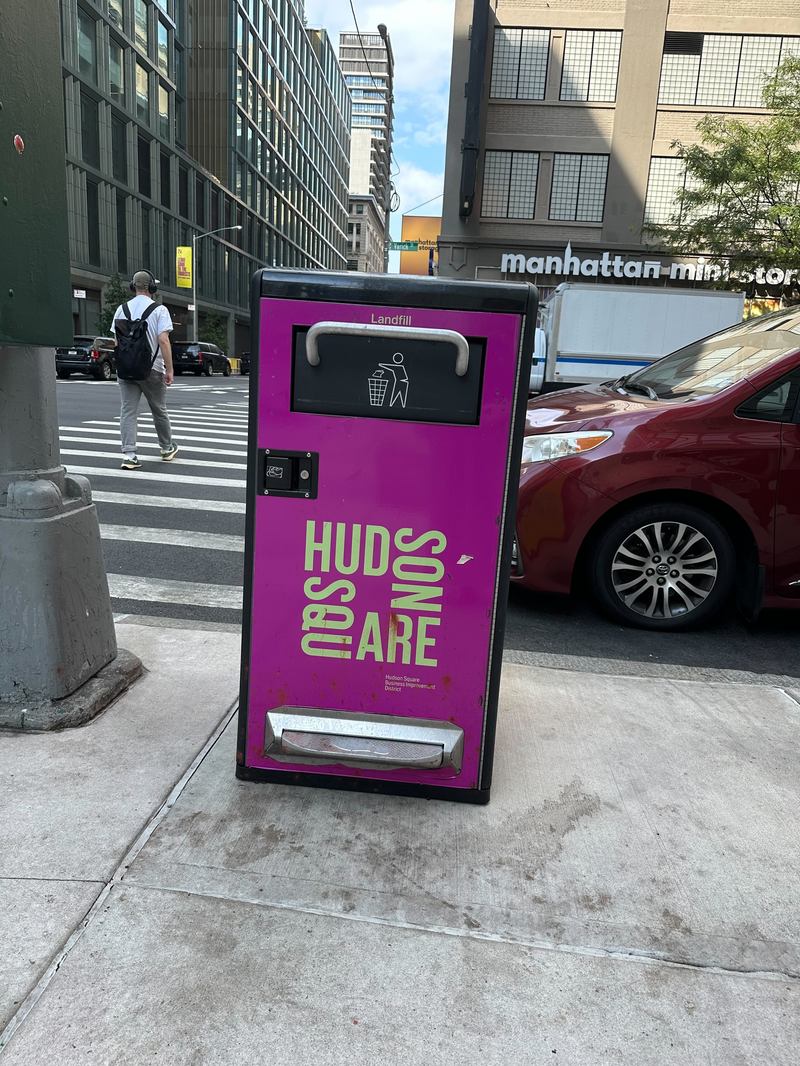
David: Normally, when Alison Stewart kicks off the show, she says we are live from the WNYC Studios in SoHo. That's because WNYC is on Varick Street, a couple of blocks South of Houston, a couple of blocks North of Canal. Recently, we received a letter saying we are mischaracterizing our neighborhood. "Attached is a photo of the trash bin in front of the green space," says the listener. That's the green space, our performance space down on the ground floor of our building. The trash bin says Hudson Square.
The letter writer goes on to define Hudson Square as Canal to Houston, Hudson River to Sixth Avenue. A universal truth about New York is that neighborhood borders are complicated. If you live or work here long enough, you'll see attempts to rebrand neighborhoods. Here now to talk about the history behind some New York City neighborhoods and their changing names and borders is Greg Young. Greg is a co-host of the long-running New York City history podcast, The Bowery Boys. Greg, welcome back to All Of It.
Greg: I am delighted to be here, especially to talk about something as silly, contentious, but beloved as neighborhood names.
David: Delighted to be here.
Greg: Thank you, David.
David: Where is here? Is this Hudson Square? Where are we, Greg?
Greg: All right. Knowing that we were gonna discuss this, I did some research onto this. We are, in fact, in Hudson Square. That is correct, but I'll explain to you why it feels uncomfortable, awkward in our mouths, perhaps. We are surrounded by SoHo over to the East, West Village to the North, and then Tribeca down in the South. When I hear Hudson Square, to me, that sounds like a made-up name. It sounds like, "Oh, a developer made up that name," because it's sort of Hudson Yards a little bit. Yeah. In fact, it is a very old name that goes back to the early 19th century.
David: There's some real history here.
Greg: Yes. If you didn't know, one of the biggest landlords in all of New York City history is actually Trinity Church. Trinity Church owned all of this land up here in the early 19th century and began developing it, really as one of the first breakout neighborhoods from outside of Lower Manhattan. They developed this neighborhood called Saint John's Park, and it was also referred to, or I believe it also may have been an area next to it called Hudson Square, all the way back in the early 19th century.
You may wonder, "Why doesn't it roll off the tongue like Greenwich Village or something like that?" The name went away. Part of it did have to do with the construction of the tunnel because it became less residential, and then the names around it became more popular. We can talk about that as to why in a second. I dug around this morning and found an article from 2001 in the New York Daily News that specifically said that Trinity, because they still own the land, was trying to rebrand this particular neighborhood.
It was kind of a square that was not only a no man's land, but you had SoHo, which was really trendy, you had Tribeca, which was really trendy. They wanted to get in on the action, so they rehabilitated this old name in 2001 and called it Hudson Square. That's why some of the old timers, like me and some of you out there, may not call it that. It's not the thing that jumps into your head because it's an old name, but it's also a new name.
David: I can already imagine the controversies and arguments building. If you want to get into this conversation, if you have a question about a New York City neighborhood, call us or text us, the number 212-433-9692, that's 212-433-WNYC. Maybe you want to share what makes your neighborhood name special, maybe you just want to know where you are.
[laughter]
David: Call us or text us, 212-433-9692. Greg, you'll do your best to answer all of this.
Greg: I've studied up on everything. I'm not necessarily a history jukebox, but if you put a quarter in, I might be able to know the tune.
David: Hudson Square borders SoHo. When did the name SoHo first come into you?
Greg: SoHo, I'm sure there might be an example or two a little earlier, but gave birth to this abbreviation type of thing that we now live with in New York City. SoHo came along in the late '50s, early '60s, because this particular area of New York, which was all kind of cast iron. It was warehouses, sweatshops, that kind of thing during this period. It was around the '60s and '70s that people started to move into those big lofts. I'm sorry, it was in the '70s. That changed the character of the neighborhood because working class had actually been these factories, and now it was artist studios. Now you had trendy bars and things that were moving in on the side.
To separate it from the rest of the village, because I think people just mostly called it the village, just this whole area, they ended up taking SoHo, South of Houston, which, by coincidence, also sounded like a really hip, trendy neighborhood in London. A little bit of that cachet was added to it as well. That became really popular. Just a few years later, you have Tribeca coming in, which is the triangle below Canal. Then that picks up to the same sorts of artist groups, bohemian types move in here. Then it starts a wave of these new names in a way we can't even stop them now. Some of them click, some of them get ignored.
David: What causes it to click? Obviously, SoHo, if you can already use a name that's a name of a trendy neighborhood in London, that helps.
Greg: That makes sense. I think part of it is just as populations change, as real estate agencies come in, they want to sell certain areas, certain properties, and our neighborhoods become smaller and smaller. Keep that in mind, too. What we refer to as a neighborhood today would be very different in scale than what it had been 100 years ago. Because of that, these smaller areas start getting defined in specifically different ways. Then if you have a SoHo, then a few years later, you've got to have a NoHo. NoHo, that particular area above Houston, has an incredibly rich history. Nobody called it NoHo until the 1970s. It's just a way to distinguish an area from another area that's already been distinguished by abbreviations.
David: We will be branding the northeast corner of this studio in the near future. We do have a lot of phone calls-
Greg: Oh, cool. Okay.
David: -coming through right now. Let's get to some of your questions. You can call us or text us, 212-433-9692. First, I really want to read this text. Someone writing in to say, "When my mom was growing up in what is now SoHo, she said back then in the 1960s, there was no such thing as SoHo. It was all just Little Italy. Funny how the rebrand completely takes over."
Greg: Oh my gosh, that's so true. In fact, the one name that stuck that I actually still have a problem with is NoLIta, which is North of Little Italy. It's very interesting to think of the Italian quarter, which is Greenwich Village, sort of Southern Greenwich Village, because there was a large working-class Italian population from there.
It got whittled away over the years. Part of it has to do with NYU and the student population that's around there. Then there was always solid Little Italy until the '80s, when, again, as part of this growing, we need to make things trendier and have the real estate higher, they chopped off a part of it and called it NoLIta. It's crazy to me because the San Gennaro Festival still takes place there, so it is, to me, Little Italy. This was a huge Italian neighborhood. It's true.
David: Let's hear from Janet, calling from Little Italy. Welcome to All Of It.
Janet: Thank you very much. Can you hear me?
David: Oh, yes. Welcome.
Janet: Okay, good. I've lived here for 50 years. When my husband and I first moved to the neighborhood, we were in a tub and kitchen walk-up between Prince and Spring and watched the area across the street from us change from our 5th-floor tenement department. Now, we moved uptown a block to being right across the street from Old St. Patrick's Church. My front windows look out on the cemetery that is on the north side of Old St. Patrick's. It was definitely Little Italy when we moved in here.
John Gotti was a very familiar figure. My daughter's best friend was the youngest member of a Sicilian family, and she, for the most part, translated for her parents. I just love saying her name, which is Rosalba Buzzetta, daughter of Sal and Concetta Buzzetta. Now the neighborhood is completely transformed and is just all upscale shops, very fancy stores, very few Italians, but a few left, and they deign to nod at me, and I nod at them-
[laughter]
Janet: -with just a chin gesture, as is the way we communicate around here. It's very safe neighborhood.
David: Thank you for sharing that. Nodding is always pleasant.
Greg: [laughs]
David: It's always friendly. Sure.
Greg: I was going to say, it's sort of sad, isn't it, that this name, Little Italy, basically only means essentially a tourist neighborhood. It's a vestige. It's very fun on the weekends, I'm not going to lie, it is fun, but it used to represent something else. It used to represent a large group of New Yorkers who lived here and defined the culture, which most of them moved away, and it's been diffused into this kind of hyperactive Italian experience in Manhattan.
David: We're speaking with Greg Young, co-host of the long-running New York City history podcast, The Bowery Boys, and we're taking your calls if you'd like to join this conversation, 212-433-9692. Let's hear from Rebecca in Brooklyn. Welcome to All Of It.
Rebecca: Hi. Thank you. I want to talk about the neighborhood that I have lived in for over 200 years. When I first moved to Third Avenue in Brooklyn, the real estate folks referred to it as South Slope, trying to align with Park Slope, of course. Over time, the neighborhood gained its own identity. While I generally hate new neighborhood names, I love the fact that my neighborhood is called Gowanus because instead of trying to align with something sexy, it's aligning with an industrial canal that until recently had live gonorrhea in it.
Greg: [laughs]
Rebecca: We're really owning where we are. We're next to a super fun site, and our neighborhood is called Gowanus, and I personally love it.
Greg: I love that too. I'm a Brooklynite, and it is funny because there was just a moment in time-- When you're trying to get developers to develop things and the Whole Foods was down there first to lure other people in, those developers don't want you to be reminded that you're by this putrid body of water that, for generations, was disgusting, and like, let's not go swimming in it today. It is funny how that shifted, in a sense, that more grimy history actually works to its advantage today because that is an old--
I believe it's a Native American name, but it traces back to the Dutch also. There was a very famous Revolutionary War battle, the Battle of Gowanus Creek. It does have an incredibly rich historic name. It would be tragic if they had erased that and come up with something like "go papa" or whatever, something like combining all of the different names into something that I think takes away from the history, which you can actually see when you walk through there today.
David: If you want to join this conversation, give us a call, 212-433-9692. You can also text 212-433-9692. We will get to more of your calls in just a moment. This is All Of It here on WNYC.
[music]
David: This is All Of It here on WNYC. I'm David Furst in for Alison Stewart. We are speaking with Greg Young, co-host of the long-running New York City history podcast, The Bowery Boys, and we are taking your calls about New York City neighborhood names. Greg, are you ready for a speed round of questions? [laughs]
Greg: Oh, okay. I'll try my best. I'm gripping the desk.
David: We have a lot of texts and phone calls coming through. We will get to your calls. Here's a few texts, quick ones. "I moved to Ditmas Park in Brooklyn and discovered most people refer to the neighborhood as either Flatbush or Midwood, and there's no park. Where am I really?" This is from Luis.
Greg: Ditmas Park would have been a name that came out-- I believe it's the late 19th century, even early 20th century, when there was very in vogue, because Brooklyn was expanding rapidly by that point. They were creating all of these different developments with these very gorgeous names. Don't even get me started on Ozone Park, for instance, Floral Park. There's a bunch of neighborhoods that are new developments. What's interesting about Ditmas Park, because it does look so strikingly different from Flatbush, which is right next to it, it is built in Flatbush. Flatbush is one of the oldest. Literally, it was a Dutch village. That name traces all the way back, whereas that is a little different.
David: "Greg, can you weigh in on the boundaries of the Upper West Side versus Lincoln Square, Manhattan Valley, and Morningside Heights?"
Greg: Oh, no, no, no, I can't. I would say this: they're not solid lines, they're blurry lines because I feel like you know when you're in one, but it would be hard for me to say-- For me, personally, Lincoln Square ends around 70th Street, but others might be like, "No, that's hardcore Upper West Side. Then Morningside Heights is definitely above the line of Central Park, and then maybe in the Middle Manhattan? That's tricky for me.
David: This is why you said no.
Greg: [laughs] Right.
[laughter]
David: Here's another one, "Great debate in our building. We live on East 25th between Second and Third Avenue, Manhattan. Are we in Kips Bay or Rose Hill? Please help settle the debate."
Greg: I would say that you live in Rose Hill, but that's on a name that a lot of people know. It's actually a little less common than Kips Bay. Not to get out of this, but I think, in a sense, it's kind of both. A neighborhood can actually be both because things change over time, names are in vogue. Both of them are historic names. Kips Bay is actually an, I believe, older name. Rose Hill was named as a mansion that was around that, an estate. I think if you want to be cool, you say Rose Hill, but if you wanted people to actually know where you're at, you might say Kips Bay.
David: All right. Everybody's a winner?
Greg: Yes, I think so. [laughs]
David: All right. There have been attempts over the years to actually legislate New York City neighborhood names. Back when he was a state assemblyman, Hakeem Jeffries sponsored legislation in 2011 that would punish real estate agents for inventing neighborhood names and/or stretching their boundaries. State Senator Brian Benjamin tried this again in 2017. Neither bill went anywhere. Is there a formal process when it comes to renaming neighborhoods, or can anyone just start calling their neighborhood whatever they want?
Greg: It is some of that, but what you will find is it will sometimes come from the community. For instance, Flatbush is sort of, I guess, coterminous. The name is Little Caribbean because it's the same neighborhood, but it's aspects of that neighborhood. That's a name that's it's really like a community-based initiative to unite that. Another way that these names get solidified is when they become historic districts. When landmark preservation, when they sweep in and they're like, "We need to define this particular area so we can protect it," sometimes they'll use a name that is more colloquial, for instance. In that case, you'll get names that way. I don't think that any neighborhood is properly official.
I suppose if you were to look at Times Square, which was named after The New York Times in 1904, because their offices were right there, that's about as official as you can get, because the city had a big party for it and everything. I think it's important to remember that a neighborhood is people, and although real estate developers want it to be buildings, at the end of the day, it's people. It's what the people call it who live there, ultimately. You can do whatever baby talk you want to with bukaka or hohaho or whatever, it doesn't matter. If the people who live there don't use those words, then that's not going to be the name of the neighborhood.
David: Greg Young, you're making those rulings today.
Greg: I am. I'm going to make that decision.
[laughter]
David: Co-host of the New York City history podcast, The Bowery Boys. If you want to join this conversation, the number 212-433-9692. Tracy in Staten Island, thank you for waiting to speak with us. Welcome.
Tracy: Oh, hi. I'm a native Staten Islander. When my husband and I bought our first house, we bought it in Stapleton. You say Stapleton to any Staten Islander, they'll know what you're talking about. When we sold that house, the realtor listed it and called it a lovely historic home in Stapleton Heights.
Greg: Oh.
Tracy: My husband and I laughed so hard, and were like, "If we knew we were in Stapleton Heights, maybe we would have stayed here."
David: [laughs]
Tracy: We drive past it every once in a while, and trust me, it's still Stapleton.
David: Is that an old trick, adding heights to something?
Greg: In fact, that story reminds me of Greenwood Heights, which is this neighborhood over by Greenwood Cemetery, which is a way to gussy up a neighborhood that might have some negative connotation. I don't know why Stapleton would have that, but it is like that's a trick all the time. If you go through, especially in, not Manhattan necessarily, but in the other boroughs, when they really started to develop in the late 19th century and early 20th, where people were buying tracts of land specifically to get people to move out there, they were coming up with all of these names.
They're a little less historically authentic except, of course, now a name like Ozone Park is historic even though it's not based on anything that happened in the ground there. I would still call it Stapleton, [laughs] but maybe they're able to get, I don't know, $100,000 extra for [laughs] the property if you add a heights to it.
David: All right. We have another caller. Ryan in Harlem, welcome to All Of It.
Ryan: Hello, everyone. Thanks for having me. One thing that I noticed that's happening in the real estate to gentrify the neighborhood is the SoHa in Harlem. I think anyone that wants to refer to Harlem as SoHa should not move here.
David: [laughs]
Greg: That's the one I hate the most.
David: [laughs]
Greg: I was trying to think if there's one I don't like the most, and the moment you said it, I was like, "Harlem is one of the most historical places in the United States." Literally, it gets its name from a Dutch village. It has been there for three 375 years or something. Then, of course, it has one of the most amazing lineages because of African American Black cultural history that has come through there. To me, I'm like, "Why would you change the name of this incredibly important place?" Of course, they're trying to rebrand certain things so that it seems like a brand new neighborhood, something where the slate is wiped clean.
David: Not everything is calling out for a rebranding?
Greg: No, that definitely is not. That drives me nuts.
David: Robin in Brooklyn, welcome to All Of It. Do you have a question?
Robin: I do, yes. Thanks for having me. I live in a neighborhood I've never been able to know the exact name of, but it's where Bed-Stuy meets Fort Greene meets South Williamsburg, and it's right by a Home Depot, so I always just call that neighborhood By the Home Depot.
[laughter]
Robin: Maybe there's a better name for it.
Greg: I don't know quite exactly. I have to probably look at a map. I could probably figure it out.
David: Maybe "By the Home Depot" could become an acronym?
Greg: Yes, BHoD.
[laughs]
Greg: Here's the thing: in the 19th century, that's mostly how people refer to their neighborhoods. There are certain old neighborhoods that were used, like Murray Hill, for instance, was in vogue back in the 19th century. Most people said they lived by things. It was defined by landmarks. What's interesting is if we're having a naming structure that was very 19th-century oriented, you would actually call it By the Home Depot [chuckles] if we had such a thing back in the 19th century. Again, this kind of idea of naming everything, every single inch of land, gets a little silly when you get to things like that, where it's like, "No, people know it more if you just name it by the landmark."
David: 212-433-9692. We're talking about New York City neighborhood names. Davidson in Manhattan, welcome.
Davidson: Thank you. I'm enjoying your show very much. I moved to New York in early 1970s, and I live near 29th and 5th Avenue, where in Marble Collegiate Church is. In those days, it was called East Midtown. There were a lot of businesses, East Midtown this, that, or the other. Now they're calling it NoMad, North of Madison Square Park. It's been called that, I think, for about the last 10 years. I thought it was rather silly when they started calling it that. I've gotten used to it now. I don't know where they came up with that, but I'm sure it was a real estate thing.
Greg: My first apartment in New York, I moved here in the early '90s, and it was actually at 23rd and Park. It would be technically, I guess, a part of or right near "NoMad." NoMad is an example of something that I begrudgingly use because it rolls more off the tongue. NoMad is something you can use a lot more easily. It's underscoring a certain kind of new development that happened in that area. If you remember in the '90s, it was a little bit rundown. I remember I used to not go to the park, which seems crazy, like Madison Square Park, but then a lot of money got infused into it starting in the late '90s into the 2000s, and so sort of a new cultural influx of especially these trendy hotels.
When I hear NoMad, I think they were calling the whole neighborhood. To me, they're calling the culture of that neighborhood NoMad, in a sense, because the buildings, many of them, are super historic. It's the Flatiron Building. To me, in a sense, I would still call it the Flatiron District. It is in the halo of Flatiron, or do what they did in the old days and say I live next to Madison Square Park.
[laughter]
David: Exactly. We're going to get to more of your calls in just a moment. Very quickly, though, do you have a favorite New York City neighborhood name? Putting you on the spot [crosstalk]
Greg: No, no, no. This goes back and forth because there's so many interesting stories, but I'm going to pick one right now and say City Island out in the Bronx because you go to City Island, it's almost respite. It's very suburban. In the early 19th century, when this city was starting to begin developing, but up there, it was still very rural and still undeveloped, a developer came in and was like, "I'm going to make this the new Port of New York." He wanted to move the port from basically Lower Manhattan to this area of the Bronx.
To do so and to sell the whole area, he bought the island and named it New City Island because this is where the new city is going to be centralized. Of course, all that fell through. The word new fell off of it, but the fact that it's still City Island, it talks about the potentials of New York. We have so many stories like that. Astoria is actually very similar to that, too, where the name was an aspiration of we're going to be this. It didn't quite get there, but we still have the name of the good try that they tried to make.
David: [chuckles] A good try they tried to make. We're speaking with Greg Young, cohost of The Bowery Boys podcast. I want to read this text. "Loving this segment. Your guest just got a new listener."
Greg: Oh, thank you.
David: "I live in East Williamsburg, which, to anyone who has lived here for 10 plus years, calls it Bushwick. My first apartment in the city was on the border of Astoria and Long Island City. It's now called Dutch Kills.
Greg: [chuckles] That's interesting because, again, I think that it may be an old name of something, but is brought back because as the whole neighborhood gets redefined based on high rises, rising rents, it gets broken down a little bit more, and so somebody took an old name and they called it Dutch Kills. I would still call that Long Island City/Astoria, depending on where you're at, but that's just me. Then the whole East Williamsburg thing is very funny. East Williamsburg, Bushwick, Greenpoint, this whole area, I feel like you could call it any of that and be somewhat right. I had a friend who bought a business there 15 years ago, and it was at this area where he was like, "What neighborhood is this?" I was like, "Honestly, I couldn't tell you."
David: [laughs]
Greg: I was like, "I don't know where this is. You're just five blocks from Williamsburg, five blocks from Bushwick." I was like, "I don't know what this--" Today, everything is a lot more defined over there because it's a lot more trendy and more expensive to live.
David: I'm just becoming more and more fascinated by this. Oh, I want to take another call. Nicole in Ocean Hill, Brooklyn, welcome to All Of It.
Nicole: Hi. Loving this segment. I've been in New York for almost 30 years. I started off in Alphabet City. Not sure if that's still called that. Then lived in Greenpoint, and now I have been in Ocean Hill, Brooklyn, for about 10 years. I have two parts of this I wanted to ask. I actually had someone staring at my property one day, and I asked them, "Oh, what are you doing here? What are you looking at?" Her grandmother, who was Italian, used to live in the Ocean Hill area.
Then I did a little research, and I found this area actually was founded by Italians. I'm just wondering if you know any of the history of this area. Then my second part is that from what I understand, Ocean Hill is part of the bigger Bedford-Stuyvesant area, and I believe there's four or five neighborhoods within that. How does that work, and why do they break it up like that? If you can clarify that for me, because it's so confusing.
Greg: Bedford-Stuyvesant, obviously, those are old names. They're streets. Those are names from the 18th century. Stuyvesant's even older. Ocean Hill is again one of these developments. The thing to remember about Brooklyn, which is interesting, is Brooklyn was, until the 1890s, not all of what Brooklyn is today. Brooklyn, actually, it started as this little village, which is basically where Brooklyn Heights is, and there were several other little villages. Flatbush was its own village. Gravesend was its own village. Coney Island was part of it.
When they became closer to consolidating with the rest of New York, is when Brooklyn got bigger and bigger and eventually takes up the whole, what we call Brooklyn today. Then if you think about places like Ocean Hill, there would not have been any kind of real development at all, but then knowing that consolidation was going to be happening, and then with all these populations moving out of congested New York and going into these other boroughs, is when that neighborhood would have been a proper developed neighborhood.
If you go through an old newspaper, you can probably find literal ads, goes like, "Move to Ocean Hill," back when no one lived there. It's sort of a certain planned development, probably around older structures, but mostly a planned development.
David: Thank you for all of the phone calls and texts. We could only get to a fraction of them. Greg, if people wanted to follow up-
Greg: [laughs]
David: -get some more information, what would be the best thing if they have questions to track down your podcast, The Bowery Boys?
Greg: For instance, our show last week is all on this magical NoHo. Our sister podcast, The Gilded Gentleman, recorded it. It's about the history of that neighborhood, but the whole kind of joke or running gag is that no one back then used this name, but we used this name to describe the whole thing. I would say listen to our podcast.
We also have a website, boweryboyshistory.com, and that is where you'll find all sorts of little articles that I've written over the years. If you just go to the little search bar, type in Ozone Park, that's a good one because the history is just incredible to me. Type in Wall Street, you'll learn all about how that was named, things like that. Go to our podcast and our website. That's boweryboyshistory.com.
David: Boweryboyshistory.com to follow up. Again, thank you, thank you, thank you for all of the calls this hour. Greg Young, co-host of the long-running New York City history podcast, The Bowery Boys. Thanks for joining us.
Greg: Thank you. This was a delight. I'm going to go back into Hudson Square, SoHo, [laughs] wherever, I don't know.
David: You could turn off your brain now. Rest for a minute.
Copyright © 2025 New York Public Radio. All rights reserved. Visit our website terms of use at www.wnyc.org for further information.
New York Public Radio transcripts are created on a rush deadline, often by contractors. This text may not be in its final form and may be updated or revised in the future. Accuracy and availability may vary. The authoritative record of New York Public Radio’s programming is the audio record.