
Train Hour Part 2: Amazing Train Journeys
( Photo by Joe Raedle/Getty Images )
Alison Stewart: This is All Of It on WNYC. I'm Alison Stewart. We continue this hour with a focus on trains, real ones this time. Trains are a great way to travel. You can go from Chicago to San Francisco, New York to New Orleans, from Bangkok to Singapore. With me now to suggest some train trips for 2026 is Tom Hall, Vice President and Editor of Lonely Planet. You can see more of Lonely Planet's train ideas in their book, Amazing Train Journeys. Hi, Tom.
Tom Hall: Hello there. Thank you for having me.
Alison Stewart: Listeners, we'd like to hear from you. Do you like traveling by train? What's the best train ride that you have ever been on, either in the US or internationally? Call us or text us now, 212-433-WNYC. 212-433-9692. What makes a train ride stand out from traveling by plane or car? Any activities that you love to do on the train? Our number is 212-433-9692. 212-433-WNYC. At a certain point in history, train travel, it was the common way to travel. How much is that history and that sense of nostalgia for this past era factor into the way that trains can be fun today?
Tom Hall: I think that some of the romance of traveling by train is timeless. It does go back to those early days of the railway when it was first established. It was the only way really to get from A to B. I think some of that still survives, some of the glamour of what you might think of the golden age. I know I'm talking to people in a city where you have probably the most beautiful train station in the world in Grand Central. I think that that atmosphere still exist today. Certainly a lot of people want to take a train for the experience, which isn't something you hear people say about a flight very often.
Alison Stewart: When you think about train travel versus planes or cars, what makes a trip by train special?
Tom Hall: I think that the first thing is there's an element of relaxation. We talk a little bit at Lonely Planet about the idea of slow travel, about letting the journey unfold itself, about taking in the sights, the people that you meet along the way. Sometimes that means just going to a particular place and immersing yourself in it, but it can also be how you get there. Taking a train is a great example of that. I think some of the routes that we're going to talk about are just wonderful places to meet people as well as to see the landscape go rolling by in a very relaxed way.
Alison Stewart: We shouldn't think of the days in the train as wasting a vacation day?
Tom Hall: I think it will, for a lot of people, be a highlight of the vacation depending on where you go. Look, trains can be prone to being delayed sometimes all over the world, in the US, in Europe, everywhere, but so are other forms of transport. I think one of the differences is that you have the chance to stretch out, to look out of a nice big window, look at the landscape going by, and maybe take a stroll up to the cafe car or the dining car and get yourself something to eat. There's a lot to be said if you're slowed down slightly while traveling on a train.
Alison Stewart: I'm speaking with Tom Hall, Vice President and Editor of Lonely Planet. We're discussing some of his favorite train rides and destinations to travel by train. We're also hearing from you. What's the best train ride you've ever been on? What makes a train stand out from traveling by plane or car? Or maybe you have a travel plan this year and involves a train, tell us about it. 212-433-9692. 212-433-WNYC. Let's talk to Marshall, who's calling in from Brooklyn. Hey, Marshall, thanks for taking the time to call All Of It.
Marshall: Hey, how are you? Can you hear me?
Alison Stewart: I hear you great. Where did you go?
Marshall: In 2008, I took the Trans-Siberian Railroad from Beijing to Moscow, and I went through Mongolia, went around Lake Baikal. It was an amazing train trip.
Alison Stewart: What made it amazing?
Marshall: Just seeing part of the world that most people I know have never been to.
Alison Stewart: Thanks for calling in. Let's talk to Bill from Seaford, Long Island. Hey, Bill, how you doing?
Bill: Good, thanks. Thanks for taking my call.
Alison Stewart: Where did you go?
Bill: Can you hear me?
Alison Stewart: Yes. Where did you go?
Bill: I went across the Rockies from Banff, Alberta, to Vancouver, BC on that trip.
Alison Stewart: What made you take the train?
Bill: Just a friend of mine was really good at researching places to go, and that was a spectacular trip through the mountains. So many things I can talk about, but there was a little bit of problems with the food because it was labor problems at that moment, 1977. I had a beer and some Cracker Jacks in the observation car, which was spectacular.
[laughter]
Alison Stewart: Thanks for the memory. Let's get into your list, Tom. California Zephyr. All Right. Where do we start? Where do we end up?
Tom Hall: California Zephyr. We had to start with, I think, one of the iconic cross-country American trains. This is a real classic through day journey from Chicago to Oakland, California. In doing so, it travels nearly 2,500 miles, crosses prairies, deserts, some of the most spectacular mountains that you'll see from any train anywhere in the world, and ends up on the shores of San Francisco Bay. It sounds pretty good to me.
Alison Stewart: How long does it take, roughly?
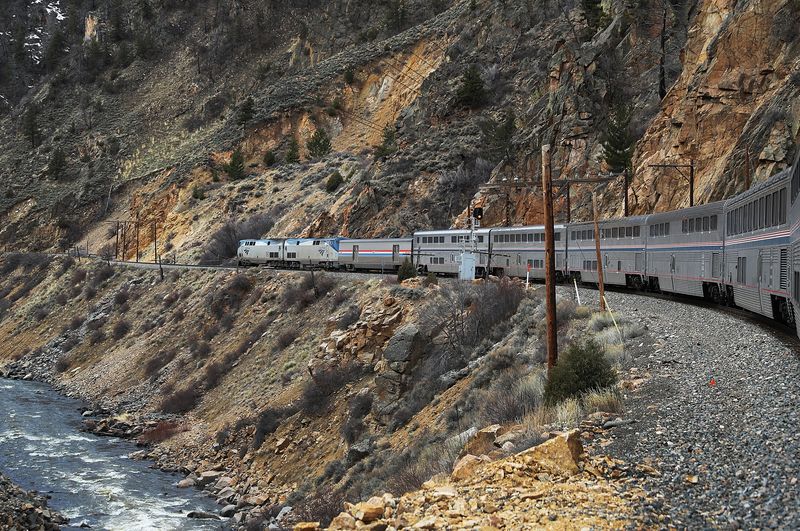
Tom Hall: Roughly, three days in my experience. Did this train a few years ago. It can be delayed, but it's also very magical. It may well be both things at the same time. If three days sounds like a long time, you can obviously do sections of this train. I think probably the element from Denver, Colorado to Glenwood Springs up in the Rockies is the one to go for. The train travels through a roadless wilderness, going through some deep, narrow gorges of orange rock. It really is a stunning journey made better by the observation car that you can take in the views into full effect.
Alison Stewart: Some of these trains have great names like California Zepar-- It's Zephyr. Random question. How do trains get named? Do you know?
Tom Hall: Trains are often named historically by the company that originally set them up. You talk about California Zephyr, the Orient Express would be another one. I think we're going to talk about the Deerstalker, which is a sleeper train in the UK. Very often, they get these names as a way of marketing them originally. Even though companies may not still run them-- the Orient Express actually doesn't exist in its original form. It's a completely different thing. Those names have stuck around, and people still call them that. Bit of marketing and a little bit of magic dust, I think.
Alison Stewart: All right. I need to know about the Deerstalker, since you said it. [laughs]
Tom Hall: Okay, so the Deerstalker is-- I think this would be my contender for my favourite in the world. It's a train which leaves London in the dark from London Euston Station, and it rattles up through the north of England and passengers wake up in the Scottish Highlands in absolutely magnificent scenery on their way to Fort William in the shadow of Ben Nevis, which is the highest mountain in the UK. It's the sort of train where you can go to the lounge car and have a malt whiskey nightcap, and then you fall asleep. As I say, you might see deer, you might see other wildlife from the train when you wake up. It's a really wonderful, very, very civilized way to travel.
Alison Stewart: Explain the sleeper car situation to me.
Tom Hall: Okay, so maybe lots of people are thinking, "Sleep on a train. Does that mean I sleep in my seat, a little bit like if I was on an airplane?" There are seats on a lot of trains that roll through the night. Sleepers are either a lie-flat room of your own or in some places in Europe, you would still share with other people, but increasingly it's a private cabin. It certainly on the Deerstalker, on the Caledonian sleeper train, and indeed on the California Zephyr that we were just talking about.
In the case of the train to Scotland, this is a very modern service. You get a card a little bit like you're checking into a hotel. You go into your room, you close the door and lots of rooms are en suite, and you just snooze your way through to breakfast when the guard will bring you what you've ordered overnight, whether that's porridge or maybe it's a lorne sausage roll or something like that. Typical Scottish food you're getting into as well. Absolutely lovely experience, whether you're an adult or indeed if you take your children on these services, as I have done. There's nothing more exciting for a child than falling asleep in one place on a train and waking up in another location entirely.
Alison Stewart: We are talking about train travel with Tom Hall, Vice President and Editor of Lonely Planet. We'll take your calls after the break. This is All Of It.
[music]
Alison Stewart: You're listening to All Of It on WNYC. I'm Alison Stewart. My guest is Tom Hall, Vice President and Editor of Lonely Planet. We are discussing his favorite train rides and destinations to travel by train. We're also hearing from you. Tom, let's take some calls. Let's talk to Katie in Brooklyn. Hi, Katie, thanks for calling All Of It.
Katie: Hey, thanks for having me. I'm excited to talk about trains with you.
Alison Stewart: What train are you going to talk about?
Katie: I'd love to talk about the Northeast Regional. I take it every year from New York to Chicago. It takes about 19 hours. I get a sleeper, and it's one of my favorite holiday winter traditions.
Alison Stewart: Why is it a favorite?
Katie: Yes, I love seeing the country. You ride past the Great Lakes, especially in the winter, all the leaves are gone, so you can really see the water. It's a great moment to just take some time for myself. Spend about 20 hours alone with my thoughts and knitting and favorite podcasts. It's a great way to just find a moment of quiet.
Alison Stewart: Love it. Thanks for calling, Katie. Dan is calling us from Mountain Lakes, New Jersey. Hi, Dan. How are you?
Dan: I am great. Thank you for having me. It's a treat to talk about train travel. I've been a train buff all my life, but in 1980, an older cousin of mine shared a dream that he had to go to Peru and see the Amazon. I said to him, "Well, my dream is to ride the train over the Andes." We put our heads together, and the next thing you know, we're traveling off to Peru. There was three great train rides there. The train to Machu Picchu, which many people have experienced. The train to Lake Titicaca from Cusco, which is a very beautiful ride. The train over the Andes topped everything. At the time, it was the highest train ride in the world going over the Andes, something like 15,600 ft, to such an extent that you see people on the train literally putting their head down, passing out. A doctor going around with a bag of oxygen.
Alison Stewart: Wow.
Dan: That was an experience. It's no longer the highest train ride in the world. I think now the Russians built one across Tibet, but it's very, very close. That ride, it was a day going up and a day coming back, and you had to hope that they were running the train the next day. It was a real adventure.
Alison Stewart: Sounds like it, I have to tell you. Thank you so much for giving us a call. I want to get back to your list, Tom. We're going to go up to Canada. You selected a train ride called-- I love saying these names, The Rocky Mountaineer.
Tom Hall: Yes. I am absolutely blown away by the amazing trains that your listeners have been on, by the way. This is like a whole new to-do list for me. Look, the Rocky Mountaineer is another train that I think will be on a lot of people's to-do lists. It is an absolutely amazing way to travel from Vancouver on the British Columbia coast to Banff in Alberta. That's quite a long way, this journey, 37 hours, 550 miles, but an absolutely amazing adventure. The railroad itself, we describe it in Amazing Train Journeys as all at once, a geological field trip, a sightseeing adventure, and a wildlife safari. That's just a fantastic way of describing it.
You can throw into that some of Canada's most breathtaking mountain landscapes. The thing that I think really makes the Rocky Mountaineer special is that it is a pretty premium service. You get extremely high-quality food and beverage and also guides along the way. You spend the night in Kamloops, you break the journey on route. It feels like really in a premium experience all round. By the way, there is also VIA Rail Canada. It's national rail that operates along the same route if you want a regular passenger service. The Rocky Mountaineer is really a once-in-a-lifetime experience.
As you come towards the end of the journey, as you get further into the Rockies, it just gets better and better. Culminates by rattling past Lake Louise and then arrives in Banff National Park. I think, for me, it's probably the most aspirational train that I think you could pick to do. A wonderful thing to try.
Alison Stewart: This text says, "The Train to the Clouds from Salta, Argentina to the Chilean border. It's a tourist train, but still a marvel of engineering." This text says, "The best journey I've taken is from Fairbanks to Denali National Park in Alaska. The scenery was majestic, and it was unforgettable." I did that train ride, and it was so much fun. The conductor said, "If you see a moose, you yell 'moose,'" and everybody should run over and check out to see if they could find the moose with their binoculars.
Tom Hall: Apparently, on the Rocky Mountaineer, moose sightings happen. Bear sightings are much rarer, and you need a very good telescope or telephoto lens to spot one of those. What a wonderful way to pass the time on any journey.
Alison Stewart: You've also done a trip in Germany. Tell us a little bit about this, from Cologne to Mannheim?
Tom Hall: Yes. Any of your listeners who've traveled in Europe will know that Europe's railways are extensive. There's lots of high-speed networks, and many of the trains connect up some of the most scenic areas of each country. This route that we're talking about runs from Cologne in Germany to Mannheim, and it passes down the River Rhine, one of the iconic and broadest waterways-- one of the longest waterways of Europe.
Just taking this train is such a fascinating experience because you have ancient Europe, medieval Europe, and modern Europe all, all in front of you in, in just a few hours. The Rhine is a busy waterway. There's a lot of boat traffic. The railway is very busy, and the roads are quite busy going alongside it, but it's also a wine-growing area. There are medieval castles that you can spot. You can spend the night in medieval castles, depending on where you break your journey along this route, and you feel like you're in a sort of deepest Europe. There is a rock, Lorelei rock, which features very strongly in Germanic mythology that you pass on route.
These beautiful little fairy tale towns that you see. It's so easy to just stop and start, break your journey where you want to. There are intercity services, but there's also lots of little regional trains that pass along the Rhine. If I sound excited, I can put my money where my mouth is because I'm taking my family there this summer, and I promise you, they're in for a real treat.
Alison Stewart: Let's talk to Inez from Astoria. Hi, Inez, thanks for calling All Of It.
Inez: Hello, Alison. Thanks for having me. I just wanted to talk about my epic bike camping trip or bike race last year. I was participating in a bike race from Bari, Italy, and finish point is in Amerongen, Netherlands. However, I couldn't finish. Knowing that it's Europe, there is a very vast train network. I basically, from Bari, I bike as close to Rome as possible. Then I took the train from Rome toward Verona, take a break, sightsee, and then bike some more. Then from Verona toward-- where was I? Basically in Zurich. Then got to ride the Rhine a little bit, and then took overnight train to Amsterdam and then finished the rest of my bike ride to the finish line and meet up with all the cyclists that actually did the race.
It just turned out to be a lifesaver with the whole train system.
Alison Stewart: Sounds great. Let's talk to Dwight in Canada. Hi, Dwight, thanks for calling All Of It.
Dwight: Hey there. Two quick stories. You got me?
Alison Stewart: Yes, do it real quick.
Dwight: Okay. Canadian Montreal, New York, often along the Adirondack line, wonderful. Estimated time, 12 hours. Could be 13 or 14. Takes you to Penn Station. Great. Prior to that, in the late '90s, I took a trip from Mexico City to Oaxaca. It turns out this is a train that was retired from Amtrak from Chicago. I met the engineer on this train who explained me the history. It was an overnight trip. So wonderful. All the doors were open between the adjoining cars. It was so fascinating. Moonlit night. I arrived in Oaxaca in the morning and didn't realize my face was covered in soot. [laughs]
Alison Stewart: Because all the doors were open. That's very funny. Thank you so much for calling. I want to get to your recommendations, Tom. Tom Hall is the Vice President and Editor of Lonely Planet. All right, we're going to go to Norway. I'm going to let you pronounce the name. [laughs]
Tom Hall: I'm going to recommend to you what is known in Norway as the Bergensbanen, and known to the rest of us as the Oslo-Bergen Railway. Oslo being the capital of Norway, and Bergen being the second city on the west coast. If you look at the map, this looks like a curvy line linking those two cities, and it just doesn't do it justice. Takes 6 hours to travel 300 miles on this trip. It covers the broad spectrum of Norway's natural splendor. Norway is just a breathtakingly beautiful place. You'll climb through canyons, cross rivers, burrow straight through mountainsides, and cross these giant ice scapes where, for instance, The Empire Strikes Back film was filmed. If you're familiar with the ice planet scene on that.
This train is also incredible because it runs four times a day with clockwork-type efficiency, no matter what the weather is. It really is a wonderful addition to any European itinerary. One thing to think about as well, there's a stopper on route called Myrdal. I will have mangled the pronunciation on that, and you can take a detour on the historic Flåmsbanaline to reach Bergen via a different route. That's part of something called the Norway in a Nutshell tour, which is just a brilliant alternative as well. Just a great trip. Can't recommend it enough.
Alison Stewart: Our last moments, you want to go from Bangkok to Singapore. What train should you take?
Tom Hall: You can go through in about three days from Bangkok to Singapore via a combination of trains that isn't a through service. There's. It is better to take this one slowly. As you go through Thailand, you'll be wanting to pause and go off to various paradise islands on route, crossing into Malaysia. You'll travel through jungle, thick rainforest, some really interesting historic towns. You can get to the Island of Penang very easily and the colonial city of Ipoh, and then travel down to Kuala Lumpur, capital of Malaysia, and on into Singapore.
It is as it sounds. It is steamy, it's tropical, the food is incredible, everything is intense and it's a really great and very safe way to travel.
Alison Stewart: I think we have time for one more call. Sakita, you're our last call. Where did you go? What did you see?
Sakita: Thanks so much for having me. This fall, during peak fall foliage, I went to Switzerland, and I traveled exclusively by train to the Swiss Alps. It was remarkable. The Swiss have perfected train travel. It was a premium experience. We traveled first class, and they really know how to travel beautifully. The picture postcard valleys, happy cows. It was just remarkable. Everything we saw was so, so beautiful. You really felt like you were in the moment. Tom was talking about slow travel, and you really experience it going to Switzerland.
Alison Stewart: Thank you so much for your call. In our last minute, you're going to suggest something right here, Metro-North Hudson Line. Tell us why.
Tom Hall: I'm very nervous about this one, suggesting to a new because-- not being one myself. However, I have ridden this train. I discovered it by accident. I just wanted to take any train from Grand Central. I ended up traveling up to Poughkeepsie. Apologies again for my pronouns.
Alison Stewart: Poughkeepsie. It's okay. We got you. [laughs]
Tom Hall: I just love the way you leave the city behind. The sense of suburbs and industry give way to small marinas, bucolic river towns, and just these wonderful river views, high cliffs. There's even a Bannerman Castle you can spot on the way. Lovely at any time of year. Spectacular. In for 90 minutes from the center of New York. I just thought, "Wonderful. Sign me up for another ride."
Alison Stewart: Tom Hall is the Vice President and Editor of Lonely Planet. Thank you for joining us to talk train travel.
Tom Hall: Thank you for having me.
Alison Stewart: There's more All Of It on the way.