
The Whitney Investigates the 60s Through Surrealism
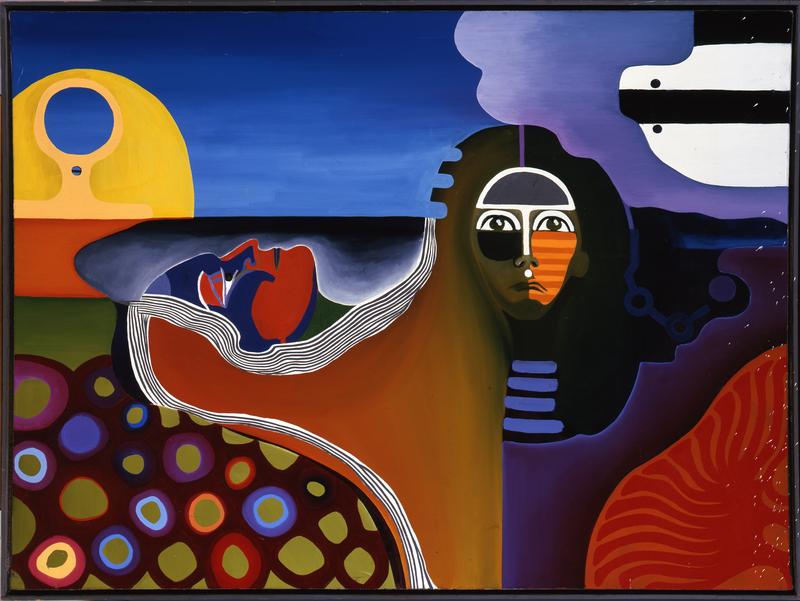
( Gift of the artist, © Linda Lomahaftewa (Courtesy of the Whitney) )
David Furst: This is All Of It on WNYC. I'm David Furst, in for Alison Stewart. The 1960s in America can be described in many ways: turbulent, revolutionary, fast changing. According to a new exhibition at the Whitney, the '60s were also surreal. Sixties Surreal is the major show on view at the Museum this fall. It makes the case that underneath the veil of pop art, Surrealism was a defining movement during a turbulent decade in American culture. Sixties Surreal opened today at the Whitney Museum of American Art. It's on view through January 19th. Two curators, Dan Nadel and Laura Phipps, are here now. Welcome.
Laura Phipps: Thank you.
Dan Nadel: Thank you for having us.
David Furst: First, we hear that word "surreal" a lot, but for those of us without the art history degree, Dan, what does surrealism mean in the art world?
Dan Nadel: Well, Surrealism was a movement that began between World War I and World War II in Paris. It was really about accessing the unconscious to come up with radical ideas about protest, and sexuality, and dreams, and all the things possible from a dream state and things we wouldn't otherwise imagine.
David Furst: Laura, how would you describe the general artistic aesthetic of Surrealism, or is that hard to put your finger on?
Laura Phipps: It is wonderfully hard to put your finger on.
[laughter]
Laura Phipps: We really thought about this history of Surrealism coming out of Paris in the 1920s, the way it's morphed and changed over decades and how, in a way, both historic Surrealism as an art and literary movement and the surreal as sort of this small s idea of what is surreal, what is weird or off kilter in our world, how those were really part of the groundwater that artists in the 1960s were accessing. The aesthetics of historic surrealism, this idea of collage putting together ideas that maybe were unconsciously accessed, comes out in different ways for artists of the 1960s.
David Furst: I want to pick up a little bit on what you were just saying there. In some texts on the wall at the show, you write that Surrealism was "in the groundwater of American culture." Dan, how did Surrealism travel from Paris to America?
Dan Nadel: It was catnip for filmmakers, and graphic designers, and illustrators, and writers, and musicians after World War II. You have filmmakers like Alfred Hitchcock literally using Salvador Dalí in one of his films. You have 1950s films, romance films, and science fiction films using the unlikely dream states to telegraph that things are not what they seem here in America. Graphic designers and illustrators were likewise using those motifs to show us that other things were possible outside the realm of rationality.
David Furst: Why do you think Surrealism was able to take hold in American culture?
Dan Nadel: I think after World War II, people were disoriented and had seen something that was far beyond what they ever could have imagined in World War II, came back and needed a sort of release valve. Putting in popular culture, things that were other, things that were beyond the norm. Even if you think about somebody like Elvis Presley suddenly appearing on television, that in itself was a surreal moment. People needed a release valve and to feel like the strangeness of what they'd just been through might be reflected in the art and the culture they were absorbing.
David Furst: Interesting to hear you talking about Elvis Presley appearing and that feeling like a surreal moment, because now he's been around forever. We don't think of it as an unusual, surreal experience.
Dan Nadel: That's right. A lot of things in our exhibition reference the commonplace. We have a gallery devoted to visions of the city, but also visions of television. The sudden presence of a new consciousness in our living rooms. We think of the screens all around us right now as being completely everyday, but at the time, they were new incursions into our reality.
David Furst: Laura, the new show, Sixties Surreal, displays work from over 100 American artists, including Faith Ringgold, David Hammons, Diane Arbus, all of whom engaged in Surrealism in some way during the 1960s. Can you tell us about this work that is on display in this show? Is it unusual for all of it to be grouped together in this way?
Laura Phipps: Sure. That's one of the really exciting things about this exhibition, in particular is over the past, I don't know, 15, 20 years, there's been amazing scholarship, there have been amazing exhibitions that have really dug deep into particular areas of the 1960s, looking at the work of Black radical women, the work of Chicago images, all of these different artists that maybe weren't as well known in the time that they were working.
We've really benefited from that amazing scholarship, these museum shows, to look across the country, to look across different modes of making and see what the connections are that artists have, and to really try and bring together a show that really canvases a more fuller picture of American art of the 1960s. There are a lot of, I think, surprising juxtapositions of artists' gallery to gallery.
We have so many different mediums within any particular gallery, but we're including works of, say, filmmakers Gunvor Nelson and Dorothy Wiley in a gallery also with James Rosenquist, so thinking about these artists that we think we know really well. Claes Oldenburg, Rosenquist, with these more experimental filmmakers that maybe weren't as well known, and seeing how they were actually thinking about many of the same ideas around mass media and the domestic life.
David Furst: When you're putting together a show like this and trying to tell a story, Dan, how do you decide who has to be in the show, who doesn't make it in? There are over 100 artists in the show, but what is the process like to identify and narrow down which artists really sum up what you're trying to show here?
Dan Nadel: We started with a lot of historical research. We looked at exhibitions all over the country and self-formed artist groups and exhibitions from 1958 to 1972. We started looking and seeing artists repeating across these exhibitions and groups. We found protagonists throughout the country that felt essential. Then we started thinking about what other kinds of voices were adjacent to these shows. Who else was thinking about, let's say, bodily abstraction, or the art of protest, or pre feminist thinking? Started looking at, "Well, okay, this person is thinking about it this way, this other artist is thinking about it another way. Let's put them together so that we can build a complementary and additive vision of the 1960s.
It was about finding the right combinations of artists to speak to one another across time, really, and across space. It became less about assembling the greatest hits, let's say, and more about assembling a really interesting group of voices that could sing together, but sometimes they harmonize, and sometimes it's a little dissonant. That's the beauty of it.
David Furst: We're talking about that time frame, 1958 to 1972. Why did you pick on this time frame to capture this movement of Surrealism?
Laura Phipps: Sure. There is the common phrase, "The Long Sixties," which captures a little before 1960, a little after 1969. What we saw is that there were these aesthetic shifts happening in the late 1950s in particular, thinking about artists that were working in Northern California and coming out of maybe beat poetry, and how that shifted aesthetics, and that seemed to be a through line in many of the artists. 1972 became our end date in thinking about, again, another shift in aesthetics back to a maybe more formal understanding of art making.
We let the art guide us in those time frames, and also the socio-political feelings of the '58 to '72 helped us create those limits. You have to create limits in a show this large. [chuckles]
David Furst: Give me a sense for what kind of art can we see here? What type of work can we expect?
Laura Phipps: Sure. I'll start with what you see when you get off the elevator. [chuckles] The first works in the show are three sculptures by the artist Nancy Graves, who made these incredible sculptures of camels. They come across as real live camels in the gallery, but they are actually sculptures that she made after years of interest in taxonomy, in zoology, and in particular in spending time in Morocco and seeing the way that these animals move and live in the world, and came back into her studio and thought, "These animals, these creatures, are surrealist objects within themselves," and created these incredible sculptures.
You get off of the elevator, and this is what confronts you. These three incredible sculptures that, for Dan and I and our curatorial colleagues, really sets the stage for the understanding of this show as something other than historic Surrealism, something other than maybe your textbook 1960s.
David Furst: It's also a challenging notion that you're bringing up because you first described these statues as looking very realistic. [chuckles] You're saying the very notion of a camel, a camel is surreal in itself.
Dan Nadel: Camels look strange.
[laughter]
Dan Nadel: Let's not kid ourselves. They've got humps, they've got legs that move funny, and awfully long necks. Encountering these things, also, what would they be doing in an art museum, for that matter? This is not where they belong. We want people to be slightly destabilized and realize that this is not art historical Surrealism. This is us telling you, "Get ready. You're about to enter into something destabilizing, and fun, and interesting, and mind-blowing at times."
David Furst: I could use some destabilizing. I think--
Dan Nadel: We can help with that.
[laughter]
David Furst: The name of the show, again, it's Sixties Surreal. This is open as of today at the Whitney, and this is running through January.
Laura Phipps: Through January 19th, yes.
David Furst: January 19th. The Whitney described the show as a revisionist survey. Why is that? What is revisionist about it?
Laura Phipps: Sure. I think that if you were invested in art historical canon, the 1960s is about pop art. It's about minimalism, maybe moving into conceptual art. We all know that there's more to history and there's more to art than the things that are in our textbooks. This show is really an attempt to look at what those other things are, look around and through all of the isms of art history, and just see what it was that artists were making that isn't categorized by art history necessarily.
David Furst: We know when we talk about the ''60s in America, everyone conjures up all of these immediate things and how the decade changed American culture. Why were the '60s such a potent time for, I guess, all of that change, but for surrealist art in this case in this country?
Dan Nadel: It's a good question. I think what you had starting in the late 1950s, it was the largest population of people going to college, for one thing. There was an enormous educational boost. Also, the first time, really, since civilization that people had the loose change to live cheaply and be bohemians across the country. You have this enormous youth boom, or really the baby boom. They were looking for new ways forward. They didn't want to repeat what their parents were doing. They didn't want to be children of the Depression and of war again, although of course they were.
Also, suddenly there was a war on, and there was the civil rights movement, and the sexual revolution. All these things that were happening as an entire generation began to try and change the course of the country and for themselves. Everything was up for grabs. Religion, civil rights, protest, all these things were happening all at once. How better to deal with that than to express the irrationality of it all in visual art?
David Furst: '60s were a surreal time. You could argue that the 2020s's pretty surreal as well.
Laura Phipps: Sure. It's always interesting to see the way that history repeats itself or the lessons that have or haven't been learned. I think one thing that's been really exciting for us to think about and see is the way that artists explore society around them, the way that they push on institutions, push on the understanding of what it even means to be an artist. We love to think that these artists from the 1960s are actually giving us new ways to imagine moving forward from our own moment as well.
David Furst: Just before we wrap up, I know you put together a companion playlist for this exhibition. Dan, who are some of the artists that you included, and why do you think this really lends itself to surrealism in the show?
Dan Nadel: We put together a fun playlist of everybody from Miles Davis to Jimi Hendrix, to The Doors, to Townes Van Zandt-
David Furst: Wow.
Dan Nadel: -to the Burrito Brothers, to all kinds of fun tunes that often have surreal lyrics or are coming from across the spectrum of genres.
David Furst: We have been disgusting--
[laughter]
David Furst: I'm getting surreal right here. We have been discussing Sixties Surreal, a new exhibition opened today at the Whitney. This is on view through January 19th. Our guests have been Whitney curators Dan Nadel and Laura Phipps. Thank you both very much for being here today.
Laura Phipps: Thank you.
Dan Nadel: Thank you.