
'The Voice of Hind Rajab' Tells a Heartbreaking True Story in a Unique Way
Alison Stewart: This is All Of It on WNYC. I'm Alison Stewart. The Golden Globes have had its ups and downs over the past few years, but last night there was history made. For the first time, there was a Best Podcast category, four big-name shows plus NPR, and the winner was Amy Poehler for her podcast Good Hang. Here's a little bit of her acceptance speech.
Amy Poehler: I just want to say that I know I am new to this game. I have great respect for this forum. I have great respect for all the people that I am nominated with. I am big fans of all of you except for NPR.
[laughter]
Amy Poehler: Just a bunch of celebs phoning it in, so try harder.
Alison Stewart: We will try harder, Amy. We do promise, but we need your help to try harder. Feel free to donate by going to wnyc.org and say it in honor of Amy. Other notable wins last night were Wagner Moura, who won Best Actor for his role in the film The Secret Agent, and Rose Byrne, who won for If I Had Legs I'd Kick You. We spoke to both actors about their performances a couple of months ago. They were great conversations, and I've linked them on our Instagram stories. Head to @allofitwnyc to check them out.
Now let's get this started, hour started with another film. This is the Voice of Hind Rajab. In 2024, during so much devastation during the war in Gaza, one little girl's voice broke through. An innovative film seeks to tell that story. Hind Rajab was a six-year-old girl. She was in a car in Gaza City with her aunt, uncle, and cousins when they were shot by Israeli forces occupying the area. Hind was the only one in the car left alive.
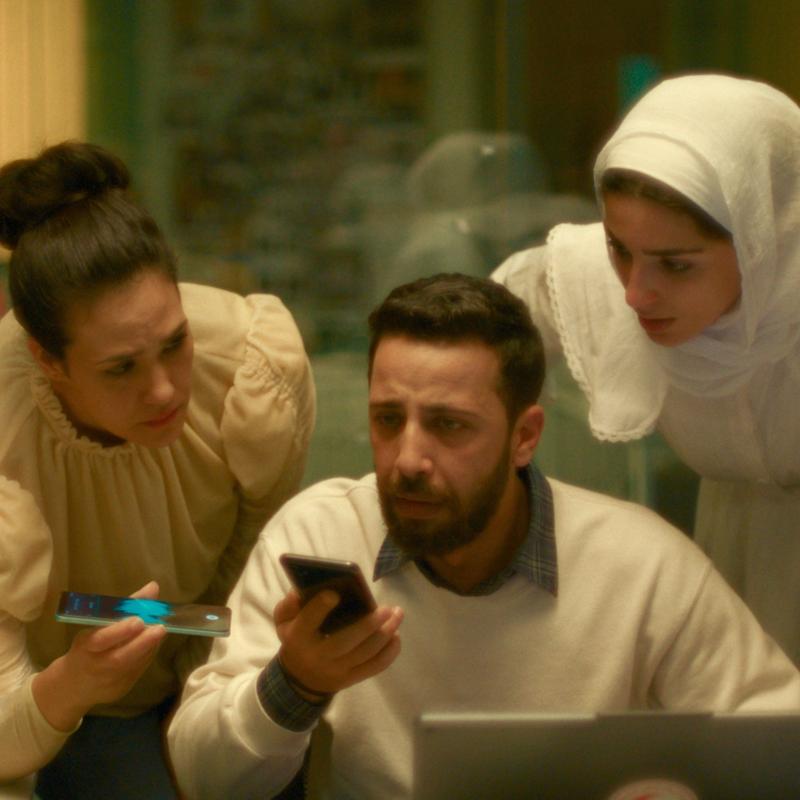
She was alone except for the voices of Red Crescent emergency workers who stayed with her on the phone as she pleaded for help and tried to find a way to rescue her. The recordings of her voice on the phone begging to be rescued were heard around the world via social media. Now Hind's voice can be heard again through a unique film that blends documentary and fiction. The Voice of Hind Rajab focuses on the Red Crescent workers who worked tirelessly to try and save her.
Now those workers are portrayed by actors, but the voice of the little girl on the line are the real voice recordings of Hind. The Voice of Hind Rajab has been shortlisted for Best International Film at the Oscars, and it took home the Silver Lion Grand Jury Prize at the Venice Film Festival last year. It's now playing at Film Forum and in select theaters in New York. I'm joined now by the film's director, Kaouther Ben Hania. It's nice to meet you again. Actually, I met you during Four Daughters.
Kaouther Ben Hania: Exactly. Thank you very much. Thank you for inviting me.
Alison Stewart: When was the first time that you heard Hind's voice?
Kaouther Ben Hania: Actually, it was not long time after the event. I was with Four Daughters doing the Oscar campaign, and I was at the airport in Los Angeles. I was glued to the news, following what was happening in Gaza and thinking about what kind of story I can tell when the unthinkable is happening in reality. It was in this position of despair. I heard The Voice of Hind Rajab. It was a small extract on internet, on social media, as you said, and it haunted me. I couldn't unhear it.
I was about to start another movie, which was written, financed, and I stopped everything because I couldn't do or think about any other thing than this little girl pleading for her life, surrounded by the dead body of her family and asking to be saved. I had this strong feeling of helplessness, and I hate it when I feel helpless. I asked myself, "What can I do?" I couldn't save her, but I can do movies. From there started the idea to do this movie.
Alison Stewart: I know you were able to speak with Hind's mother about making this film, and you wanted her to agree before you moved forward. What did she want you to know about her child? What does she want to know about the film before she said yes?
Kaouther Ben Hania: At the time, yes, it was the first step, because I have no legitimacy if the family don't want to. It was the first step. I called Hind mother. At the time, she was still in Gaza in a very horrible situation. She was mourning, but at the same time, moving from one house to another. She's for me at least, we became very close now, since the first call, the representation of resilience. She's a very courageous, strong woman, and she told me, "My daughter is not the only child in Gaza. Every day there is Hind Rajab's ongoing and I want justice for my daughter. If this movie can help in a way, to bring some accountability in this horrible world, please do it."
From there, having her words in my mind, I started working on this movie, and we kept in touch. I'm very happy that she was evacuated from Gaza finally. It was a long process, but we succeeded. Now she's in a safe place, and we met actually physically, which was a very, very moving encounter because we met, me, my actors, and the real Red Crescent person, the far real hero, and Hind's mother. We met in a film festival around the movie, and it was very, very moving moment.
Alison Stewart: I'm sure it was. My guest is director Kaouther Ben Hania. We're discussing her film The Voice of Hind Rajab, which uses actors and the real voice recordings to tell the story of the Red Crescent workers who attempted to rescue a little girl from Gaza City. The film is so interesting to watch because it's narrative nonfiction. It's a real story with fictionalized parts, but the audio from Hind is real. Why did you think that blend of fact and dramatization of events fit the story? Why was it the way to tell this story?
Kaouther Ben Hania: This story was investigated. The proof are there. The forensic architect did a great job identifying which weapon, which Israeli tank was firing at this family with the satellite image, analyzing the sound. The Washington Post did a great piece of investigation about this story. I was thinking what cinema can bring more than proof, more than explaining what happened? I thought that cinema, and that's why I love cinema, can bring empathy, can bring emotion.
Let's not stop explaining and let's live the life of those Red Crescent employee. Their job is to save lives, which is a very noble thing, and they are working in impossible situation, being faced with moral dilemma imposed by the Israeli army because they can't send an ambulance. The ambulance in this story is eight minutes away from this little girl, and they couldn't send it because they risk the life of their aid worker.
If they go there to save this girl, they will be bombarded by the Israeli army, and they needed to have the approval of the Israeli army. This is why this call was so long, because Hind was on the phone telling them, "Come and get me." They can't because their colleague can be killed. It took them all this time to do coordination operation through intermediary with the Israeli army, so the Israeli army give them a green light and don't bomb their ambulance.
There is no spoiler in this movie because it's a known story. When they got the approval from the Israeli army, they sent the ambulance. This is in the recording, actually. We have the voice of Yusuf Zeino, who's one of the two paramedics sent to save Hind. He sees the car. He's meter away, and he says, "There she is." We hear the bomb. They were bombed, killed, and then the phone was cut with Hind. Then they spent 12 days under siege, and nobody had news from them.
Alison Stewart: At one point in the film, towards the end of the film, you show the real Red Crescent members on cell phones, and you blur the actors in the background, and it goes back and forth a little bit. Why did you want to make sure that the audience saw the real Red Crescent workers?
Kaouther Ben Hania: Because what I just said, when I was listening to the recording, which was the starting point of this movie, and following this coordination thing, and finally, the ambulance was sent. When I heard the explosion, how they bombed the ambulance, I told myself, "This is not real," which is a paradoxical sentence, because it's real. I was thinking, my job as a filmmaker is to find the right form, to express those things.
I had this incredible archive filmed by the Red Crescent people at this exact moment when they heard the real person, they heard the bombing of their colleague, and they were trying to understand what happened. At this moment, I said, "I have to tell the audience this is real. Let's go to archival documentary mode at the end of the movie."
Alison Stewart: We got a very nice text that says, "This is the best movie of the year. A compelling and very moving real story. Thank you to the filmmaker for bringing this tragic story to the screen for the world to see." I just wanted to read that to you.
Kaouther Ben Hania: Thank you.
Alison Stewart: The set was created in Tunisia. It's the Red Crescent Center. That's where most action takes place, within the Red Crescent Center. Why did you choose to keep all of the action in one location?
Kaouther Ben Hania: For me, it was out of question to do the mise en scène of this little child in the car. For me, it's an ethical question. We have her voice. Her voice was alive, was strong, and I needed to honor her voice. I wanted to shoot this movie with a respectful distance, which is from the point of view of those who listen it. It's in the offices of the Red Crescent dispatcher. Their position, in a way resemble to our position around the world because we are hearing voices coming from Gaza. We are seeing in social media, but we have our hands tied.
The position being in those offices, there is not a drop of blood in the movie. There is no graphic images. We are just filming people in offices. It sounds very boring like this, people in offices. When we understand what is happening to them and how they will do everything possible to save this little girl, I was personally in admiration to those people. I wanted also to pay homage to their struggle, to their work saving life during very, very hard situation.
Alison Stewart: You were able to connect your actors with the real-life Red Crescent workers who they are playing. What did your actors hope to learn from the real Red Crescent workers?
Kaouther Ben Hania: It's a paradoxical thing for an actor to play a living human being, because actors are used to a character written on paper. For them, it was a responsibility. They needed to talk to the real people, to ask them question, to depict them in a very accurate way. The actor in this movie, I was so lucky to find those four great, wonderful actors. They were aware that they are vessels for the real person. The connection between them was very, very important for the movie.
Alison Stewart: We're talking about the film The Voice of Hind Rajab. I'm speaking with its director, Kaouther Ben Hania. We'll have more after a quick break. This is All Of It.
[music]
Alison Stewart: You're listening to All Of It on WNYC. I'm Alison Stewart. My guest is director Kaouther Ben Hania. We are discussing her film The Voice of Hind Rajab, which uses actors and real voice recordings to tell the story of the Red Crescent workers who attempted to rescue a little girl from Gaza City. We hear Hind's voice, little girl's voice, and often we see waves on the screen like radio waves. How did you come upon that choice?
Kaouther Ben Hania: This movie started with the voice of this little girl, the voice of Hind Rajab. At some point, I wanted the audience to listen because I found her voice on social media. As you may know, social media is not a great place for remembrance, for grief. It's scrolling amnesia thing. At some point, even filming was too much. I needed the audience by moment to listen.
That's why at some point in the movie when she's saying something that moved me beyond any strong emotion, I wanted to share it with the audience in a raw, rough way only the recording, only her voice, because her voice, we can feel the fear, we can feel the strength also because she was commanding them, telling them, "Come and get me right now." For me, it was very important to make room for her voice.
Alison Stewart: I want to ask you about the few of the actors that you worked with. Rana is the Red Crescent worker who seems to have developed a special relationship with Hind over the phone. Hind seems most comfortable talking to her. What did you learn from Rana about that relationship that they built on the phone?
Kaouther Ben Hania: The real Rana, we talked a lot. She told me something that moved me, which is for those three hours-- She don't have children, but then become her daughter in a way. Actually, she became very close with Hind mother, and she is the one who gave me Hind mother number.
Alison Stewart: Oh, I see.
Kaouther Ben Hania: She become like a posthumous mother for Hind. They make this promise because Rana lives in Jerusalem, and Hind's mother at the time lives in Gaza, this promise that one day they will go together to the grave of Hind to make a prayer. Rana is professional, but with this specific case, she was the mother of this voice, I would say.
Alison Stewart: Then there is Omar versus Mahdi. It's not versus. Both of them are trying to do their jobs. Omar is the one taking calls from people. Mahdi is responsible for coordinating the rescue, and their tension is a big part of the film. Omar tells Mahdi that it's because of people like him that their country is occupied in a moment of tension. How did you want to explore the conflict through these two characters?
Kaouther Ben Hania: Both of them want the same thing to save this little girl. Omar is impatient. He want to save this girl right now because her life in danger, which is understandable. He want to send his colleague in Gaza to save her. Mahdi, he's older, and he know, because he lost a lot of colleague, that if they send the ambulance like this, his colleague will be killed. He needs to follow a set of Kafka rule set by design by the Israeli occupation to make this mission quasi-impossible. He wanted to follow the rules.
We have this character who needs to follow the rule to protect his colleague and the other character who have no trust on those rules and on the Israeli army, and he want to save this little girl right now. The two positions are actually very understandable. We often say, "Oh, Palestinians are divided," but they can be divided because they are dominated by a set of rules that make them facing impossible dilemma. I wanted to show this in the movie because, as I said, both of their position is understandable.
The tragedy in this story that we follow Mahdi strategy, which is being sure to follow every step and doing things by the book so the Israeli army don't bombard his colleague and receiving the green light and everything but the Israeli army bombarded his colleague. We are in something beyond cruelty and beyond the unthinkable. Mahdi, the real Mahdi, there is a scene in the movie to explain to Omar why he don't want to send his colleague. He showed the photo of the other killed colleague by the Israeli army. He said, "If there is a new photo added to this wall, I'll resign." This is what he did, actually, after--
Alison Stewart: Really?
Kaouther Ben Hania: Yes, after the killing of his colleague because his job mainly is to send people to rescue people, but by doing this, the people he's sending, taking the responsibility to send them, are killed by the Israeli army. It's an impossible job.
Alison Stewart: Much of the film involves tight close-ups on your characters' faces. Why did you want to spend so much time so close on their face, whether they're talking or not?
Kaouther Ben Hania: In cinema, I love close up. I love close-up done by Bergman. I can tell you how many filmmaker I admire for doing close up because I think that we all know that the human face is something very strong, in terms of it's a mirror for the heart, for the emotion.
With my DP, Juan Sarmiento, he's from Colombia, and he's a great DP, we decided to do handheld camera to be very close to the emotion of the actors because they weren't performing actually. The actors were hearing the voice of Hind Rajab for the first time on the shoot so their reaction are not like acting or performance. I knew because their reaction are genuine and true, I couldn't ask them to do second take and to do it that way. It would be not the right place to work like this in this movie. We decided to be close to them to capture their raw emotion, and it gave this movie this closeness and this style.
Alison Stewart: As one character points out in your film, there have been so many stories and pictures of children dying during the war in Gaza. Why do you think the story of Hind Rajab broke through?
Kaouther Ben Hania: Because it was recorded. Hind mother told me, imagine you see the pain of the story of Hind, imagine all the voices of the children who were killed without being recorded or captured, and multiply this. We talk about 20,000 killed child. Multiply the pain we felt for Hind with this number. It's something beyond the capacity of a human heart to contain.
Alison Stewart: What's been the response of people to the film? What have people said to you, something that stuck with you?
Kaouther Ben Hania: Something?
Alison Stewart: Yes. If something that someone has said to you about the film that has really stayed with you.
Kaouther Ben Hania: There are two elements. People are afraid to go to watch the movie. Some people they don't think that they can take it. I, in general, tell them you have to bear witness.
Alison Stewart: Oh, [unintelligible 00:24:10]
Kaouther Ben Hania: It's not your life. Thanks God, you are privileged. You have to bear witness, and if it's really too hard, do something about it. It's better than hiding. When people watch the movie, the same people afraid they are very grateful because they witnessed something very strong. It's a human connection, this movie. There is something that transcend a partner's religion because we are talking about child. The most significant feedback I had from audience I've been doing Q&A is when people tell me this movie changed me. This is for me, very, very flattering as a filmmaker.
Alison Stewart: We got a text that says, "Thank you for making this film that will hopefully ignite righteous outrage and action in viewers toward a just world." The name of the film is The Voice of Hind Rajab. We've been speaking with its director, Kaouther Ben Hania. Thank you for being with us.
Kaouther Ben Hania: Thank you. Thank you very much.