
The Story of NYC's Legendary Venue "The Bottom Line"
Alison Stewart: This is All Of It. I'm Alison Stewart. What do Patti Smith, Ravi Shankar, Linda Ronstadt, Prince, Billy Joel, and Dolly Parton have in common? They all performed live on stage right here in New York at the legendary music venue called The Bottom Line. It opened in Greenwich Village in 1974 by co-founders Allan Pepper and Sandy Snadowsky. I hope I said it right. They use their networks among jazz artists to create something special. As musician Jimmy Vivino says in a new book, "It was a rock club that was kind of like a jazz club where you could actually sit down."
The venue made a point of looking for opportunities in the music world without ever pigeonholing the scene into a particular genre. That flexibility and love of music allowed The Bottom Line's founders to remain a staple of NYC's live music scene for 30 years. A new book called Positively Fourth and Mercer: The Inside Story of New York's Iconic Music Club, The Bottom Line is available now. It's presented as an oral history by those involved, including Allan Pepper, who joins us now as the club's co-founder, and his co-author of the book, music journalist Billy Altman. Allan and Billy, thank you for being with us.
Billy Altman: Great to be here. Thank you.
Allan Pepper: Thanks, Alison.
Alison Stewart: Hey, Listeners, do you have memories of concerts or other great times that you had at The Bottom Line? I know I do. Give us a call and [chuckles] tell us what you remember. 212-433-9692, 212-433-WNYC. Billy, how did you and Allan connect to make this project happen?
Billy Altman: Well, it's interesting. I went to shows at The Bottom Line as a working critic and journalist basically from the time it opened in 1974, just about to when it closed in 2004. After the club closed, I did a piece for a magazine about the club closing. I guess over the years Allan was thinking about trying to do a combination memoir history of the club, and he kept coming back to the article that I had written. Then, finally, a couple years ago, he got in touch with me and said, would you be interested in doing this? I thought, this could be a very interesting project, [chuckles] and indeed it did turn out to be.
Alison Stewart: Allan, did you have any sort of ground rules that you had with Billy when starting out on this project?
Allan Pepper: Yes, Alison. I knew I just did not want it to be a bunch of stories about nights at The Bottom Line, although that's certainly a part of it. I said to him I want it to be a narrative, I wanted to have a beginning, middle, and end, and I want there to be the presence of my partner, Stanley Snadowsky, who's no longer with us, and my wife, Eileen, who was very important to me, and really, a muse throughout our whole life together.
I looked at it, and I presented it to him. I said, "Billy, this is actually a love story. It's about a time and place, and it's a love story to friendship, romance, and following a dream." That was the context we set up.
Alison Stewart: Billy, in the first few pages, you have Paul Shaffer, Loudon Wainwright, John Hiatt, Betty Buckley. Later on, there's Suzanne Vega telling stories, Bruce Springsteen, even Buddy Guy. When did you decide that an oral history would be part of its form?
Billy Altman: Well, Allan was the one that suggested we try and do it as an oral history, and as a lifelong critic and journalist, I was like, hmm, because oral histories can be a little tricky. I think once we found a way in, which was to proceed chronologically and to just tell the story, because it's so much a story about the city. It's a story about Greenwich Village. It's a story about radio. It's a story about the music business. It's a story about a club that's juggling all of these balls throughout its entire history.
Once I was able to find a narrative, then it kind of began to take shape. Then, it was just a question of how many of the more than 3,000 artists that played the club were we going to interview and the genres of music that were covered, because The Bottom Line presented everything in its history. It was a challenge, but Allan was great at guiding me towards people to talk to, and then there were musicians that I've known through the years, people associated with the club as well. Eventually, it started to take shape.
Alison Stewart: Allan, The Bottom Line opened in 1974. What was the shape of the music scene in Greenwich Village at the time?
Allan Pepper: It was a lot more open than by the time it closed. There were a lot of different kind of music clubs. Well, actually, when we opened in '74, the Village wasn't having this renaissance. This renaissance actually began once we were there because we were open in a fairly desolate part of the city. In terms of what we started presenting, we were starting to draw 5,000 and 6,000 people a week into that area, so the whole Village kind of rejuvenated.
CBGB's had opened, actually, I think, several months before. There was CB's, there was The Bottom Line, and there was Reno Sweeney's, and ultimately, there was a very healthy music scene, certainly in the mid-to-late '70s in the Village.
Alison Stewart: Yes, Billy, CBGB's opened just a couple of months before, and it was sort of a place where you could be like a punk rock, and sort of iconoclastic artists appeared there. What did a venue like The Bottom Line offer as a different perspective?
Billy Altman: It was so interesting, because from the time that I first started going there, the club had immaculate sound. The sound system was tremendous. The sight lines were tremendous. You could see from basically any place that you sat, and I was with the critics all the way in the back. The club was built with little tiers so that even if you sat in the back, you could just look straight through. When I started to work on the book with Allan, he started telling me about how he and Stanley purposefully built the club from scratch.
They took over a place called The Red Garter, which had been a beer and banjo joint with people with armbands, and that kind of stuff. They built the club to be a listening room more than anything else. I think once the club established itself as a listening room, it wasn't so much a scene like you went to CBGB's, you hang out with the punks. You go up to Studio 54, you hang out with the disco crowd, and I was doing all of that [chuckles] also during this.
Alison Stewart: You were busy.
Billy Altman: I was busy as a working critic. At The Bottom Line, it was really whoever played there that night, that's the kind of club it was. When Jimmy Vivino said that it was a rock club, it was a folk club, it was a jazz club, it could be a comedy club, it could be a theater club. Every night at the club was like that.
I like to tell everybody that maybe my two favorite nights in a row at The Bottom Line is in the spring of '77, they're finishing up Lou Reed, who's basically, as Lenny Kaye put it, sparring with his audience, almost getting into fights from the stage, and the next night, there's Dolly Parton playing her first-ever solo show in New York and charming the pants off of Mick Jagger and all the celebrities that had come to see her. Those two nights in a row was the same room, but a completely, completely different atmosphere. It was to Allan and Stanley's credit that they could pull that off night after night after night over all the years.
Alison Stewart: Allan, why'd you call it The Bottom Line?
Allan Pepper: Well, it's so Interesting. Stanley and I decided that we wouldn't call the club something that both of us weren't in love with. I went in with a whole set of things, and he hated it. He came to me with a whole set of things, and I said, keep thinking. Then, Stanley was in Puerto Rico, and a friend of ours who worked for Record Company came by where I was working in Folk City. We went out to eat, and I said, "Did you have a good time?"
Because he was working for Electra Records, and they went out to one of those retreats, and I said, "Did you have a good time?" He said, "We had a great time until The Bottom Line boys got there." When I heard that, I said, that's the name. I called Stanley in Puerto Rico, and I kind of held my breath, and I said to him, "Stanley, what's the one term that's used in the music business more than any other term?" He instantly said, The Bottom Line.
Then, he tried it out like he was tasting a fine wine. He said, "Hm, The Bottom Line. The Bottom Line. The Bottom Line." He said, "Yes, I think that could be it." It spoke to what both of us were about. For me, the whole thing was about the music and putting together the best of what was available, and for him, it was always about making the deal. It was always about the bottom line. It spoke to both of us.
Alison Stewart: We are talking about the new book Positively Fourth and Mercer: The Inside Story of New York's Iconic Music Club, The Bottom Line. My guests are co-authors music journalist Billy Altman and Bottom Line co-founder Allan Pepper. We have asked you for your remembrances of The Bottom Line. Our phone lines have exploded. Let's talk to some people. Hi, Rob from Brooklyn.
Rob: Hi. I wanted to share something about Allan's kindness and also making The Bottom Line a place that was affordable. I was a poor kid growing up in Coney Island, and The Bottom Line became sort of my second home when I could go there. There were occasions, and so this is long overdue, thank you, Allan, when I was a couple of dollars short, and he would tell the ticket people, "Just give him the ticket for," whatever I had. That was one thing that made it really, really nice.
Also, there was no minimum. There was no two-drink minimum. If you wanted to buy food, you did. It made it so nice, and I always knew just intuitively that it was about the music for him as well. Yes, he was a businessman, he had to stay in business, but that was not the priority. That came through even as I was a teenager. Thank you so much. I had so many wonderful nights there, and you were a big part of making that happen. Thank you, Allan.
Alison Stewart: Thank you so much.
Allan Pepper: Thank you.
Alison Stewart: Let's talk to Scott in Manhattan. Scott, what do you got to say?
Scott: Hi. I'm a huge fan of all three of you. First of all, Jimmy, I have to express my condolences about your amazing brother Floyd. Floyd Vivino was one of the greatest entertainers in history, and anyone who's familiar with him will back me up on this, he's also one of the greatest piano players I've ever seen. It's so tragic because I think there-- Jimmy, am I wrong? There are thousands of songs [crosstalk]--
Alison Stewart: Jimmy's actually not-- Jimmy's somebody I quoted in the intro, but thank you for your call. We really appreciate it. I want to get to more questions, but we're running out of time. Let me get to my questions. I'm sorry to put the callers on hold. Let's talk about Bruce at The Bottom Line. What did you discover when you decided to talk to Bruce for this book?
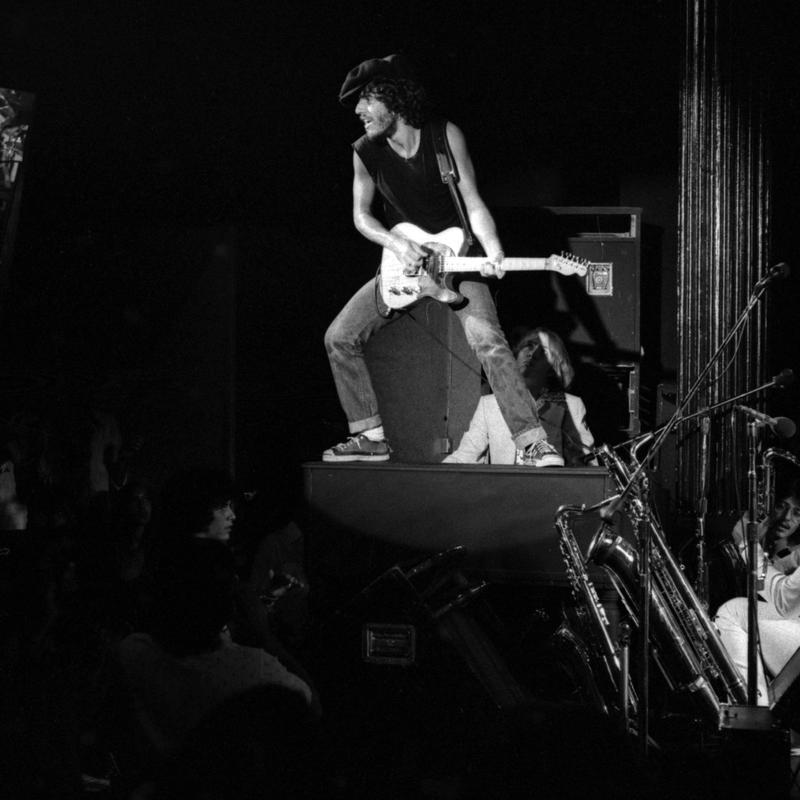
Billy Altman: It was so interesting because Bruce has talked about his shows there, and his five-night stand in which he did two shows a night, he was, what, 24, 25 years old, he said to me, "I could do that in those days." He could do back-to-back shows. His Born to Run album was just about to come out, and when we were able to talk to pretty much so many people that were involved in that, and to hear from him that those five nights, he found the Bruce Springsteen on stage that he was still working on getting to. Allan can speak to the show that he did a year before when he hadn't quite gotten there yet. Right, Allan?
Allan Pepper: I was not necessarily a believer. He had performed the year before. He came out kind of in an undershirt with dark glasses, kind of like that Marlon Brando kind of thing. You could see he was working on something. You could see it was happening, but he hadn't found it yet. For me, as a businessman, the shows were interminable. I kept walking around saying to myself, "Come on, Bruce, I got another show to do. Let's move this along. Come on."
If you had brought a hundred of your friends, he was there for three nights, I could have gotten you the best seats in the house. Flash forward a year from that point, we have lines down the block and around the corner, and I'm waiting to let some people in in front. We start talking, and two people had driven up from Philadelphia, and they said, "Since we've seen Springsteen, he's killed live music for us." I said, "What are you talking about?" They said, "We can't see anybody else with maybe the exception of The Kinks." I'm thinking to myself, "These people need serious therapy."
Anyway, this show happens, and Bruce comes on, and holy mackerel, it had come together for him. He was amazing. By the end of that engagement, I understood what people meant, because I couldn't-- I had a lot of great acts that followed him, but his essence and spirit and energy was still in that room. It was just an amazing experience. One last thing I'll say. For people who might want to buy the book and might be interested in this Springsteen chapter, Billy has done an amazing job because he spoke to so many people. He actually puts you in the room. You actually feel that you're sitting at one of those tables watching that concert.
Alison Stewart: This text says it all, "The Bottom Line is one of the city's lost treasures." The name of the book is Positively Fourth and Mercer: The Inside Story of New York's Iconic Music Club, The Bottom Line. You should definitely get the book. Billy Altman, thanks for being with us,-
Billy Altman: Thank you.
Alison Stewart: - and thank you, Allan Pepper.
Allan Pepper: Thank you, Alison.