
The Secret World of Roald Dahl
Alison: This is All Of It. I'm Alison Stewart, live from the WNYC studios in SoHo. Thank you for spending part of your day with us. I'm really grateful that you're here. Coming up on today's show, sports reporter Matt Futterman will help us kick off our Winter Olympics coverage as the events get underway tomorrow in Milan. Listeners, we want to hear the competitions you're most excited for. Musician Jesse Malin will perform live in our studio. His new one-man off-Broadway show is called Silver Manhattan. That's the plan. Let's get this started with a beloved children's author.
[MUSIC - Luscious Jackson: You and Me]
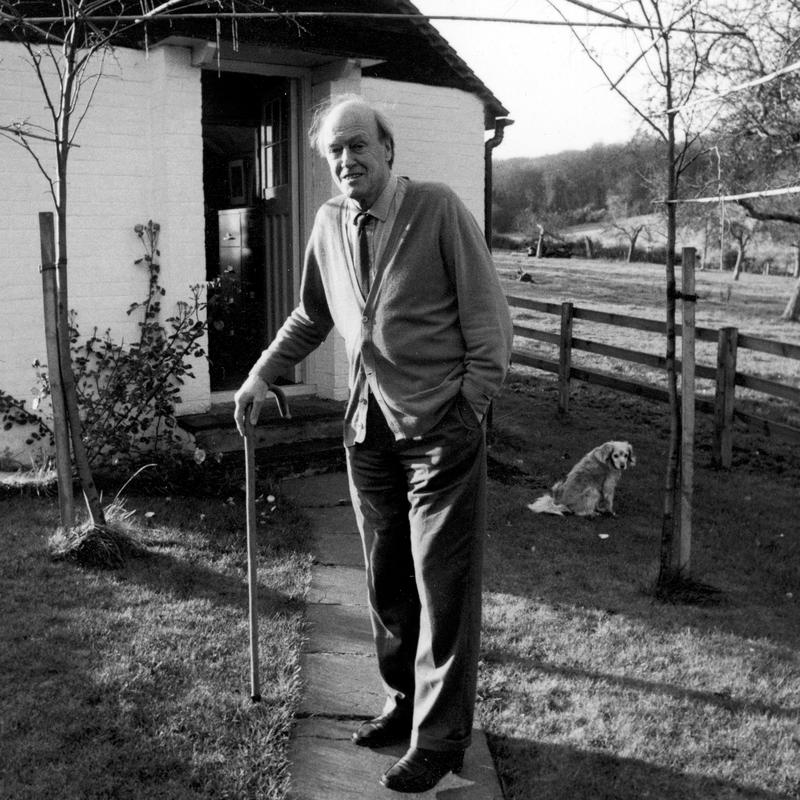
Alison: Picture this. During the Second World War, a young former RAF pilot charms his way through Washington DC and New York City in his job as a British spy. He gambles with powerful figures like Harry Truman and media mogul Charles Edward Marsh and seduces movie stars, heiresses, and other people's wives, all in the name of British intelligence. No, his name was not Bond, James Bond, but keep that in mind. His name was Roald Dahl, who went on to become one of the most read writers in the world. His books, like James and the Giant Peach, Matilda, and of course, Charlie and the Chocolate Factory, have sold millions of copies, and they are continually being adapted for stage and screen.
A new podcast chronicles the early life of Dahl from his days as a fighter pilot to his life as a spy to his accidental writing career. It also looks at how his traumatic childhood and numerous battle scars might have informed some of his more prickly tendencies as well as some of his more controversial statements, without excusing them. It's called The Secret World of Roald Dahl, and its creator and host is author and screenwriter Aaron Tracy, who is here with us now. Welcome to the show.
Aaron Tracy: Thanks so much. I'm so happy to be here.
Alison: Listeners, what is your favorite work by Roald Dahl? What questions would you want to know about him? Give us a call 212-433-9692, 212-433-WNYC. What's your first Roald Dahl story?
Aaron Tracy: Let's see, I think the first one I read, like so many people, was James and the Giant Peach when I was a little kid, probably first grade. It was also the first book that Dahl wrote, which I was really surprised when I did my research. That was the first book he wrote. He was 46 when he wrote it. He had such a big life before he ever got into children's books, so many different chapters of his life.
Alison: It's interesting because you teach creative writing at Yale. What do you think a student can learn from Dahl as a writer?
Aaron Tracy: So much. Dahl contains multitudes as a writer. He not only wrote these extraordinary children's books, like James and the Giant Peach and Charlie and the Chocolate Factory and Matilda, but he also wrote a ton of adult fiction. He wrote for Playboy, he wrote for The New Yorker, he wrote all sorts of screenplays and teleplays for Alfred Hitchcock. Depending on you know what kind of writing you're interested in, depending on your age, you can find almost anything in Dahl.
Alison: What made you go down the rabbit hole of Roald Dahl?
Aaron Tracy: I was looking for someone to write about. As you said, I'm a dramatic writer, and Dahl kind of was the perfect person sitting out there. One, because there had not been a ton about him. There have been very few movies where he appears as a character, but he does hold this kind of rarefied place in the public consciousness, in that he shaped so many of our childhoods. Then when I started digging into him, like I said, his story is just extraordinary. He was a fighter pilot, he was a British spy for MI6, he was an amateur neuroscientist, and so it was just the perfect subject to dive into.
Alison: When you're researching something, you go back to a certain source over and over again. Sometimes you go back to the source at the beginning, and it makes more sense after you've gone through what you consider to be your research. What was one area that you went back to again and again on him?
Aaron Tracy: That's a good question. I'm a huge movie buff, and so I was really interested in the Hollywood chapter. When Dahl was 26 years old, he wrote a short story called The Gremlins, which has nothing to do with the Steven Spielberg-produced classic. It was the short story that was all about British-American cooperation in order to defeat the Germans. It got passed around Washington, and Eleanor Roosevelt got her hands on it and loved it. It got to Walt Disney eventually, and Disney wanted to make it into a movie.
He flew Dahl out to Hollywood and put him up at the Beverly Hills Hotel and got him a driver. It was like Dahl was going to be a screenwriter. He was going to be Ben Hecht, or he was going to be some great screenwriter, but things did not work out. Dahl was not able to collaborate. Disney eventually dropped the project. Dahl did not give up and had a series of failures in Hollywood, as so many people do, but when we think of Dahl, we think of extreme success in writing. It was one miss after the next in Hollywood for him, which I was really interested in until he wrote the fourth James Bond movie, which was informed by his own experiences in MI6. That was a huge hit and set him up for the rest of his life.
Alison: I'm speaking with Aaron Tracy, creator and host of The Secret World of Roald Dahl podcast. It's the first three episodes are out now, wherever you get your podcasts. We're asking you, what is your favorite work by Roald Dahl? What question would you want to know about him? Give us a call 212-433-9692, 212-433-WNYC. Am I saying his name right?
Aaron Tracy: [laughs] That's a great question. I think people I know certainly say Roald Dahl, but the correct pronunciation is Ruel.
Alison: Ruel Dahl?
Aaron Tracy: Yes, but you sound kind of, I don't know-- I'm too embarrassed to pronounce it that way. I think that I would sound kind of silly. His wife, Patricia Neal, certainly says Ruel.
Alison: All right. I'm going to say Roald Dahl, just sort of--
Aaron Tracy: It's accepted.
Alison: Okay, thank you. It's an unusual name.
Aaron Tracy: Yes.
Alison: Where's it from?
Aaron Tracy: He's Norwegian. His parents were Norwegian and British. I think that's one of the things to having such a strange name to American ears, and being 6'6" and being as striking looking as he was, has contributed to this overall impression that we have of him being a real-life BFG. He just seems so otherworldly.
Alison: I wanted to ask you before we get into the podcast, some of the details of the podcast, how did you just decide to deal with his difficult side and the antisemitic statements that he made?
Aaron Tracy: The antisemitism is certainly a very personal issue for me. It's something I was really grappling with, so I brought on a bunch of critics and thinkers much smarter than I am on this issue and talked to them on the podcast. I bring on The Atlantic's Yair Rosenberg, I bring on Roxane Gay, Claire Dederer, who wrote a definitive text on this issue, and everybody comes down in a different way. He was an unrepentant antisemite. There was an interview he gave with a New Statesman in 1983, where he said, "There is a trait in the Jewish character that does provoke animosity. Even a stinker like Hitler didn't just pick on them for no reason."
There's a play coming to Broadway, starring John Lithgow, that's going to really tackle that interview specifically, and this subject. It's difficult for me. I think the reason that I'm able to still read Dahl and enjoy Dahl is because I can't locate the antisemitism in the text. Some people say they see antisemitic tropes in the witches. I'm not sure I agree with that. If I can't see it in the text, then it feels a little bit hypocritical for me to deprive my children, for instance, of reading Dahl when I don't deprive myself of watching the movies and reading the books of people that we now know are monsters.
Alison: He grew up in England. Where did he grow up? What was his childhood like?
Aaron Tracy: He grew up in a place called Buckinghamshire, and his childhood was really tragic. When he was three years old, his father and his sister died within three weeks of each other. That colored Buckinghamshire for him. That really obviously was the biggest event of his childhood and something he never got over. A big part of my podcast is about Dahl's search for identity. His whole life, he was searching for who he was. I think part of that stems from not having a father growing up because it very much feels like he was trying to figure out not only what kind of man he was, but what it even meant to be a man in his part of the century.
He became a businessman first, and that didn't quite take, and then he became a fighter pilot, and that didn't take, and then he became a spy and a playboy and a screenwriter and a short story writer like Hemingway. He was just trying on all of these different, what felt to me like masks of masculinity, trying to figure out who he was.
Alison: Let's take a couple of calls. Let's talk to Allison, who's calling in from the Bronx. Hi, Allison. Thanks for taking the time to call All Of It.
Allison: Hi. Thank you. I grew up in Cincinnati, and when I was in the third grade, which was the early 1990s, our entire class each wrote individual letters to Roald Dahl because our teacher was reading us James and the Giant Peach, and we had to do a book report on a Roald Dahl book, but he actually took the time to write our entire class back. It was just one letter, but it was neat-
Aaron Tracy: That's amazing.
Allison: -because he would answer some of the questions that some of us had written to him. I remember he had opened up the letter, and he addressed it to our teacher, and he called her the beguiling Ms. Carol. We all thought that was quite funny. That's all I wanted to share.
Alison: Thank you so much for sharing that story. Does that surprise you?
Aaron Tracy: No, that's a beautiful story. For all of the terrible things that Dahl's wife of 30 years said about him in her memoir, and there were a lot of terrible things, she always said what a great, great father he was. Dahl was fantastic with kids. He truly loved kids. All of the dark side that was really separate from the way he treated, certainly sounds like you and your classmates and children in general.
Alison: Let's talk to Laura, who's calling in from Manhattan. Hi, Laura. Thanks for calling All Of It.
Laura: Hi. I was going to say, my son's four, and I'm starting to read him books out loud, which I love. My mother did to me. We started with Charlie and the Chocolate Factory because his name is Charlie and he loves chocolate. We read it on long car rides, but then we tried to read the second one, The Great Glass Elevator, and it's just too bizarre. It's like, I actually don't even know what the plot of that book is. There's aliens, and then the United States is involved in a hysterical way that feels very relevant today, but we never finished it. We moved on to James and the Giant Peach.
Alison: Thanks for calling in. There's two interesting things that we discover in the podcast that Charlie initially was supposed to be a Black boy.
Aaron Tracy: Yes.
Alison: Could you tell us that story?
Aaron Tracy: Yes. Dahl spent a bunch of time when he was trying to be a businessman. He was working for Shell Oil, and they sent him to Africa, to Tanzania. He had a lot of time to just sit around and observe, and that's where he came up with the idea for Charlie and the Chocolate Factory. The character was based on a little boy he knew there. It's remarkable to think about how different the story would have been perceived.
You remember the family in Charlie and the Chocolate Factory, they're incredibly poor. The grandparents all share a giant bed, and then Charlie triumphs at the end. I think if he had remained Black the way Dahl wanted him to be before his editors insisted that he become white, I think it could have been seen as a story of a racial reckoning. It just would have been very, very different. It's fascinating to think about.
Alison: I'm talking about the new podcast, The Secret World of Roald Dahl. I'm talking to its host and creator, Aaron Tracy. The first three episodes are out now. We're asking you to call in with your favorite work by Roald Dahl, or what would you like to ask a question about him? Perhaps you have one. Give us a call at 212-433-WNYC, 212-433-9692. I want to get into his spy life a little bit because the first three episodes talk about that quite a bit. He became part of a cohort called the Irregulars. It sounds like dun, dun, dun, the Irregulars. Who were they? What was their mission?
Aaron Tracy: It's amazing. It's this group of British spies living in DC and New York, all working for this legendary spy named William Stephenson. In New York, they actually worked out of 30 Rock, where Saturday Night Live is filmed now, very strangely, and that's where Dahl got the idea for The Great Glass Elevator, actually, the incredible elevator in 30 Rock. The Irregulars were a group that was operating right before America got into the war, and their job was to help bring America into the war on Britain's side.
It was Britain's darkest hour, and they were going to do anything they could to get America's help. They had all these 20-somethings, including Dahl, coming up with propaganda missions. There was a lot of seduction. Dahl's job was to seduce the wives of powerful Americans who were not yet on the Allied side in order to sway them or even blackmail them. There's a bunch of examples of that. One of the most striking things to me is the eye for talent that Stephenson had.
He brought on Dahl, but he also brought on Ian Fleming, who would go on to create James Bond. He brought on David Ogilvy, who would go on to become the father of modern advertising and was an inspiration for Mad Men, and Noël Coward, the playwright. The way I think of it, these dashing young men, you got to think of Noël Coward, Roald Dahl, James Bond, and Don Draper, all hanging out at a Georgetown bar at midnight at 26 years old, throwing back whiskeys and coming up with propaganda ideas.
Alison: How did he become a spy at 26 years old?
Aaron Tracy: They saw something in him. Dahl was this incredibly handsome, tall, former fighter pilot, who was a fantastic storyteller and incredibly charming. British intelligence saw all of that and said, "You're being a little bit wasted in the RAF. We can use your talents in the espionage game." They sent him to DC and New York in order to get involved.
Alison: Was he good at it?
Aaron Tracy: He was really good at it, yes. His stories of seduction are pretty legendary. He was such a creative storyteller that a lot of the ideas, a lot of the stuff that they were doing, we don't know specifically what exactly came from Dahl, but probably a bunch of it, and it's all very creative and fun and interesting.
Alison: This text says, "My kids grew up with Dahl on repeat. Part of the reason is that in the tradition of children's literature, he deals with the darkness of the world, which I think is very cathartic." Where do we see that?
Aaron Tracy: I totally agree with that. All of his children's books, honestly, have gruesome elements to them. Certainly, the other kids on the chocolate tour in Charlie and the Chocolate Factory and Matilda, there's a lot of darkness and gruesomeness, which you see in the stage play adaptation. I totally agree with that text. Dahl knew that kids didn't just want sugary, sweet, saccharine stories where everything is fine. Children like the darkness because it makes them feel older, it makes them feel a little bit respected that they're starting to sense that the world can be an unfair kind of dark place. This is someone who's actually, if not telling them the truth, at least respecting them enough to show them some dark sides.
Alison: This says, "Talk about weird Dahl stories. The Magic Finger, kid becomes a hunted duck, and the story is traumatic." Where do you think he pulled that darkness from?
Aaron Tracy: I think a lot of it does come from his real life. The tragedy of his youth with his father and his sister dying within three weeks of each other when he was three years old. Then when Dahl got older, he had a bunch more family tragedies, just horrible stuff. His poor son, who was only a few months old, got hit by a taxi on the Upper East Side. His daughter died of measles at seven years old. His wife, the famous Oscar winner, Patricia Neal, had a series of strokes. Dahl was dealing with so much darkness and tragedy in his personal life, and like any writer, it found its way onto the page.
Alison: Let's talk to Rachel, who's calling in from Philadelphia. Hi, Rachel. How are you?
Rachel: Hi, Alison. I'm doing well. I'm originally from New York, I just have to say. [unintelligible 00:17:57]
[laughter]
Alison: All right.
Rachel: My question is about actually one of the gruesome stories of Dahl's that I read when I believe I was too young for it. It's called The Swan, and it's from The Wonderful Tale of Henry Sugar and Six More. Essentially, I'm just curious why, with these gruesome themes, the story of The Swan is a boy is bullied by two other boys. He's tied up to railroad tracks. The train rolls over him, he survives. Then there's animal cruelty, which that involves a swan and the boy with the swan's wings, he flies away, the boy who was bullied. I'm just curious why we do consider Dahl a children's author when these themes are pretty dark. I know I read this too young, since I read it once, and it stayed with me, probably 30 years later.
Also, to your guest, Aaron's point about not being able to read antisemitism in the text. There's a particular instance when the boy is being tied up that he realizes he needs to lie completely flat in order to survive the train that rolls over him. There is a lengthy description of the boy's nose, and how large it is, and how, in order to survive, he needs to move the rocks from behind his head in order to compensate for his large nose. With themes of bullying, with themes of violence against Jews, I'm just wondering if he does see some antisemitism in that text, and also just why certain texts are considered children's stories when perhaps they shouldn't be.
Aaron Tracy: I think that's really interesting and well-observed. The Wonderful Tale of Henry Sugar and the other short stories there, I actually would call those adult stories. Dahl wrote, as I said, a bunch of short stories for The New Yorker well before he ever thought about writing for kids. I would definitely put that book in the category of adults. The title story, The Wonderful Story of Henry Sugar, is an absolutely beautiful story.
It might be my favorite of all of Dahl's works. It's very much a metaphor for the writing life and how someone can be changed for the better through meditation and persistence with their craft. I think because Roald Dahl is so famous as a children's author, we tend to assign some of his stories that were not meant for kids to kids, which is very detrimental.
Alison: Let's talk to Mike on six. Hi, Mike. Thanks for calling All Of It.
Mike: Hey. I was just calling to say that you might've touched on this earlier in the segment, I just hopped in, but I always really liked his book, Kiss Kiss. I always like short stories. It was kind of dark in the vein of like The Twilight Zone or Tales from the Crypt or Edgar Allan Poe, Stories. That was a great short story book. Then there was My Uncle Oswald that I'd read when I was younger, and it had a lot of sex in it and was pretty steamy book. Just when I was younger, getting out of all the children's books that I knew him better as I thought those were two really interesting books.
Alison: Thanks so much for calling in. Let's talk to Patty in Brooklyn. Hi, Patty. Thanks for calling All Of It.
Patty: Hi. I just wanted to talk about Champion of the World. I was a teenager and my mom loved this story, and so she gave it to me and my brother and sister. It's about these two poachers, they're in Ireland, and they want to get all these pheasants off this estate. They push a baby pram out and they've loaded it with fruit soaked in alcohol. They toss it around and the birds start falling off the trees and getting drunk, basically. They pile the pheasants into this baby pram and push it home and push it along the road. It was just hilarious. It inspired my mom on a visit to London to soak a lot of raisins in alcohol and distribute them in Trafalgar Square to see if any of the pigeons fell off.
Alison: That is quite a tale with your mom.
[laughter]
Aaron Tracy: These books are not instruction manuals. I just want to be clear.
Alison: This is from Alec from Hell's Kitchen. "I have a bunch of old Dahl stories from my dad. I admit they've been collecting dust. As someone who has not read Dahl before, what is a good text that is generally representative? What is another text that stands apart from the others stylistically?"
Aaron Tracy: Great question. It really depends what you're looking for. If you're looking for something to read to your kids, I think Matilda is right now my favorite of the children's books. It's just such an extraordinary, beautiful story that's probably a little bit less gruesome than his other children's books.
If you're looking for something for yourself, The Wonderful Story of Henry Sugar, I think is, as I was saying, just a beautiful story about the power of meditation and persistence with craft. It's very much about him as a writer. Also, Netflix made a great adaptation of it. As a previous caller brought up, if you're looking for something sort of raunchy, My Uncle Oswald, you will be very surprised that the author of Charlie and the Chocolate Factory also wrote this very sort of hard R book.
Alison: What is the one thing you learned about Roald Dahl during the making of this podcast?
Aaron Tracy: I truly did learn so many things. I think the most amazing thing might be that I mentioned his son was hit by a taxi and was in and out of the hospital as an infant for years. He developed hydrocephalus, which is water on the brain. There was no valve, there was no device to get the water off the brain without infection. Dahl said, "You know what? I know I'm a writer. I know that this is not my business, but my son's life is at stake." He created a writer's room. He brought in a toy maker, and he brought in a neuroscientist. The three of them together invented a medical device, a valve that was able to save people who suffered from hydrocephalus. It got manufactured around the world, and it's credited with saving 3,000 lives.
Alison: If you want to know more about the secret world of Roald Dahl, you should listen to the podcast. I've been speaking with its creator, Aaron Tracy. Thank you so much for joining us.
Aaron Tracy: Thanks so much for having me. This was great.