
'The Rocky Horror Show' Time Warps to Broadway
Title: 'The Rocky Horror Show' Time Warps to Broadway [music]
Alison Stewart: This is All Of It live from the WNYC studios in SoHo. I'm Alison Stewart. Thank you for sharing part of your day with us. I'm really grateful that you're here. On today's show, a celebration of performances. We'll have live music from a local band, the Fourth Trio, who have been seen at the same subway stop of the same name, an intergenerational conversation between the outgoing and the incoming genies of Broadway's Aladdin, and then Adrien Brody, who stars in The Fear of 13 on Broadway. First, get ready to do the Time Warp again.
[music]
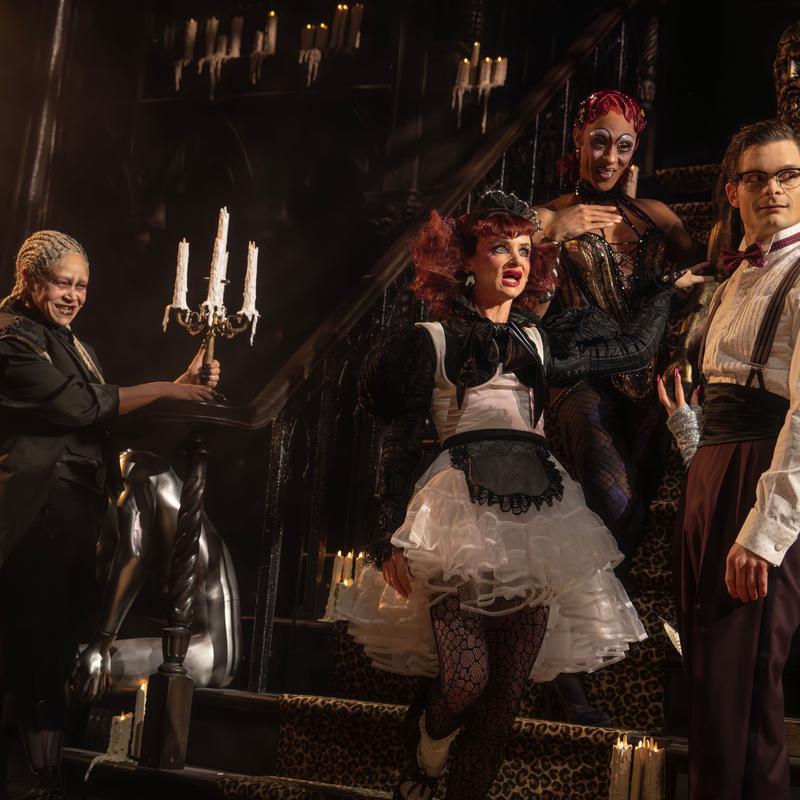
Alison Stewart: Once you enter the doors of Studio 54, you are no longer in New York City. You're in Frank N. Furter's Transylvanian castle because this is The Rocky Horror Show. Just leave the bags of rice and toilet paper at home because this is real live theater. The revival of this 1970s camp, sexy, subversive cult classic features a cast of stage veterans, screen actors, and comedians. At the helm is Sam Pinkleton, who also directed a little show called Oh, Mary! The Musical stars Luke Evans as the seductive and cruel Frank N. Furter. Later, we'll hear from two of his servants, Amber Gray, who plays Riff Raff, and Michaela Jaé Rodriguez as Columbia. They'll also be joined by Stephanie Hsu, who plays Janet, a woman eager to discover more about her sexuality. First, we're going to speak with Sam Pinkleton. Hi, Sam.
Sam Pinkleton: Hi. Thanks for having me.
Alison Stewart: The excellent Rachel Dratch. She plays the Narrator of this Wild Rob. It's nice to meet you.
Rachel Dratch: Hi.
Alison Stewart: Sam, what was your first exposure to Rocky Horror?
Sam Pinkleton: I saw Rocky Horror in my early 20s and was so angry that I hadn't seen it earlier because I thought if I had seen this when I was 15, it would have solved a lot of big problems that I was thinking about at the time.
Alison Stewart: When was the first time you saw it?
Rachel Dratch: I was in junior high. I went with a friend. We put on what we thought was punk makeup. I think I was intrigued because it was just like for me watching early SNL. I don't quite know what's happening here, but I'm really into this.
Alison Stewart: It's interesting. You've been on Broadway before in POTUS. You were great in POTUS.
Rachel Dratch: Thank you.
Alison Stewart: A hilarious farce, but it's a very different kind of role being the narrator. How did you see the possibilities for the narrator?
Rachel Dratch: Oh, Sam and I worked a lot. We had many, many conversations about what the narrator should be in this. We didn't know how much the audience was going to be yelling things like, how many comments I'd be fielding, all that. I don't know. Sam had this great analogy that I was the messed-up stage manager from our town, although he didn't say messed up, and I loved that. I'm your guide, but I'm observing this freaky weirdness, but then I'm a part of it too. It was a discovery first.
Alison Stewart: What do you think of Sam? Why did you think the role was so pivotal to have a narrator?
Sam Pinkleton: The thing about The Rocky Horror Show, especially on Broadway at Studio 54, is that every night it is completely different.
Alison Stewart: I bet.
Sam Pinkleton: It is completely different, and that is the joy of it. There's a lot of stuff that we could figure out in rehearsal. I do feel like Rachel, and I created this together in a really joyous way. Part of the fun of the narrator is hosting the audience every night and responding live to whatever is being thrown at them. Rachel has this incredibly singular way, if I may compliment you while you sit next to me-
Rachel Dratch: Thank you.
Sam Pinkleton: -of doing that with a dryness and an economy that is so funny and so simple. It's why I don't get tired of watching the show, because I have no idea what is going to come out of your mouth next.
Alison Stewart: It's so interesting because when Dick Cavett played the role 25 years ago, they leaned into his talents in a way. Rachel, in what way do they lean into your particular talents?
Rachel Dratch: I saw the Dick Cavett performance. He was amazing.
Alison Stewart: He was amazing.
Rachel Dratch: That whole production was. I only saw it one time, but I heard that he did a lot of his own stand-up material, [unintelligible 00:04:10] and that's not me, really. I don't know. I think the fun of it is playing with the audience, letting them know that it's okay to yell things out and that we're enjoying that. There was a lot of talk when this was all boiling of like--
Sam Pinkleton: Discourse.
Rachel Dratch: Yes, Discourse.
Alison Stewart: Discourse.
Rachel Dratch: Are they going to yell? Yes, people are yelling things out, and we welcome it. It's fun. I guess what I'm bringing is like, "Yes, yell things out. Let's play with each other, me and the audience." Also, like he said, hosting the party.
Sam Pinkleton: You have an amazing sense of reminding us constantly that we're all in the room together, and that's so much fun.
Alison Stewart: It's also your improv skills really come to play.
Rachel Dratch: I started out in improv back at Second City in Chicago. That was more like scenes and stuff with other people. We had our occasional improvising with the audience type of scene. It draws on that.
Alison Stewart: Let's listen to a little bit. This is Rachel Dratch as the narrator in Rocky Horror Show.
Rachel Dratch: I would like, if I may, to take you on a strange journey. It seemed a fairly ordinary night when Brad Majors and his fiancée, Janet Weiss--
Stephanie Hsu: What?
[laughter]
Rachel Dratch: -two young, ordinary, healthy kids, left Denton that late November evening to visit a Dr. Everett Scott, ex-tutor and now friend to both of them. It's true there were dark storm clouds, heavy, black, and pendulous, toward which they were driving. It's true also, the spare tire they were carrying was badly in need of some air. They, being normal kids and on a night out, they were not going to let a storm spoil the events of their evening on a night out. It was a night out they were to remember for a very long time.
Alison Stewart: That was Rachel Dratch as the narrator in The Rocky Horror Show. I'm talking to director Sam Pinkleton and Rachel Dratch. How did you prepare for the call-outs? You knew they were going to be coming. You couldn't necessarily practice it in rehearsal. How has it evolved?
Sam Pinkleton: It is the amazing thing about previews. We had four weeks of previews, and we anticipated some things in rehearsal. We invited the New York City shadow cast to come to rehearsal and yell at us one day, which was joyous and sobering. From the beginning, it was about figuring out, like, "Okay, what's going to happen a lot. What do we do when there's total curve balls?" Because there's a lot of call-outs that are classic call-outs that there's 10 things that everyone knows.
Sometimes people show up, and they're like, "This is a call out that we only do at my theater in New Jersey once a year." Rachel has very smartly found ways to embrace surprises without letting the whole thing fall apart because it is this very distinct thing of, like, we're all in a room together with live humans. We're not yelling at a movie screen. The call-outs are just an amazing part of the Rocky Horror culture that's embedded in.
Rachel Dratch: It's also a much bigger space than I think when people go to shout at Rocky Horror. Sometimes it's fun because people get to yell in this giant space. I think they're just delighted that someone on stage is looking at the direction where they yelled at it, making an interaction with them. I think that adds an element that you wouldn't find in just a regular show.
Alison Stewart: What has been the strangest thing someone has yelled thus far?
Rachel Dratch: That would need the beep.
[laughter]
Rachel Dratch: A couple of them-
Sam Pinkleton: Many.
Rachel Dratch: -would need the beep.
Sam Pinkleton: Just hold that beep down, and we can tell you all of them.
Rachel Dratch: [laughs] There was a pretty shocking one a few weeks ago, but I guess that made me ready for anything.
Alison Stewart: That's amazing. We'll discuss it during the break.
Rachel Dratch: Okay. [unintelligible 00:08:32] Sorry, go ahead. [laughs]
Alison Stewart: You were actually set to direct Rocky Horror in 2020?
Sam Pinkleton: I was.
Alison Stewart: How is it different today, having that much time to actually think about it?
Sam Pinkleton: Sure, yes. I was originally going to direct Rocky Horror in San Francisco in a production that was very Bay Area-centric, that celebrated all of the collisions in San Francisco. I'm a big believer in the chopped approach to theater, where you just use the things that you have in your kitchen cabinet. In this case, the kitchen cabinet is Studio 54 and the greatest cast ever assembled in a Broadway musical.
I got to take eight years of thinking about this incredible, enduring piece of theater and just trust that that was there and come into the room with this cast and these incredible designers in this room that has all this history and say, "Okay, how do these things hit up against each other now?" It would not look or sound the way it did, or the way it does, were any one person different, I think. So much of this production was informed by the space, by Studio 54.
Alison Stewart: That's an amazing space.
Sam Pinkleton: It's as good as it gets.
Alison Stewart: It's so great. Rachel, when you think about the show and all its silliness aside, what's radical about this show?
Rachel Dratch: Oh, what's radical? That's a good question. What appealed to me about it now, of course, getting the call to do this. I wrote him back immediately, like, "Yes." I think what appeals to me now is, I think in the now of it all, right now, there's people telling us who the right person is a lot in our government and stuff like, "Here's who's right." I love that this show has all kinds. Not just cast. The characters, yes, but the cast too. Both are just coming from all different areas and backgrounds. The characters themselves they're out there. I like that vibe. I like walking in the theater and seeing that this is being celebrated right now, which I don't know if that's radical, but I think maybe right now that's radical. It's helpful anyway. It's affirming.
Alison Stewart: It's interesting. You have so many different types of people who are in this show, different backgrounds. How do you get everybody rowing in the same direction as a director?
Sam Pinkleton: I actually think the joy of Rocky Horror, and especially this production, is that it is uncontainable. It embraces the messiness. It doesn't have clean edges. To me, the collision of experiences and superpowers is part of the fun as opposed to trying to smooth the edges out. As long as we're working from a baseline of like, "Let's have a great time and let's be nice to each other," because we get to make an alien sex musical joyously, while much of the world indicates the opposite. To your other question, I actually think that it is radical that Rocky Horror is so committed to chaos and mess and contradiction and nuance and so many things that are pretty unpopular right now. It says, like, this is your worst nightmare, and look how fun it is.
Rachel Dratch: I love that.
Sam Pinkleton: I don't want to smooth it out.
Rachel Dratch: I love that.
Sam Pinkleton: We've had fun being messy about it.
Rachel Dratch: Also, I just like to say some plays, you come in, and you start right away looking at the script or thing. Sam had this sort of two-day theater camp extravaganza. It was so fun. It was like getting to know you. It was like summer theater camp where we were doing these dance exercises and writing certain words, like put this word on a piece of paper. I don't know. It was very Kumbaya in the best way possible. It was a great, I don't know, launch off for the whole process.
Sam Pinkleton: If we can't be woo woo, what's the point? Not to use your word.
Rachel Dratch: Yes, exactly.
Alison Stewart: Your famous word.
Rachel Dratch: That's not my word, but yes.
Alison Stewart: You've done it all. You've done a podcast, Woo Woo. TV, SNL movies. What do you like about live theater?
Rachel Dratch: Oh, my gosh. I always feel like I have to have this [unintelligible 00:12:44] like, I started in live theater. No, but that's how I started the improv, the interplay with the audience. I love having to figure, like, "Okay, oh, wow, this crowd's really hot tonight. This is going to be this way," or like, "This crowd's a little more quiet." I love having to find that adjustment in that moment and just the shared experience. There's nothing like it. Of course, if you're a comedian, the laughs right there, like, "How am I going to get the laugh here?" I love all that too, figuring that out.
Alison Stewart: It was really interesting. I had a theater writer on the show, and she talked about the downtownification of Broadway between Oh, Mary! and Titanic and Rocky Horror, she mentioned. First of all, do you agree with that sort of posing that the downtownification of Broadway and is that a good thing?
Sam Pinkleton: I am really bad at answering that question because I'm inside of my body, and I work in a lot of different places. I do think that the rewarding of riskifying of Broadway is a real thing. I hope that the success of Oh, Mary! is empowering to all weirdos making things in basements right now. If we had made that thinking it was going to be on Broadway, it would have probably been rotten, but risk was rewarded. In the case of making Rocky Horror, risk has been rewarded. I think it's unfair to downtown to be like, "That's downtown, and this is uptown." It's like, "What if we were just excited about risky, cool, exciting stuff that was worth leaving your house for?"
Alison Stewart: My sister sent me an email saying that you were going to be the graduation speaker at Dartmouth College. She's a Dartmouth grad.
Rachel Dratch: Yes, I am. That's my next thing to do. Dart writing, yes.
Alison Stewart: When you think about college, what is something that you learned in college that you use in your stage work?
Rachel Dratch: Oh, wow. This is college-related, but in college, I was in the improv group there, and it wasn't connected to a professor or a college itself. It was like, we just did it. Someone had read a Del Close book or something like that or something about the Herald. I don't know. We just like what we put on shows. We didn't have a rule book or anything. I think just that thing of, like, "Go do it," that was very helpful to me. Also, geez, I don't know. What did I learn in college? I need to get this together for the speech.
Alison Stewart: We got a couple of weeks.
Rachel Dratch: I got to think on that. I'm sure I'm going to think of it all when this interview's over.
Alison Stewart: Sam, before we let you go, some people have no experience with Rocky Horror. This was their first time seeing the show. How did you think about introducing them to Rocky Horror?
Sam Pinkleton: Richard O'Brien, who is very much with us in New Zealand and sends me incredible coded messages, is quick to remind us that Rocky Horror is a great musical with killer songs. It's a story about two kids who have a wild night and get sucked into a different world, much like, I don't know, The Wizard of Oz and many of other favorite stories. Part of the fun of this was looking at it through a lens of, how do I feel watching this if I'm a Rocky Horror fanatic and I know every word, and how do I feel about watching this if I just want to see a Broadway show?
It is the collision of those experiences that is unique to doing it on Broadway at Studio 54. I do think, if I may say so, that we've made a great musical that just stands on its own as a fun night at the theater. I hope it's additive. If you have no idea what you're walking into, that you get dunked into this experience of slightly feral fandom that may be around you at times.
Rachel Dratch: We had a student matinee yesterday, and I was thinking, like, "Student matinee. Who booked this?" They were screaming the whole show.
Sam Pinkleton: [unintelligible 00:16:48]
Rachel Dratch: They were so into it. It was really cool. Not just at the sexy stuff. They were screaming when Luke hit his high note on the-- They were so into it. It was really a cool extra perspective to the whole thing.
Alison Stewart: It sounded like you were really into them being there.
Rachel Dratch: Yes.
Sam Pinkleton: It was awesome. Rocky Horror is just like everything that I love about live theater. That isn't just about the myth and the pop culture of it. It's just a fun night at the theater.
Alison Stewart: We've been talking to director Sam Pinkleton and Rachel Dratch, who plays a Narrator in The Rocky Horror Show. We're going to have more with Stephanie Hsu, Amber Gray, and Michaela Jaé Rodriguez after the break. This is All Of It. Let's time [unintelligible 00:17:32]
[music]
Alison Stewart: You're listening to All Of It on WNYC. I'm Alison Stewart. We're still here in Frank N. Furter's castle discussing the Broadway revival of The Rocky Horror Show. We just spoke with director Sam Pinkleton and hilarious Rachel Dratch, who plays the narrator. Now I'm joined by three more members of the cast. Amber Gray, who plays the spooky Riff Raff. Hi Amber.
Amber Gray: Hi.
Alison Stewart: Michaela Jaé Rodriguez, who plays another one of Frank N. Furter's minions, Columbia. Hi, Michaela.
Michaela Jaé Rodriguez: Hello.
Alison Stewart: Stephanie Hsu, who stars as the uptight but very curious Janet. Hi.
Stephanie Hsu: Hi.
Alison Stewart: Stephanie, this ensemble of actors comes from all different backgrounds, all different experiences. Why does that work for this show?
Stephanie Hsu: Oh, gosh, it's my favorite thing about this show, the collision of backgrounds. We have people who are drag performers deep in Bushwick. We have people who come from the film world, Broadway veterans, SNL. I feel like that sort of collision of backgrounds is what makes this production especially queer in spirit. Queer outside of sexuality, but queer in the spirit of art making, and that you can be anybody and still be an artist that deserves to take up space on Broadway. That's a really rare, rare thing. It's amazing.
Amber Gray: I found it's kept the company buoyant, too. We all have different skills, so we really take care of one another to make sure everybody's good and special in that way.
Alison Stewart: Michaela, it's your Broadway debut.
Michaela Jaé Rodriguez: Yes.
Alison Stewart: What has surprised you the most about being on Broadway?
Michaela Jaé Rodriguez: I will say, I did have a little bit of taste of the Off-Broadway world back in the day. I did get the cycling and the work ethic. I will say the bigger audiences is really surprising to me, and getting all of that energy is really exciting and ecstatic. Is that how you say the word? It's relieving and also a little intimidating because when you're in a more intimate space, it's a little bit more contained, whereas if it's bigger audiences, it's a little bit more overwhelming. I love it. It's the best thing that you can get, and also a little challenging. We love a challenge.
Alison Stewart: Amber, you are a true Broadway veteran. You were great in Eureka Day, Hadestown. Amazing.
Amber Gray: Thank you.
Alison Stewart: What has been interesting to you, being part of a cast that has performers come from all different backgrounds?
Amber Gray: I was just mentioning I just love that we all have different skill sets, and it has encouraged caretaking in a way that I don't always experience. We're quite good to one another because we come from the different backgrounds, I think.
Alison Stewart: Your character, Riff Raff. What's his relationship with Frank N. Furter?
Amber Gray: [chuckles] Sometimes I think of it as like severe daddy issues, like, "Just love me. Love me, please." Also, I really want to go home to my home planet, and Frank N. Furter's gone too far, so now I got to take him out. I love him. I think I really love him, but it's gone too far, and now he has to be removed from the picture.
Alison Stewart: How did you approach the character, which is usually played by a man?
Amber Gray: To be honest, on that front, I didn't think about it too much. I more focused on being an alien and what that meant in my human form, like, how do humans talk and move? That's the main thing I focused on. It was a lot of fun playing with strange body movements of mocking, mimicking human behavior.
Alison Stewart: Stephanie, what would you say Janet's relationship with sex is at the beginning of the show, and how does it evolve?
Stephanie Hsu: I love Janet so much. My focus for Janet was, she has been played by so many iconic women, especially, of course, Susan Sarandon. When this came out, 50 years ago, it was a very different time, the '70s, women's lib, et cetera. I really wanted to figure out a Janet that felt applicable and expansive for 2026. To me, her biggest arc, her biggest journey, is going from a woman who desperately wants to be chosen to learning how to choose for herself.
I feel like how that applies to sex or partnership in the beginning, she's like, "Just choose me. I want to get married. If I can just get the ring on my finger and it's better than Betty Monroe, then that must mean I'm worthy of something." Through getting to stumble upon the castle and Frank and the beautiful castle of freaks, she starts to realize that there's more to it all and that she actually has the ability to claim it for herself, whatever that desire is.
Alison Stewart: We're going to hear a clip of There's a Light. Would you set this up for us?
Stephanie Hsu: Yes. Brad and Janet, newly engaged. They are on a tiny road trip to visit their ex-tutor and friend, Dr. Scott, who's the reason they met. Their car breaks down, and they have to find someone to help them fix their car, I guess.
[laughter]
Stephanie Hsu: Along the way, through the dark, dark woods, they spot a light that they follow.
Alison Stewart: Let's listen.
[music]
Alison Stewart: You are laughing, Amber, hearing yourself sing.
Amber Gray: It's my worst nightmare. I've never heard a recording of it yet. I don't love listening to myself. That's all that's about.
Michaela Jaé Rodriguez: You sound great.
Alison Stewart: You sounded great.
Stephanie Hsu: You sound amazing.
Amber Gray: Appreciate you.
Alison Stewart: My guests are three actors from the Broadway revival of The Rocky Horror Show. Stephanie Hsu plays Janet. Amber Gray, who plays Riff Raff, and Michaela Jaé Rodriguez, who plays Columbia. The Rocky Horror Show is running now at Studio 54. Let's talk about Columbia. She seems to have a special relationship with Frank and with Eddie. Then Frank gets killed pretty early on. How would you describe her relationship with these two characters?
Michaela Jaé Rodriguez: Convoluted. It's a very complex relationship. Me and Sam, the dramaturge at the time, we had conversations in the beginning about what Columbia story was possibly before and how it came about. We would talk about the possibility of her even maybe being along with Eddie, the first Janet and Brad, and how she got swiped up into this world of these aliens, and her falling for him and having hope that they would probably last.
I think it lends itself to that because she does have a breakdown in the middle of the show, in the second act. Not even in the middle, close to the end of the show. I think that's her moment where she's really trying to define herself and trying to say, "Look at what I've done. I've done all of these things for you. I've been here from the beginning and all the way until the end." Not to give anything away, but she throws herself even in the way of him. Somewhat, maybe to her would probably seem like it's not enough, but she still does it because she loves him. It's convoluted, it's complex. I think that's probably what makes her a bit unhinged, and I like playing an unhinged character.
Alison Stewart: Oh, you do? Why?
Michaela Jaé Rodriguez: I do. For the longest, I've played characters who were very solid, and they've had to be pillars for other people.
Alison Stewart: Loot, for example.
Michaela Jaé Rodriguez: Yes, Sofia, and even Blanca, I had to be a mother. Now I get to be a little bit of free-spirited kind of. I get to live in this world a little bit of youth due to what Frank gives to her and what he makes her feel, along with Eddie. It's really fun to play that. It's fun to work around it and work with voice, characterization, everything. It's really cool. That's Columbia in a nutshell. I guess people will have to come and see the show with all of us in it.
Alison Stewart: Let's talk about shout-outs.
Stephanie Hsu: Okay.
Alison Stewart: Stephanie.
Stephanie Hsu: You're the first person to ever ask.
Alison Stewart: Girls at 101. I have to ask. You have a lot of things shouted at you during the show.
Stephanie Hsu: I do.
Alison Stewart: How do you work that into your performance?
Stephanie Hsu: I think we've all found a really lovely relationship to it by now. Sometimes, now when it doesn't happen, I'm like, "Hello, it's your turn." Someone said to me early on when we were trying to figure out the relationship to the call-outs, that it's a deep type of love language from the audience. Also, culturally in this production, we are trying to figure out our sweet spot. It feels the best when we can really love on it together, simultaneously, both us as the actors and the audience, when they're along for the journey, and we find that flow together. Now I love it.
It's unlike any other Broadway experience you could ever have, where there is this kind of radical permission not only as with the content of the story itself, but with the relationship to the audience. We're saying, like, "Come here, be yourselves, and come be with us." I think there is something quite necessary, actually, now to the fabric of the show for that to be what it is.
Alison Stewart: We're in a moment when trans rights in America are under attack, and here you have on a big Broadway stage, a show celebrating sexuality and gender and whateverness. What do you think is powerful, Amber, about the way this show handles sex and gender?
Amber Gray: Oh, what a huge question. It's beautiful. I hope we are expansive on that front, more so even than people were allowed to be 53 years ago when the piece was first made. That's what I can hope for. It makes me emotional. I'm not even sure how to get into it. Our cast is wonderfully diverse on that front, and we're just playing those characters and trying to tell the truth of this story, and hopefully that comes across just based on who we are as people, playing these roles. I don't think we have to add much on top of it to be effective in that way.
Alison Stewart: Michaela, what is bold about this show?
Michaela Jaé Rodriguez: I think what's bold about this show is what we've said before, is that we have different intersectionalities of this show. We have so many people who are a part of different cultures, a part of different walks of life. To what Amber was saying, there are some really hard times happening right now, but just to have even a trans woman playing Columbia, that has not happened, and that's even a slap in the face to anyone who says that it can't happen. I think that's even a step forward to what is put against us and how we have to continue to keep going forward and how we have to continue to shine light and awareness on any person who takes on a part in any role or any position in life, it's possible, it's tangible, it's achievable, it's obtainable.
All of those things are able to be accessed. We are the pillars, like I said before, and we are the people that will continue to shine that light so that when adults come to the show or when we had a matinee show for a whole bunch of kids yesterday, who were all types of queer and every part of walk of life, they got to see us, and they got to see us in our highest and strongest and sharpest form. That is what boldness is. I hope we continue to do that. We will continue to do that. Like Stephanie said, this is one of the Broadway shows that don't do what is typical. We step outside of the norm, and that's because we are not the norm. That's what boldness is.
Stephanie Hsu: Can I say something, too?
Alison Stewart: Of course.
Stephanie Hsu: I just want to shout out Richard O'Brien also. When you watch the documentary Strange Journey that was made by his son, Linus O'Brien, you start to hear him speak about the time in which he was writing Rocky Horror. The gift of doing a revival is you go back, and you take the source material very seriously, and you excavate it like a excavator, like a Stonesman. I honestly, sometimes, especially after watching that documentary, for all the history and opinions that people have about the Rocky Horror picture show, and the aliens and the sci-fi, whatever, when you really work with the material, it really feels like Richard was also trying to excavate this part of himself that was not available at that time, 53 years ago.
He's a very genderqueer person, and we were not talking about things like that in this way 53 years ago. It's such a gift to go in there. You see, we take these story lines very seriously because it's actually like to make sense of it feels like you're inside of someone's psyche, also trying to liberate themselves and had nowhere to go but to fictional outer space, in order to do so.
Michaela Jaé Rodriguez: Oh, I love that.
Stephanie Hsu: I just wanted to bring that. That's the gift of the material itself.
Michaela Jaé Rodriguez: Well said.
Alison Stewart: I want to talk about costumes before I let you go. Riff Raff has braids.
Amber Gray: Yes, baby.
Stephanie Hsu: [unintelligible 00:33:17]
Alison Stewart: Tell us about that conversation.
Amber Gray: I had worked with Alby before, the wig maker, and we wanted to honor the original silhouettes of Richard O'Brien and his slimy, stringy hair.
[laughter]
Amber Gray: It was such a wonderful combination in a way to honor me being biracial. I just love my wig.
Alison Stewart: What part of your costume that do you like the most, Michaela?
Michaela Jaé Rodriguez: I like the lesser parts of my costume because I'm very body-conscious. No, I do love the corseting. The corseting is wonderful. I think it's a wonderful [unintelligible 00:33:52] to Columbia and her sparkle, but yet rippedness. I love that about it.
Alison Stewart: You get two sets of costumes. You get the Chase costume and the Vava Voom costume. Which one do you like the most?
Stephanie Hsu: My favorite is the moment, no spoilers, but that I have an Adidas tracksuit chased dress that rips off my body to reveal-
Michaela Jaé Rodriguez: To reveal.
Stephanie Hsu: -my vavas, my vava-
Michaela Jaé Rodriguez: [chuckles] The Vava.
Alison Stewart: The vavas.
Stephanie Hsu: -in and of itself. I do love just that my really beautiful '50s dress gets like, b-boyed off of me. [laughs]
Michaela Jaé Rodriguez: It does [unintelligible 00:34:30] good.
Alison Stewart: The Rocky Horror Show is running now at Studio 54. Thanks to Amber Gray, Michaela Jaé Rodriguez, and Stephanie Hsu. Thanks for coming in.
Stephanie Hsu: Thank you.
Alison Stewart: Thank you.
Stephanie Hsu: Thanks for having us.
Copyright © 2026 New York Public Radio. All rights reserved. Visit our website terms of use at www.wnyc.org for further information.
New York Public Radio transcripts are created on a rush deadline, often by contractors. This text may not be in its final form and may be updated or revised in the future. Accuracy and availability may vary. The authoritative record of programming is the audio record.