
The Erie Canal Marks 200 Years
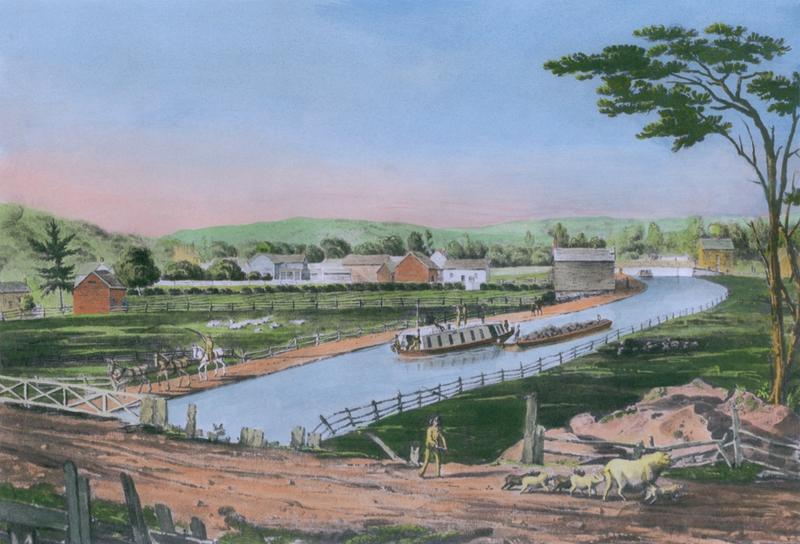
( Everett Historical / Shutterstock )
Alison Stewart: This is All Of It. I'm Alison Stewart. This year marks the 200th anniversary of the Erie Canal opening for business. It was an important for marking New York State, and New York City as the powerhouses of industry they'd eventually become. Back in 1825, it was a major feat of engineering. It was the second largest canal ever built at the time. It gave New York ports access to resources from the middle of the continent, and was one of the key developments that let our young country grow in population, and settle the West. Joining us now to celebrate the Erie Canal's 200th birthday, please welcome SUNY English Professor Mark Ferrara, author of The Raging Erie: Life and Labor Along the Erie Canal. It's nice to speak with you, Mark.
Mark Ferrara: Thank you. Pleasure to be with you.
Alison Stewart: The Canal was completed 200 years ago this year, but let's start going back a little further. What were some of the risks, and some of the opportunities officials would have been weighing around 1817 when the construction was first authorized?
Mark Ferrara: Many of the challenges are geographical. How do you build a 363 mile canal from Albany to Buffalo with no trained engineers in the country, and the most primitive of tools. We're talking shovels, pickaxes, and being able to organize crews to construct sections of the canal as we move towards from Rome to Albany, where we have to deal with a series of lock building. As we move west, we've got to deal with the Niagara escarpment as we approach Rochester, and the Lockport area. Why would somebody want to build a ditch that is 40ft wide, and 4ft deep from Albany to Buffalo?
There are many benefits to it. Many people had been looking for a passage across the Appalachian Mountains to connect the eastern seaboard with the new expanding western territories. This was seen as vital to a kind of bond of union to keep the United States together. There was a worry that westward expansion could fragment the country.
Then there's the the issue of if we're talking about 1817, trying to send goods across the United States in wagons on roads that were pitted, and unpassable, at times made a water route that could go east to west very attractive. It allowed the movement of people, and commodities, even though it was a very slow pace by our standards today, 4 to 5 miles an hour, 24 hours a day during the canal season. It radically transformed New York State, turned it into the Empire State, made New York City a leading city, and contributed to national prosperity in an unprecedented way.
Alison Stewart: We should note though that the building of the canal meant displacing people of the Iroquois Nations. What was the cost to the Native people in the area?
Mark Ferrara: Devastating. It was nearly complete land disenfranchisement in the decades following the American Revolution. So much so that Governor DeWitt Clinton, as he's taking a trip in 1810 to survey the possible route of the canal, even notes the absence of Haudenosaunee people as he moves west from Rome. That disenfranchisement took place over decades, and was the result of a series of fraudulent treaties, and Indian removal as a policy of the United States. I actually start my book with a chapter on the Haudenosaunee, and the land dispossession that made the Erie Canal possible.
Alison Stewart: It's interesting to think that the United States was just about 30 years old-
Mark Ferrara: Right. Exactly.
Alison Stewart: -when they decided to go to go ahead with this. It would have been the second longest canal in the country. I think China was number one.
Mark Ferrara: China, yes. The Grand Canal in China is 1,100 miles long. That's correct.
Alison Stewart: How did this project square up with the other ambitions of this young 30 year old country?
Mark Ferrara: You were just talking about the nation being so young, 30 years old. There's a question at this time about what the role of the federal government is in what was called internal improvements. We would call them infrastructure development. You have a young nation that in order to prosper, needs transportation routes, but the question of who's going to finance such projects was still an open question.
It ended up that New Yorkers issued bonds, and financed the canal. When President Thomas Jefferson refused to fund what he thought was a crazy project to try to dig a canal 363 miles long. There had been other attempts to build canals across the Appalachian Mountains, most notably George Washington's Patowmack Canal, which ended up opening but not being very effective. It was really a series of skirting canals, more than a canal than we would think of. The importance of building roads, and canals was essential to the development of the United States.
Alison Stewart: We're speaking with SUNY English professor Mark Ferrara, author of The Raging Erie: Life and Labor Along the Erie Canal. The canal opened for business 200 years ago this year. Listeners, do you have a question about the Erie Canal? We want to hear from you. 2124-3396-9221-2433 WNYC. Maybe you have a connection to it being built. Maybe you have a relative who used to haul barges. Or maybe you make use of the modern canal for recreational boating. Our number is 2124-3396-9221-2433. WNYC. Who built the canal? Who are the people who signed up? Was it a good job? Was it a tough job? [laughs]
Mark Ferrara: [chuckles] It was not a good job. Not a job that many people would want. That's an interesting story. In the first couple of years of canal building, this would be 1817 to 1819, a decision was made to start in the middle of the state around Rome. That's because there were 70 miles, or so of flat terrain. Mostly local contractors, people in the area, farmers, people who had experience digging, and doing this kind of work were employed to do small sections of it at a time. Then a engineer would come by and approve it. in this way, small sections were made contiguous so that by 1819, 1820, you could go from Syracuse to Utica, for example, in the canal, even though it wasn't finished until 1825.
In the first couple of years, you have local labor being hired. By 1819, and 1820, you start to see an influx of Irish immigrants working on the canal. They're probably most closely associated with construction on the canal. Although there were Germans, Welsh, and other groups who were also working on the canal. It was a big challenge to get that much labor upstate. You're talking about 9,000-
Alison Stewart: Wow.
Mark Ferrara: -or so workers that needed to be coordinated.
Alison Stewart: The canal is a big factor in the growth of cities along the route like Buffalo, and Utica, and Rochester. What did the transformations in those place look like after the canal was completed?
Mark Ferrara: That's enormous difference because upstate New York in around 1820, 1825, these were small towns of hundreds of people that weren't connected to the city, or to other areas except by natural waterway. The transformation that was wrought in these boomtowns was amazing. You had all kinds of industry springing up. You had dock work, you had houses going in, and then you had all of the businesses that you would need as population started to grow. The term boomtown comes from cities like you just mentioned Utica, Syracuse, Rochester, Buffalo, Albany to some degree, although it was at the end of the Hudson river there. It was settled earlier, and was a larger area.
You really want to imagine upstate New York as in 1820 as still wilderness west of Rome, and full of old growth forests. That's another story. Another interesting part of the canal is what happens to the natural landscape. As the canal comes through, you start to clear the old growth forest around the canal, but then people start to settle along the canal corridor, and they start to create farms, and transform the landscape in ways that made it impossible for Native Americans to continue their traditional lifestyles as things got fenced off, and a lot of land was cleared. There's quite a few transformations that happen as a result of building the canal. As you-- Go ahead, please.
Alison Stewart: I was saying there's a text here, a question that asks, "Was slave labor used to build the canal?"
Mark Ferrara: What an excellent question. That's one I've been researching, actually. It's very hard to know because these early records are incomplete, and so we don't have accurate lists of who was working on the canal. Slavery is legal in New York State until 1827, and New York is the largest slave holding state in the North. It's possible, and likely that some slave labor was used to build the canal, and probably some free Black labor as well, but it's very difficult from the lack of records to determine exactly the scope of the use of slave labor, and indentured labor, and free Black labor.
Alison Stewart: Here's another question. I don't know if you can answer, but we'll try. It says, "Erie Canal parallels Lake Ontario, so I'm curious, why not just use the lake?"
Mark Ferrara: That's a good question. There were alternate routes, and there was a northern route that was contemplated, but when the surveyors got out there, and started looking for a place that turned out to be the Mohawk Valley, where one could cross the Appalachians, it just made sense to keep the route a little more southerly. That way you could end in Buffalo.
Alison Stewart: The canal actually paid for itself pretty much within the first year. What can you tell us about how this piece of infrastructure raised money?
Mark Ferrara: Tolls.
Alison Stewart: Tolls, yes. [laughs]
Mark Ferrara: There were weightlock buildings along the canal where boats would be weighed, and there would be tolls that were assigned based on the weight of the ship, and what they were carrying.
Alison Stewart: Let's talk to Stuart from Malvern, Long Island. Hi, Stuart, thank you so much for calling All Of It. You're on the air.
Stuart: Thank you. Well, I actually did a project. I'm a musician, and I was given a commission by an organization called Long Island Traditions to do an audio video project in elementary schools in 2017, when we were celebrating the 200th anniversary of the beginning of the canal's construction. One thing interesting to note is that the canal was also an escape route for people escaping slavery in the South.
Mark Ferrara: Absolutely.
Stuart: It was much easier to hide someone on a riverboat going up the Hudson, and then a canal boat going across the canal across the state that way to Canada. There's a reason why Frederick Douglass made Rochester, my hometown, his hometown, because it was a hotbed of abolitionist sentiment. If you go to the Rochester Museum and Science Center, there's a huge 3D map that includes all the safe houses that were around Rochester at the time that were stations on the underground Railroad.
Mark Ferrara: Excellent.
Stuart: It also became a way for people to make a living that couldn't. There was a whole demand for canal boaters, canalers, they were called, or hoggies was the slang term for them.
Alison Stewart: [laughs] Thank you for your call. We really appreciate it. What other kind of opportunities came out of the canal being built once it was up running, and running a profit?
Mark Ferrara: One might think of it as a early 19th century's information [chuckles] superhighway, but moving at 4 or 5 miles an hour. Yes, it was an important route for the underground railroad, and the anti-abolition movement. The canals also a birthplace of new American religions, so Mormonism, and spiritualism, for example are born along the canal corridor, as are all kinds of reform movements.
The canal corridor met a lot of itinerant people moving through upstate New York. There was a lot of drinking that went on a lot on the job. There was a lot of alcoholism, there was a lot of poverty. A lot of these jobs, like digging the canal, $10 a month. The hoagies are small children who led the horses, and mules that pulled the boats. A lot of these children are kind of orphaned or semi-orphaned working along the canal. Women are marginalized in many ways along the canal corridor, and relegated to certain kinds of work.
A variety of reform movements popped up along the canal that were aimed at addressing some of the ills that came with marginalized scut work, and labor that wasn't particularly valued, and was looked down upon. We're also talking about a time when we're moving from family farms to industrialization, and so we're moving from self-sustenance, and families being able to sustain themselves, to wage labor, and wage labor that usually didn't pay a primary breadwinner enough to support a family. The idea of asylums, poor houses, work farms, and other kinds of social services, I think is an important part of the story of the Erie Canal.
Alison Stewart: We've been waiting to ask you this because we've gotten a lot of text about it. It says, "I want to hear the Erie Canal song. [chuckles]
Mark Ferrara: [laughs]
Alison Stewart: Please explain." I remember seeing this with the community church sing group. [laughs] Explain the Erie Canal song.
Mark Ferrara: I assume they're referring to the Fifteen miles on the Erie Canal. Fifteen miles would be the average distance that horses, and mules could pull before they needed to be changed. I think that's where that comes from. That is a kind of romane-sized version of the canal where the hoagies, and the mules are best friends. Iit's lovely, and it was taught in schools for years and years. One of my former professors, when I told him I was working on a book on the Erie Canal, he remembers being a young person in Long Island in school, and learning the Erie Canal song. It's a wonderful connection.
Alison Stewart: The name of the book is The Raging Erie: Life and Labor Along the Erie Canal. My guest has been SUNY English professor, Mark Ferrara. Mark, thanks for spending some time with us.
Mark Ferrara: It's a great pleasure. Thank you very much for the invitation.
Alison Stewart: Do you want to hear the Erie Canal song?
Mark Ferrara: I love it.
Alison Stewart: Let's listen to it by Bruce Springsteen.
[MUSIC - Bruce Springsteen: Erie Canal]
I got a mule, and her name is Sal
Fifteen miles on the Erie Canal
She's a good old worker and a good old pal
Fifteen miles on the Erie Canal
We hauled some barges in our day
Filled with lumber, coal, and hay
We know every inch of the way
From Albany to Buffalo
Low bridge, everybody down
Low bridge, yeah, we're coming to a town
And you'll always know your neighbor
And you'll always know your pal
If you ever navigated on the Erie Canal
We'd better look around for a job, old gal
Fifteen miles on the Erie Canal
You can bet your life I'll never part with Sal
Fifteen miles on the Erie Canal
Get up, mule, here comes a lock
We'll make Rome about six o'clock
One more trip, and back we'll go
Right back home to Buffalo
Low bridge, everybody down
Low bridge, yeah, we're coming to a town
And you'll always know your neighbor
And you'll always know your pal
If you ever navigated on the Erie Canal
Alison Stewart: We remind you that we speak with Warren Zanes, the author of Deliver Me From Nowhere, making of Bruce Springsteen's Nebraska. That is going to happen on Monday.