
The Directors of "Project Hail Mary" on Creating a Heartwarming Space Epic
Alison Stewart: This is All Of It on WNYC. I'm Alison Stewart. You've already heard by now. This Thursday, we're kicking off a new season of our Broadway on the Radio series, bringing the best of Broadway to WNYC and live to you in person and on the radio. Today we have more news. We're announcing a full spring slate. You've already heard about Chess the Musical. This Thursday we have its stars, Aaron Tveit, Nicholas Christopher, and Lea Michele, plus Chess's director and book writer. They'll be downstairs.
Then on April 17, we'll be joined by the stars of Ragtime, Joshua Henry, Nichelle Lewis, Caissie Levy, Brandon Uranowitz, Benny Levi Ross, and Shaina Taub will all be here performing live at the Greenspace. Then let's move on to May. We're bringing Ballroom to WNYC with the cast and the creative team from Cats: The Jellicle Ball. You can get tickets and info for all of these events and stay tuned for more by going to wnyc.org/events. This Thursday's event for Chess is officially sold out. You can still tune in live for free by tuning into WNYC at noon or by watching the livestream at wnyc.org. Now let's get on with the show.
[music]
Alison Stewart: In the new movie Project Hail Mary, Ryan Gosling plays a man who finds himself alone in space. Sort of. Gosling stars as Dr. Ryland Grace, a middle school teacher who wakes up one day to find he is the sole survivor on a spaceship light-years away from Earth. He is on a mission to save the world. Earth's sun is dimming. Tiny creatures known as astrophage have been feeding off the sun's surface, and man, they are hungry. It becomes the focus of the world's best scientists to stop them now or else.
Grace has to figure out how to complete his mission. Luckily, he has some unexpected help. A friendly alien he meets, who is also the sole survivor on its ship. They have the same goal to save their respective planets from the sun eating stuff. Project Hail Mary is exciting and funny and really heartfelt. It's based on the best-selling novel by Andy Weir and was directed by Phil Lord and Chris Miller. The movie is in theaters on Friday, March 20th, and I'm joined now by its co-directors, Phil Lord. Hi Phil.
Phil Lord: Hi.
Alison Stewart: Chris Miller. Hi, Chris.
Chris Miller: Hello.
Alison Stewart: What do you admire the most about the original novel by Andy Weir? I'll have you go. Who wants to go first? Chris.
Chris Miller: Oh, we read the manuscript when Ryan Gosling called us up, and it was thrilling. It was full of wonder and awe and spectacle, but at its heart were these very small, intimate relationships. It was really about how in order to save the world, you needed to make a friend. Even though it was about an apocalyptic event, it was really optimistic and hopeful and emotional and funny. It had all the things that you want in a story.
Phil Lord: A sweet, funny movie about the end of the world.
Alison Stewart: That works. When Ryan Gosling, he had the rights to the book Project Hail Mary. What becomes possible for you as directors when you have Ryan Gosling attached to the script?
Phil Lord: I mean, he's-- This is Phil. He has so many different moves, and you see them in each of his films. He's trying something new. You need somebody with that breadth of experience for a story where he has to be terrified, he has to be bashful, he has to form this relationship with a rock, and--
Alison Stewart: We'll get to the rock in a minute.
Phil Lord: Yes, so you get to have all of those Ryan Gosling moves in a single movie. It's an incredible value.
Chris Miller: You need someone who can command the screen as the only human being on screen for two-thirds of the movie.
Alison Stewart: Yes, yes. When was a moment during filming when you knew that Ryan was the right person for this role?
Chris Miller: Oh, man, we knew it before we started filming because he's so thoughtful and so creative. He sweats all the details, like us.
Alison Stewart: Oh, interesting.
Chris Miller: When it came to details of his costume or just scene by scene, he was really thoughtful about how he saw the character. He had fallen in love with the book as well, and what would make the most engaging story. We knew in development, that we had a great partner.
Phil Lord: He's such a playful actor. We had auditions of all the best puppeteers in the world to play an alien friend that he makes. Watching him be so nimble and responsive to these different performers and their energy let us know that on set we were going to be in great shape.
Alison Stewart: Oh, that's very interesting. The movie moves back and forth between Grace's life on Earth and his time in space. Why did you think that was important? To communicate about who Grace was before the mission.
Phil Lord: The movie takes place in two different time periods as Ryan is waking up in space and remembering the events that led him to be there. That could have been disjointed, but the way Andy structured his book and Drew structured our screenplay, it's really a character study that happens in a quite linear way about somebody who's afraid to connect with folks. Slowly, over the relationships and friendships he makes in the movie, becomes a person strong enough and open enough to make the friendship that is going to save the galaxy.
Alison Stewart: Yes. You realize in the beginning, he does not want to be there. He does not want to be there. We're just going to leave it for people who haven't read the book.
Phil Lord: Yes.
Alison Stewart: The thing that's sad initially is he doesn't think of himself as brave.
Chris Miller: Right.
Phil Lord: Yes.
Chris Miller: I think it's hard for me to relate to a character who, from the jump, is like, "I'll drive into that burning building and save those kittens." Has no fear, no vulnerabilities, no weaknesses. That's why I think he's a very relatable character because he starts his movie, he is scared. He doesn't want to do the job. He's full of fear and anxiety. On Earth, he's also a character who has social anxiety and has to be pulled into it. I think bravery to me isn't about not being afraid of something. It's about being afraid and then doing it anyway.
Alison Stewart: When was the last time you had to be brave about something?
Chris Miller: Ever since I've had kids, it's a daily thing.
Alison Stewart: How about for you, Phil? When was the last time you really had to be brave?
Phil Lord: Oh, gosh. Anytime we make a public appearance in any way, I know we look like, or we sound like 6-foot-2 Adonises just throwing touchdowns everywhere we go. We may suffer from social anxiety ourselves. I'm an inside cat, and somehow this job keeps putting me outside.
Alison Stewart: We like inside cats. It's okay. You're in public radio. It's a nice, safe place.
Phil Lord: [unintelligible 00:07:45] be in public radio.
Chris Miller: This is more our speed.
Alison Stewart: We're discussing the new film Project Hail Mary with co-directors Phil Lord and Chris Miller. The movie stars Ryan Gosling as a man whose mission is to save humanity as well as his friendly alien friend. Project Hail Mary hits theaters on Friday. Andy Weir's novels are known for their scientific detail and accuracy. How did you convey the science in a way that was accessible to audiences? Because, you know, accessibility.
Phil Lord: Yes. The book is written in the first person, and Ryan's character narrates all of the science that happens throughout the book. We approached it like it was a heist film. One of our favorite movies is an old franchise film called Rififi, in which, for some reason, it's riveting to watch 5 men drill a hole in the floor for 20 minutes. I think the reason is it's really fun to watch people do a job well on screen. Ryan said, "I am not a molecular biologist, but I can play engagement." That's a big part of it, is he's interested in it, so we are.
Chris Miller: Right. Thankfully, having one great thing is having Andy Weir as a producer on the movie meant that he was around and made sure that our science was accurate that we were doing. Drew Goddard, who wrote the screenplay, is great at condensing concepts that are complicated into digestible, entertaining little nuggets.
Alison Stewart: Yes. We've had Andy on, I think, for Project Hail Mary, and he's a great interview.
Phil Lord: He really is. He's got an awfully high EQ for somebody who came to light as a coder who wrote his own novel on his computer in the dark.
Alison Stewart: Many space stories like this one can be really scary. They can be very serious. This has very tense moments in it, but there's a real sense of humor to it, and there's a real warmth to it. Why was warmth important in this film?
Chris Miller: It's a movie about friendship and about communication and empathy. The book is funny, even though it is about these serious subjects. To us, we don't really try to think about genres, boxes, labels to stick something into, where our favorite dramas make you laugh, and our favorite comedies make you cry. We wanted to have the movie, have moments of levity, have moments that make you cry, and have you on the edge of your seat. We had a great partner in Ryan, who is a very funny guy. We wouldn't have been interested in making the movie if it didn't have a sense of humor.
Phil Lord: I think that in this moment, it feels punk rock to make an affirming movie that means the audience well. Ryan is going through really difficult things in the movie, but the movie itself has a way of letting you know that he's going to be okay and that we're rooting for him. Right down to the soundtrack, we have this great composer, Daniel Pemberton. Our first conversation was he's not alone. The whole planet is rooting for him. Let's hear the voices and claps and stomps of a thousand people.
Alison Stewart: That's so interesting because we just got a text from one of our listeners that said, "Hi, Alison and team. I went to a screening of Project Hail Mary this weekend-
Phil Lord: Nice, thank you.
Alison Stewart: -and I have to say the casting and music choices were fantastic. What was Miller and Lord's approach to the music?"
Chris Miller: There you go. We wanted it to feel like a mixtape from planet Earth. A lot of the needle drops are from-- There's like a Maori farewell song. There's this Mercedes Sosa song called Gracias a la Vida. We have music from all around the world in it. The score, as Phil said, from Daniel Pemberton, has a large choral element and a very human feeling thing that we wanted just to feel like all of Earth was with him.
Phil Lord: Ryan starts the movie as a teacher, so Daniel brought in a whole class full of kids to clap and stomp and make the percussion for the climactic action sequence. The kids were still part of his consciousness.
Alison Stewart: We are discussing the film Project Hail Mary with its co-directors, Phil Lord and Chris Miller. Let's talk about his co-star, Rocky.
Phil Lord: Yes.
Alison Stewart: Rocky is out to save his own planet. They meet cute, as they say. [laughs]
Phil Lord: Yes, meet very cute.
Alison Stewart: Rocky is an actual puppet.
Chris Miller: That's correct.
Alison Stewart: The puppeteer is James Ortiz, who a lot of people in New York know from the theater world. He's really big. He also voiced Rocky.
Chris Miller: That's correct.
Alison Stewart: Why did you decide to go with the puppet?
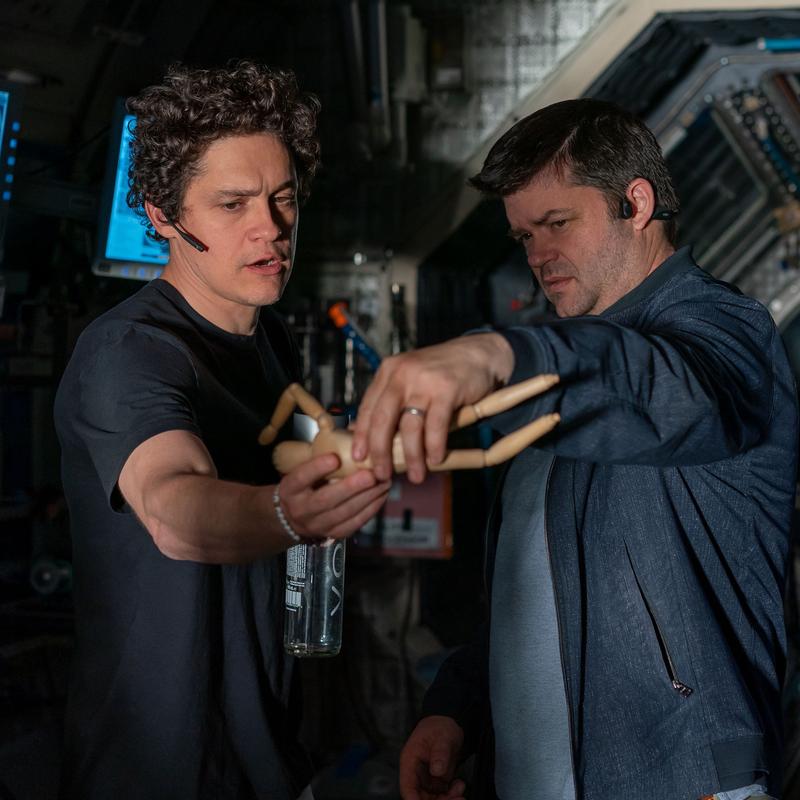
Chris Miller: The whole movie hinges on the chemistry between these two characters and their relationship. If it was Ryan talking to a tennis ball on a stick and imagining conversations, it wouldn't have had the same back and forth we had having James and his team. We call them the Rocketeers. It took five people to operate the puppet there, meant that they could have moments of spontaneity back and forth, they could improvise with each other, and we could really capture it.
At the end of the day, it ended up being about 50, 50 animation and puppetry, but it was a perfect blend, so much that you couldn't know which shots are which. There was always James and the puppet on set so that we got these real moments with Ryan.
Phil Lord: Yes, the chemistry with Ryan can't be faked. You can't do that in post.
Alison Stewart: I like the idea of improvisation with him.
Chris Miller: Oh, my God, it was so much improvisation to do them.
Phil Lord: The hardest thing to do in a movie like this requires so much planning, is to make sure that the process accommodates spontaneity.
Alison Stewart: That's interesting. Oh, that's very interesting. You know what? That leads me to a question I ask a lot of directors. I'm going out of order here, but-
Phil Lord: Let's do it.
Alison Stewart: -a lot of directors, they say my job is just to make choices. From the minute you get on the set to the minute you go to sleep, and you get up.
Chris Miller: There's a lot of decisions that get made.
Alison Stewart: What was a tough decision for you to make on this movie?
Chris Miller: Oh, I mean there was a lot of choices in how do you condense a book that's 16 hour audiobook into a movie size?
Phil Lord: I went to the same place.
Chris Miller: It means killing some darlings.
Alison Stewart: That's why you work well together.
Phil Lord: Yes, in the book, there's this sequence where they blow up Antarctica to stave off the Earth's destruction.
Chris Miller: Yes. To slow the global cooling that's happening.
Phil Lord: We were really fired up to do it. We just didn't want to be part of the relationship story with Rocky.
Chris Miller: Right. There's certain things that you love that have to go to make it in the size of a movie.
Phil Lord: You keep it the main thing, the main thing, like everything you're doing on set and in post is about making sure that the relationship story is at the center.
Chris Miller: There's a second relationship story that's on Earth that's between Ryan's character and Ava Stratt, played by the amazing Sandra Hüller. That was the main core relationship of the Earth story that we really leaned into on that.
Alison Stewart: We'll talk more about it after a quick break. This is All Of It.
[music]
Alison Stewart: You're listening to All Of It on WNYC. I'm Alison Stewart. We're discussing the new film Project Hail Mary with co-directors Phil Lord and Chris Miller. The movie stars Ryan Gosling as a man on a mission to save humanity alongside a friendly alien. Project Hail Mary is in theaters this Friday. I want to talk about Rocky just a little bit more. How many versions of Rocky did you have to see before you gave it a thumbs up? [laughs]
Chris Miller: Oh, gosh, like hundreds.
Phil Lord: Hundreds. For a year and a half, we designed that little guy.
Chris Miller: We worked with Neal Scanlan in the Creature Shop over in London, and they are experts in designing aliens. We spent a long, long time with many variations of a rock creature with five legs and no face, and trying to get something that felt appealing. Once we finally got the size relationship right, then we went to all this detail about the carvings on his body and what each facet of his carapace looked like. It took a long, long time, but because of it, he's an appealing character, and you fall in love with him.
Alison Stewart: How did you decide on his voice? On James Ortiz's voice?
Chris Miller: James came in for an audition with Ryan. They were excellent together. Our casting director, Jeanne McCarthy, when James left the room, said, "I told you so."
Phil Lord: She told us six months before. It was like, "It's going to be James Ortiz." While we were shooting, he was part of the process of developing Rocky. When we're on stage, and we're shooting, it just-- There's this thing that happens, like you can't get him out of your head. When you start imagining other voices, it just doesn't feel right. In animation, you say you never trace a drawing. It will take the life out of it. The truth is James was Rocky, and anything we did on top of it just didn't feel right.
Alison Stewart: You built practical sets for the elements of the spaceship. We were talking off mic that I've been on sets that they look fake up close. They look great on the screen, but they [unintelligible 00:17:39] like.
Phil Lord: They look great. A little bit blurry.
Alison Stewart: Exactly. You said that your set was very different.
Chris Miller: Yes, very, very real. We had an amazing production designer, Charlie Wood, and his team, and they were psychopaths about making this interior of the spaceship and exterior look as real as possible. They were sourcing stuff from aeronautics companies. It was so real, and it was 360. You really felt like you were inside of a spaceship. It was crazy.
Alison Stewart: What was the hardest thing to figure out how to build?
Phil Lord: Oh, there were. What wasn't hard? We built this whole spaceship. The spaceship itself has two different gravitational orientations. That means that if you're standing on the ground, there's like a desk and chairs coming out of the wall. Every set had to be taken apart and then put back together on its side for the scenes in which the gravity was on the wall.
Chris Miller: A lot of the movie takes place in this tunnel between Rocky's ship and Grace's ship. We built this tunnel that was going to be semi-translucent, which, when they were spinning their ships together so they had gravity, centrifugal gravity. That meant the light around the exterior of the tunnel was going to spin. We had to build this light array around the tunnel.
Phil Lord: There's a set that's a tunnel that's like the length of the longest stage on the lot. Around the tunnel, there are lights all the way around 360 degrees that turn off and on to create the sense of it spinning. Then there is this glass membrane wall built out of molded plastic. It reflects cameras and lights, and all of these things. It's unbelievably inconvenient to shoot through.
Chris Miller: It took so much power for that light. We had to steal power from the neighboring stages across the street and build a bridge over with a bunch of wires just to light the scene. It was a massive undertaking.
Phil Lord: We were like the Rats of NIMH stealing power from this farmer.
Alison Stewart: They're like, "Oh, God. Project Hail Mary, guys, here they come again."
Phil Lord: The lights are going.
Chris Miller: Oh, boy.
Phil Lord: Luckily, that was also our stage.
Alison Stewart: I did want to ask you about Sandra Hüller, who most people remember from Anatomy of a Fall. She plays this amazing scientist on the ground. There's so much going on behind her face. Why was she the right person to play that role?
Phil Lord: First of all, anytime anyone talks about Sandra, they just start shaking their heads, like, "I can't believe she exists," and she just has so much versatility. We didn't remember it when we started talking about her, but she's in this movie called Toni Erdmann, where she's hysterical.
Chris Miller: That's true. Not just Anatomy, but Fall Zone of interest. All these wonderful films, she's got as much range as Ryan, and the two of them together really admired each other, and they really wanted to do a good job for each other. She has so much nuance. That part could have been played stereotypically like an ice queen. She brought all this warmth and humanity to a person who has to make tough decisions to try and save the world.
Alison Stewart: She does a great karaoke singing the Son of the Times with Harry Styles.
Phil Lord: That's right.
Alison Stewart: I'll just leave it there. People have to see the film. I understand you watched the movie so many times to get to the final cut.
Phil Lord: [laughs]
Alison Stewart: That was an evil laugh. What were you looking for in those screenings?
Phil Lord: Oh, the most interesting ones are when you put them in front of an audience. At this point, by the time we locked the cut, we'd seen it with an audience something like 15 times, whether it was like pile a bunch of people into the edit suite or formal test screenings where you've got hundreds and hundreds of people there. We road test a lot, and it's less about the feedback that they write down and more about the feeling in the room with all the other chickens that you have watching them and experiencing the film with them. That's part of it.
Chris Miller: You can feel when people are engaged, and you can feel when people are checked out.
Alison Stewart: Oh, that's interesting.
Chris Miller: You try to go, "Oh, oh, we're losing their interest or checking their watches, or shifting in their seats. Something is not working here." We find out what's confusing, and with all the science, you want to make sure that you're just giving just enough to make it not confusing, but also not like a lecture hall.
Phil Lord: You're also looking for those moments that give you goosebumps.
Chris Miller: Right.
Phil Lord: The thing that's so beautiful about watching movies in a group is that you're all feeling the same thing at the same time, and you can feel your mirror neurons are firing, and you're imagining what everyone around you is experiencing while you imagine what the characters on the screen are experiencing. It's this like empathy workout that happens in the theater.
Alison Stewart: When you were thinking about making this movie about countries working together to thwart an existential crisis, you had to think about climate change. I have to imagine.
Phil Lord: I mean, it's never a bad time to tell a story about what we are capable of when we work together and imagine that difficult things are possible. That's what I love about Andy's work is like, problems can be solved. You don't just need Superman to show up.
Chris Miller: Right. We read this manuscript in 2020, in the heart of the pandemic, when it was like things felt really hard and maybe impossible. This was a book that was saying, like, "Hey, if we can communicate and work together on things, we can solve problems."
Phil Lord: Especially when we feel the urgency collectively. We were working on a movie, everything shut down. The pandemic. A week later, there was something called Zoom, and we were all on it, and we never skipped a beat, right?
Alison Stewart: Yes.
Phil Lord: I think a lot of the things, to me, it bothers me when problems are presented as impossible to solve because there's too much evidence to the contrary.
Alison Stewart: The name of the movie is Project Hail Mary. It's hitting theaters this Friday. My son loved it, by the way. [laughs]
Chris Miller: Oh, nice. Excellent taste.
Alison Stewart: 17-year-old boy. [unintelligible 00:24:23] [laughs]
Chris Miller: Oh, nice.
Phil Lord: Oh, yes, that's great. We wanted a movie that played 8 to 80. He's right in the pocket.
Chris Miller: I would say 88 even.
Phil Lord: Yes, sure.
Alison Stewart: 88. Let's go with 88.
Chris Miller: Let's go. It's got another eight in there.
Alison Stewart: We've been talking to co-directors Phil Lord and Chris Miller. Thanks for being with us.
Chris Miller: Our pleasure.
Copyright © 2026 New York Public Radio. All rights reserved. Visit our website terms of use at www.wnyc.org for further information.
New York Public Radio transcripts are created on a rush deadline, often by contractors. This text may not be in its final form and may be updated or revised in the future. Accuracy and availability may vary. The authoritative record of programming is the audio record.