
The Comic Book History of the Cocktail
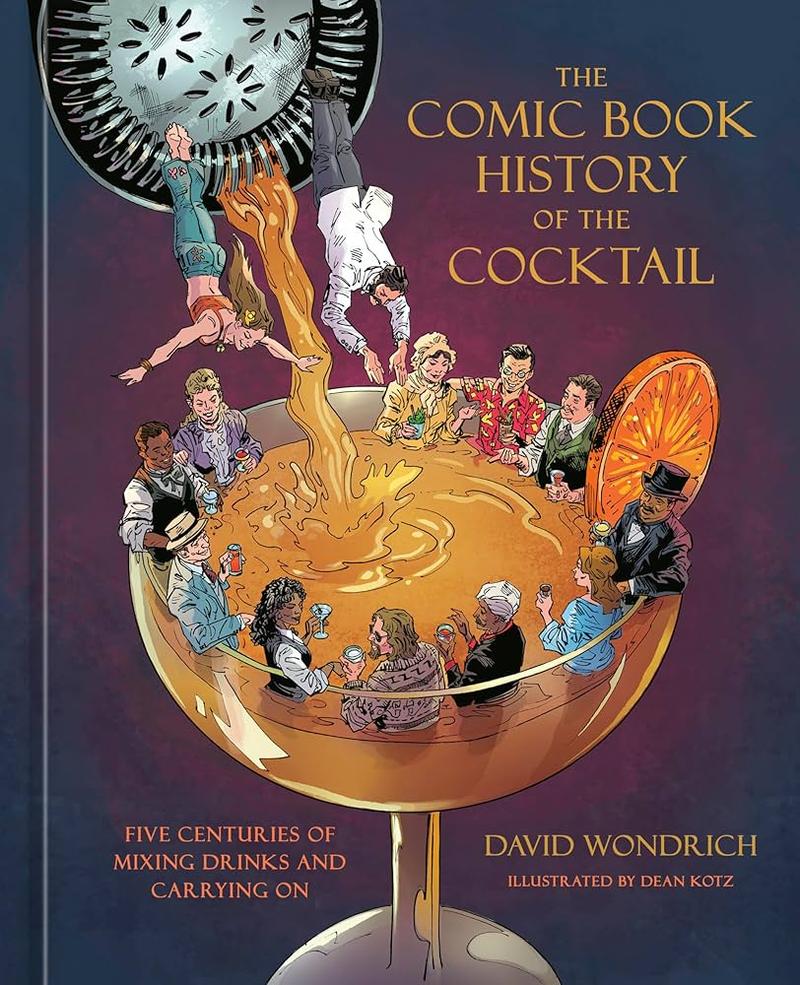
Alison Stewart: This is All Of It on WNYC. I'm Alison Stewart. A new graphic book from writer and historian David Wondrich illustrates the origins of some of the world's most classic cocktails. It's titled The Comic Book History of the Cocktail: Five Centuries of Mixing Drinks and Carrying On. The book tells stories of the Roman cities that housed establishments run by wise trekking bartenders, the history of Cuba and its birth of the tropical cocktail, and explores the birth of American mixology in the 1850s. In it, Wondrich writes, "Like its subject, the history of the cocktail is a mixture stirred together from hefty slugs of stories of mixed drinks and of bars and bartenders spiked with some good stiff dashes of the history of distilled spirits." The Comic Book History of the Cocktail is out now. Dave Wondrich is also the author of Imbibe, the first cocktail book to win a James Beard Award. Dave, welcome back to All Of It.
David Wondrich: Thank you so much, Alison. It's so great to be here.
Alison Stewart: We're so glad to have you. Folks, do you have a rare spirit you'd like to get Dave's take on? Do you have a burning cocktail Question? Our phone number is 212-433-9692, 212-433-WNYC. You can call in, you can join us on air, or you can text that number as well. You developed a reputation, shall we say, as one of the experts on cocktail culture. You're becoming one of the most respected experts of the past 20 years, I might say. How did you get the idea to write a graphic book?
David Wondrich: I'd always keep a list of books I want to write, and there was a comic book on there about bartending and comics, but this one, the publisher Ten Speed, actually asked me if I were interested in doing it, and of course I was. I had just finished doing The Oxford Companion to Spirits and Cocktails, a huge book that I was the editor-in-chief of. It took nine years and 1100 entries.
Alison Stewart: Oh, I got a copy of it in my cart. I do.
David Wondrich: That is a big book.
Alison Stewart: It's a big book.
David Wondrich: It's a big book. I didn't really want to do anything like that, and so this seemed like the perfect chance to go into a different field and try to come at the whole history of the cocktail business from another direction.
Alison Stewart: It's been interesting because it looks like a graphic novel. That's why people keep calling it a novel, but it's a book. It's history about.
David Wondrich: It is. They wanted a really serious history.
Alison Stewart: Yes, they really, really did.
David Wondrich: It's got footnotes, it's got all that kind of stuff, but at the same time, it's a graphic one. We get to bring people out of the shadows and show you their pictures. We get to have little skits and playlets of what's going on with the cocktail. It's getting invented, all this stuff. It was really fun to be able to do that.
Alison Stewart: How did you work with illustrator Dean Kotz?
David Wondrich: I planned out what I'd like to see on the page and sent it to him, and he drew these beautiful pencil sketches, really quick, rough ones. He'd send them back, and I'd say, "Let's go with it." Then he'd pen them in. We didn't really change much. He's very good. He's a wonderful illustrator and has a really good firm line. I wanted people to look like themselves because for many of these people, this is the first time they've ever been pictured in a book.
Alison Stewart: Oh, wow. Give me an example of someone whose first time ever been pictured in a book.
David Wondrich: Raymond Ching, who was a bartender who worked at the original Don the Beachcomber, the cafe that invented tiki drinks in the 1930s. That was in Los Angeles. He came to New York and was at a bar that basically hired him away and also called itself the Beachcomber, which was a bit of a low blow because there was no relation except Raymond Ching in New York made the zombie the most popular drink of the day. He may have helped invent it first on the Beachcombers, but in New York, he sold it to the point where they were selling them even at the New York World's Fair, these huge tall drinks full of liquor. [laughter]
Alison Stewart: Drinks historian, author Dave Wondrich is my guest. He has a new book out called The Comic Book History of the Cocktail. He's here with me now to discuss. Listeners, do you have a rare spirit you'd like to get Dave's take on? Do you have a burning cocktail question? Our phone lines are open. 212-433-9692, 212-433-WNYC. We got Susan in Ridgewood, New Jersey. Ringwood. Excuse me. Hi, Susan. Thanks for calling All Of It.
Susan: Hi. Sure. Thanks for having me. I have a question about the old fashioned. I was a bartender many years ago and was taught that you definitely muddle the fruit in an old fashioned, the cherry and the orange. Recently, I was out to dinner and ordered an old fashioned, and the youngest bartender said he had never been taught to muddle the fruit, and I had not heard of that. I was wondering if the new, younger generation of bartenders are being taught not to muddle the fruit.
David Wondrich: I think they are, because over the past couple decades, we've gone back to the origins of some of these drinks. Originally, the old fashioned didn't have any fruit muddled in it. All it was was an old fashioned style cocktail. Bitters, sugar, and booze on ice. Very, very simple. During the 1930s, 1940s, the muddled fruit version came in. That was the novelty, and they're both perfectly legitimate. I used to do face-offs with my dear friend and mentor, Dale DeGroff, the dean of American bartenders, where he'd do the version he learned with the muddled fruit, and I'd do the original version, and we'd try to see who liked them better. He usually won, but not always, thank God.
Alison Stewart: It's really interesting. I think that the mint julep is a good example of how the history is taught in this book. When you think about it starting in what? 1770. It's the son of a punch, and then how it developed over time.
David Wondrich: It was a very different drink.
Alison Stewart: Explain to me what it was originally and then how it developed over time.
David Wondrich: Originally, it was rum, mint, sugar, and water. Then in the classic period and the pre-Civil War period, it was imported French brandy. It was a fancy drink. It was an expensive drink, and it was a good, huge slug of liquor. About 3 ounces of brandy on very fine crushed ice with a little sugar and mint just lightly pressed in it. Then they'd float rum on top and stick a forest of mint on the top of the glass, and they'd cut the straws really short, so you had to get your nose in among the mint. And this was a real rich person's drink. It was not a country drink. This was a city clubs drink, that kind of thing.
Alison Stewart: Enslaved Americans were an important part of the mint julep.
David Wondrich: They were the masters of this drink. Enslaved and also free Blacks of color, as they were called, were real innovators. They were some of the most famous American bartenders at the time. They were the people who really had control of how this drink was made.
Alison Stewart: Then it's interesting in this section about mint juleps, as we're learning all about these people. You end with a Latina woman, Alba Huerta. She's an award-winning mixologist from Houston mixing a drink, and you say it's one of the best out there.
David Wondrich: Oh, yes. She has a bar, Julep. She's the modern specialist in mint juleps and just a wonderful person and just a great bartender.
Alison Stewart: I'm talking with drinks historian, author Dave Wondrich. He has a new book out called The Comic Book History of the Cocktail. We'll get to your calls after the break. This is All Of It.
You're listening to All Of It on WNYC. I'm Alison Stewart. My guest is Dave Wondrich. The name of his book is The Comic Book History of the Cocktail: Five Centuries of Mixing Drinks and Carrying On. It's a graphic book describing the history of a cocktail. This is cracking me up. I have a text for you. It says, "What mixed drink can spruce up a low-shelf bourbon?"
David Wondrich: [laughs] An old fashioned is always my go-to, however you like it, with muddled fruit or without. That is a real quick fix.
Alison Stewart: That one made me laugh.
David Wondrich: Or you can also mix it, to be perfectly honest, with a Paul Newman lemonade.
Alison Stewart: It's good with lemonade.
David Wondrich: Yes. Then you've got an instant whiskey sour.
Alison Stewart: This one says, "In New Orleans, the French 75 is often made with cognac, but in New York it is made with gin. What gives?" That's Mary from the Upper West Side.
David Wondrich: It was originally a gin drink. It was basically a Tom Collins, where you replace the soda water. That was gin, lemon, and sugar with soda water. You replaced the soda water with champagne. It's a very dangerous drink, but some people said French, it should have cognac in it. My favorite version made by Chris Hannah in New Orleans is with cognac.
Alison Stewart: This says, "When I was a child, my mom often ordered an apricot sour. As an adult, I have tried many, many occasions to order one to no avail. Usually, the bartenders don't know what it is. Less often, they say they don't have the first key ingredient. What does your guest think?"
David Wondrich: Apricot brandy, usually with sour mix. It's a drink from the 1970s. You can replace the sour mix with sugar and just a little bit, because the apricot brandy is sweet, and lemon juice. The best version is made by Portland bartender Jeffrey Morgenthaler, and he adds a big slug of high proof bourbon in there and that dries the drink out and balances it because otherwise it's a pretty sweet drink, but can be very tasty, even without the bourbon. I got to admit I'm partial to the bourbon version.
Alison Stewart: Let's talk about some more stories in your book because there are so many people that we can talk about, but I wanted to concentrate on Jerry Thomas. He made his way in New York. He had a fanciful life, shall we say, but he opened a bar in the corner of Waverly and Broadway, and then he was a bartender at the Metropolitan Hotel. He wrote a book you called a watershed in the history of the cocktail. What did this book contain?
David Wondrich: It's the first cocktail book. It has chapters on mixed drinks in the American style. Individual drinks mixed to order, made with ice, and that was our innovation. What we think of as a cocktail today is basically an American idea, and Jerry Thomas was the first to gather it between the covers of a book.
Alison Stewart: He was also a bit of a character.
David Wondrich: He tended bar for a while with his matched pair of pet white rats on his shoulders that would frolic on his shoulders and climb up onto his bowler hat. [laughs] He had a life-size statue of him in the middle of his bar mixing drinks and caricatures by the famous Thomas Nast, one of the great American engraving artists, two stories high on the walls of his bar. Oh, and that bar had a shooting gallery also.
Alison Stewart: How did you deal with Prohibition in the book?
David Wondrich: There's a lot of mythology today that all the great drinks came out of Prohibition, and that's simply not true. I went out of my way to show how really poor most of the drinks were and how things were adulterated, and the good ingredients just weren't there. I talked about that a lot.
Alison Stewart: Are there any speakeasies in New York that you find authentic?
David Wondrich: The best one closed a few years ago, unfortunately. That was Bill's Gay Nineties, which was an absolute time capsule of an 1890s bar. The guy got money from his in-laws, who owned the 21 Club, to open a speakeasy, Bill Hardy. He collected old-time memorabilia, and the whole building was just stuffed with things, and it was a glorious place to drink.
Alison Stewart: As I was reading the book, there were a lot of women in your book.
David Wondrich: A lot of women were mixing drinks.
Alison Stewart: Truly, yes.
David Wondrich: Yes, absolutely. We don't hear about them as much in part because it really wasn't as many as the men, but there were still plenty. In some periods, there were a lot at the very beginning, even before the cocktail itself. The cocktail descends from punch, the original mixed drink based on distilled spirits. Punch was mostly an English drink, and in England, it was the women who mixed the drinks, so they mixed all the punch.
Alison Stewart: Got a couple more questions for you here. "A friend of mine adds St Germain elderberry to his Manhattans. Is that a sacrilege?" Will from Harlem.
David Wondrich: I don't think you can really get to sacrilege in mixing drinks. It might be a little eccentric, but it's not going to hurt it unless it's two parts St. Germain and one part Manhattan or something like that, but a little splash of almost anything can go into a Manhattan and make it interesting.
Alison Stewart: You have three New York City variations on the Manhattan in this book. What is the difference?
David Wondrich: The vermouth gets replaced with an aperitivo or something like Dubonnet French.
Alison Stewart: That's the Bedford.
David Wondrich: That's the Bedford invented by the great Del Pedro, who has Tooker Alley bar now-
Alison Stewart: Then there's the Red Hook.
David Wondrich: -in Prospect Heights. Yes, there's the Red Hook with Amaro in it. There's another one with Amaro in it. It's easy to spin out variations on these things, and if you have good knowledge of your ingredients, you can make things that are really tasty.
Alison Stewart: This question says, "What drink do you save for special occasions?"
David Wondrich: French 75s. [laughs] I'll crack open some real champagne for that, and I'll make the cognac version.
Alison Stewart: Someone else wanted to know, "How did you decide which cocktail moments to include? That's a dude on the cover, right? Thanks."
David Wondrich: It is the dude on the cover because the White Russian, he's the poster boy for, and that's an important '70s drink. Mostly, the cocktails and the people dictated themselves because I put in almost everybody I know in some of these chapters.
Alison Stewart: Oh, like, who else?
David Wondrich: There's so many bartenders in the past that we just don't know about. In the early days, very few names came down to us, so for the early days, I put in everybody. Then later, I had to be a little more choosy. For the modern cocktail revolution, I couldn't put in very many people because it would drown out the rest of the book.
Alison Stewart: Who did you want to make sure you got into the book?
David Wondrich: Dale DeGroff, because he was my personal mentor and really important. I wanted to make sure to get people like Ada Coleman at the Savoy bar and John Dabney in Richmond, Virginia, who made mint juleps for the Prince of Wales and made so much money in tips on his bartending that he was able to purchase his and his wife's freedom in a very bad time. I wanted people like that. Jerry Thomas, of course, he's the only bartender who got his own chapter, but he needed one just because he was so larger than life.
Alison Stewart: There's an international element to the book. You talk a lot about Cuba.
David Wondrich: I talk a lot about Cuba.
Alison Stewart: What's important to know about Cuba?
David Wondrich: Cuba was where American mixology met tropical ingredients. The Cubans were very good at mixing drinks and made very seductive bars, and they still do. That was an important place. It road-tested the principles behind how we mix drinks and proved that they could work in other contexts. I also talk about Paris a lot, which was the big city for Americans. It had an American sector back before the First World War, and there were a lot of American bars in Paris.
Alison Stewart: A lot of people talk about how 1990s, it was a resurgence of the cocktail. Do you think there was a resurgence initially?
David Wondrich: I do. Things had gotten bad in terms of using artificial ingredients and not really balancing drinks, just making really simple drinks. We'd lost some of the deliciousness that was in these drinks. There were a lot of very bland drinks that they were still fun to drink because you were out with your friends. If you still drink Long Island Iced teas, all I could say is, "God bless you." Drink what you like. This book isn't here to say you're a bad person, but it's here to show you some of the alternatives.
Alison Stewart: How would you describe cocktail culture right now?
David Wondrich: Right now, it's transitioning. It's starting to recover from the effects of lockdown and pandemic, which drove a lot of experienced bartenders out of the business. An experienced bartender can work in many other different kinds of jobs. It's a job for somebody who can process information fast and has a good memory, and can deal with people. You're quite hireable as it turned out, and so a lot of these people went off to other jobs. The people who came in now are starting to reconnect with the traditions of the bar and get serious about the career aspects of it, so they're starting to educate themselves. There's some very good cocktail books coming out and things like that.
Alison Stewart: The name of the book is The Comic Book History of the Cocktail: Five Centuries of Mixing Drinks and Carrying On. It is by Dave Wondrich. Thank you for coming in.
David Wondrich: Oh, thank you so much, Alison. Such a pleasure.
Alison Stewart: That is All Of It for today. I'm Alison Stewart. I appreciate you listening, and I appreciate you, and I will meet you back here next time.