
Testosterone Could Help Women's Libido. Why Won't Doctors Prescribe It?
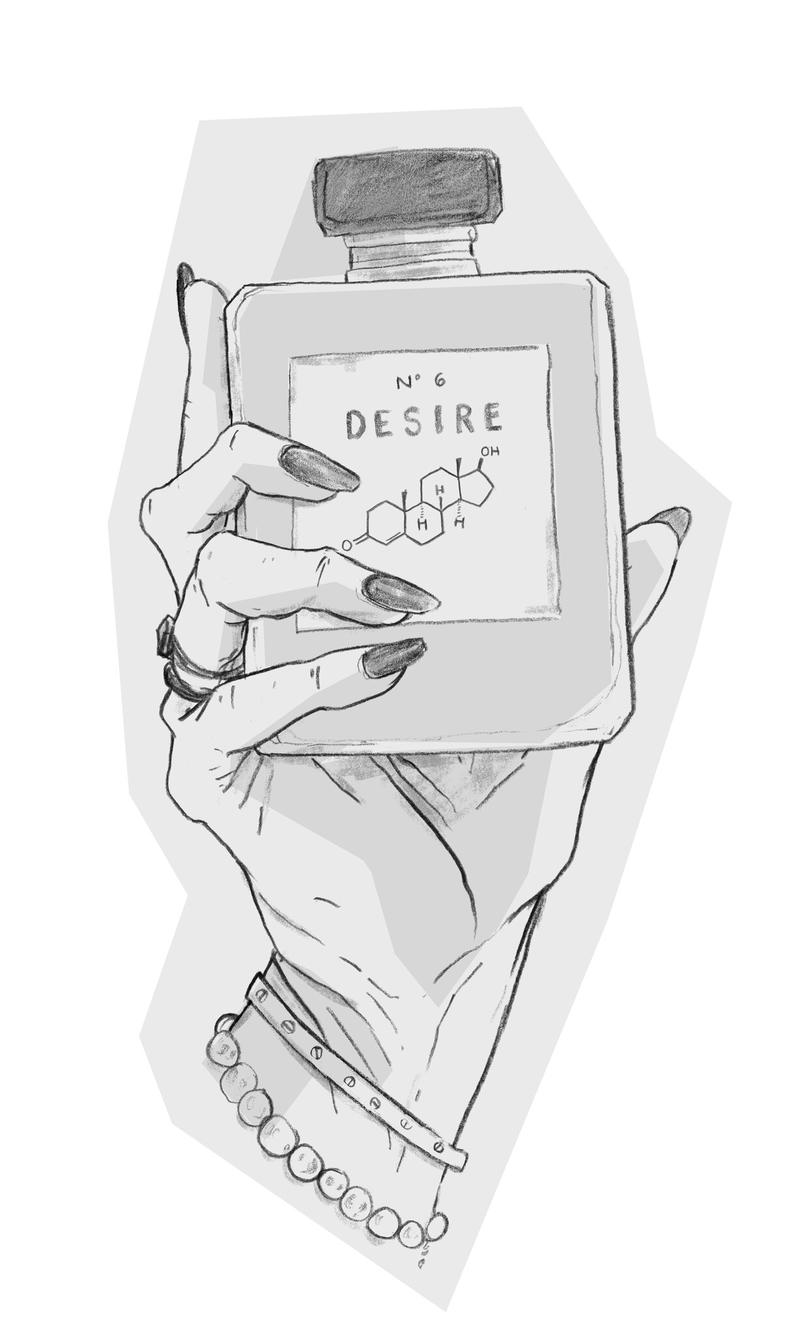
( Illustration by Elsa Paulson / Commissioned Public Domain dedication )
Alison Stewart: This is All Of It. I'm Alison Stewart, live from the WNYC studios in Soho. Thank you for spending part of your day with us. I'm really grateful that you're here. Congratulations to everyone who participated in the New York City Marathon yesterday. We had some members of the New York Public Radio family running, huge applause to them. We also wanted to shout out actor Jordan Litz, who plays Fiyero in Wicked. Why, you ask? I'll let Brad Oscar, who plays the wizard in Wicked, explain from here.
Brad Oscar: Jordan Litz, our Fiyero. I want you to know something you already do. This man ran the New York City Marathon this morning.
[applause]
Brad Oscar: He completed it, and then he did two shows. He did two shows today.
[applause]
Brad Oscar: Come on. I give you Superman, the musical.
Alison Stewart: Did you hear that? He ran the marathon, then performed in the matinee, and then the PM performance. Congratulations to Jordan, and I bet you are really glad the house is dark today. On today's show, we'll speak with the photographer and author Deborah Willis about her groundbreaking book Reflections in Black. We'll hear excerpts from our recent Get Lit With All Of It book club event featuring author S.A. Cosby and musician Yaya Bey. That is our plan. Let's get this started with reporter Susan Dominus.
[music]
Alison Stewart: As women hit middle age, many find their energy levels are lower and so are their sex drives. To solve that problem, some women are turning to taking high doses of testosterone, a non-FDA-approved method of treatment. New York Times Magazine reporter Susan Dominus spoke to women who shared how taking testosterone changed their lives sexually and emotionally. There are, of course, side effects to taking testosterone, and the long-term effects aren't yet fully understood. Plus testosterone-proven treatments, they can be expensive.
Susan Dominus spoke to women about their journey with her new piece called 'I'm on Fire': Testosterone Is Giving Women Back Their Sex Drive, and Then Some. She joins me now to discuss. Susan, welcome back to All Of It.
Susan Dominus: Thank you so much for having me.
Alison Stewart: Listeners, we want to hear from you. Have you ever taken testosterone? Are you taking it right now? What made you decide to try it? What have the positive and negative effects been? We want to hear women's experiences with taking testosterone. Our phone lines are open. 212-433-9692, 212-433-WNYC. You can call in, you can join us on air, or you can text to that number. Once again, 212-433-9692, 212-433-WNYC. Why did you get interested in looking at women taking testosterone?
Susan Dominus: A couple of years ago, I wrote a story for the New York Times Magazine about menopausal hormone therapy in general, which was mostly estrogen and progesterone. Every once in a while, testosterone would come up, but it didn't seem to be a hormone that was being taken seriously as a supplement in this country as much. In the UK, yes. Then, in the past six months, I just started seeing it all over Instagram. It became a really big part of the conversation. I think there are some women who didn't even know that women have testosterone in their system. It seemed like an interesting opportunity to explore what women were experiencing.
Alison Stewart: I was interested. Is it a new trend or has it been happening for a while?
Susan Dominus: It's been happening for a while, but I think because there is all this new excitement and awareness about the needs of menopausal, postmenopausal, perimenopausal women, testosterone has really entered the conversation. I think women, also, maybe to the detriment of their own care, some doctors think, have really come in strong to their doctors' offices demanding that they get their hormones. Women do feel empowered, which is obviously great, and they're asking more questions. I think doctors sometimes feel like they're not getting great information, and they're coming in asking for things that the hormones might not even deliver.
Alison Stewart: Let's start at the beginning. What is the function of testosterone in general?
Susan Dominus: To be honest, its function in women is not that well understood. In men, we do know that it is a hormone that is associated with aggression and also sexuality, and sex drive. It exists in women, but it drops over time much more in women than it does in men, so that by the time a woman is 60, her testosterone levels are about half of what they were when she was maybe 18, 19.
Alison Stewart: Why is testosterone important for women?
Susan Dominus: As I said, we're not exactly even sure. All we know is that when you do replace testosterone in women whose levels have really dropped, often they do report that they have more of a sex drive, and they get stronger, they look more ripped if they're taking it at very high levels, which doctors don't generally recommend. It, obviously, has a connection to bone health, mental health, but we don't know at what point are women surpassing levels that are also known to be safe?
Alison Stewart: What is its relationship to menopause, testosterone?
Susan Dominus: That is a great question. It's actually not a hormone that plummets during menopause the way that estrogen and progesterone do. It's just that the lowest point that women experience testosterone is something that coincides with menopause. Just as you're losing your estrogen and your progesterone, you are also really at the nadir of your levels of testosterone.
Alison Stewart: As you were talking to women, what explanations did they give you for why they wanted to be on testosterone?
Susan Dominus: A lot of them were hearing about it from their friends, or they were seeing influencers talking about it. I think it made sense to them. We do associate testosterone in men with sexual drive, and I think for women whose libidos have really dropped, it makes sense that they would want to try that if that's something available to them. Also on social media, you do see people talking about how it gave them energy. It was the final piece in the puzzle, some experts say, of their hormone replacement, that it's just this thing, everything clicks. Some women report feeling "more like themselves".
Alison Stewart: You talked about there are many people on social media speaking about it. Let's listen to this clip and we can talk about it on the other side. Do you have it?
Audio Clip: Ladies, you're not lazy. You may have low testosterone. You may not have just a lack of motivation. You may have low testosterone. Your struggle to stay organized, low testosterone, low libido, brain fog, depression, anxiety, low testosterone. I've struggled with these for years. It explains why I depended on caffeine in the morning and throughout the day just to feel normal. Why, when I quit caffeine, that certain supplements, I relied on those to make me feel normal. Then I also have to keep my diet pretty strict.
Now, of course, some of that does have to do with a chronic illness and autoimmune symptoms that I've been keeping in remission as well. I have to do all those things to keep those in check as well. I just did a DUTCH Test with a functional medicine practitioner, and they found that my testosterone was low. It makes so much sense.
Alison Stewart: All right, first of all, what expectations do influencers have, or what do they set about testosterone, and are those expectations somewhat unrealistic?
Susan Dominus: I'm really glad you asked that, because, as we know, testosterone in any dosage is not approved by the FDA for use in women. However, a body of very well respected medical societies got together in 2019 and issued a consensus statement saying we think in the short term, like two years to six years or so, 5 milligrams of testosterone a day for women seems to be safe and something that restores their testosterone levels back to where they were in their 30s.
The only thing those doctors and those societies will tell you that it is likely to do is improve women's libido. They'll say it's a modest but meaningful effect. They tell women, "Look, if you're not feeling an effect in six months, just go off of it." This is the only thing they will tell women that testosterone at that dose will do, libido. They also don't think it's necessarily something anyone would want to take at higher doses than that because it really hasn't been studied well. This is where the buck stops. 5 milligrams, maybe it'll help your libido. Give it a try.
There are women who are going to wellness spas, aesthetic centers, even some OB-GYNs who are taking testosterone in levels that bring their testosterone levels three or four times higher than it ever was when they were in their 20s or even 18 years old. They're experiencing testosterone at a level that is unprecedented for women. Some women are starting to take it even at the levels that are the low levels that people take who are transitioning.
Those women do report bursts of real sex drive and energy. They also report sometimes feeling incredibly irritable and frustrated and angry, or like over aroused in a way that's uncomfortable. Not only do you not know what your particular response is going to be, but we really don't know what's the safety profile. There are, obviously, doctors do have real concerns.
Alison Stewart: We're talking about the rising popularity of women taking testosterone. My guest is New York Times Magazine staff writer Susan Dominus. Her new piece is titled 'I'm on Fire': Testosterone Is Giving Women Back Their Sex Drive, and Then Some. Listeners, we want to hear from you. Are you a woman who has taken testosterone for energy or sex drive benefits? Have you thought about it before? We want to hear your experiences with taking testosterone. Our number is 212-433-9692, 212-433-WNYC. We've got Cynthia, who is calling in from Manhattan. Hi, Cynthia, thank you for making the time to call All Of It.
Cynthia: Hi, thank you. Yes, I started taking a very low dose of testosterone a little over a year ago, and maybe like a year and a half ago. It's just like a topical, a clear little gel. I put very little on my thigh. I originally got it because-- I went to my gynecologist because I was feeling-- I'm 47 now, and I was just starting to feel, at that time, like some changes in energy, in my mood, especially, also in my sex drive. I knew this is related to menopause.
My gynecologist suggested a very low dose of testosterone to start. I was a little apprehensive at first, but I took home the prescription, I started to do some research, and I thought, "Why not? Let me just try it." I haven't looked back. I really love it. It's added a lot of value to my life.
Alison Stewart: Cynthia, thank you so much for sharing your story. Let's talk to Francesca, who is calling in from the Bronx. Francesca, you are on the air.
Francesca: Hi. I have not yet tried it, although I would like to. I don't have the cash to lay out for that. When I was in my 20s, back in the '90s, I was taking a progesterone cream, like a topical cream. Nobody knew about this at the time. I happened to be living in Minnesota. There was this product Melinda Bonk made with a doctor, Wise Essentials. They still make it. The doctors were not helping me. I had debilitating periods. It was cramping, bleeding, mood. It was horrible. It was a nightmare.
The doctors were not helping me. They were giving me synthetic hormones, making it worse. I was desperate, casting about, and I found this. It was life-changing. All I remember is the doctors telling me-- I mean, it was incredible. It cut [unintelligible 00:12:46] from 10 days to 5, bleeding became mostly normal. The painkillers I had to use were severely reduced. The Advil is very bad for you to take too much, all of that, the moods, everything.
They were like, "Oh, but this isn't studied. You shouldn't be taking this. This is--" I get it on the one hand, but on the other hand, it's like they don't study us. They don't study us. Then they're like, "Oh, but don't take matters into your own hands. We don't have anything for you."
Alison Stewart: I want to dive in here real quick because you made a really interesting point, Francesca. "They don't study us." How much of this has to do with the bias against women in medicine, bottom line?
Susan Dominus: I think specifically when you speak about testosterone, it's hard to separate out the way that women are indeed under research, particularly middle-aged women, but also this particular hormone, it's just the standard was much higher, the safety standard that the FDA put in place. When testosterone was approved for men, basically, they just needed to find that it did indeed restore men's testosterone levels to where they were.
For women, because there are real and valid concerns about breast cancer, they didn't just want to see that it restored women's testosterone to where it was. The FDA really wanted long-term safety data, which I think some people think was excessive, but other people think is completely justified. It's one of those questions that you can get different answers about. I think testosterone, in particular, kicks up a lot of uncomfortable feelings for people when they think about women taking it.
Alison Stewart: We're talking to Susan Dominus about her piece about women taking testosterone. Listeners, we want to hear from you. Are you a woman who has taken testosterone for energy or sex drive benefits? Have you thought about it before? We'd like to hear your experiences with taking testosterone. Our number is 212-433-9692, 212-433-WNYC. We'll be right back.
[music]
Alison Stewart: You're listening to All Of It on WNYC. I'm Alison Stewart. My guest in studio is Susan Dominus. She's a writer for the New York Times Magazine, and she's written a piece called 'I'm on Fire': Testosterone Is Giving Women Back Their Sex Drive, and Then Some. We've talked about an increased sex drive when taking testosterone. What did women tell you about the potential downside of an increased libido?
Susan Dominus: Oh, that was super fascinating, I have to say. One of the foremost researchers in the field told me about a woman who came to her and had been taking very high doses of testosterone. This is a middle-aged woman who had basically injured her back because she'd insisted that her husband pull over by the side of the road while they were driving so that they could stop and have sex. It became this uncomfortable distraction.
One woman who was on high dose testosterone told me that she definitely felt more eager for sex, but that the hormone also seemed to be making her so irritable and annoyed with everybody that she couldn't bring herself to have sex with her husband because she was so mad at him all the time, even though she was really interested in sex at the same time. There were these emotional side effects for some women.
Other women also told me that they had really been uninformed about really common side effects like hair loss. One woman went on high doses of testosterone, many times the level she'd ever have naturally. She said she lost within the first three months of taking a form of testosterone that you can't stop halfway through. It's a pellet that gets-- this tiny grain of rice that gets inserted under your skin and releases testosterone. Over three months, she lost up to 40% of her hair, and there was no way to stop the process. That was really challenging.
I think that a lot of the places that are offering these high doses are very high-profit-driven kinds of places. Maybe women are signing the paperwork that informs them of the risks, but they're not really being talked through the reality. Like, "Look, you really could lose your hair. You could start growing facial hair in ways that are irreversible. That your hair will forever come back a little darker, a little bit coarser, that kind of thing on your face."
Alison Stewart: What kind of expense are we talking about?
Susan Dominus: Oh, it could be upwards of thousands of dollars a year because each pellet, for example, lasts three or four months. I think each one is about $400. Yes, it depends where you go. They also often are pushing on women these supplemental shots, a $100 a pop here and there. It's just, there's a lot of churn, and a lot-- These places will tell you that they are really trying to individualize it to women, but at the same time, they're taking it much higher than these established medical societies recommend.
Alison Stewart: I wanted to ask you about this idea of increased energy that some women talk about. What does that mean? What's different than getting a good night's sleep gives you increased energy? What do they say about the kind of energy that they are experiencing?
Susan Dominus: It's like a steroid. It's going to give you that burst at these very, very high levels, that pop of energy. Some women found when they take these pellets that they have a burst of energy and libido in the beginning, but then they crash. It's a little bit uneven. Whereas the daily cream that women take at that standard dose that's endorsed by the medical societies that's a little more steady, you can regulate it yourself a little bit.
I did have two different women tell me that they had so much energy that they went on to get their advanced degrees that they wouldn't have thought they had time or energy to pursue before. It is a real thing. It's just you're rolling the dice because we don't have great safety data about it. You don't know if you're going to be the woman who loses half your hair, and you don't know if it's going to give you good energy or bad energy.
Alison Stewart: Yes. One woman in your piece talked about having the energy of a teenage boy. She was argumentative.
Susan Dominus: Yes.
Alison Stewart: Very insistent on her opinions. Her daughter said to her, "Mom, you're acting like a teenage boy." She had the levels of hormone in her, this hormone that teenage boys actually have.
Susan Dominus: Another woman said to me, "I feel like I'm a little bit more matter-of-fact." Maybe she meant a little bit even less empathetic. She said, "That's great, because I don't have time for all that stuff anyway."
Alison Stewart: Did you talk to anyone who truly regretted taking testosterone?
Susan Dominus: Yes, I did talk to women who felt that the irritability of it made them uncomfortable, and that they-- Some of them felt like they're-- that they were spotting afterwards and that their mood was screwed up for a little while. I did hear from one woman who took it years ago and is still dealing with unwanted coarse facial hair. That she feels like it's such a chronic problem for her. I do think she regretted it.
Alison Stewart: Let's talk to Emily, who's calling in from Atlantic Highlands, New Jersey. Hi, Emily. Thank you so much for making the time to call All Of It.
Emily: Oh, it's my pleasure. Thank you.
Alison Stewart: You're on the air.
Emily: I was simply calling to give my experience of having taken a pharmaceutical called Estratest, which is like a big pharma version of testosterone. I've been doing it for 30 years, and I love it. I feel great. People tell me all the time that I seem so much younger than my age. I thought I'd let you know.
Alison Stewart: Emily, thank you so much for calling in. This text says, "My perimenopause symptoms included muscle weakness and joint pain. Taking testosterone has been a game-changer. I apply a small amount on my inner thigh daily, and the cost is nominal. Not going through insurance, a whole box of packets of testosterone that lasts a year cost me $100 for my local pharmacy pickup." Is that how most people take it?
Susan Dominus: How most people take it, we don't know, because insurance isn't covering it, so we don't have great records. If you go to a reputable OB-GYN and say, I would like the standard dose," many of them may figure out how to get it through the pharmacy in just that form. It doesn't have to be that expensive. Other people find it easier. The problem with them taking it from a standard pharmacy is that you're usually getting a packet that is intended for men. Men will use the whole packet and rub it on their legs. If you're a woman, you take a tenth of what men take. You have to estimate what a tenth of the packet is. That's a little bit of a guessing game.
Other people will prescribe it through a compounding pharmacy, and there's a dispenser, you turn it, it clicks, and it'll give you this standard dose, this 5 milligram dose. The only problem with that is that compounding pharmacies, their medications are also not regulated as carefully by the FDA. It's a little bit less quality control, basically. Again, you're rolling the dice a little bit more than if you take it through a standard pharmacy.
Alison Stewart: When is the FDA going to get on this?
Susan Dominus: We do not know. There is a pharmaceutical company that has-- It used to be that people could take testosterone via a pill, men took it in a pill, but it was causing liver problems. Now, a pharmaceutical company has a product on the market that bypasses the liver. This pill is very easy to take. That company is in discussions with the FDA about getting some studies going of a female-appropriate dose of the same approach to testosterone delivery.
These things take a very long time. It's been a really long time so far as I know before-- because it's been a long time since a pharmaceutical company has even come to the FDA with a product, because they've gone to the FDA twice before and failed. After something like that happens, it's very expensive to run these trials. Once two different pharmaceutical companies have failed, it's very hard to get something back on the market. Here we are. There is this company, Marius Pharmaceuticals, that is approaching them once again.
Alison Stewart: There are nearly 1,300 comments on your piece. What was a response that either surprised you or brought up an issue that you hadn't thought of before?
Susan Dominus: A lot of the comments were actually about the illustration that we ran with the piece, which was wacky. I heard from all kinds of women. One woman was convinced that testosterone, which she had been taking for many, many years, was causing non-cancerous tumors. I think people do have real concerns about the long-term health effects, but just in general, I think there's a sense that women deserve more information, and they certainly deserve a female-appropriate dose of a medication as long as their doctors are telling them exactly what we do know and what we don't know. It's true that we don't really know that much about long-term use of testosterone, even in these standard doses.
Alison Stewart: This comment was from a reader named MJ. They said, "I mean, if you're running around for 18 hours a day, of course, you're tired. You don't need testosterone or cocaine. You probably need to rest. I despise how our entire culture is geared towards popping pills to keep up with hustle culture. No, thanks, I'll keep my hair and happily do less."
Susan Dominus: I love that.
Alison Stewart: Yes, I know what you think about this idea of hustle culture or the idea that this is supposed to happen to women as they get older, they lose testosterone, [unintelligible 00:24:48] just diving in and changing our humanity and the way we were supposed to age.
Susan Dominus: It's a really profound and important question. I wish I'd been able to quote in the piece one of the really wise sex therapists I spoke to, who said some women want to be done with sex in their 50s and 60s, and we can normalize that too. Just as there shouldn't be shame around being in your 50s and 60s and wanting to have sex and wanting to feel that red-hot desire. We also shouldn't be shaming women who want to say, like, "That was great and now I'm moving on to other things."
Some of the women who were taking it for energy, these are women who have lots of kids, and they have lots of jobs, and they're really juggling so much. I did sometimes think we do know that the labor of child rearing still falls to women in large part, and it does seem like-- I did sometimes think it shouldn't be this hard just to get through the day that you need to take these really high doses at a level that has never really been experienced in past centuries, certainly by women at all.
Alison Stewart: We've got a question here that says, "How did working on this piece make you think differently about sex and gender?"
Susan Dominus: Oh, that's a really good question. Let me think about that. I actually thought it was really interesting to think about gender to the extent that some of the things that we associate, for better or for worse, with certain gendered behaviors, just having more of a sense of how much testosterone women do have, which is, of course, much less than men, but just the fact that we do have it, and of course women have it in different levels. I did start to think of gender as a little bit more of a continuum.
Then when you think about the fact that some women are taking testosterone at levels that approach the low levels that people take who are transitioning, some of these women, by the way, so far as I could tell, quite politically conservative or religiously conservative, you just realize that increasingly people, whether they realize it or not, are playing around with that spectrum and deciding where they want to be on it.
Alison Stewart: What are some of the big questions that you still have after working on this piece?
Susan Dominus: I would like to have more safety data, to be honest, because it's-- The best safety data we have, even on the standard doses, really only goes out like two to six years. I think a lot of people, once they start on a hormone, it's really hard for them to walk away from it. For women's sake, I would like better long-term safety data. I think we should have-- One of the doctors I quoted in my articles, Rachel Rubin, this really outspoken and smart urologist. The companies that produce these pellets haven't really done very long-term randomized control trials. We don't really know what's going to happen to women who are taking these very high doses. We know what the side effects are going to be. Forget the side effects. What are the long-term health repercussions? Somebody needs to answer that question.
Alison Stewart: The name of the piece is 'I'm on Fire': Testosterone Is Giving Women Back Their Sex Drive, and Then Some. It is by my guest, Susan Dominus. Thank you for coming to the studio.
Susan Dominus: It's always a pleasure. Thanks so much for having me.