
Tayari Jones on Her New Novel 'Kin'
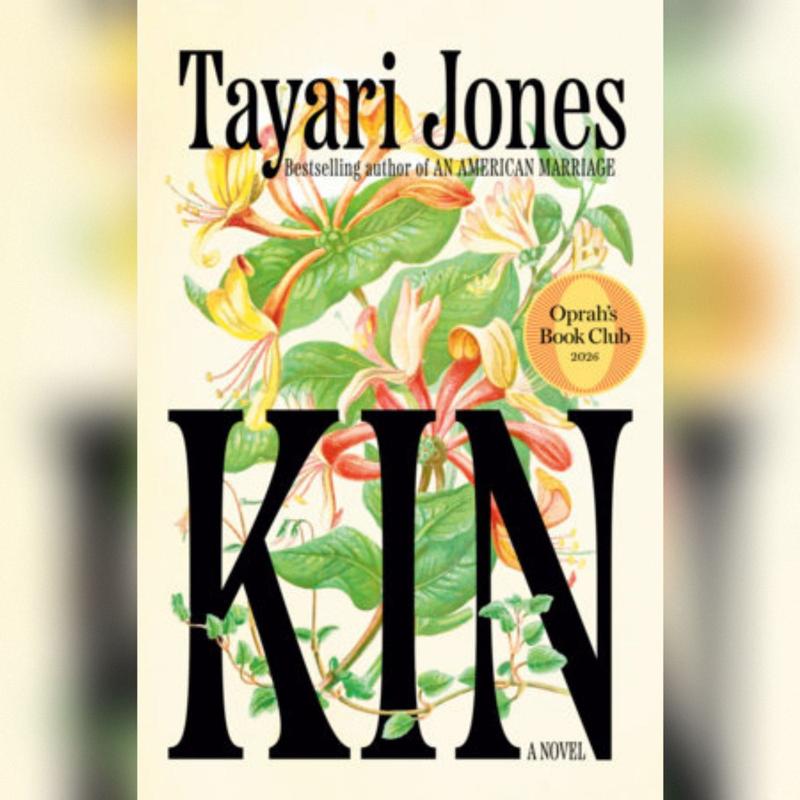
Alison Stewart: You're listening to All Of It on WNYC. I'm Alison Stewart. Though it was just published on Tuesday, the latest novel from Tayari Jones is already one of the most acclaimed of the year. The title of the book is Kin. It was selected for Oprah's Book Club this month. Kirkus calls the novel, "Beautifully written and powerfully compelling." The New York Times review said, "When reading Kin, I wanted nothing more than to keep reading it."
Kin tells the story of two young women bound together by loss. Vernice's mother was shot and killed by her husband when Vernice was just a baby. Annie's mom left town shortly after Annie was born. Annie and Vernice, who goes by Niecy, quickly become friends, each leaning on each other to provide some of the love they're missing from their moms, but soon, life takes them in different directions. Niecy heads off to Spelman College in the midst of the civil rights movement. There, she's introduced to a world of educated and upwardly mobile Black women, a world that feels very far from the small town in Louisiana she left behind.
Annie also leaves town, but she heads to Memphis, determined to find her mother. These different paths will separate Annie and Niecy for a while, but life will eventually bring them back together. Kin is the first novel from Tayari Jones since her bestseller An American Marriage. She'll be doing a live taping of the Poured Over Podcast tonight at 6:00 PM at the Union Square Barnes & Noble, but first, she joins me in studio. It is really nice to see you.
Tayari Jones: It's so nice to be here.
Alison Stewart: I read that you moved back to Atlanta.
Tayari Jones: I did. I moved back to my hometown.
Alison Stewart: What made you move back to Atlanta to write this book, especially?
Tayari Jones: I really moved back for my parents. They're in their 80s. It wasn't that I moved home so much to take care of them, it's that I moved home because I wanted an opportunity to get to know them as adults. When I was living away, I would basically see them when I would come home for the purpose of visiting them, but I would be sleeping in my childhood bed, and that wasn't a way for us to really see each other as we are now.
Alison Stewart: How did it affect your writing being home?
Tayari Jones: I think it really, in some ways, inspired this book because although I have a fantasy to be like one of the characters in the book, where the aunt says, "You and I are going to have a drink and talk like two grown women," my mother does not share this fantasy, and so I never have-- I won't say I never, because it ain't over till it's over, but I have yet to have that real conversation that I've always wanted. I think my imagination gave me this book instead.
Alison Stewart: In the thank yous, in the back of the book you wrote, "Time is the greatest gift to artists, when you were thanking the fellowships that you had. Why was that important for you to put in the book?
Tayari Jones: I think that the arts support organizations are the unsung heroes of the creative world. For a writer to be given a semester, a year away from her job to just create, and also just the affirmation that someone says, "I want to invest in giving you this time," it's so important, but it's invisible. Your average person who reads a book will never know that the Mellon Foundation made this possible. I just want to shine a light and elevate that so that when these organizations, which are so under siege in our current economy, that people can see the real tangible effects of their generosity.
Alison Stewart: You've shared that Annie and Niecy weren't your original protagonists. They were actually going to be matriarchs.
Tayari Jones: They weren't my original anything. I thought I was going to be writing a novel about gentrification in the modern South. I was having a hard time. The novel, it just wasn't noveling. I started writing, just scratching around on a piece of paper, and that's when I met Annie and Vernice. Since I was under the impression that I was writing about the modern South, I said, "Well, this is the 1950s, so clearly these must be my character's parents, because while I believe myself to contain multitudes, I do not believe myself to contain a historical novel."
Alison Stewart: I'm talking to Tayari Jones. We're discussing her novel Kin, about two best friends who are bonded over the loss of their mothers. It's out now. What were you interested in, in exploring the role of a mother in someone's life, because both these women have different relationships with their mothers?
Tayari Jones: They're both motherless. Annie was abandoned, and Niecy's mother is dead. They grew up as these poor motherless babies. That actually, in some ways, became their identity as children. Everyone knew they were without their mothers, but for different reasons. I felt like this idea of wanting a mother and not having a mother, it causes you to want the ideal mother. When you say you're a motherless, you imagine yourself deprived of just the warmest, kindest, most supportive mother ever. Chasing a ghost, chasing an ideal, I think, does more damage because no real person will ever be able to live up to that.
Alison Stewart: I'm going to get you to read a little bit from your book. This is Annie. Where are we meeting her?
Tayari Jones: This is right at the start, when we hear her voice, when she explains this sameness that she and Niecy have because they have no mother.
"Niecy and me have been friends since we smiled with our milk teeth. We were two motherless girls that everyone felt sorry for, but Niecy was especially cooed over because of her sweet face, which reminded folks of her mother, who was gone from this world, and it was a crying shame. My situation also called for pity, but no one remembered my mother as a poor thing. If there was one word on every lip, it was trifling. It's one of those words that Webster's doesn't know anything about.
I looked it up one time and saw something about a cake. In Honeysuckle, we know it can be one of the harshest words ever spoken. I say can be because you can soften it up with a little bit of a laugh. When you chase it with a chuckle, it just means you didn't do your best, like only rubbing lotion on the parts of your body that didn't show, leaving the rest ashy, but when the word is sneered and disgust, there is no damnation more vicious."
Alison Stewart: I love that word trifling.
Tayari Jones: The word trifling is used as evidence that African American vernacular English is a language because it is an untranslatable word.
Alison Stewart: But you know what it means.
Tayari Jones: Yes. Yes, you do. When someone says it to you, especially if they don't laugh, you will go back home and get into bed.
Alison Stewart: Have you ever had a friend that meant so much to you as Annie and Niecy mean to each other?
Tayari Jones: I have, and I feel like I am very blessed because of that, as a matter of fact. When you finish a book, you can look back and see the way your life is manifested on the pages. I lost a good friend about three or four years ago.
Alison Stewart: I'm sorry.
Tayari Jones: I miss her all the time. I do feel that our old friends, friends you've been with for decades, in many ways, they carry with them the archive of your heart. When you lose those friends, some of your own memories are lost.
Alison Stewart: When Annie leaves town to find her mom, she doesn't tell Niecy that she's leaving. Why not?
Tayari Jones: She runs away. She runs away from home. She doesn't tell Niecy for a lot of reasons. One, she doesn't want her friend to have to hold that secret. Also, I think Annie did not want to say goodbye. She did not want to say goodbye. The last time she saw Niecy, she knew she was leaving, but Niecy didn't know.
Alison Stewart: Spelman opens up a whole new world to Niecy. You're a graduate of Spelman yourself.
Tayari Jones: I am.
Alison Stewart: Your grandma was as well.
Tayari Jones: Actually, my found grandmother is a graduate of Spelman College, but yes, I went to Spelman. I was just a kid when I went. I was only 16, so I feel like I came of age on that campus.
Alison Stewart: That's so funny. My grandmother went to Spelman when she was 16 as well.
Tayari Jones: I did not know your grandmother went to Spelman.
Alison Stewart: Oh, yes.
Tayari Jones: I feel that you buried the lead on this entire conversation.
Alison Stewart: We'll discuss it later. Where did you go to understand what Spelman would have been like when she attended, when Niecy attended?
Tayari Jones: I read a wonderful book called A Mighty Justice by Dovey Johnson Roundtree, who finished Spelman in the '40s. In reading her memoir, I discovered a proud, strong, working-class history of Spelman College. People so often think of it as this place where people sent their debutante daughter, but a lot of people came from these small towns in the South seeking education. My nana said when she was there, she knew a pair of sisters where one worked full-time as a maid for the whole year, and went to school the following year, and her sister went and worked for that same family.
Alison Stewart: Oh, wow.
Tayari Jones: That is such a commitment to education.
Alison Stewart: Did you want to put a spotlight on HBCUs with this book?
Tayari Jones: I feel like for me, HBCUs are just such a part of life. My parents were professors at HBCUs. I went to one, and it just felt natural and organic for me. I feel like every day when I wake up, get dressed, and leave the house, I am a spotlight on a HBCU because Spelman is such a significant part of my identity.
Alison Stewart: My guest is Tayari Jones. We're discussing her new novel, Kin, about two best friends who are bonded over the loss of their mothers. It's out now. It's going to be a bestseller. I want to read a passage of Niecy talking about segregation because this is taking place during the Civil Rights movement. She said, "Who didn't admire Mrs. Parks down in Montgomery, and what about Barbara Posey and the lunch counter kids in Oklahoma City? Don't forget about the young folks in Little Rock dressed to kill, determined to bust up that white high school. What courage, but all of that was city life." Barbara Posey.
Tayari Jones: We've met.
Alison Stewart: Please explain.
Tayari Jones: Barbara Ann Posey is my mother. When my mother was only 15 years old, she and some other young people from her church, they sat in at a drugstore lunch counter every day for the entire summer and on weekends during the school year for two years. This was before Greensboro. This is when it was a very novel idea of a way to challenge segregation. Just imagine these kids in their smart school outfits, and they just sat there, and they just, by their very presence, challenged the moral authority of those around them.
Alison Stewart: She's challenged to be a bigger part of the Civil Rights Movement. How does she feel about that?
Tayari Jones: Niecy feels like she got to college by the grace of God, really. She doesn't necessarily want to join the movement because she fears she'll be expelled. My dad went to the army, and then he went to Southern University in Baton Rouge. He also was in college by a miracle, and he risked it all, and he was expelled for demonstrating. There were real consequences. When she's asked to join, the person who asked her is from a much more privileged background, and she feels like this girl has the luxury of perhaps being jailed or expelled.
Alison Stewart: Niecy and Annie write each other letters throughout the novel. They're really interesting to read. Are you a letter writer?
Tayari Jones: I am a letter writer. I love communicating by paper. I think I love to write, but I also love that our letters are a physical artifact of our relationships.
Alison Stewart: Explain that a little bit more.
Tayari Jones: A letter serves three functions. If you receive a letter from me, you have the information contained therein. You also have the emotional knowledge that I thought of you today, but the letter itself is a tangible reminder. You can put it in a drawer, you can press it in the pages of a book, and come across it again and be reminded of our relationship.
Alison Stewart: When we first meet the girls, they're just babies, and we follow them through adulthood. What was challenging or exciting about following two characters through so many different stages of their life?
Tayari Jones: The most challenging part was keeping them connected. Just like in real life, the challenge of a friendship, when your friend moves away, is staying connected without the dailiness of seeing each other. It was also narratively challenging. Their lives were so different. Here is Niecy in college, living in a dormitory for the first time. Simultaneously, here is Annie, who, through a series of coincidences and mishaps, is living in a whorehouse where she does laundry. That's all she's doing there, but still, to live in a whorehouse, you could not be further from a college dormitory.
Alison Stewart: These two characters, did they come to you-- I've heard writers say this, "This character came to me, and I just wrote," or did you develop them?
Tayari Jones: I am never that person that says a character came to me. Just your tone, I can tell what you think, and that is how I've always thought. I always thought when people say characters came to them, they're just trying to seem interesting, like they have a hotline to the divine. These characters, they came to me, but then I had to develop them.
I did not intend to write about anybody living in the 1950s. I did not know that I would write about anybody accidentally challenging segregation on a bus.
Those plot points came to me in a surprising way, but I do think, even though it seemed to come-- It's like this. You know, when you're in love, you feel that everything you do is guided by your own little beating heart, but when it's over, you see what issues you're really working out?
Alison Stewart: Yes.
Tayari Jones: I think that's what happened to me. This book felt magical, like it was from my own heart, and it was, but when it was over, I could see the way my own experiences guided me to these characters.
Alison Stewart: People who say characters come to them, I'm like, "I wish I could be like you." I keep thinking, "Does it come that way?" No. You're like, "No."
Tayari Jones: I suppose it varies from person to person.
Alison Stewart: It's very interesting because I've quoted you to several authors, and you said something that was so smart. I think it really helps people who listen to this show. You said you can't always have an hour to write in the morning. You don't have an hour to put aside. You might have five minutes on a bus, and you write something down. If we say that you can only have an hour to write in the morning, think about how many stories we're missing from people who are bus drivers, who are nurses, people who have something to say, but they only have a short period of time to write.
Tayari Jones: Indeed. All the things that are keeping you from having dedicated writing time every day, these are the exact same things that are making your story meaningful, that are enriching your life. Yes, there are people who get up and write all day in their pajamas, but I will tell you, I am not interested in anybody's pajama book. That's called a journal. I want to read a book by someone who's living a full life, who's engaged in the world. Give me the books by the people raising kids. Give me the books by the people working two or three jobs. Give me the books by the caregivers. I want to hear what these people have to say.
Alison Stewart: You pick a word every year for you to focus on. In 2024, you were working on this book. It was discipline, was that right?
Tayari Jones: Discipline. Yes.
Alison Stewart: What is your word for 2026?
Tayari Jones: The word for 2026 is a little bit of a cheat because it's present, which is, I want to be present and really think about this moment I'm in. Don't worry about what happened yesterday. Don't worry if I'm living up to my last book. Don't worry about the future book. Just be right here, but also, I think about present because I'm going on a 30-city book tour. I have a platform, really, for the first time in my life. What am I going to present? What am I going to talk about? What do I want people to know?
Last, I know this is a little saccharine, but I also want to use present as a gift because this whole amazing experience of being a writer, meeting readers, it is a real present and I want to enjoy it.
Alison Stewart: What would you have done if you'd finished this book and it wasn't well-received?
Tayari Jones: I was totally prepared. I was so grateful to have finished the book. Keep in mind, I was contracted for a entirely different book. I turned it into my editor, like, "Here you go," and basically the electronic equivalent of ran out the room. The fact that she accepted it at all, I felt so lucky. Everything else has just been, as they say, it's just icing on this cake.
Alison Stewart: Was it always called Kin?
Tayari Jones: It was always called Kin. I had to turn it in, this new book. I needed a title, and I just thought, "How can I distill the feeling of this book?" I was apprehensive about the title because I was always told you should not give a book a title you have to spell. I say, "Oh, the book is called Kin, K-I-N," but no other title fit it.
Alison Stewart: What happened to the original book that you wrote? Are you going to get to it, or is that just sitting over the side?
Tayari Jones: No, I hope I can write it. As my students would say, the book wasn't booking. It was a good idea. I still think it's a really good idea, but it was like I was in an arranged marriage with an idea, and we didn't have chemistry, but I hope that now, a year or two later, me and the book idea, we've both grown, we're at a better place.
Alison Stewart: You'll hook up.
Tayari Jones: Hopefully. I know. I hope it'll invite me out.
Alison Stewart: The name of the book is Kin. The author is Tayari Jones. Tayari, thank you so much for joining us.
Tayari Jones: Thank you for having me.