Subway Series: West Fourth Trio Plays Live in Studio 5
[music]
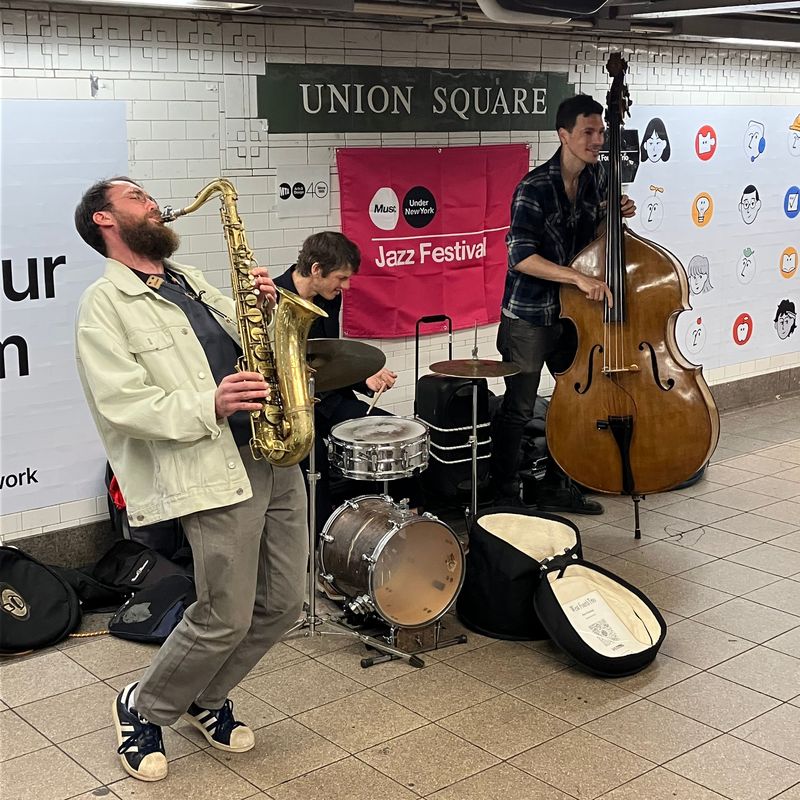
Alison Stewart: This is All Of It on WNYC. I'm Alison Stewart. Our show, devoted to great performers, continues with a trip into the subway. This year, we're showcasing musicians who are part of the MTA Music program, and add to it that April is Jazz Appreciation Month. In studio with me now, we've got members of the jazz group West Fourth Trio today, featuring Alex Feldman on drums, Billy Edwards on bass, and Danny Raycraft on tenor saxophone. You can see the band performing in the subway as well as around Central Park. Now, they are at WNYC. Welcome, guys.
Alex Feldman: Hey, Alison, thanks a lot for having us.
Alison Stewart: All right, we're going to start with the first performance. Alex, what would you like to play first?
Alex Feldman: Our first song is going to be This Time the Dream's on Me. Here you go.
[music]
Alison Stewart: That was the West Fourth Trio. You can often see them playing in the subway or in Central Park. Alex Feldman on drums, Billy Edwards on bass, and Danny Raycraft on tenor sax. They're here to perform live as part of our series this year, spotlighting musicians who are part of the MTA Music program. Alex, we'll start with you since you get to stay in the booth. [laughs] When did you first get the trio together?
Alex Feldman: I started playing in the subway maybe seven or eight years ago. I started playing at the West Fourth Station with two other guys. Hence, the ultra-creative West Fourth Trio.
Alison Stewart: [laughs]
Alex Feldman: Yes, I spent about five seconds trying to think of the name. That's what I came up with. Yes, it's too late to change it. We have too big of a fan base. They would be confused if we changed it.
[laughter]
Alison Stewart: New York is obviously an incredible place to play. When did you first start busking, Billy?
Billy Edwards: Oh, Danny got me in. That was crazy. I am from San Jose, California. I would come out to New York for gigs. At a certain point, I was trying to spend more time here, but I wasn't really sold on moving to New York. I'm not sold on the New York jazz musician thing, but I met Danny at ornithology, and then I told him I wanted to play. He's like, "Come to the park tomorrow."
We play with this really crazy drummer, really beautiful drummer who passed away last year, Uros Markovic. He would call you for eight-hour sets. You just play one set, 11:00 to 7:00, and he would call you for five days in a row. Eventually, I started gigging, and it's like, "Oh, Uros, I can make money through Friday, but Wednesday I need to leave at 6:00 PM or 6:30." He's like, "Never mind. You're canceled from all of them."
Alison Stewart: [laughs]
Billy Edwards: How I started was Danny got me with Uros about three years ago, and it was like busking boot camp. It was really awesome. He was also part of this program, Mooney.
Alison Stewart: Tell me about busking boot camp. What does that look like?
Danny Raycraft: Oh, well, just this one guy in particular. Playing with him, that's often what it felt like. I really started busking with this guy, Mark Johnson, this great drummer who played with people like Jackie McLean and Abbey Lincoln. That's when I really got into it, and then did that for a couple of years. When you do this, you play with all kinds of different people. That was my first busking experience. Then, later, I met Uros, and then I got Billy involved in that. Then, Billy introduced me to Alex, so it all ties together.
Billy Edwards: Well, yes, the former guy, Ben Frank.
Danny Raycraft: Oh, Ben Frank, who was also working with Uros, introduced me to Alex. It's like everybody plays with each other.
Alex Feldman: We met each other through busking, I guess, when you think about it.
Danny Raycraft: At Washington.
Alex Feldman: Yes, Washington Square Park. Yes.
Alison Stewart: Alex, what do you like about playing for New Yorkers?
Alex Feldman: For New Yorkers? Well, I'm not really sure.
Alison Stewart: [laughs]
Alex Feldman: I've never busked in another city. Like you're talking about, busking specifically?
Alison Stewart: Yes.
Alex Feldman: I don't know. I guess they're psyched to hear some music. Some people come here to hear jazz, and so you can tell that they're excited.
Danny Raycraft: Alex, you were just talking the other day about how jazz is such an integral part of New York City culture, and so it's really cool that we're doing it on the street.
Alex Feldman: Yes, sure. Yes, it feels like we're representing that, doing our small part to represent jazz music out there on the streets or in the subway. I don't know. Plus, we just love playing music. We love playing as much as we can.
Alison Stewart: Danny, what is something that you've observed about the subway, people in the subway, that only a busker can experience?
Danny Raycraft: Well, we probably spend more time down there than anybody else.
Alison Stewart: [laughs]
Danny Raycraft: I don't know. Maybe just the fact that music is just a thing that brings everybody together. There's all kinds of people down there in the subway, and music unites pretty much everybody. Every once in a while, you get someone who walks by covering their ears. It's like, "Do you even realize how much quieter we are than the trains themselves?" That's okay. It takes all kinds of people, including people who don't like music, I guess, so it's fine.
Alison Stewart: Billy, what's the difference with playing underground versus playing in the park?
Billy Edwards: I'm biased. I love the park. There's sunshine. You can breathe. People are dressed funny. The subway is like-- I don't know how to describe it. It's definitely an exercise in meditation and focus. It's like, "Do you really want to play?" Sometimes when these guys are busy or it's like the middle of the night, like 5:00, 6:00 AM, or something like that, I'll go to the subway and just see if I can play louder than the train.
Alison Stewart: [chuckles] How do you do?
Billy Edwards: Horribly. I haven't done it yet, but I want to. I want to get like that. When nobody's there, you can hear the bass. It's awesome.
Alison Stewart: This year, we're spotlighting musicians in our subway system that are part of the MTA Music program. My guests are members of the West Fourth Trio, where you can often see them play or in the subway or at Central Park. Our guests are Alex Feldman on drum, Billy Edwards on bass, and Danny Raycraft on tenor sax. They're here to perform live. Alex, you're part of the MTA Music program. Why did you want to get involved with the MTA Music program?
Alex Feldman: Well, I think that during the winter months, it's like things slow down. I knew if I joined that program, I'd have a vehicle to keep playing live through the colder months. It does get cold down there. Don't get me wrong, but you can't. It's really difficult to play outside to keep busking during the winter. In order to keep the ball rolling, I guess, it was just a good thing to do. Yes, we definitely utilized it a lot, so I'm very happy. I'm thankful for the program.
Alison Stewart: I want to ask you. As a busker, as somebody watching a busker, are there important etiquette tips that people should keep in mind when we're watching you play?
Danny Raycraft: Yes, absolutely.
Alex Feldman: Give us some money.
Alison Stewart: "Give us money," is number one.
Danny Raycraft: If you take a picture of us, if you like us enough to want to take a picture or a video or something, you should consider giving us a tip. That is something that not everybody realizes. It's nice to get this little opportunity to say that to the public. If you like us enough where you want to have us on your story or something, you should consider giving us a dollar or something.
Alison Stewart: Billy, how do you feel about people taking films of you?
Billy Edwards: We have a friend who is a very great saxophone player who hates it, and he'll legitimately stop playing. I think he's a big wuss, and we're out there anyway. Who cares? I like playing. The thing I like about Alex on that previous question was I took a screenshot of the weather app, and it was -16. Alex and I played something like six or eight hours straight that day.
Alison Stewart: Oh, my gosh.
Billy Edwards: It was awesome, like in the middle of the weather.
Alex Feldman: I don't know if it was eight hours. That might be an exaggeration, but we were down there. We were down there.
Billy Edwards: It was all day. It was like, that's what we spent our day doing, just playing in the subway in -16. It's like, that's why that program is so important to us.
Alex Feldman: The fact that it's adversarial conditions, much of the time, maybe is like-- yes, that can be a real pain, but that also can make it interesting. That can also bring something out of the music that might not happen otherwise.
Billy Edwards: It strengthens your conviction.
Alison Stewart: [laughs] I'm going to ask you two to head back to your instruments. We're going to hear our next song. Alex, what are we going to hear next?
Alex Feldman: This is called From This Moment On. It's by Cole Porter.
[music]
Alison Stewart: You'll hear more from the West Fourth Trio after a quick break. This is All Of It.
[music]
Alison Stewart: You're listening to All Of It on WNYC. I'm Alison Stewart. I'm here with Alex Feldman on drums, Billy Edwards on bass, and Danny Raycraft on tenor sax. They make up the West Fourth Trio. You can see them play underground as part of the MTA Music program. They're performing live in our studio for our series, spotlighting musicians who busk around the city. Danny, why was the tenor sax right for you?
Danny Raycraft: Well, actually, when I was growing up, my dad had a poster of New Orleans Jazz Fest in the basement in the playroom. It's like a cartoon drawing of a guy leaning up to a wall playing the saxophone. Turns out it was the tenor. Just from a very early age, I remember looking at that being like, "Wow, that's so cool. I want to do that."
Alison Stewart: How about for you, Billy? How did you pick up the bass?
Billy Edwards: I used to play drums. My middle-school band teacher was a drummer, and he's like, "This is not for you." His name was Jemal Ramirez, and he hit me up with an upright bass.
[laughter]
Billy Edwards: That's still my bass, so it's cool.
Alison Stewart: How did you end up on the drums, Alex?
Alex Feldman: When I was in eighth grade, my brother got a guitar, and so I was coerced into getting a drum set. I reluctantly went along with it. I was into music. I love Green Day and Nirvana and whatever. After a few months, I was like, "Oh, this is what I want to do for the rest of my life."
Alison Stewart: As you think about playing in front of people in the subway and in the park, how has it made you a better musician?
Danny Raycraft: Well, first of all, just the opportunity to put in so many hours honing our craft, but then also, I love playing for people who come and go. We don't have to be the center of attention. At a club, it's fine if people are talking. We don't need everyone to shut up and listen to us or whatever. We're just doing our thing. If you like it, you can check it out. If not, don't worry about it. Yes, putting in the hours and that kind of variety just gives us a lot to work on.
Alison Stewart: Billy, how is playing in front of all of these people in public spaces made you a better performer?
Billy Edwards: Just hours logged. One thing is the pressure. It's like, I could play in my bedroom, and that's like a certain vibe. Then, you have these guys over in my bedroom, and then it's a cramped vibe.
[laughter]
Billy Edwards: These guys are always down to play. Danny and Alex, always down to play. It's just like working under that pressure for so long, you get focused on what you really want to play.
Alison Stewart: So many people are trying to get someplace fast in New York City. That's just the rule of New York City. Alex, have you figured out what it is that makes them stop and listen, even if just for a few minutes?
Alex Feldman: Well, sometimes it depends on how good we're playing. Sometimes we're playing and whatever. It sounds like music, sounds like jazz, or whatever, but it's like there isn't that kind of X factor that's happening. Sometimes that doesn't happen until three hours into it or whatever.
Alison Stewart: Oh, interesting.
Alex Feldman: Not to sound too woo-woo, but it's like sometimes it just levitates. You don't know why it happens. It does. It's this intangible thing that like--
Alison Stewart: That's the second time someone used "woo-woo" on this show today.
Alex Feldman: Oh, okay.
Alison Stewart: There's woo-woo in the air, I guess. I don't know. [laughs]
Alex Feldman: It's this whimsical quality that you don't really necessarily have control over, but you do have to court it by really dedicating yourself to it, to playing. I don't know. Does that track? What do you think?
Alison Stewart: What do you think, you guys?
Danny Raycraft: Yes, some people I've heard it referred to as touching the electricity. It's like you put in all the time, and then sometimes the magic comes. You can never control it, so you're just always looking for it.
Alex Feldman: Yes.
Alison Stewart: When you're thinking about busking and the music ecosystem, why is busking important to the music ecosystem in New York City?
Danny Raycraft: Well, not everybody does it. To me, it's vital. To us, it's vital. There's not that many gigs. There's not that many clubs, performance opportunities, just work in general. It is a way for us to be working all the time, honing our craft, as we said, and also working, making some money. That's why it's vital to me and to us, probably.
Alison Stewart: Why do you think it's vital?
Billy Edwards: We need to play. We're going to do it either way, yes.
Alison Stewart: Bottom line, you need to play.
Billy Edwards: Yes. [chuckles]
Alison Stewart: Alex, where can people follow up on you with more information, and where can they see you most often?
Alex Feldman: Well, I'm not as diligent as I should be with having an online presence. I have an Instagram. It's West Fourth Trio on Instagram, but I'm notoriously lazy for posting. I outsource that. If people do a story and tag us in, I'll be like, "Okay, I'll share this," or whatever. In terms of where they can find us, these days, it's spring season, so we're out in Central Park more often. I have to keep the exact location confidential.
Alison Stewart: Okay. All right.
Alex Feldman: For various reasons.
Alison Stewart: That'll be exciting. People can look for you in Central Park on the weekends.
Alex Feldman: We're certainly out there. If they look hard and listen, they'll find us.
Alison Stewart: We're going to hear one more song. What are we going to hear?
Alex Feldman: This last one is called Night Dreamer. It's by Wayne Shorter.
Alison Stewart: My guests have been the West Fourth Trio. Alex Feldman on drums, Billy Edwards on bass, and Danny Raycraft on tenor sax. They were here to perform live as our series, spotlighting musicians that are part of the MTA Music program. Thanks, guys. Let's play us out.
Alex Feldman: Thanks, Alison. Thanks so much.
[music]
Copyright © 2026 New York Public Radio. All rights reserved. Visit our website terms of use at www.wnyc.org for further information.
New York Public Radio transcripts are created on a rush deadline, often by contractors. This text may not be in its final form and may be updated or revised in the future. Accuracy and availability may vary. The authoritative record of programming is the audio record.