
Steve Earle on 'Fifty One Years of Songs and Stories'
Alison Stewart: This is All Of It. I'm Alison Stewart, live from the WNYC studios in Soho. Thank you for spending part of your day with us. I'm really grateful that you're here. Coming up on the show today, we'll speak with the Oscar nominee Will Tracy, who wrote the screenplay for the film Bugonia. The writers and stars of the new musical BIGFOOT! will be in studio. Amber Ruffin, Crystal Lucas-Perry, and Grey Henson. We'll speak with the authors of The Diaspora Spice Company Cookbook. That's our plan. Let's get this started with Steve Earle.
[music]
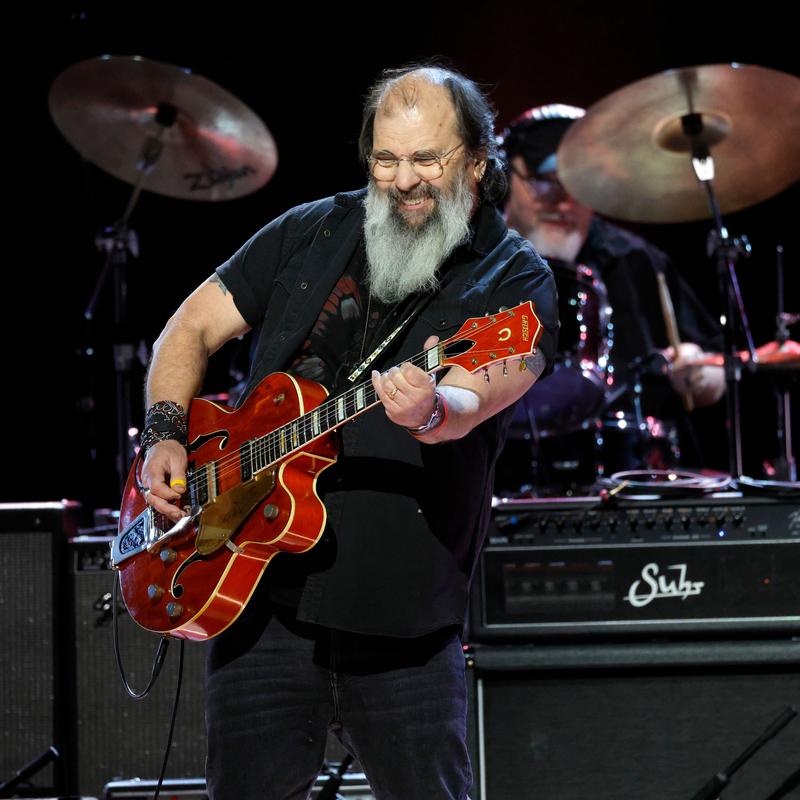
Musician Steve Earle is playing tonight at the Gramercy Theater, but not just any show. Steve will be playing solo and acoustic. It's a chance to hear up close how his songwriting has touched hearts for years. A talent that recently earned him an induction as a member of the Grand Ole Opry in Nashville. Steve also won a Grammy this year for his work on the album A Tribute to the King of Zydeco, which was made to celebrate the music of zydeco artist Clifton Chernaire. Steve Earle will be at the Gramercy Theater tonight and again on March 13th. He's on tour with his Fifty One Years of Songs and Stories tour. Hey, Steve.
Steve Earle: How are you?
Alison Stewart: I am doing well. Before we get to the music, were you in town for the blizzard?
Steve Earle: No, I missed it. It was weird. My son had his winter break, and he normally would go to his mom's in Tennessee, but that didn't work out this year. I fish with a fly rod. I took John Henry and our child care guy, Stephen, and we went to the Bahamas, went to Abaco. The guys hung out at the pool all day, and I fished all day for a week, and that was great. Then I had to do the Opry last Saturday night. We flew to Nashville on Friday. I played the Opry on Saturday. Just as I got off stage, our flight was canceled the next day, and we were stuck in Nashville for three days.
Alison Stewart: Oh, my gosh.
Steve Earle: I do have a house there still. I've been here, God, it'll be 21 years in May. I've been here a little over 20 years now, but I still have a house in Nashville because I do work there sometimes, and I've kept it for just-- I keep a lot of stuff there. [unintelligible 00:02:36]
Alison Stewart: It's your storage unit.
Steve Earle: Yes, you need one when you live in New York. It's just part of the deal.
Alison Stewart: You do. You're playing the Gramercy Theater tonight, and you're there on March 13th as well.
Steve Earle: Right.
Alison Stewart: Why did you want to play these shows acoustic?
Steve Earle: It's all I do at the moment. Well, it's not strictly true. I don't keep a band anymore. I did until about, I don't know, three years ago. I guess it was. Maybe it's four. My band all quit by email the day after Hardly Strictly Bluegrass. I've been keeping it going. I was reduced to touring only in the summer some years back, simply because I have a 15-year-old with autism. His mom moved back to Tennessee. She's not a New Yorker, and she wanted to go back there.
We were trying to come up with something for him to stay in the school he's been in since he's three, and there's nothing that compares to it. Kids in New York City are lucky. There are some choices. John Henry goes to a school called the Keswell School, which is, as far as I know, the best care for kids like him with autism. He's nonverbal. It's pretty profound autism, as they say. He's smart. He figures things out, unfortunately, to the point of he can navigate an iPad and find stuff that he should not on the Internet, just like any other 15-year-old. We have to watch that stuff. He's a trip. It's me and him.
Basically, I came off the road nine months of the year. I tour for three months in the summer. Doing that with a band, it was hard to make money anyway, but the decision got made for me, and I just decided-- I started out in coffee houses. I'm pretty good solo. Now, I play most of the tour in the summer is solo. This will be the fourth year, I think, that it's strictly solo except for there's a man called Reckless Kelly in Texas who grew up on my stuff, and we do a handful of shows with backing me up, and they love it and play it on a pop.
To me, they literally grew up on my music and they're really good at playing and there's a few bluegrass outfits that I play with. I decided after Warren Hellman passed, I really wanted to put a bluegrass band on stage there every year, which I did for some years. A band called the Bluegrass Dukes, I had for a while. I love the bluegrass thing. I do a couple of bluegrass gigs a year and then I do-- It amounts to this summer, I think there's six with Reckless Kelly and the rest of them are solo shows like this.
Alison Stewart: How do you set your list? How does your set list come about for a solo show? What songs do you know you have to do? What songs are a little bit challenging to do alone?
Steve Earle: I don't even think of it that way. If you can't take a song and sit down and play it with one guitar, you probably--
Alison Stewart: Shouldn't be playing it.
Steve Earle: Yes. I just grew up that way, so I don't. For years, when I did a solo tour, I always did solo tours. I've always done it just to keep my hand in that. I just thought it was important. Sometimes it was when I was writing a record I could try new material out. It's the context of the audience who genuinely plays smaller places. The Gramercy it's receding, so it's a little over 300 seats, which is fun.
I've done residencies in the winter different places over the years since I quit touring year-round. It's one of those things that I used to not make a list. I just go out there, and I know what I was starting with. I know I've got to play Copperhead Road. I know in New York City, I got to play The Galway Girl, any place in Ireland, I play The Galway Girl. That's one thing I know it's going to definitely be there when I'm gone. Is that song at least on that island. Because every musician in Ireland hates my guts now because I wrote the Irish version of Freebird. Everybody has to play it. I'm very proud of it.
Copperhead Road, I play that every night. There's some other stuff that people that follow me along want to hear every night. There's about six or seven things I know I can't get away without playing. I always play those and then I change the other things up. This tour right now is a little different. It developed into the same set every night because it was about 50 years. I realized last year the oldest song I still played was written in 1975, which was the first year I had a publishing deal in Nashville.
I threw everything I'd written in Texas away. When I got there, I was 19, and by the time I was 20, I had a deal. There's about three songs from that period that I still play. We called the last 50 Years of Song. Whatever we called it. I can't play every place I play in three months. We're continuing that in a lot of places this summer. On the ad mat, we just crossed out the zero and put a one on it.
Alison Stewart: Put a one next to it.
Steve Earle: That's what we're doing. There's a few markets we're repeating, and I'll do something else. That's nice. Then, at the end of the summer, I go to Dublin for a few days and rehearse with The Water Boys. Because Mike Scott and I have been friends for a long time, and there's only three bands I've ever wanted to be in, and it's like, The Rolling Stones and NRBQ, and The Water Boys.
Alison Stewart: NRBQ, I love NRBQ in Providence.
Steve Earle: ME too. That's the thing, man. Joey Spampinato is one of my best friends. All those guys are friends. I used to sit in with them a lot, and I'm almost got to make a record with them. I'm trying to do a lot of stuff now that I get some stuff done because there's regrets. There is an NRBQ, by the way, and it's absolutely worth seeing it. Some of the people that-- Joey isn't crazy about it, but you know what? Terry has a right to go out and be NRBQ with kids that can play the stuff, and they do a great job with it. If you get a chance to see the Q, go out and see him again.
This show, I did get the criticism. I realized that there just weren't enough chick songs in the show last year, so I have to write. I write those songs on purpose. I'm modifying it slightly this year to remedy that when it comes right down to that.
Alison Stewart: My guest is Musician Steve Earle. He has a show tonight at the Gramercy Theater and again on March 13th as part of his 51 Years of Songs and Stories tour. Do you tell stories on stage?
Steve Earle: Oh, yes. I've got. I talk. Some people think I talk too much and sometimes I talk about stuff people don't want to hear about. Most of the time, I've learned how to do it. As far as the songwriting part of it, one thing you will hear in the every show I've done in recent history is a song called City of Immigrants, which is my first New York album, which was called Washington Square Serenade. We are getting ready to make a new video, City of Immigrants and get it out there. I've also written a song. It's called Voy a Volver a Salaya, I'm going back to Salaya.
It's basically, I grew up in South Texas, so the first straight jobs I had were hammer and nails and I worked on crews and I would work on cruise with Mexicans and none of the other white boys would because they worked too hard and they worked too many hours. Most of the white crews knocked off at 3:30 in the afternoon. The minimum wage when I started doing this, it was 1971, was a dollar sixty an hour. If you wanted to come up with enough money to get a girl to even talk to you and buy a bag of pot, you needed to work more hours than that. It was just one of those things.
I would go ahead and work the hours because I was desperate. It's just people that I knew doing that and connected with and stayed connected with. I watched people come to stay with families that were citizens on one side of the border. It's a different thing than New York. New York, it's everybody from everywhere, but I grew up in a place where immigration was part of our lives, and whether it was legal or illegal was irrelevant. Watching all this is pretty heartbreaking for me in a way because it hits really close to home. The song, I finished it and I sent it to Steve Berlin because I had his number, and Los Lobos and I are going to record it in the next few weeks and try to get it out.
Alison Stewart: Oh, that's amazing.
Steve Earle: We're also going to try to get this new video for City of Immigrants which we're going to shoot here in the city in the next few weeks and. Steve Buscemi is probably directing that. We haven't got the budget back yet, but right now that's who we're talking to about directing it.
Alison Stewart: Why is this so important to you to get this done?
Steve Earle: Haven't had a new record in a while, and I'm starting to write some songs. I've been writing a musical for-- I came here to do music for theater. I did music for a couple of off Broadway things. I did a Richard Maxwell play at Soho Rep years ago. Theater takes a long time. That was four years work. Then, Coal Country at the Public Theater, which was Jessica Blank and Eric Jensen, and all the songs were mine. I ended up on stage in both of those.
I was the stage director and the stage manager in our town with a guitar in that show. I've been very polite and trying to-- It's not lost on the musical theater community in New York that the record business didn't give a damn about them for a long time until our business model died and we come like rats from a sinking ship. I've tried to be respectful about it. Now I've got a Drama Desk nomination and a Lortel nomination and I've been here and I think I've been accepted.
Meanwhile, in the last five years, Daisy Foote, whose father was Horton Foote, and I are writing a musical of her based on her father's screenplay for Tender Mercies, which was Robert Duvall's only best acting Oscar and won best screenplay for Horton. We've been working on that. I've written some songs I'm very proud of for it. We're ready to start workshopping that. That's what's next. I'm also free to start thinking about a record of my own.
Tom Morello went to Minneapolis and he's one of my best friends and Bruce went and I couldn't go. It got me going. We started on rereleasing City of Immigrants. Then I wrote the song, and so I needed another ball in the air. I'm already a single parent. It's one of those deals that I'm feeling pretty happy about all that. Not about why I'm doing it, but I'm just--
Alison Stewart: You're wound up about it.
Steve Earle: Yes. It put me into a place I think I needed to be. I'm 71 years old, and writing as you get older does take a little extra effort to keep things going. You have to get up and do it every day or you're done. I've seen people stop writing, especially songs in their 40s, great songwriters. Musical theater is one of the only areas where people wrote until they were older. It's funny because I've always loved it. My grandmother she was a seamstress in the drama department a little tiny college in northeast Texas called Lawn Morris that doesn't exist anymore. Tommy Tune came from there.
Alison Stewart: Tommy Tune, really?
Steve Earle: Yes, absolutely. Well, she was more proud of the fact that Sandy Duncan came from there because she was on TV. They did a Shakespeare and a straight play. It was only a two year school, but they did a Shakespeare, a straight play and a musical every year. Drama was the only cast I didn't get kicked out of in high school, the two years I was there. It was two ninth grades and I didn't finish either one of them. I got a good show telegram for my grandmother every show that we did, so it's always been sort of there. I've always loved theater. It's my favorite.
I love the American book musical. Musicals became, and Sondheim was a genius, but he did start this idea where they slowly became operas rather than book musicals. The American book musical is an American art form like jazz, rock and roll, bluegrass, it's something we invented. Those started to come back around the time I moved to the city. There were a few that happened that just encouraged me that I could do that again.
Alison Stewart: What have you seen lately that you've thought musical?
Steve Earle: I haven't seen anything in the last two years just because my schedule with--
Alison Stewart: Go see BIGFOOT!. They're going to be on the show next.
Steve Earle: I saw that.
Alison Stewart: It's really good.
Steve Earle: The first 16 or 17 years I was here, I saw two or three things at least. I was touring you around. I got to see stuff, like I said. This is like I got nine months, but I'm a full-time single dad, and it's just harder. I feel a little weird about going out. I got one 12 step meeting I got to make once a week. Then other than that, I don't go out very much. I need to get out and see more theater, actually, to tell you the truth.
Alison Stewart: Well, there's more coming. That's a good thing.
Steve Earle: Absolutely. No doubt about it.
Alison Stewart: My guest is Steve Earle. He's playing tonight at the Gramercy Theater and again on March 13th. Last year, you became a member of the Grand Ole Opry.
Steve Earle: I campaigned really hard for that. When I first started making records, I was just trying to make credible country records. I made a record for a label that there were two people that really believed in me that signed me, like Emory Gordy and Tony Brown. Jimmy Bowen, who ran MCA Nashville, had hired them and told them, you can go sign whoever you want to." They said, "Oh, cool, we're going to sign Steve Earl." He said, "Anybody but Steve Earl."
It started this tenuous relationship with my record label. We made Guitar Town my first album. We got on the radio. Guitar Town was a top 10 single. I'd been in Nashville for 13 years with only marginal success. People thought I was talented, but I missed the outlaw window or something, so I didn't get a record deal. Then I finally get one when I'm 30. Nowadays, boy, that's over the hill in country music now. It wasn't quite then. It was a little different then.
The first album did really well, and it was a number one country album. Then the second album, it became clear my own record label just didn't want it to succeed. It was because basically the head of it had said my first one wasn't going to. Then, when it did, it made him look bad. People will say that I'm paranoid, but there's other people that were witnesses to this. Just because you ain't paranoid doesn't mean they ain't out to get you.
Finally, I made a rock record, or my version of a rock record, out of desperation, which was Copperhead Road. I went to Memphis to make it. That was a matter of survival for me. Then I go through, I make another record, and my drug habit took me completely out of everything after four albums. Then, when I get back to the road in the mid-90s, I made what were essentially rock records but I still talk like this and I'll still sing the way I do. Country kept seeping back into it. Then I made a bluegrass record.
The last band I had was an unapologetic country rock band with a steel guitar player and a fiddle player. I loved it. I loved having that big event. It was very hard to support. It's just one of those things. I always wanted to be a member of the Grand Ole Opry. That would have impressed my uncle, who was the best nine fingered piano player in northeast Texas. He was where most of the country music I listened to when I was growing up came from. It's a big deal, and the Opry has tried really hard to make itself vital again, because by making sure--
I was surprised that I thought somebody else would get inducted before I did. There were a couple of younger people that were up, but they inducted me first and Jelly Roll after that. Actually, me and Kathy Mattea, both signed our first record deals the same day. Old friends. They inducted both of us and then Jelly Roll. I thought he was going to be in before either one of us, if I ever made it at all.
Alison Stewart: Next Week is the 40th anniversary of Guitar Town.
Steve Earle: I know. It's crazy.
Alison Stewart: I was in college. I remember it came across. Everybody loved it. Didn't know why I loved it, but I loved it.
Steve Earle: It's weird because I did get this amount of--
Alison Stewart: College play.
Steve Earle: I had had a Rockaville event in '82 and '83 that got some college airplay. I think that's where it started. The labels had started having college radio reps, students that worked in the college radio stations and labels would go in and find one and make them, I think it was an internship of some sort. I ended up marrying one of them when she later on became an NR person, which is an unnatural act. It didn't work out. We did some cool stuff. That's when I made Copperhead Road. I was married to Teresa Ensenat and she had a lot to do with that record being as good as it was.
I can remember coming to CMJ when Guitar Town was out, and here in New York, it would be me, whoever the singer in New Model Army was. Jason Ringenberg, one of my best friends, because The Scorchers had gotten their major label deal by then. We put our first records out literally at the same time. Who else was on? Oh, Steve Albini and The Beasties. His first record had just come out, and The Beasties were there for just a little while. At one point, Adrock says, "Hey, take my picture with him. He talks like Elvis."
Then they got on their end of the table and they stole the three microphones at that end of the table and split about halfway through this thing, which was mostly these Albini and this other guy, haranguing these college radio programmers because they were continuing to play REM after REM broke nationally. I finally just got tired of it and I just said, "Hey, college radio broke rem they have every right to keep playing REM and should play REM." I left and that was the end of me at CMJ. There was always some interest at some college radio stations in some parts of the country.
Alison Stewart: Do you mind if we play a little bit of Guitar Town?
Steve Earle: No, not at all.
Alison Stewart: Let's play it.
Steve Earle: It's embarrassing how much I like to listen to my own records.
[MUSIC- Steve Earle: Guitar Town]
Hey, pretty baby, are you ready for me
It's your good rockin' daddy down from Tennessee
I'm just out of Austin, bound for San Antone
With the radio blastin' and the bird dog on
There's a speed trap up ahead in Selma Town
But no local yokel gonna shut me down
'Cause me and my boys got this rig unwound
And we've come a thousand miles from a Guitar Town
Alison Stewart: Still sounds good.
Steve Earle: Yes. It's weird.
Alison Stewart: Still sounds good.
Steve Earle: It was a digital record, which, going back now, it doesn't sound as good as we thought it did then. Analog had some depth to it that that doesn't have, but it punched really hard. We all drank the Kool Aid, and then by the time I got out of jail and started making records again, we threw it up. I became painfully analog for years. My first record in Pro Tools was Washington Square Serenade, because it finally started sounding good enough. I was co owner of a studio in Nashville, and we kept with some great antique analog gear that we somehow kept going because of Ray Kennedy, my partner-- I still work with Ray. He mixes nearly every record that I put out. He's done all of the recent Lucinda Williams records. First time he recorded Lucinda was a duet with me, and he and I produced Car Wheels on the Gravel Road. That was made in our studio, too.
Alison Stewart: Nice.
Steve Earle: I've known Luc since we were teenagers, the two of us. We go back farther than anybody else I know that's still alive.
Alison Stewart: You said Copperhead Road a couple of different ways. I saw this in the prep, and I was like, "Oh, I know that much of Steve Earle, I don't have to." Then it said, it's a state song in Tennessee, and I said, "I don't want to read this. I want him to explain this to me."
Steve Earle: Most states have one state song. Because it's music city in Nashville, in the middle of the state, and it's the capital, Tennessee hasn't been able to get away with that. I don't know. There's seven or eight. Tennessee Waltz is one of them. Rocky Top is one because. It became that because it became such a big deal with UT football. It's always played at that-- It's a fight song at Tennessee. Knoxville, Tennessee, is the only place where jail inmates in Tennessee don't wear orange suits because they're afraid that if there was a mass escape on a Saturday, they'd never weed them out from the football fans. They were black. That's a fact. It's the same color orange. It's one of those things.
Who else? There's several of them. It was a guy that was my state representative for years, and a couple of other people got together and presented it, and somehow it got through. It is a state song. I went to the Capitol and accepted it, and then I reminded them as I was walking off, because it was right after the school shootings, and I said this-- By the way, there's another song on the Copperhead Road album that you should check out. It's called The Devil's Right Hand. It was just about guns and how they can go south on you.
It's one of those deals that-- I learned my craft in Tennessee. I'm connected to it. I'll always be a Texan, even though I left there when I was 19 and I've never lived there again. Well, I lived there for about six months in a trailer, decompressing, going back from San Miguel de Allende to Nashville in the late '70s because I was between publishing deals, and I just set it out in Mexico because I still had a draw going for another six months and $150 a week went a lot further in San Miguel than I did in Nashville. That's what that was about.
Alison Stewart: Steve Earle. He'll be playing tonight at the Gramercy Theater and again on March 13th. Thanks for coming to the studio.
Steve Earle: It's good to come. I haven't been down here in a while. I guess I need to get a new record out so I get invited more.
Alison Stewart: Until then, let's listen to Copperhead Road.
[MUSIC-Steve Earle: Copperhead Road]
Well, my name's John Lee Pettimore
Same as my daddy and his daddy before
You hardly ever saw grandaddy down here
He only come to town about twice a year
He'd buy a hundred pounds of yeast and some copper line
Everybody knew that he made moonshine
Now, the revenue man wanted grandaddy bad
Headed up the holler with everything he had