Steal This Story, Please!' Spotlights Journalist Amy Goodman
Alison Stewart: This is All Of It on WNYC. I'm Alison Stewart. On March 23rd, Riverside Church held a party, a 30th anniversary celebration for Democracy Now!, the independent news program. The night ended with Patti Smith, Bruce Springsteen, Michael Stipe, Aaron Dessner, and the whole church singing People Have the Power. Now, on more than 1400 stations, Democracy Now! started as a small enterprise on nine stations in 1996, hosted by a 20 something journalist named Amy Goodman.
The story of Democracy Now! and how Goodman became a force for independent media are documented in a new film called Steal This Story, Please! The film follows her as a young person who sought answers amid the corporate media world that seemed frightened or too enmeshed to ask important questions. Questions like how come the US supplied weapons to Indonesia to invade East Timor? Goodman reported on that story and found herself under attack. Questions like how come Chevron was involved in the killing of two Nigerian activists, one of whom Goodman interviewed? Steal This Story, Please! is in theaters now. Joining me now are its host, Amy Goodman. Amy, it's nice to see you.
Amy Goodman: It's great to be with you, Alison.
Alison Stewart: And Carl Deal, one of the co-directors of the film. Hi, Carl.
Carl Deal: Hi. Thanks for having us.
Alison Stewart: Full disclosure, I did a Q&A for the film on Saturday and I had a lot more questions which I get to ask now. Amy, how is this documentary presented to you?
Amy Goodman: The directors, Carl Deal and Tia Lessin, came to me and they didn't say, "Can we stalk you for two years?" but that's how I heard it, which meant it was going to be very painful, but I thought it was worth the price because independent media is essential to the functioning of a Democratic society. If we could get word out about it, no holes barred. I agreed.
Alison Stewart: There are two stories being told, Carl: The story of Amy Goodman and then the story of journalism in the past 30 years, corporate journalism. How did you balance the two?
Carl Deal: Amy's story, it highlights the importance of having an independent media in this country. Independent media, these days, can mean anything. It's the arts, it's movies, it's television, and it's the news. Amy and what she's done with her team at Democracy Now! has really been an incredible example of what it looks like when you can operate completely unfettered and unattached to anybody's agenda other than your audiences. You know a little bit about that yourself.
Alison Stewart: A little bit. [chuckles]
Carl Deal: It's a really special way to operate and it's really unique, and especially today, when we have a president who has declared the press the enemy of the people. For Tia and I, we're filmmakers, and we're also journalists of a sort, and so it gave us an opportunity to really engage in this moment and hopefully create something that is going to help other people make sense of this chaos.
Alison Stewart: You mentioned this, Amy. Journalists don't like to be the story. How did you handle being the subject?
Amy Goodman: It was tough. I want to put my mic in front of other people. These guys, Tia and Carl, their reputation preceded them. They had been Michael Moore's producers. They were Oscar nominated for the film about Hurricane Katrina, Trouble the Water. Tia won three Emmys for The Janes, about the underground abortion network in Chicago in the '60s. They had done Citizen Koch and other films. It was a remarkable experience. It was a big deal to open our archives to them. That's 30 years. We've been doing this show for 30 years.
From the beginning, we have been covering movements around the world, so it's a really original archive. As I always say, the President of the United States occupies the most powerful office on Earth, but there is a force more powerful, and it is everyone around this country and around the planet who are part of movements. Movements make history. That's what we particularly focus on.
Our motto is "Go to where the silence is." It's not always quiet there. Actually, it's raucous, it's rowdy, people are organizing, but it doesn't hit the corporate media radar screen. That's what we wanted to capture. I really think it's the majority of people across the political spectrum because those who care about war and peace, as we see right now, those who care about climate change and the fate of the planet, those who care about inequality, about LGBTQ rights, are not a fringe minority, not even a silent majority, but the silenced majority, silenced by the corporate media.
Alison Stewart: What is a story that didn't catch fire, that corporate media didn't pick up on that you were surprised? You've broken a lot of stories, but one that you're like, "Why didn't someone follow up on this?"
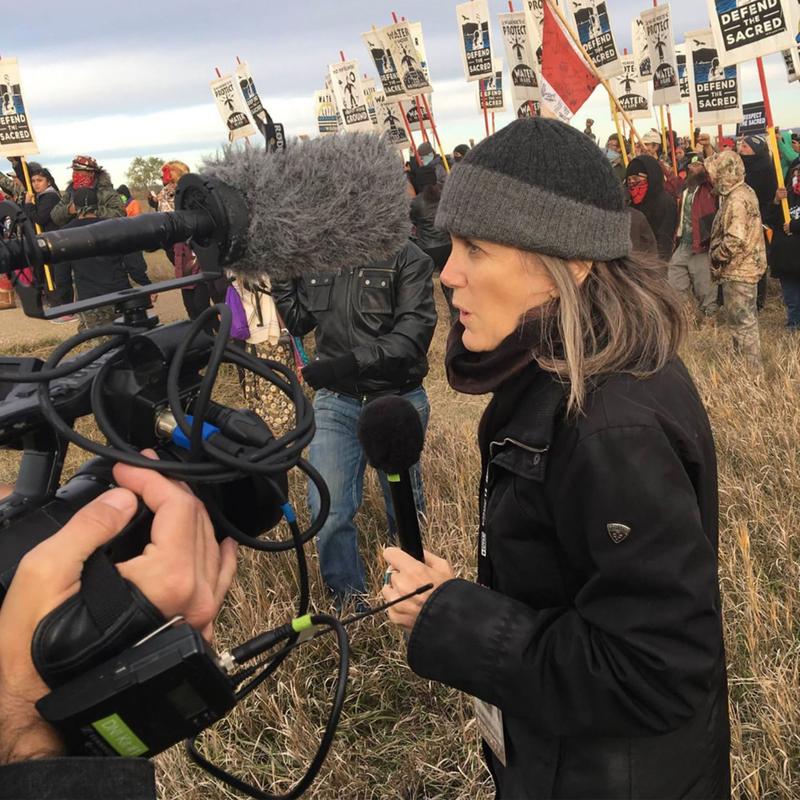
Amy Goodman: Let's go back to there's a whole segment in the film about the standoff at Standing Rock. It began in 2016. Native Americans, Standing Rock Sioux, were opposing the Dakota Access Pipeline. It was, I think, April 1st, 2016. It was in the middle of the presidential race between Hillary Clinton and Donald Trump. The unofficial historian of the Standing Rock Sioux, LaDonna Brave Bull Allard, who has since died, said, "I'm going to open my property to anyone who will come and help us oppose this."
The Dakota Access Pipeline would go beneath the Missouri river, the longest river in North America. They were afraid it would imperil the water supply of millions of people, native and non-native. She thought maybe a dozen people would come. They'd set up their tents and teepees, and hundreds came. Then thousands came: Native Americans from Latin America, Indigenous people from the United States, first nations from Canada. This was epic. This was a gathering like we hadn't seen in decades. Then thousands of non native allies.
As it's going through the year, we're covering it from afar, but Labor Day weekend, we decided to go and see what was happening. This was not just about the Dakota Access Pipeline, it was about the climate catastrophe. Often Indigenous people are the leaders there. We were following group of people. They went onto some property that was in dispute and a judge was going to rule a few days later, the excavating of what they called their burial ground.
When they got there, the bulldozers were already excavating on this holiday weekend, Labor Day. Women, girls, men, boys stood in front of the bulldozers. The bulldozers, they are frightening earth crushing machines, but they actually pulled back six of them. Then the Dakota Access Pipeline guards unleashed dogs on the protesters. We filmed a dog with its nose and mouth dripping with blood. We posted online. We had to go back to New York. Within 24 hours, there were 14 million views.
I was sometimes invited, at the time, MSNBC, CNN. I'm not even talking about Fox. I would say, "Why don't you cover?" I'd say to the host, "The climate catastrophe." They'd say, "The executives upstairs think that there won't be enough eyeballs on it." Any executives would drool at getting 14 million views. We waited a few days. When the judge was going to rule, we were covering this.
I was headed with my colleague, Nermeen Shaikh, to Toronto, to the Toronto International Film Festival, because there was a film about I.F. Stone, the muckraking journalist, and they wanted us to speak about it afterwards. I.F. Stone said to students, "If you can remember two words, remember governments lie. If you can remember three words, remember all governments lie." That was the name of the film.
Then I was speaking to the University of Toronto students, and all of a sudden I got a text and it said, "You're under arrest." I thought, "Oh, my God. One of these students hacked my phone." I saw it was a North Dakota number that, "There's an arrest warrant for you." I thought, "I better get back into the United States." I didn't want to publicize this. I wasn't sure if it was true. I just said, "Could someone call me a cab?" I raced to the airport, came back, and yes, it was true. I didn't take it personally, but I thought, "This is a warning sent out to all journalists. Do not come to North Dakota."
Alison Stewart: You got arrested. You got 14 million views on Facebook, and it still didn't get the pickup that you expected?
Amy Goodman: Not exactly. We went back to challenge the charges against me. Very interestingly, we broadcast across the street from the court so I could turn myself in right afterwards. There was so much now press attention that morning that one of the hosts at the North Dakota National Public Radio called who'd been there for decades, and said, "No way the judge is going to sign this against you. There's too much attention." This is the lesson. The charges were dropped also against many of the Native American activists who were going to court that day: Misdemeanors and felonies.
It was the New York Times on the homepage, BBC, Al Jazeera. Vogue Magazine was covering this. If anyone could see me now, you'd wonder why. It had to be about the issue. This is what happens when the media shines its spotlight in the right direction. Now, in that case, it was a journalist was about to be arrested, but it then went to the whole issue. That video that got 14 million views, almost every network took it and ran with it because there was no other journalist there. That's the idea. I consider an exclusive, a failure. I want the rest of the media to steal this story, please.
Alison Stewart: The name of the documentary is Steal This Story, Please! I'm talking to Amy Goodman, the anchor of Democracy Now!, as well as the co director of the film, Carl Deal. We learn a lot about Amy's background. Her maternal grandfather was an orthodox rabbi who would accept all questioning. Carl, we're going to talk about you like you're not here, what surprised you about Amy's background as a kid who grew up in a suburb on Long Island?
Carl Deal: Tia and I had known Amy for Years because we'd been on the other side of her microphone as guests on her show with our films, most recently Tia with her film, The Janes, about the abortion underground in Chicago. We'd also bumped elbows with these guys with her crew. They seemed to be everywhere that we wanted to be.
We bumped into them in New Orleans, we bumped into them in Baghdad in the weeks before Shock and Awe when we were there doing our work, and at the Republican National Convention where Amy and Sharif Abdel Kouddous, her producer, and Nicole Salazar were arrested for covering the protests. While they were being arrested, I was on stage with Keith Ellison just down the street presenting the film and talking about New Orleans. We seem to always be in the same place.
Amy Goodman: I didn't know that. [laughs]
Carl Deal: No, you didn't know that? I was there with Keith. It blew my mind because I walked out and Tia said, "Amy just got arrested." She said, "Be careful out there." I went out and the streets were completely empty because they had cleared it all out in the wake of Democracy Now! and their crew. Anyway, what surprised us was how hilarious Amy is, how funny she is. It tells you a lot about how it is that she does the work that she does because she finds joy in everything around her. She grew up with three brothers.
Alison Stewart: Oh, you have to find joy.
[laughter]
Carl Deal: Laughter and rabbis on both sides of the family. That incredible comedic timing was there and it was great treat for us as our own kind of storytellers because you never want to take a laugh out. Our friend, the Pulitzer Prize winning playwright Lynn Nottage, always talks about how important laughter is in her work because when your mouth is open, you're breathing, you're getting oxygen and you're relaxed and you're off guard and you can take things in. It's something that's always been really important to us in our work. The surprise also for the audience is the laughter they're going to find at these really, really dark times.
Alison Stewart: You get a sense that family is very important to you. Amy, we meet your 106 year old grandma, we meet your brothers. What is something you took from your family, a lesson that has served you as a journalist?
Amy Goodman: I just have to share now that you raised my grandmother. She actually died at 108. We met her at the young age of 106, right in the film. It always touches me when I sit down, that scene, to see my grandmother. She lived Long Beach. My parents grew up in Midwood and Flatbush in Crown Heights. My mother was born in Harlem.
My grandmother, just to tell a quick story, I went and said to her, "I'm coming out to visit you," and she said, "You can't. I'm heavily drugged." My grandmother did not take drugs. I said, "What are you talking about, Grandmama? How did you get heavily drugged?" She said, "I took a half an aspirin about a week ago, and I'm feeling the effects still." I said, "I'm coming to visit you." [laughter] I'll with your half-an-aspirin-week-ago hangover.
What I learned from my parents and my grandparents. My dad was with Physicians for Social Responsibility. He was an ophthalmologist in Long Island. He was the face on the Long Island Railroad in posters that said, "Your doctor is worried." It was a picture of a doctor. He looked like Peter Sellers. In the stethoscope was a nuclear mushroom. My mother founded the first SANE/FREEZE chapter in Long Island. She taught women's history and literature in local colleges. They were just a mighty duo.
Then there were my three brothers. I was inspired to do journalism from my younger brother David, who at 8 years old, put out Dave's Press. You see that in Steal This Story, Please! That's where we had our family debates. The dining room table, Shabbat meals on Friday were about debating the political issues of the day. With love and anger and absolute defiance, we would fight each other, but we were a family. All my friends would come over and say, "God, we just eat at our table."
I think that showed me I'm not afraid of debate. It's the way you express love and caring and how we move forward. That's really, I think, a great way to begin journalism, is to engage in the debates of the day. That's why I see the media as a huge kitchen table that stretches across the globe that we all sit around and debate and discuss the most important issues of the day. Anything less than that is a disservice to the service men and women of this country. They don't get to publicly debate whether they kill or be killed. Anything less than that is a disservice to a democratic society.
Alison Stewart: We'll have more with Amy Goodman and Carl Deal after a quick break. This is All Of It.
[music]
Alison Stewart: You're listening to All Of It on WNYC. I'm Alison Stewart. We're discussing a new documentary about the independent news program Democracy Now! and its founder, Amy Goodman. It looks at the show's history, the corporate media, and Goodman's life story. I'm speaking with Amy Goodman as well as co-director, Carl Deal. You graduated from Harvard Radcliffe in '84, and you were sure that you wanted to be a producer on the Phil Donahue Show. [laughter] Why was Phil Donahue a hero to you?
Amy Goodman: I found that in the corporate media, at least, sure, there were a lot of silly issues he dealt with, but a lot of serious issues. Carl and Tia pull some from the archive of him talking with Larry Kramer, the fierce AIDS activist, and taking on nuclear issues and much more. They also show clips of him with Donald Trump. I thought this is where you could have a big effect.
At the end of college, every day in the last days of college, I was writing down every single name on the credits of the Phil Donahue Show because I was going to send absolutely everyone my very thin resume. Then I would just wait. Maybe it would take a couple weeks to become the producer of the Phil Donahue Show. I waited, and I did get a call. They said, "Hey, did you ever get a job?" I said, "No." They said, "Can you come in tomorrow?" I said, "Absolutely." They said, "Great. We're doing a show on the unemployed, and we'd like you to be in the audience." Oh my God. [laughs]
Alison Stewart: You got a [onomatopoeia] [laughs]
Amy Goodman: I want to say something about that. This is really interesting. I would come to be friends with Marlo Thomas and Phil Donahue, and he became the most popular show. He had the most popular show on MSNBC at the time of the Iraq war. Right before the Iraq war, he was bringing on a lot of anti war voices. He was dumped even though it was the most popular show.
I was invited to be a guest on the 10th anniversary show of Chris Matthews on MSNBC. Then they're going to have a big party at the top of the rock, 30 Rock. Phil had just been dumped. When we were speaking on the air, I said, "Chris, I want to congratulate you on the 10 years of MSNBC, but I wish Phil Donahue was standing next to you." I had a memo. We had put it in our book, my brother and I from NBC, that said we can't have these anti war voices when the rest of the media is waving the American flag.
I personally think you're waving the American flag when you express dissent. I think dissent is what will save us. I said that on the air. I said, "I only wish that Phil Donahue was standing next to you right now because he is a great American patriot." It's wonderful to be here as we now remember Phil and think about all that he did and how important he was and his show was.
Alison Stewart: We went digging in the archives and we found Amy Goodman on WNYC. In 1987, you hosted a show called Speaking for Ourselves.
Amy Goodman: Yes. In fact, this is a homecoming, except it wasn't here.
Alison Stewart: It was down there, downtown.
Amy Goodman: That's right.
Alison Stewart: Let's listen a little bit.
Amy Goodman: Oh my God. Students speak out on Howard Beach this hour on Speaking for Ourselves. I'm Amy Goodman. We'll talk with two students from John Adams High School on racial tension in the public schools. Then Julia Wright talks about her father, Richard Wright, author of the controversial book Native Son and the new film based on it. We take a look at surrogate motherhood on trial. All this plus your calls on Speaking for Ourselves for the 10th of January.
Alison Stewart: 1987.
Amy Goodman: It's amazing. I worked at WBAI halftime and at WNYC, and we did this weekly Saturday show called Speaking For Ourselves. Julia Wright, oh, my goodness, the daughter of Richard Wright. How absolutely amazing. I think my first guest was Gloria Steinem and we played music, [sings] Gloria, Gloria, Gloria. [laughs]
Carl Deal: Alison, where was your team when we were researching this film? I would have loved to have that.
Alison Stewart: That's a good clip. What did you find, Amy? Why was radio a good for the kind of stories that you wanted to tell? If you were here, you would be AI.
Amy Goodman: The voice is the heart of it. We started on television the week of 9/11. We were the closest national broadcast to Ground Zero. We were doing the show when the second plane hit the second tower. The first plane hit the first tower a few minutes before we went on air. We didn't know what had happened. We worked at a DCTV, Downtown Community Television. Suddenly people were running. They were covered in ash. I stayed at the pile for days, around there at DCTV, so we could do the broadcast. We were in the evacuation zone. I was afraid if I left, the police wouldn't let me back in. It was critical. We broadcast voices.
We started on television then because MNN, Manhattan Neighborhood Network, asked if they could start running us as emergency programming, and then it just blew up. I hate to use those words when we're talking about 9/11. TV stations around the country started to say, "Can we run Democracy Now!?" Then NPR stations started asking PBS stations, and it went from nine community radio stations, started at Pacifica Radio, the real founder of Democracy Now!, to 1500.
I always said at the beginning, when they were setting up the cameras, you can only do this if it doesn't introduce static into the human voice because that's what we wanted to hear. We go to where the silence is. There's nothing more powerful than hearing a man or woman or child talking about their own experience. You can't even sometimes put into words. It's that the little shake of the voice, it's how fast or slow they speak. It's hearing them tear up, believe it or not. That is what I learned from doing radio from way back. Now at the beginning, we're the only daily election show in public broadcasting for the first nine months, and then we expanded to television. That's what we've done ever since.
Alison Stewart: Carl, the film Steal This Story, Please!, opens with Amy chasing around Trump policy advisor P. Wells Griffith III at the UN Climate Summit in Poland. Let's play it, and we'll talk about it on the other side.
Amy Goodman: Hi. I'm Amy Goodman from Democracy Now!.
P. Wells Griffith III: I've got to go. I've got to go to another meeting.
Amy Goodman: Can you tell us what you think about President Trump saying climate change is a hoax? You can answer the question. Are you not speaking to the press here?
P. Wells Griffith III: Excuse me. I'm sorry, I'm running late for a meeting, thanks.
Amy Goodman: You weren't running late when you were just standing there. Can you talk about President Trump's saying that climate change is a Chinese hoax?
[MUSIC - Claire Lugan and Philippe Breniaux: Secret Plan]
Alison Stewart: This goes on for a minute.
Amy Goodman: Are you not talking to the press while you're here.
Alison Stewart: A minute of you chasing after him. Why did you want to open up with this scene?
Carl Deal: In reality, it's about 15 minutes of her following him up and down. It's in a convention hall that, as Amy has explained, in Katowice, Poland, was built by the coal industry.
Amy Goodman: It was modeled on a coal mine, and so it had a lot of fake stairs racing up. Then he would have to come right back down after.
Carl Deal: You see him running into all these dead ends. Look, for us, it just felt like that told you everything you needed to know about Amy Goodman in a nutshell. You see her athletic ability, for one.
Amy Goodman: [laughs] If only we would accept corporate advertising, we could be brought to you by sneaker companies.
Carl Deal: Exactly.
Amy Goodman: That's what we rely on.
Carl Deal: You also see her quick wit and her unwillingness to take no comment for an answer. Keep in mind that this is set against a really, really important event. This is the world coming together to try and solve this grave climate crisis, and yet the Trump administration has sent their representative there to promote coal. It's everything you need to know about Amy, right there. Go ahead.
Alison Stewart: I was going to say, Amy, you repeat questions quite often. You repeat them, you repeat them, you repeat them. How important is repetition i getting people to understand?
Amy Goodman: I only repeat them when they don't answer them. If you repeat it enough, maybe you'll get an answer. He was the envoy for president. He had just been elected the first time. President Trump was pulling the US out of the Paris climate agreement, so it was very serious.
There was Griffith, who had gone on to in this administration for a time being an undersecretary of energy. His family owned an Alabama gas station, pushing oil, gas, and coal. It was a serious issue when the rest of the world was trying to talk about renewables and how we save the planet. He said, at a certain point, as I was trying to keep up with him, "I consider this harassment." I said, "Sir, a reporter asking you a question is not harassment."
Alison Stewart: Two films came to mind when I was watching this. This is for both of you. [unintelligible 00:26:31]
Amy Goodman: Chasing Amy.
Alison Stewart: [laughs] Can a journalist be an advocate?
Carl Deal: I think we all are advocates for our values, or lack thereof. It's part of who we are as human beings. I think the problem with advocacy and journalism is when you try and conceal it and you're not honest about it, people use the word advocate or activist to try and discredit people, to try and minimize in any profession or just in life in general. If you look at the media, who are you advocating for?
A lot of folks in the corporate media, I think, are activists for power. They're activists for people who have power. We're looking at these mergers that are happening right now. They're out of control. That's the subtext for this film. It's been going on for 30 years. Everybody has seen it now. We've got this Paramount merger coming up with Time Warner. Tia and I and Rosario Dawson, Jane Fonda, Julie Cohen, the great filmmaker, are all executive producers with us.
Us and hundreds of our colleagues in the documentary community have joined with over 1,000 media professionals to oppose this merger because what people don't know is it's not a done deal yet. It hasn't been approved, but it has a profound impact on how all of us get our voices heard and how media is distributed, including things like this film. Despite the fact that we have some success here in New York with a very, very strong opening, one of the strongest for a documentary in 10 years at IFC center, we're still independent. The institutions that determine who gets to see things believe that people don't want to see films about things like this, and we believe otherwise.
Alison Stewart: Quickly, we've got about a minute left. Can a journalist be an advocate?
Amy Goodman: I am an advocate for independent media. It is absolutely critical to be a sanctuary for dissent. I think dissent will save us. Independent media is the oxygen of a Democratic society. As we see these corporate newsrooms being devastated, the legacy media being sliced and diced, Jeff Bezos, the owner of the Washington Post, cutting a third of the newsroom, we have to support independent media brought to us by the listeners, the viewers, the readers who are really citizens, citizens of the world craving authentic voices. This is the kind of media that will save us.
Alison Stewart: We're talking about the documentary Steal This Story, Please!. It is out now. I've been speaking with Amy Goodman and Carl Deal. Thanks for coming to the studio.
Amy Goodman: Thank you so much, Alison.
Carl Deal: Thanks for everything you do.
[00:29:40] [END OF AUDIO]
Copyright © 2026 New York Public Radio. All rights reserved. Visit our website terms of use at www.wnyc.org for further information.
New York Public Radio transcripts are created on a rush deadline, often by contractors. This text may not be in its final form and may be updated or revised in the future. Accuracy and availability may vary. The authoritative record of programming is the audio record.