Small Stakes, Big Opinions: Dogs in NYC
Alison Stewart: This is All Of It on WNYC. I'm Alison Stewart. There are just a few days left to grab tickets to our next Broadway on the Radio event. This Friday in The Greene Space at noon, we'll be joined by the cast of the Broadway revival of RAGTIME, the earliest 20th-century snapshot of race and class, culture and political history in America. Of course, there will be music. RAGTIME stars Joshua Henry, Nichelle Lewis, Caissie Levy, Brandon Uranowitz, Ben Levi Ross, and Shaina Taub will be here, as well as Director Lear deBessonet, to talk about developing this revival with its giant cast and the largest orchestra on Broadway. Visit WNYC.org/events to get more info and to buy your tickets.
We'll have the cast all here in person, backed by a live band specially curated for an intimate show at WNYC's performance venue, The Greene Space. Now, if you can't make this event in person, don't worry. You can also tune in for free live on the radio or visit our live stream on YouTube. To register for that, go to WNYC.org/events. We hope to see you this Friday. Now, let's get this started with dogs in the city.
[music]
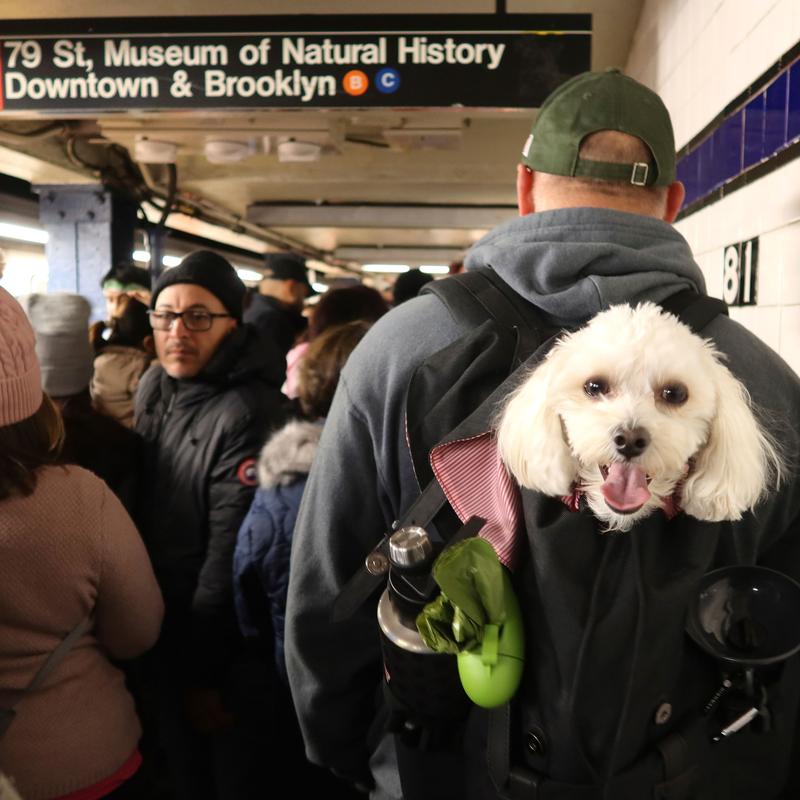
This recent winter was one of the coldest in recent memory. We had a couple of serious snowstorms, not to mention many days where the temperature was firmly below zero. One of the side effects of the brutal winter was a seemingly total breakdown in dog cleanup. In February of this year, complaints about dog waste on city streets were up more than 80%, over 80% compared to 2025, but the tensions about dogs, which is really about their owners, it doesn't stop there. There are dogs striding across the subways. There are riding in grocery carts in grocery stores, ponying up to the bar, and sometimes running off-leash in places where they're not allowed to be.
The problem may have to do less with the actual dogs, we love dogs, and more about their shifting roles in people's lives. Joining me now to talk about this is Reporter Rachel Sugar. She wrote Where Does a Dog Belong? For New York Magazine's website, Curbed, and she joins me now. Hey, Rachel.
Rachel Sugar: Hi. Thank you so much for having me.
Alison Stewart: What made you want to report this story now?
Rachel Sugar: I mean, I love a story that's not about what it seems to be about. I think the amount of passion that dogs inspire on all sides is not-- I mean, right, there are people who really love dogs and people who really hate dogs, truly. I think it's really about who gets space in the city, who's entitled to what, who's trampling over whose needs in all directions. That's really exciting to me. A story that's-- Then dogs are so fun. I mean, to me, I'm a dog person, but also a pathological rule follower. This is something I pay a lot of attention to. When things flared up this winter around the waste situation, after the snow and then more snow, it seemed like the perfect time to get into it.
Alison Stewart: Yes, what's changed about dogs in New York? That it feels different?
Rachel Sugar: What's so interesting about it is that it feels different. Is it different? It's really hard to say. There's no New York City dog census. There's no national dog census, but the data we have on how many dogs and how dog populations have fluctuated through time is pretty bad. The city keeps track of licensing, but the percentage of licensed dogs are minimal. Again, we don't know quite what that percentage is. I will say that despite being a pathological rule follower, I realized in the reporting of this piece that my own dog's license was out of date. She had been a scofflaw for three years, and she's now up to date.
The data isn't very good, but what we do know is that there's a sense that dogs are kind of invading people places, that dogs are showing up in places that they might not have shown up 10, 20, 30 years ago, maybe even 5 years ago. That's part one. Part two is like this reshuffling of the world order coming out of the pandemic, where-- Again, there's questions about how many dogs did people actually get during the pandemic. Did the dog population in New York City actually change much?
We know that people's lives changed a lot. Maybe they made choices around expanding their families to include dogs during that time, and then went back to work, and now are kind of thought their lives are going to look one way forever, and they don't. The world's reopened. I think that's leading to dogs showing up in more places, too. You are seeing them in coffee shops, in grocery stores sometimes, on the subway, sometimes in bags, sometimes not in bags, off-leash maybe when they aren't supposed to be. You're seeing them all over the place, and it feels like something has shifted. I think it's less about numbers than about attitude, but it's also possible there's number of stuff going on.
Alison Stewart: Listeners, we want to hear from you. If you're a dog owner who takes your dog to places they're not necessarily allowed, give us a call and tell us why. Our number is 212-433-9692, 212-433-WNYC. If you're a dog owner who obeys the rules, call and tell us why. If you're a non-dog owner who has a constructive, positive story to tell us about a human-dog interaction, we want to know that, too. Our number is 212-433-9692, 212-433-WNYC. While we're talking about rules, just a reminder to everybody, please don't call us while you're driving and keep us off speaker phone. We want to hear your dog opinions to be heard clearly, and we want everyone to be safe.
Our number is 212-433-9692, 212-433-WNYC. We're talking about dogs in New York City and some of the tensions that have sprung up between their owners and other New Yorkers. Rachel Sugar is the author of a Curbed article called Where Does a Dog Belong? She's joined us here in the studio. Let's talk about the complaints that were made. Are they specifically about dog bites? Are they more serious, or were they about something else?
Rachel Sugar: I think there's the cosmetic-- I mean, and to say that it's an aesthetic complaint is, I think, minimizing. It is gross when there is dog waste on the street.
Alison Stewart: Yes.
Rachel Sugar: It's like antisocial behavior to leave your dog's waste just on the curb. It's like it's hostile to everyone else in the city, but it's also, I don't think we're seeing a plague of disease coming out. It is a quality-of-life issue. I think there's that. I think the off-leash hours-- Well, dogs off-leashed sometimes even at times when they're allowed to be off-leash, but people feel threatened. If you're not a dog person, I think having dogs being in a park of dogs gallivanting freely, of all sizes and all speeds, and coming at you, is unsettling. I think when that starts to happen outside of designated hours, it can be delightful and joyful, but it can also be really threatening and feel like you don't know what these dogs are going to do.
I think there's that. There are hospitality owners and workers who love dogs, who, regardless of what the health department says--
Alison Stewart: Looked the other way.
Rachel Sugar: Yes, happy to look the other way. Happy to coo over your dog, have dog biscuits at the counter, whatever. I think there's also people who own these businesses who feel like, "I'm trying to follow the laws of the city, and I don't want to be put in this position where I have to make it weird, and put people who really do have service dogs who are allowed to be here in this position of having to defend their right to be here." I think it often puts people in hospitality, or small business owners, or large business owners. I don't know. Anybody who's working in an indoor space and coming into contact with dogs, I think that's a source of tension.
I certainly talked to a lot of people while reporting this story who were feeling like people are so bend over backwards to pet dogs, to be sweet to dogs, to be really doting on dogs, and can be really-- Don't extend that same kindness to other people, to other human beings, or watching somebody pet a dog and coo over this dog while you're a mom struggling with a stroller trying to get into a business, and people are just watching you struggle and feeling like, "That's weird. Why could we not be so kind to other people?" Is that a missed-- Are our priorities confused here?
Alison Stewart: Let's take a couple of calls from listeners.
Rachel Sugar: Sure.
Alison Stewart: Let's talk to Sarah, who is calling from the Upper West Side. Hi, Sarah. You're on the air right now.
Sarah: Hi. Thanks so much for taking my call. We were at my son's Little League game yesterday morning. The game was at 8:00, so it was around 8:15, 8:30 at The Great Lawn. Lo and behold, someone's dog just comes gallivanting across the field, steals the little red cones that are markers for where the kids are supposed to stand. He's just having a grand old time running across the field. The parents were just like, "Wow, this is out of control." It happened not just once, but it was two more times after that. This woman just couldn't control her dog. She said he was a puppy. He broke off the leash, but everyone was just like, "Wow, this is crazy."
I just think this is an example of how things have really gotten a little out of hand. I love dogs. I am a cat person. However, I do love dogs, but having lived on the Upper West Side for so long, this winter was just out of control with the poop everywhere. That's not a new thing, but it does seem worse. Like you were saying, it just feels different.
Alison Stewart: I think this winter really did something to people.
Rachel Sugar: Yes. I think this winter was so rough in so many different ways. It seems like people started behaving in bizarre ways, and people simultaneously lost their patience with that kind of behavior. It was like, "I can't take it anymore." Like, "I'm done. I'm calling 311."
Alison Stewart: Yes. Let's talk to Patrick, who's calling in from Queens. Hi, Patrick. Thanks for calling All Of It. You're on the air.
Patrick: Thanks. Well, longtime dog owner. I just unfortunately lost my dog of 19 years.
Alison Stewart: Oh, I'm sorry.
Patrick: Absolutely love dogs, but people take their dogs too many places. My hot take is a dog doesn't belong at the farmer's market. They're stressed. They don't enjoy it. People insist on dragging the dog around. It's reactive. We don't need to take our dogs everywhere.
Alison Stewart: Patrick, thank you for calling in. Let's also talk to Lourdes, who is calling in from Manhattan. Hi, Lourdes. Thank you for taking the time to call All Of It.
Lourdes: Hi. Well, I take my dog to Mass, to church.
Rachel Sugar: Oh, wow.
Lourdes: I started doing that after the pandemic, during the pandemic, when there were no services, I would take her when I went in, the church was open. I'd go in and pray. The parish priest would see us there. When services restarted, I asked permission if I could bring my dog, and he said yes. I'm not the only churchgoer who brings their dog. Most of the dogs are really quiet. I take her up to communion, and I think some churchgoers are surprised. I make sure she doesn't invade their space, but a lot are happy to see them. I started doing it because my dog likes Central Park. The church is close to Central Park. Otherwise, I'd have to go back and forth when I walk her and go to Mass.
Alison Stewart: Thank you for calling in. There was an interesting person in your piece, Rachel. It was a Greenpoint dog owner who got a little bit into it with a man who had a kid on a playground. The dog owner told him, "Hey, man, you're here with your family. I'm here with my family." What did that interaction say to you?
Rachel Sugar: I think it's so fraught, right? What constitutes a family? There's a scholar who I talked to a bit for this piece. This is one of her primary things, is looking at changing family structures and how animals, and, for my purposes, dogs, fit into that. I don't think being like, "My dog is part of my family," is a new phenomenon, but what she's identified is this idea of like, "No, my dog is part of my family, like a person as part of my family." They truly have a similar status to a human family member and a similar function. That's just observational. That's not good or bad. It's just the way it is.
Given that changing framework, I don't think it's that crazy to be like, "Well, this is my family." Like, "My family structure is me and my dog, or me and my partner and my dog, or me and my partner and my kid and my dog." I think there's often this kids versus dogs, but a lot of dog owners have kids. A lot of people with dogs will go on to have kids. A lot of people with grown kids have dog, so it's really not either or, but I think it's easy to be dismissive of that, of that dog owner who's saying, "Well, it's my family," and being like, "Well, that's not your fa-- I mean, you can see the difference between a kid and a dog. One is going to go on and carry on human civilization, we hope, and the other tops out at fetch."
I don't think that's off base. The problem, though, is if you see it that way, what do you do with that? How do you have an interspecies family? What is a New York built for the interspecies family look like? There's still the fact, like the caller who was talking about the baseball game, that this is a moment for this Little League team. They're doing a human child activity. This puppy may be a dog child, but is doing its own thing. It's not--
Alison Stewart: If a human did that and stole those--
Rachel Sugar: Yes, that would be antisocial and bizarre.
Alison Stewart: Right.
Rachel Sugar: What does the city look like? I do think it's notable in that anecdote that's in the story that the complainer, the person that the dog owner was snapping back at, took it with didn't really say anything, but accepted that, and everybody went on, and it didn't escalate beyond that. I don't know. It's tricky.
Alison Stewart: It is tricky.
Rachel Sugar: There's this point of renegotiation. What does a family look like? What do you do when it truly doesn't fit what the city is built for?
Alison Stewart: We're talking about a Curbed article, Where Does a Dog Belong? Its author is Rachel Sugar. We'll have more after a quick break. This is All Of It.
[music]
Alison Stewart: You're listening to All Of It on WNYC. I'm Alison Stewart. I have in studio with me, Rachel Sugar. She's the author of a Curbed article called Where Does a Dog Belong? We're talking about dogs in New York City. I'm going to give you two texts that are wildly opposed. The first text says, "For many of us, the subway is the only way to get our dogs to the vet or to a park. Obviously, it's important to keep animals of all types and sizes under control. I'm not against ticketing if you let your dog do something unsafe, but most dogs are better behaved than many children. To ban dogs altogether is frankly small-minded, selfish, and cruel."
This other text I have said, "Non-service dogs should never be in museums, art galleries, food stores, botanical parks, or restaurant. Many guards in such establishments have told me that dog owners snap at them and even threaten lawsuits when the guards try to enforce these rules."
Rachel Sugar: Yes. That's the story, right?
Alison Stewart: Right?
Rachel Sugar: That's the tension. Yes. Everybody, it's like, to both, yes.
Alison Stewart: Yes. Let's talk to Abigail, who's calling in from Brooklyn. Hey, Abigail. Thank you for making the time to call All Of It. You're on the air.
Abigail: Hi, Alison and Rachel. Yes, I have lots of opinions on this matter. I've been working with service dogs for 16 years. I have a disability, and my dogs are more than they-- I mean, they certainly are pets and companionable, but they give me a greater sense of safety and independence when I'm out. Thanks to the Americans with Disabilities Act, the ADA, that was passed almost 35 years ago, I have those protections to be able to take my dog, who has been trained to perform a specific task, into public spaces.
Throughout the 16 years of being with dogs, I do a lot of educating the public who are not aware of what the ADA is, but I also encounter quite a number of people who have very ill-behaved animals. I think Patrick or someone earlier was alluding to how stressful it can be to bring your pet somewhere. My dog has been trained and has been exposed to be in those public spaces. The responsibility for me as the handler is to keep the dog under control, but when there are other animals on the subway, in a restaurant, and their humans are not keeping them in check, or the businesses feel like they can't tell them to go, I mean, the businesses can. They have those legal protections, too.
Yes, this is a very sensitive, very relevant topic for me because I'm more and more encountering people who have dogs that are super stressed and don't want to be on the subway or in a market.
Alison Stewart: Thank you so much for calling in, Abigail. What are the rules about having a dog on the subway?
Rachel Sugar: The rules for the subway are pretty straightforward. You can have a dog. They need to be in a bag or other container. Are they? Question mark? There's--
Alison Stewart: They're not, no. Not that often.
Rachel Sugar: I certainly see dogs in bags.
Alison Stewart: In bags? Yes, I've seen that.
Rachel Sugar: Yes, and that works. That's where you get the meme of the husky in an IKEA bag with holes cut out for the feet. It's in a bag, technically, but a non-service dog is not supposed to be riding the subway like a person. They're supposed to be contained in some way.
Alison Stewart: I was on the subway, and it was really interesting because a dog got on, and it was a German Shepherd, and they can be very scary to so many people. A group of people got up and moved. I thought to myself, "That shouldn't be." I know that you might have to get him to the vet or something, but I'm not sure that dog should be on the subway because it really, really frightened people. The dog also might be frightened or put in a position where it might snap.
Rachel Sugar: Yes. There's so much to say about this because there's certainly the issue of, like, "Okay. Well, if somebody has to move." Who has to move? One guy who I talked to for this story, who does take his large, I think, fluffier, less threatening-looking dog, but big dog on the subway, was telling me, occasionally people ask him to move, say they're afraid of dogs, they can't be near this dog, and he's happy to move.
Alison Stewart: Should you have to have that conversation?
Rachel Sugar: I don't know. I was also asking somebody why they take their dog on the subway, a bigger dog, and they were saying they try to take Uber Pet, but often, even though you say you want Uber Pet and you sign up for Uber Pet, the driver gets there, they won't take you and your pet. The subway is reliable. I think it's another one of these things where you're betting-- You just need everybody to act in the best possible faith and accept everything in the best possible faith, and everybody's not always acting in the best possible faith. That's a hard way to run a city.
Alison Stewart: Let's talk to Shamaine, who's calling in from Long Island City. Hi, Shamaine. Thank you so much for taking the time to call All Of It.
Shamaine: Hi, Alison. How are you? Can you hear me?
Alison Stewart: Yes, I hear you great. You're on the air.
Shamaine: Yes. This is like a catch-22 situation. I'll tell you my story, just very brief. My entire life, I ran away from dogs. If I saw dog owners and dogs, I would constantly cross the street. I didn't like dogs licking me. I didn't like dogs sniffing me. I just ran away from dogs. My daughter at the time, I believe Emma, was one year old, and she was protesting a dog for at least five years. Then I finally got a dog. I feel, and I believe that the world is changing. I don't know the percentile, but I believe everyone in the next few years, like, everyone's going to have a dog. I don't think the dog is the problem.
Alison Stewart: Yes.
Shamaine: I think it's the dog owners. If we can change the way we view dogs and the way we treat dogs, I believe dogs should be able to go anywhere in the grocery store for me, like, running-- I have to have a skincare company called Love By Emma. A lot of my products, I purchase them in a supermarket. I have to run into Trader Joe's, I have to run into Whole Foods, and I have to take my dog with me because I have to get back to work, and he needs to go for a walk. He loves it. He loves the attention. Now, as a new dog mom, I'm very sensitive to other dogs. I want to pet them. I want to love them. Dogs are amazing, but I do get it for those who-- [laughter]
Yes, I know. This is very weird because I was once that person, like, "Take your dog away from me. The dog is your pleasure, not my pleasure. Don't bring him or she near me." Now I'm like, "Come. What's her name?"
Alison Stewart: She's been turned over.
Rachel Sugar: Yes.
Alison Stewart: That's interesting. This is an interesting comment we got from someone. It says, "I agree with your guest. This is partly about who has the right to take up public space and how, tied in with what is racial and racist double standards when it comes to enforcement, as is the case with fare evasion, open containers, and alcoholic beverages." You get into that in the article a bit about-- We used to say like the other word for gentrification was dog park.
Rachel Sugar: Yes.
Alison Stewart: Right?
Rachel Sugar: Right, yes.
Alison Stewart: You get into gentrification and the racial element of this.
Rachel Sugar: It's tricky. Again, I so wish there was better data on this because who has dogs is really interesting, and the data is just not that good.
Alison Stewart: Available.
Rachel Sugar: Certainly, historically, and from what we do know, dog ownership is not evenly distributed, which doesn't mean that people who, I think, Asian Americans and Black Americans have much lower overall or at least had much lower rates of dog ownership than Hispanics and white Americans, but that doesn't speak to every individual person.
Alison Stewart: Yes, of course not.
Rachel Sugar: I think one thing that's fascinating about dogs is that, obviously, there are different cultures and different attitudes from all over the world and within the US, and rural versus suburban versus urban, and how any individual person was, right? There's so much going on with how any-- the factors that produce how an individual person might feel about dogs. One of the things I really think is fascinating about dogs is they do cut across. They don't follow standard political, or racial, or socioeconomic divides. When you look at I don't think dogs really have a conservative versus liberal valence. I think they're kind of their own thing.
Yes, certainly, there are these at least historical disparities in terms of who wants to have dogs or who does have dogs and who doesn't. When you see a bunch of dogs come in, I think at least in the popular imagination, even if it doesn't necessarily bear out 100%, and we don't really have great data here, but in the public imagination, it's rich white people coming in with their designer dogs and trampling all over everybody. I think that's a very real feeling. Again, it's a good example of it's not the dogs. It's the people.
Alison Stewart: It's not the dog. Let's talk to Paula in White Plains. Hi, Paula. Thank you for taking time to call All Of It. You're on the air.
Paula: Thank you, Alison. I have to tell you how much I love you. You're terrific.
Alison Stewart: Thanks.
Paula: What I'm going to say is going to be very unpopular. I am allergic to dogs. It's not the hair, it's not the fur. There's no such thing as a hypoallergenic dog, period. What most people who are allergic to animals are allergic to their saliva. What happens when I'm near a dog, so it's whether I'm enclosed in a subway car with a dog and I'm on the other side, or they're standing under my nose, what happens is my bronchia, and everything gets inflamed, and it's really difficult for me to breathe. I just think people need to understand that this is real for other people.
When I say to people, "Excuse me, could you move your dog? I'm allergic to your dog." I get snapped at. I get very nasty comments. It's because then I can't breathe. Is that fair? If I lit up a cigarette in front of somebody, would they not tell me to put it out? It's the same kind of deal. I think all dog owners need to understand that when they're doing that, there is that odd person who they are hurting, not helping.
Alison Stewart: Paula, thank you for calling in. Let's talk to Mark, who's calling in from Pleasantville. Hey, Mark, thanks for calling All Of It.
Mark: Hi, how are you? I am one of the people who would take my dog pretty much wherever she was comfortable. I think we live in a time where what even is a rule anymore? I think one of you used the term antisocial and bizarre to-- I mean, we live in an antisocial and bizarre time. If we're willing to tolerate antisocial and bizarre people at the coffee shop and in public office, whatever your view is, why wouldn't we accept the most loving and endearing living things that, for some reason, spend time with us and allow some shot at redemption in a effect, like what even is a rule at this point? I get it, there are laws, but the only reason I go to the coffee shop anymore is to see people's dogs.
Alison Stewart: Thank you for calling in, Mark. Owen, he's calling from LA, I believe. Hey, Owen, thanks for calling All Of It. What's--
Owen: Thanks for having me on.
Alison Stewart: Yes, what do you think?
Owen: I listen to you guys up, by the way, every morning. It makes Los Angeles life bearable, so thanks for that. As a lifelong dog owner and as a parent, I was listening to the comment about the irate dog owner in the park who's like, "Well, hey, it's my family, too." I get that. I feel it. I've lived it, but you know what? If I left my kid at home all day, I'd be arrested. I can leave my dog at home. There are distinctions. We have to remember these distinctions that carry over into the street, and it becomes, as always, the responsibility of the dog owner to make sure that you're actually being productive in how you're engaged and outside.
We have these assumptions that dogs can be anywhere. I think it's part of this post-pandemic drift where we've had these social erosions in some places. Yes, they're not human, but we love them like they are. They're the best, but they're not human.
Alison Stewart: Thank you for calling in. What is your response to what we've just heard from our callers?
Rachel Sugar: There's so much. I think the point that they're not human is definitely true. I think when you're the person-- It seems to me that it's a bit on the-- If you, as the dog owner, are doing the thing where you're pushing the rule,-
Alison Stewart: The boundaries.
Rachel Sugar: -the boundary.
Alison Stewart: The rules.
Rachel Sugar: Then I think it's on you to bend back.
Alison Stewart: Oh, interesting.
Rachel Sugar: I'm a little bit surprised at the amount-- I don't know that I'm surprised, but it's a little bit discouraging to hear that, like the caller is saying, she has this allergy that's pretty serious, so saying, "Can you move your dog?" I feel like it's on the dog owner to be like, "Yes, I can, because I'm the one who's pushing it." It's disheartening that that's not happening, especially because I think the more dog owners are reasonable and pleasant about it, the easier it is to justify pushing the boundaries, the nicer it is for other dog owners. I think the issue with dog waste this winter and the anger about it was really bad for responsible dog owners, because then everybody hates your dog. That's one thing that really jumps out.
Alison Stewart: All right. We covered rules in the subway.
Rachel Sugar: Yes.
Alison Stewart: What about leash laws?
Rachel Sugar: Yes. Your dog's supposed to be on a leash, I think it's six feet, not longer. There are dog parks. There are areas and specific hours which tend to be before 9:00 AM or after 9:00 PM in parts of parks, though not necessarily the whole park, but designated areas where dogs can be off-leash. This is a really good case, I think, of those are the rules, and then you also see norms that don't match the rules. Norms where you'll see in Prospect Park, it really tends to be closer to after work, dusk-ish, not 9:00 PM.
Alison Stewart: Interesting, right?
Rachel Sugar: Then it's like, "Well, this is the rule, but this is what we do here. This is what we as a community seem to do." When those things don't match, I think you also get some tension where, "Well, you're not following the rules." "Are you new here?" Going back and forth.
Alison Stewart: It's interesting, because the pooper-scooper law, that didn't show up until the '70s.
Rachel Sugar: Yes. That is shocking to me.
Alison Stewart: Right?
Rachel Sugar: The response to it when, in the '70s, there was this real push to clean up the city, sometimes very literally in terms of the pooper-scooper law, which passes in 1978, and the build up to that, there are people saying, "I don't even understand what you're talking-- What are the biomechanics of-- How would I move my body to pick up this weight? With what? That's the craziest thing I've ever heard." That's wild. That's not that long ago. Now, that's what most people do.
Alison Stewart: Yes.
Rachel Sugar: It's fine.
Alison Stewart: Let's talk to Camilla from Bed-Stuy. Hey, Camilla. Thanks for calling All Of It. You're on the air.
Camilla: Hi, Alison. Thank you for taking my call. I am a 5'3 Black woman. I have a 95-pound German Shepherd living in Bed-Stuy. When I am on the subway and when I'm walking my dog, I communicate non-verbally with other people because they do feel safe without my dog. I'll pull my dog closer to me, not for me or my dog, but to let the other person know. Also, in terms of culture, when I do take my dog to the dog park in Bed-Stuy, I am usually the only Black person in the dog park in Von King Park.
I see the difference of when I have my dog in my dog park in Bed-Stuy, the people who like my dog are usually older, senior citizen Black people that have a reference of a German Shepherd. Whereas when I lived on West 57th Street, and I took my dog off-leash hours between 7:00 AM and 9:00 AM at Central Park, I had a lot of people trying to parent me about my dog.
Alison Stewart: I'm sure.
Camilla: There's this idea that I need to tell you how your dog is when my dog is usually the most trained person, but because of who I am optically, it's always a concern that I don't know how to parent my dog. I see that a lot in terms of me, my community, and who's responding to my dog and why, and to me, to train me.
Alison Stewart: Camilla, thank you so much for calling in. Let's talk to Shane in Riverhead. Hey, Shane. Thanks for calling All Of It.
Shane: [unintelligible 00:35:47]
Alison Stewart: Oops. Shane's got a bad connection. We're about to wrap up. Is there anything else you wanted to tell people about your piece, about your reporting? Something you discovered, something that you realized?
Rachel Sugar: Oh, I think this idea of what constitutes a family and watching this be renegotiated in real-time, it's totally fascinating, and it's not easily resolved. I don't think there's a clear, "If everybody would just do X, Y, Z," other than, like, "If everybody was nice and thoughtful about their community," but I really don't think there's a sharper takeaway, a sharper action item than that. I wish there was, but I think it's exciting that there isn't.
Alison Stewart: It's a really great piece. It's called Where Does a Dog Belong? It's by Rachel Sugar. Thank you so much for coming to WNYC.
Rachel Sugar: Thank you.
Alison Stewart: Thanks to all our listeners for all of their thoughtful calls. We appreciate it.
Copyright © 2026 New York Public Radio. All rights reserved. Visit our website terms of use at www.wnyc.org for further information.
New York Public Radio transcripts are created on a rush deadline, often by contractors. This text may not be in its final form and may be updated or revised in the future. Accuracy and availability may vary. The authoritative record of programming is the audio record.