
'Seat Of Our Pants,' A Musical Adaptation of a Thornton Wilder Classic
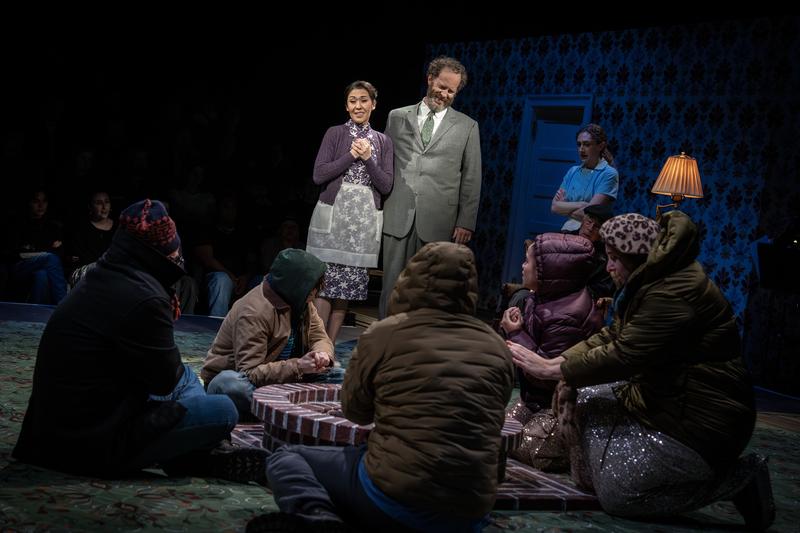
Alison Stewart: This is All Of It on WNYC. I'm Alison Stewart. When Thornton Wilder's play The Skin of Our Teeth opened in 1942, it was a bold new work that was not afraid to challenge audiences. It won the Pulitzer Prize for drama. Now at the Public Theater, you can see a brand new adaptation of Wilder's play as a musical. That adaptation was led by Ethan Lipton, who wrote the music and lyrics to this new show. It's called The Seat of Our Pants.
The story of Wilder's allegorical play remains the same. At the center is the Antrobus family. George and Maggie Antrobus have been married for, oh, thousands of years. Mrs. Antrobus is dedicated to her two children, Henry and Gladys. She's assisted by a maid, Sabina. She needs all the assistance she can get because when the play opens, it's the end of the world. Throughout the play, we see the Antrobus family navigate a series of crises, from moving sheets of ice to a torrential flood. It's a story of human failure and resilience, a funny story and a tragic one. Now it is set to great music.
The Seat of Our Pants is running at the Public Theater through November 30th. We are here for a treat in the studio because the cast is here for a special live in-studio performance. Tony winner Ruthie Ann Miles, who plays Maggie Antrobus; Tony nominee Micaela Diamond, who plays Sabina; Tony nominee Damon Daunno, who plays Henry Antrobus; Ally Bonino, you might remember her from Suffs; and multi-instrumentalist Michael Lepore, who plays various characters throughout the show. I'm tired. Before we hear some music, we're going to kick things off with Ethan Lipton, who wrote the music and lyrics for the show and adapted it from the original Thornton Wilder play. Ethan, it is nice to speak with you.
Ethan Lipton: It is great to be here.
Alison Stewart: We should also mention there's fabulous musicians here as well.
Ethan Lipton: An amazing portion of our band.
Alison Stewart: What was your first exposure to Thornton Wilder?
Ethan Lipton: I think I saw Our Town when I was a kid, and later I remember seeing The Skin of Our Teeth in a college production, which I wasn't sure I totally got, which I think is an experience that a lot of people have with that play for the first time. Then, like so many great writers, you just revisit it over time and keep reencountering it, and finding new things in it.
Alison Stewart: When did you decide this could be a musical?
Ethan Lipton: I was approached by a guy named Jeremy McCarter at the Public about 12 years ago. He was a huge Wilder fan, so much so that he is now the executor of the Wilder estate. He knew my work as a songwriter and a playwright. He reached out and said, "Would you have any interest in doing this?" He was working at the Public at the time, where I had a relationship. I think he thought my sensibility might work with it.
I remembered the play, and I was like, "God, isn't that that bonkers play?" Then I read it again with my grown-up brain, and I was just so touched by it. It's so ambitious and epic, and it's really playful about serious things. I like to be playful about serious things. I felt like I couldn't say no. This was a playground I wanted to play in.
Alison Stewart: How do you decide the kind of music that you would like to write for a play like that?
Ethan Lipton: For me, I try to listen to the play. The play is so grand structurally, but it's also so provocative about these human archetypes. I knew that with the music I wanted to try to get at the individuals within the archetypes. I wanted to create a little bit of intimacy with these people. I'm such a weird, idiosyncratic songwriter, I don't notate music, I don't play any instruments. I write songs like a five-year-old, which means I sing them until they have a form. I do that dozens or hundreds of times, whatever it takes. Then I bring them to my collaborators. Really, I was trying to listen to the play and find out what it wanted.
Alison Stewart: How did you figure out where to put a song in the play?
Ethan Lipton: Sometimes I've musicalized text by Wilder, just found the music that wanted to be with that text. Sometimes I've turned a single idea or line in the play into a song, and it's really probing and pushing it around. When I started doing this adaptation, I was very polite with the play.
Alison Stewart: You were very polite with it?
Ethan Lipton: Yes, it's Thornton Wilder. He's a fancy guy. I wanted to be respectful. Then, at some point, I was like, "You can't be reverent and respectful with such an irreverent play." At that point, I really just had to trust my own intuition about what spoke to me as a song, and what kind of a song that wanted to be in relationship to the other songs that were around it.
Alison Stewart: We're going to bring in Ruthie Ann Miles now, who stars as Mrs. Antrobus. The Antrobus family is presented as a real family, but they're also part of a bigger symbolic story, a biblical story. They've been married for thousands of years, as we learn. At the moment we meet her, what's important to Maggie Antrobus?
Ruthie Ann Miles: When we very first meet Mrs. Antrobus at the top of Act One, her children are playing outside, and their maid has just let the fire go out. Now, we know that it's cold outside. Mr. Antrobus is not yet home, and we don't have any food or fire until he comes back home. The thing on her mind is getting her children warm. "What are we going to eat tonight? Make sure when my husband comes home, he's not in a bad mood." We have to collectively, as a family, get together, be good. We're going to put our best faces on for Dad.
Alison Stewart: She has an interesting relationship with her children. How would you describe it?
Ruthie Ann Miles: Mrs. Antrobus is every mom all the time. We have to wear 10 different hats all the time. She has to listen to them and give them confidence, and feed them, and "Yes, yes, honey, of course." Also, "You drive me absolutely crazy if you ask me that question one more time. Ooh. I hope I don't raise my hand at you today." She's constantly wearing these hats. Yes, it's complicated, but it's also real life, isn't it?
Alison Stewart: Is she maternal?
Ruthie Ann Miles: She is maternal. I think she is maternal. She's a woman. She needs quiet. She needs her mental health back. She needs sleep. She would really love it if the kids would just cooperate. They'd be on my team kids.
Alison Stewart: Hey, Michael, can you come up to the microphone? This is Michael Lepore. We're going to hear a song that happens in Act One. You're playing the telegram boy.
Michael Lepore: That's correct.
Alison Stewart: What have you come to communicate to the Antrobus home?
Michael Lepore: I've come to communicate a message from her husband, Mr. Antrobus, which is actually not quite important or helpful to any of the world-ending situations that is happening. Then, before I head back out into the cold, I ask her for some advice on how to survive the end of the world.
Alison Stewart: Can you describe your outfit for us?
Michael Lepore: Imagine just like a Wes Anderson yellow-and-blue telegram boy. My suspenders are super high up, and I have a sweet little hat, and it's amazing.
Alison Stewart: The song we're about to hear is "Stuff It Down Inside." Ruthie Ann, she's the one advocating that we stuff it down inside. Why does she think that is the best thing to do in this moment?
Ruthie Ann Miles: Because if you let the cap off at all, you're going to blow. The best way to keep everyone moving forward, everyone safe, everyone happy, everyone fed is to, you know what? Keep your emotions in check. Better yet, push it so far down you don't even see it.
Alison Stewart: This is Ruthie Ann Miles, Micaela Diamond, and Michael Lepore with "Stuff It Down Inside" from the new musical The Seat of Our Pants.
Telegram Boy: Mrs. Antrobus, can I ask you one other thing? I have two sons of my own. If the cold gets any worse, what should I do?
Mrs. Antrobus: What does one do about anything these days? Just keep as warm as you can.
[MUSIC - Stuff It Down Inside]
Gather all your fears.
Fold them in a pie.
Seal it with your tears.
Bake that thing on high.
When it's done, my dear boy,
Don't even bother looking for a knife.
Just open up right here, boy,
And eat the whole thing in one bite.
And stuff it down inside.
Stuff it down inside.
Keep it from your children.
Keep it from your bride.
You could share it with them.
But there's a reason God gave us pride.
So all those awful feelings could have a safe place to hide.
Pack all of your sorrow.
Into a suitcase every night.
Think about tomorrow.
Is everybody going to be all right?
Find some hope to borrow.
From the faintest little ray of light.
Then grind it up real fine.
Pour it in a glass of wine, and stuff it down inside.
Stuff it down inside.
Stuff it down inside.
Keep it from your children.
Keep it from your bride.
I could share it with them.
No.
There's a reason God gave us pride.
So all those scary feelings could have a cozy place to hide.
If you're having trouble dealing, just stuff it down inside.
Alison Stewart: You're hearing a live performance from the cast of The Seat of Our Pants. Micaela, let's bring you in. You play Sabina, the maid for the Antrobus family. You worked on another musical that was out there Sondheim's Here We Are. How did working on that project help you with this project?
Micaela Diamond: Yes, I do have an existential thing happening, I guess, in my career. Sondheim is, I would say, the best we have. There's so much in his music that are clues or little roadmaps. I was listening to Ethan talk about how he was trying to listen to the play. I think sometimes that's what happens with Sondheim, is you have to listen to the music and let it inform something inside of you. Sometimes you have to push against that, and sometimes you float on that river.
That's something that happens with Ethan's music for me. As soon as I heard his music, I was like, "This is so special." It fits my voice in such a beautiful way. I feel like there are moments when it's really informative, and when it's actually the opposite, it's the subtext or the thing that's deep down in the core of me that I would never say aloud.
Alison Stewart: Your character frequently breaks the fourth wall, telling us, "I don't really understand what's going on in this play at all." What do you see as the importance of your relationship with the audience?
Micaela Diamond: Yes, I have a privileged relationship with the audience. I get to be their speaker. They're my jury. One of the best parts of this whole experience for me is that I get to have this secret thing with them. When they feel confused, I also feel confused. I flat out say to them, "Don't try and understand this play, for the love of God." I think I felt that way when I first read The Skin of Our Teeth. I was like, "I am confused too."
I think what's amazing about theater is you can see something and let it wash over you, let it enter your subconscious, and suddenly you're shifted somehow. It's this secret way of getting to the heart of a person. I think that's why I love my role so much, is because I can say, "Don't think about it." Then maybe they have a dream that night from a song or from an image they saw on stage, and they're moved.
Alison Stewart: That's an interesting point, Ethan, because so much of this play seems topical. You're talking about the climate crisis and hunger, and refugees. How do you think Thornton Wilder's work speaks to our current moment?
Ethan Lipton: He's so prescient in so many ways. I think it's because he likes to look at our species from 30,000 feet away, and reveal what is playful and tragic and hopeful about us. He's always taking this long view of us. That's something that I like to do in my work, too. I had a show about a guy whose job is outsourced to Mars. I'm looking for big metaphors and ways to view myself and my fellow humans in our world. He is really an expert at doing that and showing us ourselves.
Alison Stewart: We're having a special live performance from the new musical The Seat of Our Pants. We'll have more after a quick break. This is All Of It.
[music]
Alison Stewart: You are listening to All Of It on WNYC. I'm Alison Stewart. We are hearing a special live performance from the new musical The Seat of Our Pants. I'm speaking with the man behind the music, lyrics, and adaptation, Ethan Lipton, plus a very talented cast, Ruthie Ann Miles, Micaela Diamond, Damon-- Let's see if I get it right, Daunno, Ally Bonino, and Michael Lepore. The Seat of Our Pants runs at the Public Theater through November 30th.
Okay, Ally, you are up. You play a few characters in the show. We're about to hear a song that comes from a fortune teller. It's at the top of Act Two. What's going on in the scene before we hear this song from the fortune teller?
Ally Bonino: Yes, this song comes at a really fun moment. We're a little bit into Act Two, and it's a completely different setup from where we were in Act One. Act One, we are in the Antrobus house. In Act Two, we are transported to a boardwalk that is simultaneously in the 1920s, the 1950s, and out of time altogether. We are at a convention where we see the evolution of mammals in a very fun way, which I will not divulge here because come and see the show and see it for yourself. It's very fun.
We have a big tone shift from where we end at Act One into Act Two, and time has passed. We have moved on, we have come back stronger, and it's very jovial. The theme at the top of Act Two is enjoying yourself. Then we're at the boardwalk, there are games, there are shining, sparkling lights everywhere, and then you have Esmeralda, the fortune teller, who is this walking void of truth, and holding the mirror up to a society that wants to look anywhere but in that mirror.
Alison Stewart: This is Ally Bonino with The Future.
[MUSIC - Ally Bonino: The Future]
I can see the future on your faces.
I can see what happens when you sleep.
If I were you, I would avoid high places,
'Cause someday you're going to want to take a leap.
Keep an eye on things in Kansas City.
Your partner will deceive you on a deal.
I'd describe your termites as a pity,
But the termites think your house is matzo meal.
Watch out for your posture, ease up on the wine, cirrhosis of the liver, and sclerosis of the spine.
Bright's disease, shin splints,
You're going to have 18 grandkids, and they're all going to move in with you.
Don't believe the charlatans of history.
No one knows a thing about the past.
Your own youth has now become a mystery after you swore you'd find a way to make it last.
The future is the only game to count on, and I'm the only one who knows the score.
Someone here is going to hurt your feelings.
Someone else will wish they'd hurt them even more.
Watch out for your posture, ease up on the wine, cirrhosis of the liver, and sclerosis of the spine.
Bankruptcy, apoplexy, death by regret type Y.
You'll try to be angry, but no, just a whimper and then finny.
Watch out for your posture, ease up on the wine, cirrhosis of the liver, and sclerosis of the spine.
Sclerosis is very uncomfortable.
What, you ask, will happen to old Antrobus?
Well, what becomes of any great man's rise?
He'll huff and puff and blow away from us until a bolt of lightning strikes him from the skies.
And then the rains will wash it all away.
And then the rains will wash it all away.
And then the rains will wash it all away.
And then the rains will come.
And then the rains will come.
You will see shameful things before the deluge.
And some of you will say, "Let him drown; he's not worth saving."
But you're wrong.
Keep your doubts to yourself.
Again, there will be a narrow escape, the survival of a few from destruction, from total destruction.
And then the rains will come.
And then the rains will come.
And then the rains will come.
And then the rains will wash it all away.
Alison Stewart: That was Ally Bonino singing from The Seat of Our Pants. It's so interesting in the show, Ethan. The show has deep roots in the Bible, from Noah's Ark to Cain and Abel. Let's talk about you coming up next. How did you think about composing music for the show while keeping the idea of the Bible in the back of your mind?
Ethan Lipton: Oh, gosh, I don't know that I had the Bible in the back of my mind.
Alison Stewart: What was in the back of your mind then?
Ethan Lipton: I was just trying to serve the play. I like 20th-century American music, and so the show has country, and folk, and rock and roll, and jazz, Tin Pan Alley, and then a smudge of a lot of different things in there. Then I spent about a year this past year with Dan Kluger, our orchestrator, turning the songs into the music that we now have in the show, trying to make sure that it felt dynamic from song to song, but also that it felt like a cohesive whole. Hopefully, that that swath of music and genres would feel epic in the way that the play does and in the way that the Bible does. That it would give it a kind of scale.
Alison Stewart: At the microphone, we have Damon Daunno.
Damon Daunno: Hello.
Alison Stewart: He plays Henry Antrobus. We learn that your character, Henry, used to go by the name Cain.
Damon Daunno: That's right.
Alison Stewart: He has some very violent tendencies.
Damon Daunno: Indeed, to the chagrin of my mother and father, I suppose.
Alison Stewart: What's going on with Henry internally?
Damon Daunno: That's a loaded question, Alison. I think what's going on with Henry internally is an absolute void of love. I think he just wants to be a part of the crew, to be held and seen and cared for and nurtured like everyone else he sees happening in his world. It's too late, Mom. This is Ruthie Ann Miles hugging me from behind, listeners can't tell. A little too late.
Damon Daunno: Yes. I think that, as potentially one of the resident antagonists of some of the drama that happens, I always think that-- empathize with the character, to find out what is in their heart and not judge them as the bad guy or the guy who's evil or does murdery things. Those are all very results oriented in these ways, and actually it's way more complicated than that, isn't it? Much like life, much like Ethan Lipton's brain.
I think that he represents a lot of the intensity of life. There is a yin to it all, isn't there? There has to be a Malvolio. There has to be someone that reminds us the other side of the coin is still the same coin. We're quick to shun, but I think he's there to say you can't necessarily get rid of it in life.
Ethan Lipton: He's still part of the family.
Damon Daunno: Thank you, Ethan. I am part of the family.
Alison Stewart: You're going to sing "Cursed with Urges".
Damon Daunno: That's right.
Alison Stewart: When does this come on in the play?
Damon Daunno: This happens in Atlantic City on the boardwalk, and boy, Henry just wants to bust out, and he just can't. He lives his life in a proverbial straitjacket and just can't seem to get anything right. His natural tendency, though, is very passionate, sometimes that means violent. Most of the time, it means violence. When he's told not to follow his gut instincts, he's constantly raging against his own impulses. He wants to be free and just live and honor his impulses just like everyone else.
This is a moment where, much like in life, where we win imaginary arguments, we replay a moment, and, "Boy, we could've let him have it this way." Everyone around us supports you. This is one of those moments in Henry's head where we see him really speaking from his heart, finally.
Alison Stewart: This is "Cursed with Urges" from the new musical by The Seat of Our Pants.
[music - Damon Daunno: Cursed with Urges]
Why can't I ever enjoy myself?
Why must I always deny myself?
Tell me why, tell me why I can't do what I like.
You say I've got to control myself.
You don't know what a power surge is.
You've never seen a person cursed with urges.
I decide how to employ myself.
I can't lie I've got to be myself.
Mm. When I die, I'm going to free myself.
Tell me why I can't take what I like.
You say I've got to contain myself.
You don't know what a power surge is.
You've never seen a person cursed with urges.
I decide how to remain myself.
I go like this.
[laughter]
Tell me why, tell me why I can't go where I like.
You say I've got to control myself.
You don't know what a power surge is.
You've never seen a person cursed with urges.
I decide how to deploy myself.
I decide how to deploy myself.
I decide.
Alison Stewart: The Seat of Our Pants is running at the Public Theater through November 30th. Thanks to everybody for coming to the studio, we really appreciate it.
Ethan Lipton: Thank you for having us, Alison.
Ruthie Ann Miles: Thank you.
Ally Bonino: Thank you.