
Saxophonist Alison Shearer Performs Live
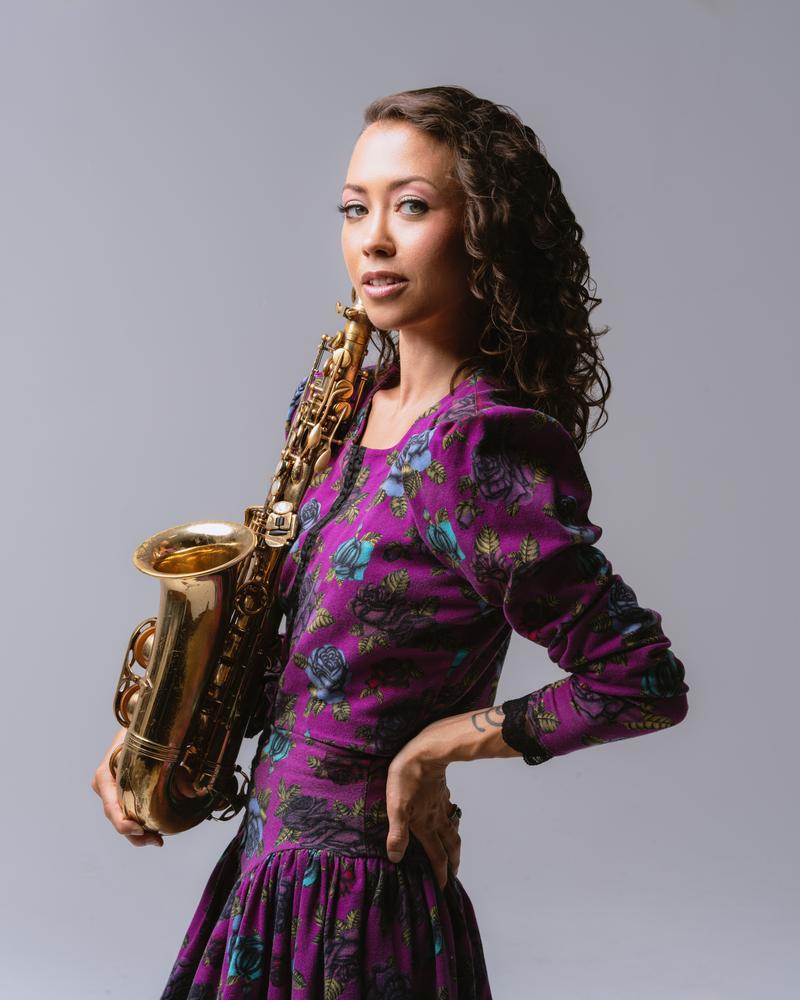
Alison Stewart: This is All Of It on WNYC, I'm Alison Stewart. Alison Shearer is a New York based composer. She's also a multi-instrumentalist, as you'll hear in a minute. I'm looking at Alison right now, with a trio of instruments. An alto saxophone, a soprano sax, and a flute, because she's going to perform live from her new album. The album is called In The Garden, released earlier this month. It is her second album. She's here with me right now, with her band, to perform live. Heads up. Alison has a release party show next Thursday, October 30th, at Nublu at 151, in the East Village at 7:00 PM. Hi, Alison.
Alison Shearer: Hi, Alison.
Alison Stewart: The first thing we're going to hear is, "Hi, Alison. Hi, Alison." We're going to hear Liberty Market. Tell me a little bit about Liberty Market.
Alison Shearer: Liberty Market is the opening track of off In The Garden, the album you just mentioned. It gets its name from a marketplace that I visited while on tour in Pakistan, in Lahore. This is inspired by that place. Here we go.
Alison Stewart: Here we go. [MUSIC - Alison Shearer: Liberty Market]
Alison Stewart: That was Alison Shearer and her band performing her song, Liberty Market, live in our studio. Her new album is called In The Garden. If you want to catch Alison live, she's having an album release party show on October 30th at Nublu 151. That's in the East Village. The show is at 7:00 PM. Before we go any further, would you introduce your band?
Alison Shearer: Absolutely. On the keys and piano, we have Christian Li.
Alison Stewart: Hey, Christian.
Alison Shearer: On the bass, Marty Kenney.
Alison Stewart: Hey, Marty.
Alison Shearer: On drums, Horace Phillips.
Alison Stewart: Hey, nice to meet you. I see a soprano sax, an alto sax, and-
Alison Shearer: A flute.
Alison Stewart: -a flute.
Alison Shearer: Yes.
Alison Stewart: Which instrument came first in your musical education?
Alison Shearer: Flute was my first instrument. Really, before that, recorder.
Alison Stewart: A recorder? [laughs]
Alison Shearer: Starting in maybe second grade, but yes, I picked up the flute in elementary school, started playing classical music primarily, and then when I was about 13, was introduced to jazz. My first record was My Favorite Things by the wonderful John Coltrane. Then alto, and then soprano.
Alison Stewart: When did you realize, "I'm good at this, and I'm going to pursue it as a career"?
Alison Shearer: Man, I feel lucky. I think music, I think it kind of chooses people sometimes, I think. I think I've known since I was maybe 10. I think it fundamentally just calms my nervous system. I fell in love with it immediately. I enjoyed school in general, so other things are possible, but I feel very fortunate that I've known for a long time that this is what I want to do.
Alison Stewart: When you start, did you start writing right away?
Alison Shearer: No, actually. I didn't really begin composing until college. I studied performer, a student. I was at the Manhattan School of Music pre-college, in high school, on the weekends, but didn't really get into composition until maybe my late 20s.
Alison Stewart: What do you like about composition?
Alison Shearer: I think that fundamentally, performing and composing are related, but also very different. I think with performing, I think so much of it is being in the moment. Even if things get messed up or flubbed, you have to stay centered and be present. That's part of the live experience. With composing it's, you're looking for something. I love that quest. You always know when something's not quite right, but then you sort of find it, and it's almost like it's been there, kind of waiting for you. I also love the relationship. I got really into running during the pandemic.
Alison Stewart: Oh.
Alison Shearer: Almost didn't-- I've lived in Brooklyn since 2006, or in New York since 2006, and I feel like I wasn't fully aware of the parks until the pandemic, and got into running. That relationship between writing music, exporting a MIDI file, listening, and running, I fell in love with that relationship.
Alison Stewart: Oh, that's so interesting. What do you do when you get stuck in your writing?
Alison Shearer: You have to get outside, or just leave the space. Sometimes songs come very quickly, and that's often-- the flute tune that we're going to play, I think I wrote in about an hour, which is a good thing. Then sometimes you wrestle with the song. That's part of it, too. You know?
Alison Stewart: My guest is saxophonist and composer, Alison Shearer. She's got a new album out. It's called In The Garden. This is your second album.
Alison Shearer: It is. Yes.
Alison Stewart: What did you learn from the first album that you used on your second album?
Alison Shearer: That's a great question. I very much like to compose for the record. I mean, I know this is just my second, but I love albums that really take you on a journey. I'm a huge fan of drummer Nate Smith. I love his Kinfolk records. I loved Keyon Harrold's record, Traveling Wayfarer. Where it's not just-- you know, there's also a beauty in the ECM Records, where everything is a vibe. I like placing compositions as they would go as a collection. I felt really-- I liked how that came across with View From Above, was my first record.
That record had a number of special guests. We had a cellist, a trumpet player, five singers in total. With this record, I really wanted to go inside and just feature the quartet, which is what we did.
Alison Stewart: Well, let's hear the title track, In The Garden. What are we going to hear first?
Alison Shearer: Yes, this is In The Garden. It's going to feature a nice improvised bass intro by Marty Kenney.
Alison Stewart: Let's do it.
[MUSIC - Alison Shearer: In The Garden]
Alison Stewart: We'll have more with Alison Shearer after a quick break. This is All Of It.
[music]
Alison Stewart: You are listening to All Of It on WNYC, I'm Alison Stewart. My guest is saxophonist and composer Alison Shearer. She's just released a new album this month. It's called In The Garden. I read that you recorded this album entirely live to tape.
Alison Shearer: We did.
Alison Stewart: Oof.
Alison Shearer: Yes. I know.
[laughter]
Alison Stewart: Why did you decide to go with that route?
Alison Shearer: Well, I want to just give a quick shout out to Scott Lindner and his new label, Pinch Records, out of Brooklyn. Scott reached out to me about two years ago, asking if I wanted to do this record. They're a new label, and I think one of the greatest gifts you can give an artist is the gift of time and opportunity. It's just like an honor when someone asks you to make something. I don't think I ever could have afforded to do a week live to tape, but we got that opportunity and why not take it? Yes, it was a great experience.
Alison Stewart: On different song, you switch between sort of an electric and an acoustic sound, sometimes you have a synth keyboard, other times a piano. How do you decide when a song-- what it's going to sound like? Whether it's going to be an acoustic song, or whether it's going to be an electric song?
Alison Shearer: Yes, it's funny, I don't actually usually think of those two as the differentiating factors. I think every song comes from a very specific emotional place. A lot of it's groove oriented.
Alison Stewart: Groove oriented?
Alison Shearer: Yes. Yes, the first song was-- it has these kind of layered-- Liberty Market, the first one we played, has these layers of seven and sort of four over seven. On that, there's both a Nord and a Prophet, and that's kind of the sound world. Piano felt right for the last one. It's a softer ballad. I think depending on where the emotions sit for the song, sort of dictates what the instrumentation should be.
Alison Stewart: Your answer made me realize what I want to talk about later, is that you teach.
Alison Shearer: Yes.
[laughter]
Alison Shearer: I do. I do teach.
Alison Stewart: What age kids do you typically teach?
Alison Shearer: It ranges. I love middle school kids. I love that sort of 13 to 15, kind of just really becoming yourself, and high school kids. I've taught both at the Lincoln Center Jazz Academy and I've taught at Jazz House Kids, and I've taught privately. I really enjoy sharing knowledge with kids.
Alison Stewart: What is it they want to know? What do kids want to know when they're learning an instrument?
Alison Shearer: Oh, man, it depends on the age group. Little kids just want to get a sound, and then they play so loudly. Sometimes if they're really like, rowdy, I get them, "Okay, if you can just sit through the next 10 minutes, then you guys can battle each other." That kind of channeling the energy that way is helpful. Yes, I think every kid wants something different.
Alison Stewart: You're holding your flute.
Alison Shearer: [laughs] Yes.
Alison Stewart: You're holding your flute. Who's your favorite flautist?
Alison Shearer: Oh, wow. Hubert Laws, probably. As I said earlier, I also come from a classical background. Oh, James Galway was a hero. The classical flute tradition is so deep, and I'd like to learn more. I play more and more Indian music. I play in Red Baraat, and I'm interested in learning more about the bansuri tradition, and-
Alison Stewart: Well, that's interesting.
Alison Shearer: -as that. Yes. So I think, always finding new people, but Hubert Laws is the OG. [chuckles]
Alison Stewart: For people who are saying, "I know that last name. I'm pretty sure I know who this woman's father was." Your father was John Shearer.
Alison Shearer: He was. Yes.
Alison Stewart: Yes. He was the second Black staff photographer at Look magazine after Gordon Parks.
Alison Shearer: Yes, Look and Life magazine.
Alison Stewart: Look and Life. People recognize the picture, I think, most people recognize of him taking a picture of John Kennedy Jr. at the funeral for his father.
Alison Shearer: Yes. There's a wild story behind that photo. I'll keep it short, but when my dad was at-- Gordon Parks was a mentor, and when he was a young teenager, he entered the Scholastic Photo Competition. It was blind adjudication. He won first, second, and third in every category, which was kind of unheard of.
Alison Stewart: Wow.
Alison Shearer: What's now the Apple Store at Grand Central used to be an art gallery. My dad had a solo show. He was probably like 16 years old. The editor for Life came. Fast forward a couple months later, John F. Kennedy was assassinated. So my dad was invited to come as his assistant, climbed up the scaffolding, got this incredible angle, because he is a kid, no one's looking at him, and got the angle that then that photo ran on the cover of Life.
Alison Stewart: Oh my gosh.
Alison Shearer: He used to hate it because it was overexposed, but because of that, you can see Jackie O's face behind her veil.
Alison Stewart: Oh, that is an amazing story. That's an amazing family story for you to have as well.
Alison Shearer: Yes, yes, yes. Thank you.
Alison Stewart: I'm speaking to Alison Shearer, her new album is In The Garden. All right, she's holding her flute. What are we going to listen to?
Alison Shearer: This is Treehouse. Bembe tune, Treehouse.
[MUSIC - Alison Shearer: Treehouse]
Alison Stewart: That was saxophonist and composer Alison Shearer. The name of the album is In The Garden. Thanks to Alison and her band for joining us. Thank you so much.
Alison Shearer: Thank you so much for having us.
Alison Stewart: I'm Alison Stewart. I appreciate you listening, and I appreciate you. I will meet you back here next time.