
S.A. Cosby's New Thriller 'King of Ashes'
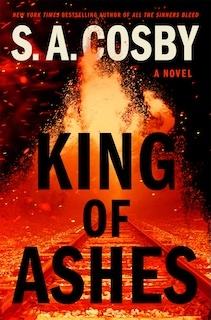
Tiffany Hansen: This is All Of It on WNYC. I'm Tiffany Hansen, in for Alison Stewart. Writer S.A. Cosby is the master of the Southern noir, and his latest novel, well, the heat doesn't just come from the Virginia setting or the propulsive plot. It also comes from the flames of a crematory. That crematory is owned by the Carruthers family. The eldest sibling, Roman Carruthers, has fled their small town of Jefferson Run, Virginia. He's become a wealthy and successful financial advisor to C-list celebrities and shady characters in Atlanta.
Roman's sister, Nevaeh, has been left at home to help their dad with the crematory. Their youngest brother, Dante, is aimless. He's got a drug problem. That addiction causes Dante to become indebted to a dangerous local gang. When Roman gets a call that his father has been in a car accident and is in a coma in the hospital, he heads home to Jefferson Run. There, he learns that his dad was targeted as a warning from the gang. Now he has to figure out how to save Dante, save the rest of the family from gangsters who are hell-bent on getting their money or else.
The novel is titled King of Ashes. It's out now. S.A. Cosby will be speaking tonight at the Upper West Side Barnes and Noble, but first, he joins us in studio. Hello.
S.A. Cosby: Hi. Thank you for having me.
Tiffany Hansen: Okay. The first question is going to be very pedantic, and it's going to be about crematory, crematorium. Did you dig into the lexicon on that? Because we had quite a discussion out here before you came in.
S.A. Cosby: Yes. My research did include some of what the plurality of that is. I think whatever you pick is fine. [laughs]
Tiffany Hansen: At this point, right?
S.A. Cosby: Yes.
Tiffany Hansen: People know what we're talking about. [chuckles]
S.A. Cosby: Exactly.
Tiffany Hansen: Where did you first get the idea to set this book? It's obviously not set in there only, right? There's all sorts of locations, small towns in Atlanta, but this idea of being and occupying space and time in a crematorium.
S.A. Cosby: I always liked the idea of fire as a metaphor for change. Change, transformation for destruction. Also, I wanted to set it in a business that, for lack of a better word, was narratively advantageous because a crematory for a crime novel is a really good setting. It's a really, I think, easy and complete way to get rid of bodies. That was the idea both thematically and just technically. A family business is always, I think, really ripe for interesting stories.
Tiffany Hansen: Well, as Hollywood has shown us, that is a definite. Listeners, do you have a question for S.A. Cosby? Question about his books or writing thrillers in particular? You can call us, you can text us your chance to talk to the writer himself. 212-433-9692, 212-433-WNYC.
I'm wondering if you're one of those authors that when you get the spark of an idea-- First of all, are you always listening in on conversations and thinking, "Oh, that might be good, that might be good?"
S.A. Cosby: Yes. I think one of the prerequisites for being a good writer is actually being a little nosy and being able to eavesdrop on people's conversations, because I love the actual rhythm of conversations. I like to translate that to my dialogue so that the dialogue in the book sounds the way people actually talk. I'm always listening and taking things down mentally, but also I'm always looking for ideas as well, whether it's in the news, whether it's a book I read, a post on social media. Those things are always percolating under the surface.
Tiffany Hansen: How do you decide what might be a good idea today, but actually maybe wouldn't be such a great book?
S.A. Cosby: I always write myself a little synopsis when I have an idea. If the synopsis is interesting enough that I feel like, oh, there's more meat on the bone, so to speak, then that'll become a book. Some things I write a synopsis for is like, "Oh, I think that'll be better as a short story that has more of a finite punch to it as opposed to the way a novel can spread and become sort of a tapestry." I have to find it interesting myself, and then once I find it interesting, usually I think it can make it out into a novel-length.
Tiffany Hansen: That's the thing, right? If you're not interested, none of the rest of us are going to be interested.
S.A. Cosby: Exactly. I tell stories that I would love to read myself, so that's why I write them.
Tiffany Hansen: I was thinking about this just in terms of the character names too, which are just-- they're such great names. Do you have to love the name in order to continue with the character as well? If you don't fall in love with that person, look, not everybody is going to be worthy of our love. You know what I mean, right?
S.A. Cosby: Right.
Tiffany Hansen: From a writer's perspective, if you don't fall in love with them and their journey, and that may start with their name.
S.A. Cosby: It definitely does. The names are very important, as are the titles of my book. I have a superstition that I can't start writing a book, no matter what the idea is, until I come up with a good title. I have to have the title in place first, and then I have to write a story that earns that good title. Same thing with the names of the characters. Names of characters always mean something, whether it's Roman in King of Ashes, who is like the Roman Empire. He thinks of himself as this rarefied protector, but really is falling apart on the inside, like the last days of the Roman Empire.
Nevaeh, heaven backwards, she's stuck in this purgatory, so to speak. Then with Dante, of course, that's a reference to Dante's Inferno, because Dante is the one that drags his family down to hell in this story.
Tiffany Hansen: Nevaeh, you said it very fast there, but for listeners, Nevaeh, heaven backwards, basically means Nevaeh is heaven, the word, spelled backwards.
S.A. Cosby: Yes.
Tiffany Hansen: Also a great name. All right. Let's start by talking about this town where it is set – Jefferson Run, Virginia. How would you describe that town?
S.A. Cosby: I would say Jefferson Run is a town that, in many ways, their best days are behind them. It's a form of manufacturing center. A lot of towns in the South – Virginia, North Carolina, South Carolina, Georgia, Alabama – were manufacturing towns, but in the '70s pulled up places where textile factories closed, where manufacturing, metal and iron factories closed. Jefferson Run is a town just like that. In that space, when manufacturing moves out, crime comes in. Nature abhors a vacuum, and so something has to fill it.
A lot of what goes on in Jefferson Run goes on because of the fact that it has been sort of forgotten and lost. The manufacturing, the economic stability of the town is gone. Something else had to come in and replace it.
Tiffany Hansen: What about that place acts on the characters or makes them act in a certain way? Because I do think sometimes place is its own character.
S.A. Cosby: Yes, definitely. A town and its timbre affects the characters in different ways. For Roman, it's a place that he wanted to escape, a place that he wanted to get away from. For Nevaeh, it's a place that she feels she can't get away from. That she's accepted her fate. For Dante, it's a place that he wants to try to forget. He doesn't want to leave, but he doesn't want to remember all the harsh things that have happened there. That town really weighs on and affects the decisions they make, which also affects the plot.
Tiffany Hansen: We have a text here. If you're taking texts, tell him a fan is very disappointed to be out of town because they can't be near the Upper West Side Barnes and Noble. I would have come out for it, but the question is, have you ever considered a story in a different genre?
S.A. Cosby: Oh yes, definitely. When I first started writing, I wanted to be a horror novelist. My first books that I read that I felt like were grown-up books were novels by Stephen King, Clive Barker, and Richard Matheson, and so on and so forth, so I fell into crime fiction. Where I come from, I come from a very small town. A lot of times, I always thought crime fiction wouldn't be a viable genre for me because in my hometown, like I say, it's never a whodunit. Everybody knows who did it. It's like, can we prove it? I found that there were stories to be told within that space and in the larger Southern rural crime fiction space as a whole.
I still love multiple genres, and I'd love to write stories in different genres eventually.
Tiffany Hansen: We were talking about romance novels earlier this hour, the S.A. Cosby romance novels coming to a story near you.
S.A. Cosby: There's a little bit of romance in this book, so that might be [crosstalk].
Tiffany Hansen: All right, I'll take it. I'll take it. All right. We are taking your calls for S.A. Cosby. Do you have a question about the process of writing? What makes a good thriller writer? What makes a good thriller, period? Do you have questions for the author? You can call us, you can text us at 212-433-9692.
Just to get back to that hometown, New York is full of a lot of people who left their hometown. Of course, there are a lot of New Yorkers for whom this is a hometown, and they end up leaving here and taking pieces of this place with them. I think that notion of taking our hometown with us in bits and pieces, for good or bad, is something that a lot of people experience. I'm wondering what is interesting to you about that in terms of how it shapes a person.
S.A. Cosby: I think where you are raised, where you grew up, and what do you do when you leave that place? Like you said, the pieces you take with you, I think it's very fascinating how you're able to compartmentalize those pieces in your new place. Whether you come from a small town, you move to a city, what are the things that you learn in the small town that you can use in the city? What are the things you have to let go, and what are the things you have move on from? What are some of the things that maybe you're ashamed of? Is it your accent? Is it your clothes? Is it the type of food you eat?
Do you embrace that and meld that with your new home, or do you hide that away? All of that is telling a story about who you are as a character and who you are as a person.
Tiffany Hansen: Let's talk about them then in reference to your character, Roman, because he falls in the camp of wanting to leave his past behind. How did his hometown shape him?
S.A. Cosby: I think it made him someone who is incredibly ambitious. Someone who has a certain type of moral flexibility. For the job that he's done and the world that he finds himself in, I think he feels like, well, there are rules that are meant to be bent and there are rules that can be broken because the only rule is that you win. He's a very ambitious character. I think that comes from coming from a small town that was economically depressed, a town that was dangerous. For Roman, he created the fantasy life that he always wanted when he was a little boy.
Tiffany Hansen: If you're driving around Atlanta – let's pretend – do you feel like you could find him there if you look for him?
S.A. Cosby: I definitely could. I think there's a certain type of character, a certain type of person who goes to-- like in Atlanta, New York City, and Los Angeles, and who reinvents themselves in a new way. In a way that is, in many ways, the hyper-realized version of themselves. I think you definitely can find people like that. You could definitely find people who come from a small town. You could definitely talk to them for a few minutes and find themselves dropping right back into that cadence because you never leave it all behind.
Tiffany Hansen: We are talking with author S.A. Cosby about his new book. The title of the new book is King of Ashes. We're going to continue this conversation. We're inviting you to join us in that, 212-433-9692. I want to talk a little bit more about this hometown idea, but we're going to take a quick break. You're listening to All Of It here on WNYC. I'm Tiffany Hansen, in for Alison Stewart. Don't go anywhere.
[MUSIC - Luscious Jackson: Citysong]
Tiffany Hansen: This is All Of It. I'm Tiffany Hansen, in for Alison Stewart, and we are talking with S.A. Cosby about his new book, King of Ashes. It's out now. The author himself is talking at the Upper West Side Barnes and Noble and is here with us in studio.
I'm curious-- We were talking before the break a little bit about this nature of home and how we take home with us. It's a powerful motivator. There are other powerful motivators that you explore in this book – guilt, money. Do you think about those meta influences on your characters, or is it just a case of you follow these people around for a while, and then those themes kind of float to the top?
S.A. Cosby: No. I think there are definitely themes with this book that I wanted to explore. I definitely wanted to talk about, as I call it in the book, the acidicy of money. The way money can sort of burn through relationships, burn through connections, the way money burns through us. I definitely wanted to talk about the aspect of that. There's a scene in the book where Roman talks about when you go in a room with rich people, they look at you like a show horse. They check your teeth and your feet. That's something I've experienced as my career has gone on. I've been in rooms with people who were very wealthy, and you can feel that even subconscious judgment.
As a person who came from meager means, someone who grew up in poverty, I can definitely feel it. I'm aware of it. I think it's interesting to talk about it and how we navigate it. Also, the themes of guilt are huge in the book. Not just guilt for something major, but for the minor parts, the things that we have as family members. This interconnectivity that sometimes we have to apologize for, or sometimes we don't know we have to apologize for. Like in the book, the sister, Nevaeh, she feels very abandoned by Roman.
Roman left. He went to college and created a new life for him in another city. He left her to take care of both his father and the little brother. That animosity is couched with this also relief that he's finally home. Then of course the both of them, I think, are worried about Dante. There's this really, really fascinating spiderweb of connections and feelings. At the core of it, I think for these three characters, is this love that they have for each other.
Tiffany Hansen: Sean, let's bring Shane from Brooklyn into the conversation. Hi, Shane.
Shane: Hi. Hello.
S.A. Cosby: Hi.
Shane: Thank you for having me on. S.A., I'm a huge fan of your work. I've read a lot of your past works – All the Sinners Bleed, so many different ones, and they all end really well. I'm somehow left wanting to know what happens to some of those characters. What happens to Montague? What happens to some of these other guys? I was curious if you've ever considered writing a sequel to any of your previous books, or do you feel like you're just always one and done with these stories, because they're great.
S.A. Cosby: Thank you so much for that. Thank you for the call. I used to say no. I used to think I just wanted to write things as what I like call a closed loop. There are two books that have really connected with people that make me think maybe I'll do more in that world or that universe. The first one is All the Sinners Bleed. A lot of people love the main character, Titus Crown. A lot of people like for him to come back. I get a lot of fans who say he's their literary boyfriend, which I think is always hilarious. Maybe we'll see Titus come back, and I have to think of a way to bring him back.
I'm hoping maybe one day to write a very soft prequel to Blacktop Wasteland and talk about that main character's father. For those listening, the main character, Blacktop Wasteland, is a man named Beauregard "Bug" Montage.
Tiffany Hansen: Another great name.
S.A. Cosby: Thank you. I'll maybe see what happened to his dad, and what was his dad's life like before he was a father. Yes, I definitely have interest in returning to those worlds.
Tiffany Hansen: Definitely sounds better when you say Titus Crane than when I say it. Will you say it again?
S.A. Cosby: Titus Crown.
Tiffany Hansen: Crown, yes. Sorry. Thank you. Yes, I love it. All right. We have a text that relates to character names. You're going to like this, I think. "My grandfather from Smithfield, Virginia, used to say, 'If you give a dog a bad name, you might as well kill him.' In other words, give your character a good name, I think, is the advice there, right?
S.A. Cosby: Yes.
Tiffany Hansen: All right. Let's bring in somebody else into the conversation to get me out of that hole. Jesse in Fairfield, Connecticut. Hi, Jesse.
Jesse: It's funny. I finished this book ten minutes ago.
S.A. Cosby: Oh, wow.
Jesse: Got in my car and--
Tiffany Hansen: No, spoilers, no spoilers.
Jesse: Got in the car and turned on the radio, listening to this conversation. This book reminds me of The Godfather. I don't want to go too much into it, but the relationships among the siblings, Roman is a strong character, Michael's character. It's about legitimacy and money and how he moves this conversation over there, and all of the other mayhem that goes on behind. The Godfather is very similar in this book.
S.A. Cosby: Yes, definitely. I've been very open that The Godfather was a big influence on this work. I think a crime writer has four or five different types of novels that he's going to write, or she's going to write, at least once in their life. You're probably going to do a heist novel. You're going to do a true mystery. You'll do a revenge novel. I thought the crime epic is one of those novels too, and I wanted to do a crime epic.
The Godfather and the shifting loyalties and the family dynamics, and also the idea of legitimacy versus being nefarious, I think, was a really strong motivator for the story. The idea of how you want to find legitimacy. Who decides what legitimate means and what it is? That definitely was a big influence.
Tiffany Hansen: Did you ever see-- There's a series out. I don't know which streamer it's on, but it's about the making of-- Did you watch that?
S.A. Cosby: An Offer You Can't Refuse? Yes.
Tiffany Hansen: That's it. There's a great pitch that the character who plays Mario Puzo in there makes about the book to be making it into a movie. He says something to the effect of "It's evil versus evil. It's fun. It's not about the mob, it's about family." Do you think that someone-- Oh, and by the way, I'm really bad about doing this. Thank you, Jesse, for the call. Do you think that there's a notion here that someone like Jesse, who just finished the book, will come away and go, "That was really a book about family"?
S.A. Cosby: Oh yes, definitely. For me, crime fiction is a wonderful prism to talk about things that are important, including the bonds of family, the relationships of siblings. You talk about poverty, race, masculinity, tragic and toxic masculinity. For me, crime fiction is the gospel of the dispossessed, so I use it as a way to talk about things that are important to me. This book has a lot of mayhem and murder and violence and action, but at the core of it, it's about family. It's about the relationships. It's about the way we view each other in our families. The roles that we're given or the roles that we give others.
That's the main core thing that I think you'll take from it, but it's wrapped in, hopefully, an exciting and thrilling story that makes you fall in love with these characters and be concerned about them.
Tiffany Hansen: You mentioned the violence part of this. It is a thriller, people. We're going to get a little violence in here, but it gets pretty dark, even for you.
S.A. Cosby: Yes.
Tiffany Hansen: How do you decide how far to push things? What does the scene tell you that it requires when you're writing it?
S.A. Cosby: I think if you're writing a story like this, you have to make the reader understand that everybody's in peril, because it won't work. This sort of tragic story, this sort of interconnected crime story, won't work if the reader doesn't believe everybody is on the line. That everybody is in danger. For this particular work, I had to push it and make it a little bit more dark, a little bit more intense, because I wanted you to really believe, "Oh, this. Anybody could get taken out at any time." That creates a sense of dread that makes you be concerned about these characters and makes you become a part of their team.
Tiffany Hansen: How does violence move a story forward?
S.A. Cosby: I think violence can be very expository. Whether the person meting out the violence and how they react, but also the person that's receiving it, and how they react to it and how they deal with it. For me, violence doesn't have to be four to five pages. I think it's easy and more effective to just say what happens, put it out on the page, and then you can move on to the next thing. It's the way those characters react to both, again, the meting out and the accepting of the violence, or the person that's the victim and the person that's the aggressor.
I think it can tell you a lot about a character and how strong a character is or how weak a character is, and how they deal with physical pain. How they're able to translate that to either emotional courage, or does it make them fall apart? For me, violence is very telling on the character and who that person is.
Tiffany Hansen: We're getting a couple of texts here about the audiobook version. Everyone is in love with the person who's reading your audio. Tell us about who that is.
S.A. Cosby: That is Adam Lazarre-White. He's an actor, director, producer. He does all my audiobooks. He started with Blacktop Wasteland, and he's done them all up to and including King of Ashes. I'd like to say Adam is just an amazing performer. He has an incredible sense of what my stories are about and how to interpret them. For me, the moment I heard him, when he auditioned for Blacktop Wasteland, I was like, that's Beauregard. That's Bug. That's how he sounds in my head. Then he's done it with every book since. That he's able to find the voice of the characters I create, and I couldn't be happier to have him narrating my work.
Tiffany Hansen: You never thought about doing it yourself?
S.A. Cosby: [laughs] People ask me that sometimes. I've had people--
Tiffany Hansen: I think it's because you have a great voice.
S.A. Cosby: People compliment me on my voice, but I think, as Clint Eastwood said, a man got to know his limitations.
[laughter]
Tiffany Hansen: Okay. Just to get back to this notion of violence really quick. I wonder where's the line, though, because at some point it might cause your readers to give up on a character, give up on a storyline. To give up on someone's redemptive value. Where is that line?
S.A. Cosby: I think the line is wherever the character feels that they've sacrificed their morals. Wherever that character feels like they've done an unforgivable act. There's a line in the book where Roman thinks about this. He thinks about, there aren't really any lines. They're just choices. There aren't any lines to cross. They're just choices that you're going to make. For me, the choice is necessitated around, am I creating a situation and relating a situation that is going to test this character and push them up to the line of their morality? Because if I feel like I'm pushing them over it, then I feel like I'm doing them an ill service as a writer.
With Roman, though, what was interesting with that was his own personal morality kept shifting. Me pushing the line as a character, he would just keep moving it. Then I realized at some point, he is becoming the thing that he's fighting, which I thought was fascinating. How far can you justify that to yourself? Because he keeps telling himself, "I'm doing this for my family." That's a noble cause, that's a righteous cause, but do the ends really justify the means?
Tiffany Hansen: How much do you enjoy making your characters squirm and making-- You should twirl your hands when you give that evil laugh.
S.A. Cosby: [laughs[
Tiffany Hansen: Make your characters squirm and make your readers squirm.
S.A. Cosby: I don't really want to make my characters squirm, but I do want to test them. I do want to see how much they can take. There are characters that I have that I've created where they can't take a lot at all, and they fold rather quickly. Then there are other characters that end up being the protagonist who can take as much as I'm willing to dish out. I never wanted to be gratuitous. I never wanted to feel that I'm just doing it to put them through pain. The pain, the choices, the things they face are the test to see how they can handle it as a character. Because the part of the story is, I don't want them to be the same at the end of the book as they were in the beginning of the book.
For me, there is a line, there is a way that I want to put them through that. As far as the readers, yes, I want to make the readers squirm. If a reader tells me, "This book made me cry. I had to close it. I had to walk away from it, but I couldn't leave it alone," that's a win. That's a win for me. A win is a win. [laughs]
Tiffany Hansen: On that note, that's a good place to end. All right. The name of the new book is King of Ashes. It's out now. The author is S.A. Cosby. We've been talking with him about the book, and you're going to be at the Upper West Side Barnes and Noble tonight.
S.A. Cosby: Yes.
Tiffany Hansen: You're going to read from the book?
S.A. Cosby: I don't know if I'm going to do a reading, but we'll do some talking and I'll tell some stories and-
Tiffany Hansen: Do some talking. I like it.
S.A. Cosby: -it'll be interesting.
Tiffany Hansen: I like it. All right. The book is out now. You can show up at the Upper West Side Barnes and Noble if you didn't get your question in. S.A. Cosby, thanks for your time.
S.A. Cosby: Thank you for having me.
Tiffany Hansen: Hope you'll come back tomorrow because Alison will be back. It's Juneteenth, and she's having a conversation with Jonathan Eig about his new book, King: A Life, the first comprehensive biography of the civil rights leader in 30 years. I'm Tiffany Hansen. Thanks so much for listening, and we'll be back here tomorrow with Alison.