
Robert Kaplow on Writing For Lorenz Hart in 'Blue Moon'
Alison Stewart: This is All Of It. I'm Alison Stewart live from the WNYC studios in Soho. I am grateful that you're here, especially grateful if you've made a donation to WNYC for our winter pledge drive. Thank you so much for your support. A reminder to you, our February Get Lit Book Club event is happening tomorrow evening at 6:00 PM in the WNYC Greene Space. Author Angela Flournoy will be here to discuss her novel The Wilderness. It's fitting that the temperature is supposed to be in the mid-40s tomorrow since this event was originally scheduled during last week's blizzards.
Look, tickets are free but you can grab them now by heading to wnyc.org/getlit. That's wnyc.org/getlit. That event is happening here tomorrow in the Greene Space. I will see you there. What's happening on the show today? Well, we have Mexican pop star Umbe here to perform live in studio, we'll preview the Whitney Biennial with two of its curators, and Australian musician Courtney Barnett joins us for a listening party for her new album. That's the plan, so let's get this started with Blue Moon.
[music]
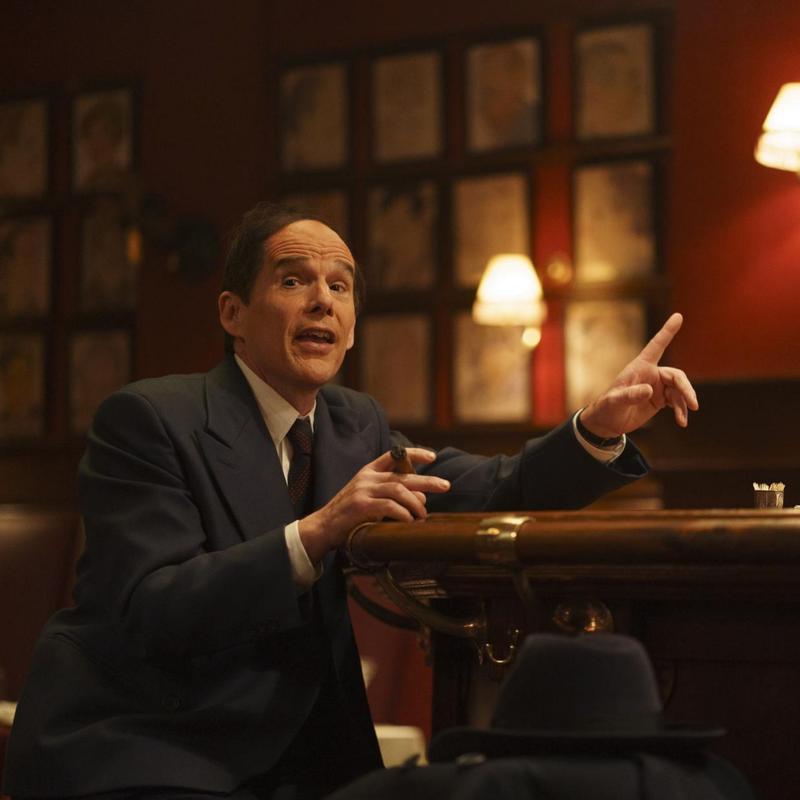
An English teacher who taught for 30 years at Summit High in New Jersey and serves as the editor and publisher of his local newspaper can add Oscar nomination to his lists of accomplishments. Metuchen's own Robert Kaplow wrote the film Blue Moon. It's set on one night where we watch the talented and destructive lyricist Lorenz Hart coping with the fact that his writing partner Richard Rogers has maybe found a new muse.
Hart wrote amazing lyrics for My Funny Valentine, The Lady's a Tramp, Blue Moon, but by age of 43 he had died from alcohol related injuries. The film shows how funny, bitchy, crafty and sad one person could be. Robert Kaplow joins us now for our series The Big Picture, recognizing talent behind the camera. He received an Academy Award nomination for Best Original Screenplay for Blue Moon. Welcome to the station.
Robert Kaplow: Thank you for having me, Alison.
Alison Stewart: How long were you working on a project about Lorenz Hart?
Robert Kaplow: A long time. I was never sure during that time, about a dozen years, that it was going to be made but I enjoyed working on it. I knew the director Richard Linklater because he had made a film from a novel I wrote called Me and Orson Welles about 20 years ago. He and I are friends, and he said to me one day, "What are you working on, Robert?" I said, "I'm trying to write this thing about the final Days of Lorenz Hart." He goes, "Lorenz Hart, I'm really interested in that. Could I read that?" Which is an extraordinary thing-
Alison Stewart: To have happen.
Robert Kaplow: -yes, for someone in the film industry to say that sentence. That sentence is the reason I'm sitting here today. He was interested, he read it, and for 10 years or so, he gave it to Ethan Hawke. We would meet usually in New York at Ethan Hawke's place and just read it. I would sit there with my ballpoint pen and fix it up and they would say, "We've heard this already. Can you get Richard Rogers in the story a little faster? It gets more interesting when he comes."
I'd just work on it and work on it. A couple years ago, Richard had a film called Hitman that was on Netflix with Glen Powell. It's a comedy. I went to the opening night festivities for Hitman in New York, and I went to the party afterwards. Richard said to me, "The producer John Sloss wants to talk to you, Robert." Sloss comes over to me, goes, "Well, Robert, we're going to make your movie this summer in Ireland."
Alison Stewart: Wow.
Robert Kaplow: I was like, "I'm glad I came to this party."
Alison Stewart: [laughs] When you were researching Lorenz Hart, what did you discover about him that made him a good protagonist for your script?
Robert Kaplow: Well, the interesting thing about Lorenz Hart is that if you were doing a story about a modern composer like Sondheim or something, you'd have hours of audio to listen to. None of that exists for Lorenz Hart. He's very rarely interviewed. He really isn't interviewed. There's almost no audio except for a few radio comedy shows he appeared as a guest star in the 1930s, and he's just reading these terrible scripts and these jokes about how short he is.
It's actually painful to listen to. The challenge for me was knowing the songs, which I knew very well, to create a plausible voice for him so that you'd hear that voice and you'd say, "Yes, that's where the songs came from." They're funny, they're ironic, they're sardonic, and they're also deeply lonely with this thread of yearning that goes through it. That was the challenge, to give that character that voice that you'd believe in.
Alison Stewart: Did you ever think of writing a play, or was it always going to be a film?
Robert Kaplow: I think probably always a film but I also knew this was the world of the theater. These were composers, lyricists, producers, investors, and I thought it has to feel theatrical in that way. Even from the very beginning, this was 90 minutes in real time in one bar, Sardi's Bar, and either you're with it for the voyage and the journey and you like hanging out at that bar with those characters, or you're not going to.
Alison Stewart: Why did you decide on one night, one night in his life?
Robert Kaplow: I like the idea that if you look at one moment in anybody's life and you move the camera metaphorically in close enough, I think you'd see everything. You'd see the DNA of everything there if you really, really looked hard. What are they thinking? What are they saying? How are they saying it? You'd see the joy, you'd see the hurt, you'd see the sense that time has moved on and left them behind. That was the challenge.
There's a scene in this film on a staircase with Rogers and Hart talking. Maybe the scene runs, I don't know, seven minutes. I thought the challenge there is you have to see this as a 25-year friendship, these guys. They love each other and they can't stand each other simultaneously. The challenge is, can you see all that in five minutes? I think because of Ethan Hawke and Andrew Scott you can.
Alison Stewart: We are talking to Robert Kaplow who was nominated for an Academy Award for Best Original Screenplay for Blue Moon, about one night in the life of lyricist Lorenz Hart. It's part of our series The Big Picture, recognizing talent behind the camera. The film is very dialogue driven. It is very heavy on dialogue. Was that because Hart was so talkative?
Robert Kaplow: Yes, I think so. I wanted to show someone who is just intoxicated with words. That's his life. He's very short. He's not good looking. That's the only commodity he has to trade in. If he can be the funniest and smartest guy in the room, then people will see him and he counts in some way. I had to show that. You just can't say he's the funniest guy in the room. He has to be the funniest guy in the room. Which as a writer is a great challenge because you say, okay, everything has to have a barb to it. It has to have a sting in its tail.
You have to see that he's just playful with language and he's taking joy in it. He's talking about this girl that he's enamored with. She's a student at the Yale School of Fine Arts. He's talking about her and he stops his dialogue and he's talking about the School of Fine Arts, and he says something like, "Bohemian goddesses in gray smocks mixing paint in morning light," and he rubs his hands and he laughs. There's no reason that he has to say that except the joy of it. Instead of saying in 10 words, I can paint cinematically exactly what this is, and look at me, I just did it.
Alison Stewart: Did you have an actor in mind when you were writing this?
Robert Kaplow: No, I didn't. In my mind, I just saw the real Lorenz Hart and the real Richard Rogers. It was Richard Linklater who gave the script to Ethan. It's a very unusual choice. Ethan Hawke is tall-
Alison Stewart: Blue eyes.
Robert Kaplow: -he's good looking. Yet that's why I think Hawke's performance is so amazing. Right in front of your eyes, from the first frame to the end, he reinvents himself.
Alison Stewart: He's nominated for Best Actor we should say. Hart drank too much and ultimately, in some ways, it led to his death. When you were writing about drinking and drinking over the course of one evening, what was important or what is important to keep it authentic?
Robert Kaplow: Well, that had to be in the story, his alcoholism. It's one of the reasons that Rogers couldn't work with him anymore. He was unreliable and didn't show up. Yet I wanted to show Hart bravely saying to everyone around him, "I've got this under control. I'm still a player. This was a problem in the past but it's not a problem anymore." Meanwhile, you see him sneaking shot after shot. I had to play it both ways, that he is a drinker with a problem and he's in denial about the problem. That was going to be part of his complexity in the way that his sexual confusion is part of his complexity too, that he's ambivalent about his sexual feelings towards men and women.
Alison Stewart: Larry, as he's called, he's going through some tough times emotionally, and we get the sense that he is really a lonely person. What's behind his loneliness?
Robert Kaplow: That's a great question and it's at the heart of the movie. I don't know if I'm enough of a psychologist to analyze it, except I think he's someone who is yearning to be in some reciprocal love arrangement. I don't think it ever happened to him in the years he was alive. I just don't think it ever happened. The wonderful irony is he took all that romance and yearning and it's all in the songs. The way somebody like Brian Wilson was scared of the water but wrote all those songs about the summer and surfing and all that kind of stuff. I think Lorenz Hart was denied love in his own life but could make it sing musically.
Alison Stewart: I'm speaking to Robert Kaplow, who was nominated for an Academy Award for Best Original Screenplay for Blue Moon. Let's listen to a clip from the movie. We meet Larry at a bar before everybody shows up at Sardi's for the afterparty for Oklahoma!. Ethan is here as Larry Hart, acting the words written by Robert Kaplow. This is from Blue Moon.
Ethan Hawke as "Larry Hart": Words by Oscar Hammerstein II. What can I say about Oscar? He's gonna come striding in here any second, all seven and a half feet of him, and you know Dick deliberately went with somebody tall this time. You know that. But what can I say about Oscar? He's so earthbound, and let's face it, most of us are earthbound. But there are moments, I swear to God, there are moments in my work when I have made something bigger than myself.
Speaker 4: I agree, definitely.
Ethan Hawke as "Larry Hart": Thank you. The words were bigger than the music, bigger than the characters who sang them, and they approached for maybe one half second something immortal. Excuse my limitless self-regard, but they did. And if nobody else is going to say it, then I'm going to. I've written a handful of words that are going to cheat death.
Alison Stewart: In the film and in real life, Hart had a hard time dealing with Oklahoma! because he sees that it might be successful even though he doesn't think much of it.
Robert Kaplow: He knows it's going to be successful.
Alison Stewart: What does Oklahoma! mean for his career, Hart's career?
Robert Kaplow: The end. I think not only does he see the show as successful but he sees that sentimental, even corny Americana, as what an audience wants in 1943. The very thing that Hart was delivering, which was these satirical, playful inversions of expectations, an audience in the war probably doesn't want to see that anymore. Hart complains, and I think accurately he says what he objects to is that Oklahoma! is nostalgic for a world that never existed. It's a romantic vision of America that probably never happened, but that's what an audience was hungering for then. Rogers, who Had his ear to the ground, knew it.
Alison Stewart: It's interesting about Richard Rogers and Larry Hart. These two men, did they have love between them or was it business or was it a mix?
Robert Kaplow: I think they do have love between them. There's a line in the movie where Rogers says, "I owe my professional career to you, Larry," and I think he does. Rogers was trying to be a composer for years. They couldn't get anything going. He was ready to go into the laundry business. Then suddenly this song that they wrote, Manhattan, became this huge hit. It's still a big hit. Rogers was 22 when it happened and Hart was probably 29, 30 when it happened.
Their lives changed and suddenly they're on the cover of Time magazine. They really were the Gilbert and Sullivan of their time. Yet I think as time went on, they're two very different guys. Roger's much more business. We're going to meet at ten o' clock in my office. Hart is mercurial, out looking for a cigar store, trying to pick up anybody he can. I think Rogers had enough.
Alison Stewart: One of the sad parts of the story when I was watching the film was that not that Hart wasn't celebrated the night of Oklahoma!, it was that he was being tolerated by people.
Robert Kaplow: Yes.
Alison Stewart: How did you convey that specific kind of decline?
Robert Kaplow: Well, it emerges, I think, as the reviews of Oklahoma! start getting phoned in one by one and it's a pyramid of raves until you get to the New York Times review, which is this is the greatest show ever written. Poor Hart has to sit there listening with a smile on his face and even says when the Times review comes and he says, "Oh, let's put that on the marquee, Dick. Quite nearly approaches perfection." He has to celebrate this thing that he doesn't respect and that is the funeral knell for his own work.
Alison Stewart: Another love story in the film is between him and a young coed named Elizabeth. You talked about her earlier. They do love each other. We get the sense that Larry is gay, Elizabeth is practical, shall we say?
Robert Kaplow: Yes.
Alison Stewart: She loves him but she wants to meet Richard Rogers along on the way. What does Elizabeth mean to Larry?
Robert Kaplow: Well, it's interesting because I think they misperceive each other. She perceives him as a mentor, as a great friend who someone is interested. She talks to him, actually, as if she were talking to a girlfriend. She can tell the story about a sexual exploit that went bad with a coed friend of hers. He listens, riveted by what she's saying. He has misperceived this as she started out admiring me as a mentor and now she's fallen for me because I've fallen for her. He clearly has and I think he realizes on some level the impossibility of it.
Certainly, as an audience member, we see the impossibility of it immediately, that a girl of that age and that looks and that ambition, as you said, is not going to be hanging around with him. We know that the movie is heading that way and suddenly they're alone together in a coat room for 14 minutes of film time. It's a very nervy thing for the director to do that scene. You know where it's going. That it's starting out very innocent, she's telling about her boyfriend at Yale, and then suddenly it's turning into when he finally says to her, he just can't wait anymore, he says, "Elizabeth, tell me how you feel about me." Which puts her in a dreadful position, and him in a dreadful position, a painful position.
Alison Stewart: Were you on set for this?
Robert Kaplow: I was for some of it. It was filmed in Ireland at Ardmore Studios. They built Sardi's there. Richard rehearsed for three weeks before the cameras ran, and I was there for two of the weeks rehearsing. I got to see that scene for the first time with Margaret and Ethan just in their street clothes doing it on the set. It was interesting to see. I remember Margaret came up to me afterwards and she said, "Is what I'm doing with Elizabeth, Robert, is that what you expected Elizabeth to sound like?"
I thought for a second, and I said, "No." I said, "It isn't, but I like what you're doing better than what I thought." She said, "What did you think?" I said, "I thought she'd be kind of weepy in that scene." I said, "You're much tougher than that and feistier and angrier. It's a lot more interesting to see what you're doing, so keep doing it." She was like, "Good, thank you."
Alison Stewart: At this point in your life, given all that you've accomplished, what does an Academy Award nomination mean to you?
Robert Kaplow: It's pretty extraordinary. I never really understood the largeness of its cultural footprint in the world. To me, the Academy Awards are a fashion show and that kind of thing, and I like to see which writers got the award. It was far away on another island somewhere. Suddenly, my girlfriend Lynn and I are in a restaurant. The owner comes out to us and congratulates me on the award and buys us dinner.
I said to Lynn, I said, "This is like I won the Pulitzer Prize. Except if I won the Pulitzer Prize, it would be less than this." It would be far less. It's been a lot of fun, and I'm enjoying it as one of those gifts that came my way that was unexpected. I'm heartened that a little movie like this, that, as you said, is very dialogue driven, got noticed in a world where the flashier movies get all the notice.
Alison Stewart: Ethan worked hard on that.
Robert Kaplow: He did.
Alison Stewart: He worked hard on that. I did want to point out one thing that you did in your career is that you used to write some spots for fundraising for NPR.
Robert Kaplow: Yes.
Alison Stewart: We have one of them. Let's listen.
Jim Morrison: Hi, this is Jim Morrison of The Doors.
Jimi Hendrix: Jimi Hendrix.
Bobby Dad: Bobby Dad.
Elvis: Elvis.
Keith Moe: Keith Moe.
Jim Morrison: You know, it's not so easy being dead, especially when you don't have much money. And, you know, that's the same problem we have here at National Public Radio. So won't you send in your contribution today so National Public Radio doesn't end up like me. Jim Morrison.
Jim Morrison: Jimi Hendrix.
Bobby Dad: Bobby Dad.
Elvis: Elvis.
Keith Moe: Keith Moe.
All: You're listening to National Public Radio, where dead rock stars live. Stronger than death.
Alison Stewart: You got a thumbs up from our director.
Robert Kaplow: Stronger than death.
Alison Stewart: Stronger than death. The name of the film is Blue Moon. Robert Kaplow has been nominated for Best Original Screenplay. Thank you for your time today.
Robert Kaplow: Thank you for sharing it with me.