
Recipes and Stories from from Mama Dip’s Daughter in North Carolina
Alison Stewart: This is All Of It on WNYC. I'm Alison Stewart. Thank you to everyone who came out yesterday to see the cast of the Broadway musical Chess perform live on our show in the WNYC Green Space. It was a fantastic event. If you missed it live, you can head to our show page to both hear it and see it. Yes, there is video. Now, Chess was sold out. When I tell you we have two more Broadway on the Radio events coming up, you'll want to get your tickets ASAP. The stars of Ragtime will be right here on April 17th. Cats: The Jellicle Ball will bring ballroom to the radio on May 21st. Both events start at noon and will be broadcast live on the radio. Go to wnyc.org/events to register and to get your tickets. Again, that's wnyc.org/events. Now, let's get this hour started with Southern Roots.
[music]
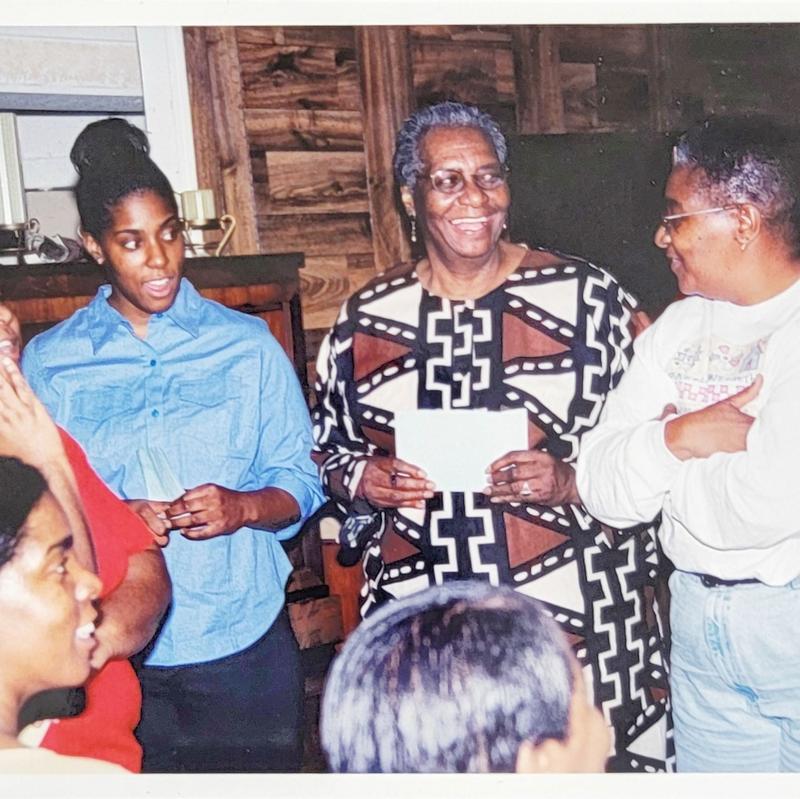
Alison Stewart: We all have that recipe that are part of the family lore, your grandma, your grandpa passed down how to make the good biscuits or how to get to that secret pot roast. In parts of the country, especially those that were passed down orally, it happened especially in the South. Part cookbook, part memoir, a brand new book tells the stories of a Southern family from North Carolina and the lessons from its late matriarch, Mildred Edna Cotton Council, affectionately known as Mama Dip. It's titled Southern Roots: Recipes and Stories from Mama Dip's Daughter.
From the perspective of Mildred's youngest daughter, Anita Spring Council, we learn her granddad, who provided meals for protesters when MLK Jr. visited, the story of Bill's Bar-B-Que, her family restaurant established in '57, and eventually Mama Dip's legacy. There are also plenty of recipes, everything from grits casserole with shrimp gravy, stewed corn, tangy potato salad, country fried cabbage, and chicken croquettes. If you have Southern grandparents, this one is for you. Southern Roots: Recipes and Stories from Mama Dip's Kitchen is out now. Anita Spring Council, welcome to All Of It.
Anita Spring Council: Well, thank you so much. I'm happy to be here.
Alison Stewart: Listeners, what's your favorite Southern meal? What makes it special to you? Is it a family rec recipe, a holiday staple, or something you've tied to a specific place or memory? Or maybe you have a question about techniques to recreate a home dish. Our number is 212-433-9692, 212-433-WNYC. I want to ask you a question. May I call you Spring?
Anita Spring Council: Yes.
Alison Stewart: Thank you. Tell me something that everyone knew about Mama Dip when she was alive. Something they would say about her.
Anita Spring Council: They would say that she was a very kind and loving person and that she was an excellent cook and a community person. She was one who helped those in need. People just loved her. They loved Mama Dip.
Alison Stewart: UNC Chapel Hill professor emeritus Marcie Cohen Ferris said that, "The women in your family are admired for their culinary genius, but also for their deep commitment to community service, education, and social justice." How did these parents instill these values in you and your siblings?
Anita Spring Council: When we were growing up, we grew in a community that had poor people and had the middle class, and there was always someone there out to help. My mom would take us along with her when she went to visit people and take them food that they had less than we had. As a child, seeing that and seeing the condition people living in, and my mom was going helping them, it was a great thing to do. We love that experience with her. That carries over to other parts of the community. When we would have the customer coming to the restaurant, they just didn't come to eat. They came to experience Mama Dip's and the love and care we gave to the food and to the community.
What she did do is she helped the people a lot of time. Other people would not take the time to-- For instance, she was on a prison board in Orange County, and she decided to let some of the inmates be on the work release program there. That was one way she gave to the community.
Another way she did was people who was drug addicted and halfway houses, they need a second chance. She would bring them in to work at a restaurant. We were all a part of that in that sense of how Mama gave back to community.
Alison Stewart: In the book, you go into detail about your family history, and you reference your grandfather Bill, who you described as a hard-working community leader. What's a story you heard about your grandfather growing up that has stuck with you throughout your life, or maybe inspired you?
Anita Spring Council: Well, he was a hard-working man. He opened a restaurant up when the year I was born. When Martin Luther King came to Chapel in the 1960s to do a speech and he actually fed the protesters, he provided the food for that. Now, I wasn't old enough to participate, but my sisters and my cousins talked about it a lot, and they was very happy to be a part of that.
He worked and created the restaurant not necessarily to drive fancy cars or to build fancy houses. He did it for the community and made sure people had jobs. We were children, we actually had jobs there too. Our first was making chicken boxes for the restaurant. That was a really great thing to do. We used that money to go swimming, buy candy. He knew that, having eight children in one household, my parents didn't always have a nickel to give out. He created that job for us.
Alison Stewart: Did you like the job?
Anita Spring Council: I loved it. The coins went with him. We would be in the back room making boxes, and we just play the game out of who can make the box the fastest. It was really fun.
Alison Stewart: Who was the fastest?
Anita Spring Council: My sister, Bunn. She was always fast at everything she did.
Alison Stewart: Mama Dip's Kitchen was one of Chapel Hill, North Carolina's most beloved restaurants. A new collection of recipes, family stories, and personal vignettes about coming of age as a black girl in the Jim Crow South from Mama Dip's daughter, Anita Spring Council. She's here with us now to discuss. Listeners, we want to hear from you. Do you have a favorite Southern meal? What makes it special to you? Is it a family recipe or something tied to a specific place or a memory?
Our number is 212-433-9692, 212-433-WNYC. I want to talk about these two restaurants that your parents started. Bill's Bar-B-Que. Was that your dad, or your grandpa?
Anita Spring Council: It was my grandfather. [crosstalk]--
Alison Stewart: Your grandfather. Bill's Bar-B-Que. How did it start?
Anita Spring Council: He actually worked in a lumber yard for many years, and he saved enough money to build a little small fast-catcher restaurant. It was mostly takeout, and my mother was his menu developer. Straight then he had other people to come in to work at the restaurant. He operated that up until 1968 when he retired. My parents started a food truck. My dad did start a food truck in 1968 and saved enough money to reopen Bill's Bar-B-Que. That's how that started.
Alison Stewart: Then we have Mama Dip's Kitchen on the other side. Tell us how we get started that.
Anita Spring Council: Yes. Mama decided to leave the Bill's Bar-B-Que restaurant. She was walking down the street one day, and Mr. Tate George, he was a business property owner and he asked her to take over a failing restaurant. She did. She went in, and she got it cleaned up and reopened. She had help from the Omega Psi Phi Fraternity came in, which my brother was going online at the time, and he helped with that as well.
Alison Stewart: Oh, that helped a lot when he was online.
Anita Spring Council: Yes.
Alison Stewart: Your mom owns a restaurant. [laughter] Let's talk about some recipes in the book, sweet potato cornbread. What does sweet potato add to this recipe that you won't get from regular cornbread?
Anita Spring Council: It's going to add that sweetness and that nice caramel flavor of the sweet potatoes, nice earthly flavor to it. Sweet potato has really been in our community a lot. It was something that was always on the stovetop for a snack, and it played a lot of history in what we cooked.
Alison Stewart: You need a cup of sweet potatoes. Do you roast them? Do you boil them? What do you do with them?
Anita Spring Council: I like to bake my sweet potatoes. Get that extra caramel flavor and then just mash them up. Not too mushy, but a chunks left and then fold them into the sweet cornbread after it's made up.
Alison Stewart: In addition to the sweet potatoes, there's also cinnamon nut bag and grated orange zest, which is what my sister puts in her sweet potato pie, by the way. What does the orange zest do to the biscuits?
Anita Spring Council: You give it a nice, [unintelligible 00:09:34] flavor, and I just want to add more layers of flavor to that cornbread. I said a little orange zest would give it a nice kick and nice orangey, zesty taste to it.
Alison Stewart: You also have braised collard greens in here. A lot of African American families have their own recipes for collard greens. What's the Council spin on collard greens?
Anita Spring Council: Well, my mother always used salt pork for collard greens. She would cook the collards first, and then she would pour off the excess liquid pork liquor, and then she would fry the fat back on the side and add that to the collard greens. With me, I did a little different take on that. You can have like a vegetarian at your table or vegan at your table. I put just olive oil sauteed with the green peppers and onions, and then put it back into the pot and braised it without the meat or the fat.
Alison Stewart: You also have turnip greens in here as well. What's the difference in terms of their flavor profile as compared to collard greens?
Anita Spring Council: I think in the sense of the turnip greens, they have more bite to them than the collard greens. Collard greens more of like a thicker green. The flavors, turnip greens is a little lighter flavor than collards. When my mom used to cook those and season those, she would actually put the fat in the collard greens and just boil them off at the same time.
Alison Stewart: Some people make their greens with smoked pork or sometimes with turkey. How much protein do you use, you said, and how much of it do you use?
Anita Spring Council: For the protein for the pork, I like to use about three or four pieces of salt pork and fry that off, and not too much. Because you don't want to get it greasy.
Alison Stewart: Definitely don't. Let's talk about apple coleslaw. You use Granny Smith apples. Why do you use Granny Smiths?
Anita Spring Council: They're a nice apple for eating raw. Nice tart apple. I like that. It plays well with the sweetness of the coleslaw. Put a little sugar in there. That goes well with that fresh dill. Then, when you make that recipe, make sure you use a fresh dill, not the dried stuff, because you really miss on a great flavor.
Alison Stewart: My guest is Anita Spring Council. We're talking about her book Southern Roots: Recipes and Stories from Mama Dip’s Diner. We're talking about mains in the book. What is something a main dish has to have in Southern cooking?
Anita Spring Council: The main dish has to have love and the best ingredients. My mom always taught me to use the best ingredients. That's what really is going to create a delicious dish. Definitely farm to table.
Alison Stewart: We're going to talk about plum dumpling encounters. In the book, you state chicken and dumplings were a dish that was occasionally served for Sunday meals and annual church homecoming dinners. Why was it served at homecoming dinners?
Anita Spring Council: Well, it was something you can make a lot at one time. Chicken dumpling is like a big pot dish, and you can feed a lot of people with that. It's one of the reasons we would take it there. Of course, it was a very popular dish. It still is a popular dish in the South. You feed a crowd.
Alison Stewart: How do you make dumplings? I make good dumplings, I will say, but how do you make good dumplings?
Anita Spring Council: Well, if you're making the roll dumpling, you have to make sure that you roll them thin enough so they're going to get done. Then making sure that you don't overcook the drop dumplings. Then just use your broth that you're cooking the chicken out. You cook your chicken in the broth first, and that help brings out the flavor.
Alison Stewart: How do you prepare your chicken?
Anita Spring Council: I boil the chicken. Boil the chicken and just take off all the skin and debone it, and then just chop the chicken up and put it in there and making sure that you don't chop it too fine, because if you chop it too much, the chicken will overcook, and you just have little pieces in your dumpling. Make sure you keep it good size.
Alison Stewart: We got a text here that says, "I've always loved Southern Creole, but unfortunately, living here on Long Island, it's really hard to find good, traditional gumbo." Do you have any recommendations in your book for someone who wants that kind of food?
Anita Spring Council: Well, I don't have gumbo in my book, but I love gumbo. What I like to do sometimes is take a roasted chicken, make it quick, and I start from that point, and then add my doing sausages, and use it that way with rice.
Alison Stewart: Working at Mama Dip's kitchen, you got to know the customers. Sometimes your experiences getting to know customers led to recipes like shrimp croquettes. Tell us what the backstory is here.
Anita Spring Council: Backstory of the shrimp croquettes?
Alison Stewart: Yes.
Anita Spring Council: Yes. What I did, I was challenged to go on a bike trip of the Outer Banks with a friend of mine who owned the bike store in Carrboro. I went on that trip, and one of the places we went to was a place that served shrimp burgers. The shrimp burgers was just on a steamed bun with some tartar sauce and the shrimp in there. I said, "Let me try creating that in a different way." That's why I came up with the shrimp croquettes to remind me of that dish I had at the Outer Banks.
Alison Stewart: I wanted to ask you about some-- They were listed as breakfasts, but I think they could be anytime, to be honest. You mentioned a plum nectarine yogurt bowl, which is a really interesting combination. What is it about the plum and the nectarine that go together?
Anita Spring Council: Well, the plum is sweet. I love plums. The plum is sweet, and then the nectar is sweet, but still have a little a sourness to it. It gives you some different layers of flavors in that, and it's going to cut through the sweetness of the granola, so you don't have too sweet of a dish for that. Then, of course, they're coming out pretty much at the same season, so you get them really good and fresh.
Alison Stewart: I wanted to ask you about setting your table. What lessons did you learn from your mother about setting the table?
Anita Spring Council: Well, Mom always say, "Use your best and stuff, and don't just put it in the cabinet. Just leave it there to make sure that you use it all the time." For my paternal grandmother, she used to have parties for the Women's Missionary Society, and they would get together to plan out what they was going to do for the community. I was always go to my grandmother's house and look at her table setting. I was just at awe at the beautiful, the china, the crystal, and the silver on the table. Not only that, I knew when those women gathered together, they came together to help the folks in the community. [crosstalk]--
Alison Stewart: This message says, "Hi, Spring. I'm so happy to hear you on the radio. Now that we're here in New York, we miss Mama Dips and you too badly. We cannot get anything like dipped sprinkled beets, fried chicken, greens, fried okra, and your wonderful zucchini casserole. If you haven't had New Year's Day dinner, you haven't lived." What's your favorite recipe in the book?
Anita Spring Council: My favorite recipe that really, actually brings back memories is the sweet potato pecan pie. I say that is because go back to my grandmother's baked sweet potatoes and my mother's. Then, if I really want to get something that brings back that comfort food my mom wanted to cook for me, it would be the braised beef short ribs. I remember the first time I ate that dish, it was just absolutely delicious, and it just stuck to my memory. I would say those braised beef short ribs. I cook that too when I want to just have that comfort food and think about Mama, I make that.
Alison Stewart: The name of the book is Southern Roots: Recipes and Stories from Mama Dip’s Daughter. It is by Spring Council. Spring, thank you for being with us.
Anita Spring Council: Sure. Thank you for having me.
Copyright © 2026 New York Public Radio. All rights reserved. Visit our website terms of use at www.wnyc.org for further information.
New York Public Radio transcripts are created on a rush deadline, often by contractors. This text may not be in its final form and may be updated or revised in the future. Accuracy and availability may vary. The authoritative record of programming is the audio record.