
Recapping Yesterday's Local Elections
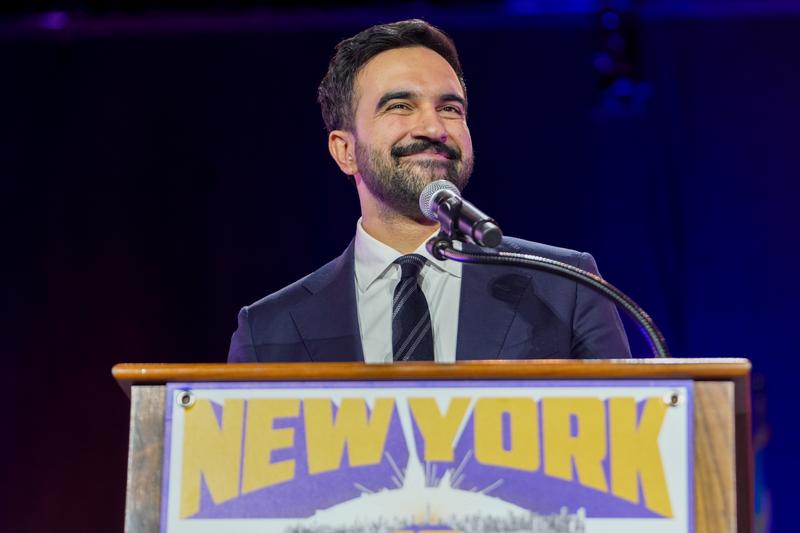
( Stephani Spindel/VIEWpress / Getty Images )
Alison Stewart: This is All Of It. I'm Alison Stewart, live from the WNYC studios in Soho. Thank you for spending part of your day with us. I'm really grateful that you're here. On today's show we'll mark National Adoption Month with a conversation with sociologist Gretchen Sisson. The cast of the musical The Seat of Our Pants is here and will perform live in Studio 5. We'll hear from Sterlin Harjo, the creator of the new show The Lowdown. That's the plan, so let's get this started with a little politics postmortem.
[MUSIC]
New York City has elected its next mayor, and New Jersey has elected its next governor. Mayoral and governor races affect us all. We wanted to give you the opportunity now to voice your opinion and your hopes for the mayor-elect and the governor-elect and to hear more about how you decided to cast your vote. Liz Kim is WNYC and Gothamist reporter covering City Hall, who has been all over the place and all over this race. She has been generous enough to give us her time this afternoon. Hi, Liz.
Liz Kim: Hi, how are you?
Alison Stewart: I'm good. How much coffee have you had?
Liz Kim: I've had a lot of coffee. I'm on three hours of sleep, so forgive me if I'm not 100% cogent, but I'm also running on adrenaline.
Alison Stewart: All right, we like to hear that. We also have WMYC reporter Karen Yi, who has been covering the governor's race. Hi, Karen.
Karen Yi: Hey, Allison.
Alison Stewart: Listeners, we want to know what are your hopes for Mayor Elect Mamdani? What is the issue or problem facing the city you hope he solves? If you are a first time voter, what brought you to the polls? Call or text us now. 212-433-WNYC, 212433 9692. Now, if you're listening from New Jersey, what do you want Mikie Sherrill to tackle right away? What do you think she should prioritize? Our number is 212433-WNYC, 212-433-9692. While we wait for the phone lines to light up, Liz, every headline this morning said Zohran Mamdani won decisively. Now comes the hard part, governing. What are his next steps?
Liz Kim: In his speech, and also in the closing days of the race, he was really stressing the three principles of his campaign that really galvanized and energized a lot of supporters: Fast and free buses, freezing the rent on rent, stabilized apartments, and universal childcare. Now, of those three items, the biggest ticket one is universal childcare. The next steps is he has to figure out a way to pay for these policies. Something like fast and free buses.
That's something that's in roughly the hundreds of million of dollars, but he still has to find a way in the budget to come up with that money annually. He has to negotiate with the MTA, which has expressed some skepticism over how to implement something like that. There's that. Rent stabilized-- Freezing the rent is probably the easiest because he appoints a board. It's that, that basically makes these decisions every year.
He can basically appoint members who are favorable to having that kind of policy. The toughest one is the universal childcare. That has been estimated as costing between $5 billion to $8 billion a year. That he will certainly need money from Albany, meaning he needs the governor's buy-in. That is the work that he face. These are the promises that helped really help get him elected.
Alison Stewart: Karen, in New Jersey, Democrat Mikie Sherrill didn't just beat Republican challenger Jack Citarelli; she beat him by 13 points, I believe. This release was predicted to be a lot closer. Why do you think she won so big?
Karen Yi: Absolutely. I was at Jack Ciattarelli's election night party, and it was very anticlimactic. The lights didn't even go off. The party almost felt like it never really got started before the race was called, like just an hour and a half after polls closed. I think Trump really loomed large in this election. Mikie Sherrill really played into the Trump card. She sort of positioned herself as the person who could fight Trump.
Ciattarelli, meanwhile, took the opposite stance. He really leaned into Trump; he really leaned into MAGA. I think, given where we are, this was a repudiation by the state against Trump. People were saying, "We do not want Trump, we do not want Trump in the state. We do not agree with his policies." I think that's why she just coasted slavery, such a decisive victory.
Alison Stewart: Where did Trump play into this election in New York?
Liz Kim: One of the things that distinguished Mamdani, I think, was his willingness to go toe to toe with Trump in a very confrontational way. There was that video during the primary race of him confronting Trump's immigration czar, Tom Homan, in Albany, that went viral. He really leaned into that in the general election. That has been a criticism of Democrats that they have been a little bit, like one person said to me, afraid of their own shadow. Mamdani is certainly not that. You can't say it enough because now that he is the mayor-elect, he does have to negotiate with Donald Trump. You can really say that it was a bit of a risk for him to go so hard at Trump in his speech. I don't know if we have that clip.
Alison Stewart: Do you have that by any chance?
Liz Kim: It's the one where he says, "If you're listening, Donald Trump--"
Alison Stewart: Two seconds, two seconds. We're going to hear that Juliana is going to pull that up for us. She's looking and she's looking and she's looking and she's looking. You know what? Let's take a call. Let's go to Terry in Union, New Jersey. Hi, Terry, thanks for calling All Of It.
Karen Yi: You're on the air.
Terry: Hi there. I am a cold, so I'm sorry, I'm a little froggy. Thank you for taking my call.
Alison Stewart: You're on the air. Go for it.
Terry: Yes. Congratulations to Mikie Sherrill. I'm delighted that she won. As I said to the screener, I said it's the first night I got a good night's sleep in about 10 months, so thank you for that. One of my main concerns is that we have a massive ICE detention center right in our backyard that is causing huge misery among our migrant neighbors.
I'm hoping that Mikie Sherrill can involve people across the state and actually get that facility closed and actually stop the ICE madness that is wreaking so much havoc. Also, just come around and involve people to say no to this because, actually, the election showed that we are a state of doers and people who love their neighbors and are not haters. I look to her for this tapestry and to bring this tapestry together and close Delaney Hall.
Alison Stewart: Thank you so much, Terry. Let's go to Rob in Brooklyn. Hi, Rob. Thanks for calling All Of It. You're on the air.
Rob: Hey, how are you doing today?
Alison Stewart: Doing all right. How about you?
Rob: Not bad. Yes, I'm just calling to say that really what we need to do next, people statewide who supports Zohran or support any of his policies, we really need to put pressure on the state legislator and the governor, really, to raise some revenue via 2% on the top tax bracket and raising our corporate tax to match New Jersey to be able to fund these policies that Zohran has run on and that he has overwhelmingly, I wouldn't want to say won a mandate on. Yes, I just want to encourage listeners to look forward to reaching out to the governor and the state legislature to actually raise revenue. We've seen time and time again that once that has been done, there has not been an exodus of millionaires out of the state. The reverse is true.
Alison Stewart: We heard that. Yes. Rob, thanks so much for calling in. We do have your clip that you wanted, Liz Kim. You want to set it up again?
Liz Kim: Sure. This was a portion of Zohran Mamdani speech last night, where he speaks directly to Donald Trump and has a message for him.
Zohran Mamdani: Together, we will usher in a generation of change. If we embrace this brave new course rather than fleeing from it, we can respond to oligarchy and authoritarianism with the strength it fears, not the appeasement it craves.
[cheers]
After all, if anyone can show a nation betrayed by Donald Trump how to defeat him, it is the city that gave rise to him.
[cheers]
If there is any way to terrify a despot, it is by dismantling the very conditions that allowed him to accumulate power.
[cheers]
This is not only how we stop, Trump, it's how we stop the next one. Donald Trump, since I know you're watching, I have four words for you: Turn the volume up.
[cheers]
Alison Stewart: He has so much momentum among first time voters, younger voters. How does he keep that going?
Liz Kim: That's a great question, Alison. at this point, what's so interesting about him is that he has really transcended politics in a way to becoming a cultural figure. We saw that in the primary, but it was really encapsulated at his election night party because this is unlike any election night party that we have seen in recent time, with the exception being Obama. For a politician, it was packed to the gills coming out at 1:30.
There were still hundreds of supporters waiting outside. They couldn't even get in, but they're waiting outside just for the hopes of catching a glimpse of him. I think that that is really meaningful, and I think that-- It could go sour very, very quickly, because a lot of it is premised on this promise of making the city more affordable. That is no easy feat. The difficulty of this is these are very ambitious ideas.
Think of it also, that he still has to do the day-to-day job of being the mayor. He still has to make sure that the streets are clean, that when there's a snowstorm, that your snow gets shoveled. When there's a rainstorm, that people's basements aren't flooding. How does he deal with that? Then there's the Donald Trump factor. ICE crackdowns. What happens when we've already seen federal funding diminish? It's both handling the politics of that while trying to shepherd this very, very big, ambitious agenda. How does he do it all?
Alison Stewart: We got a text that says, "I want Sherrill to redistrict New Jersey. I wanted to ask about something that happened in New Jersey. The Department of Justice sent federal election monitors to Passaic County. What? Why?"
Karen Yi: This was a request by the state GOP to the Justice Department to do some monitoring. We had a reporter down there in Passaic County looking at the polling sites. It didn't seem like they were a large presence or really created much of a problem. I haven't heard any reporting or anything that that caused any issues so far.
Alison Stewart: Apparently, five other New Jersey counties flipped Democrat to Democratic. Is that true?
Karen Yi: Yes. This was part of her decisive victory. There were five counties that voted for Trump, flipped back for Sherrill. That's Gloucester County, Atlantic, Cumberland, Morris, and Passaic.
Alison Stewart: Let's talk to Karina in Berkeley Heights, New Jersey. Hi, Karina, thank you for making the time to call All Of It. You're on the air.
Karina: Hey, Alison, thank you so much. Big fan of your show. fantastic to hear the discussion this morning. Really wanted to get the reaction of your panel to a comment that I heard a commentator on TV just saying to the power of Mamdani's campaign that it really became a source of connection for Gen Zers. This is a generation that sometimes struggles making connection in real life. They have a very dominant digital life, but they came together, they volunteered, they met new friends, they made new connections. I thought that was a really interesting take on the campaign. Would love to hear the thoughts of the panel on that.
Liz Kim: No, absolutely. Something that Mamdani talked about in his speech is how do you take something abstract like politics and make it really touch people's lives,
Alison Stewart: Have meaning in their lives?
Liz Kim: Yes. That's sort of what happened in his campaign was suddenly he was able to mobilize people around this singular idea about we need to make this city more affordable, and he was really relentless in that approach. Then he activated people through different platforms, like social media. I would say that even more than the platform, I think a lot has been made about him being this sort of TikTok politician.
It really starts with what is the animating idea and him as a messenger, and how is he able to communicate that? You heard in his speech where he's giving hat tips to the aunties, to the bodega owners, to the taxi drivers. It made me really think, especially when he drove drops little bits of Arabic, Spanish Hindi. He's speaking the language of New York City. Again, it's a language of diversity. It's a language of immigration. That, too, I think, really was able to tap into the young people who live in New York now.
Alison Stewart: Dylan's got an interesting question. Karen, I want you to listen in on this one. Hey, Dylan, thank you so much for calling All Of It. You're on the air.
Dylan: Hi. Thank you so much for taking my call.
Alison Stewart: Your question is?
Dylan: Less a question, or I guess maybe the reaction from your panel. In hindsight, given how close everyone thought the Mikie Sherrill, Ciattarelli race was going to be, I was curious about your thoughts on when Mamdani in kind of pseudo endorsed Mikie Sherrill, and then when Sheryl was given the same opportunity to reciprocate that support and didn't, given that at that time, it was projected to be a much closer race, and we keep having these conversations about all this energy behind Mamdani, what does that mean as far as the lessons Democrats are taking from this race nationally?
Karen Yi: Hey, Dylan. Yes, I think in many ways, just hearing Liz talk about her assessment, Mikie was not-- a lot of her criticisms was that she was sort of a milquetoast candidate. She didn't really have a bullet point or a plan, a specific plan to address the affordability crisis. She kind of spoke more in generalities. Really, she really leaned into Trump hard. I think part of that was she was trying to appeal not just to the urban vote, but really appeal to moderate voters. She really captivated the independents here.
She won independents, and that's really who tend to determine these elections in New Jersey. I think she was sort of playing it safe in that way. I think in many ways, maybe she was the perfect candidate for this moment, for this moment where people in the state maybe they didn't love her as a candidate or she wasn't inspiring as a candidate, but they just aren't agreeing with what Trump is doing. I think maybe in any other year, you had a Republican candidate in Jack Ciattarelli who was energizing voters, who was able to unify both establishment Republicans and MAGA Republicans, who was very charming, who felt very much New Jersey.
Here's a guy who visited every single of the 600-plus diners in New Jersey. In his speech, in his concession speech last night, he said, "I've had more BLTs and onion soups than anyone else." People in the audience were screaming back their favorite diner food. He was a very New Jersey regular guy, and that's what I kept hearing from his supporters. It's the first thing they said. They didn't talk about his policies.
They said, "Jack is a regular guy. He's just like us." It's someone you find in the diner. I think in any other race where Trump was not such a huge factor, he probably would have won. I think here Mikie was making a very smart, in hindsight, calculation that paid off for her to play it down the middle, to be the centrist Democrat that could get not just the progressives and the Democrats and the urban vote, but also the suburban vote and moderate centrist Democrats.
Alison Stewart: She's also the second female governor of New Jersey. The first Democratic female governor in New Jersey.
Karen Yi: Yes, that's correct. Her lieutenant governor is the first male lieutenant governor in the history of the state.
Alison Stewart: I'm speaking with WNYC Gothamist reporters Liz Kim and Karen Yi were reacting to the election in our area last night. What are your hopes for Mayor Elect Mandani and what issues do you think, you think that are facing the city that you hope he solves the most? If you're in Jersey, what are the first things you want Mikie Sherrill to do? Call us or text us at 212-433-WNYC, 212-433-9692. I want to talk to Daniel because Daniel's guy is not really in the conversation right now. Hi, Daniel.
Daniel: Hey, how are you? I'm here. All right. I just wanted to speak on Mamdani and how it's like a big misconception. This Guy speaks about free transportation and extreme rent stabilization as if the city is ran on just inspirational quotes and make believe.
Alison Stewart: Yes, but you're a Sliwa reporter. You were a Sliwa supporter, is that correct?
Daniel: Yes, absolutely.
Alison Stewart: How are you feeling this morning?
Daniel: It's terrible. Curtis Sliwa was the only candidate that you could honestly say truly cared about New York City more than being a politician. He was fighting off people with his bare hands. How could you not put someone like that in office? You'll never find somebody who cares about the city more than Curtis Sliwa. It's insane. Then you have Mamdani talking about free transportation.
Alison Stewart: Yes. We know you're a Curtis Sliwa supporter. We really feel your pain this morning. You sound like it matters to you, and that's important that the elections do matter to people. They're really invested. You heard Daniel. He's like really hurt that Curtis Sliwa didn't get represented.
Liz Kim: The turnout was historic for this race.
Alison Stewart: It was wild.
Liz Kim: Over two million voters, the most since 1969. That shows you how energized people were to show up at the polls for various reasons, whether they were Mamdani supporters, Cuomo supporters, or Sliwa supporters. That energy, I think it's going to continue for the coming months as we see how Mamdani puts together his administration and the early days of his governing.
Alison Stewart: He's got to put together his transition team. He's got to figure out his budget. Does he get any of that information before January 1st?
Liz Kim: He has advisors who have done this before, and that was something that he emphasized during the general because one of the criticisms of Mamdani is that he's 34 years old, he's never run city government before, and he really, during the general, tried to counter that. How did he counter that? He really went out of his way to have meetings with people who did run government, people who worked for former mayors like Bill de Blasio, like Mike Bloomberg.
By surrounding himself with those people, he's trying to give New Yorkers a sense of confidence that, "I'm leaning on people who have done this before." You do get a little bit of a pass when you're the first time mayor in terms of the preliminary budget. It's usually due in January, but I looked back on my reporting, and I saw that when Eric Adams took office, he released his preliminary in February. It's not like you get dinged or anything like that. I think that's fine.
Alison Stewart: Do we know what Andrew Cuomo is going to do next?
Liz Kim: We do not. I think that that will be an interesting question is what's his next chapter? Does he just leave politics altogether or does he try to mount a run for governor, which everybody has always said that really is the job that he has always wanted.
Alison Stewart: Karen, is there anything that we've missed about the New Jersey races that you haven't heard, talked about on the news? People have been talking about it nonstop. Is there anything that you think is important to think about as we go forward?
Karen Yi: Similarly to New York City, I think affordability played a huge part in this race as well. I think supporters on both sides, even last night when I was at Chiarelli's party, everyone was talking about their taxes and their utility bills. What we can expect, I think, from Mikie Sherrill in her first days is she's said that she's going to declare a state of emergency to drive down utility bills. That is she's tackling affordability sort of day one. The other big thing is unterminating Gateway and how she plans to do that.
I think we'll similarly see how she plans to deliver on these big promises that are affecting New Jerseyans in terms of housing and affordability. A lot of young people are concerned about their future in this state, and being able to afford property, being able to afford childcare, being able to find employment that can maybe pay if they have student loans. I think regionally, these are issues that everyone is feeling, and that really drove people to the polls.
At the same time, you also have this ongoing issue with the shutdown and the long term implications from that. We still have people on SNAP benefits that have not gotten their benefits this month. Who knows how long that will take? Who knows how long they'll have to go hungry and the state having to step up to fill those gaps increasingly as the federal government recedes. I think that's going to be a big issue for her once she comes into office as well.
Alison Stewart: Let's try to get one more call in here. Let's talk to Rachel in Nyack. Hey, Rachel, thanks for calling All Of It. What are you thinking this morning?
Rachel: Thank you for taking my call. I am just calling to express the joy that I feel, particularly as a mother of three girls ages 26 to 32, who have been feeling so discouraged in the last number of years, discouraged with Joe Biden, terribly discouraged with Donald Trump, obviously, not feeling like any of them are looking out for their interests as women, and many other concerns what's going on in Gaza and all of that. This hope that they feel with this man who seems to be looking out for everybody and just the joy that they have, some hope is so wonderful for me to feel that joy for them.
I have an eldest daughter who just got engaged to be married, and she and her husband would love to have children, but they have come to terms that here's a very good probability they won't because they live in New York City and they can't afford it. They're young. One's an actor who doesn't make much money, and the other's a New York City high school teacher. They now think, "If we really could pull together free child care, it could be a reality." That's just so joyful.
Alison Stewart: Rachel, thank you. Thank you. I'm going to dive in real here. Thank you so much for your call. This text says, "I'm a lefty, but New York City runs on corruption, real estate, for example. I fear Mamdani will have an uphill battle to get things done. What are you going to be looking at once you get rest?
Liz Kim: I'm going to be looking at how the traditional forces of New York City politics, much the person who texted real estate, for example, how that shapes Mamdani as he really takes office, because a lot of it is it's almost like a gravitational pull. What are the kinds of compromises he makes, for example? Because it's quite a different thing to campaign and then be forced to govern and then to make uncomfortable deals that perhaps portions of your base don't like. Then how how do you respond to their demands? It's going to be really tricky. He's young, too. He will be the youngest New York City mayor in over a century. How does he handle it?
Alison Stewart: I'll have to go on Brian Lehrer. He promised.
Liz Kim: Exactly. That is exactly like a classic promise. He made that promise during the campaign. I did hear him reiterate on Hell Gate that he had made that promise. Fingers crossed, he does follow through. Exactly, that is not an easy thing to do to submit to weekly questions, not just by Brian, but by our callers. Will he do it?
Alison Stewart: Yes, he'll do it. We'll make sure he does it.
Liz Kim: Okay. [laughter]
Alison Stewart: Liz Kim and Karen Yi, thank you so much for being with us.
Liz Kim: Thank you. Thanks, Alison.
[MUSIC]
Alison Stewart: This is All Of It on WNYC. I'm Alison Stewart. November is National Adoption Month. A lot has changed since Daddy Warbucks adopted Little Orphan Annie in the comics. You have private adoptions, transracial adoptions, open adoptions, and politics has taken a front seat. Remember when Justice Amy Coney Barrett asked why abortion was even necessary if adoption was an option? That happened during the oral arguments in Dobbs vs Jackson Women's Health Organization, the case that overturned Roe v. Wade. Adoption changes lives, and we wanted to talk more about it with a researcher who spoke to more than 100 women who have given up their children for adoption.
Gretchen Sisson wrote Relinquished: The Politics of Adoption and the Privilege of American Motherhood. She got her PhD from Boston College and is a research sociologist at the University of California, San Francisco. She focuses on the social constructions of parenthoods. To keep things honest, her work was cited in the dissent to Dobbs, her point being that adoption is not the right answer for everyone. It's an important and complex decision-making process involved for all. Gretchen, welcome to All Of It.
Gretchen Sisson: Thanks for having me. Allison.
Alison Stewart: Listeners, are you adopted? What has the experience been like for you and your family? 212-433-9692, 212-433-WNYC. Are the a parent of the adoptee? Do you wish that someone had told you good or not-so-good, or if you opted for adoption yourself, what led to your decision? Our number is 212-433-9692. I wanted to say that in your book, you talk about the language of adoption in the back, and we don't want to offend anyone, but there are very terms that are used. What language did you decide was best to use when writing your book?
Gretchen Sisson: Oh, this is a really tricky question. I'll say as a writer, I have to make a choice about what words to use just to get the job done. I think that the words I chose were not necessarily the words that every adopted person or every parent involved in adoption would choose to use. There has been a lot of work from agencies and from people who promote adoption to adopt a specific lens, not using the term adoptive parents, rather just using parent, using birth parents instead of natural parent, first parent. There's a lot of different language floating around there, and a lot of it carries its own political charge.
I use relinquishing parents, usually in my language, to describe the families of origin for adopted people. That is a fraught term. A lot of the mothers that I interviewed prefer birth parent, first parent, but it really runs the gamut. I use the term adopted people as much as possible, rather than just adoptee to focus on the fact that these are not just adopted children. They grow up. This is something that adoptive people live with throughout the entire course of their lives. Then I do use adoptive parent to describe the people who come to parenthood through adoption, largely to qualify that their relationship with their children was formed that way, rather than through other processes.
Alison Stewart: Why do you think the language is a fraught subject?
Gretchen Sisson: I think that the challenge of language really reflects so much of the power dynamics in adoption. Who holds the power and who gets to choose what words we are using? For a very long time, the language that we are using has really centered the primacy of the adoptive family. It has rendered the adoptive parent just the parent in a way that linguistically can erase the family of origin from their role in the adopted person's life. I think a lot of the adopted people who--
I'll be clear, a lot of adopted people are fine with the term adoptee, but some of those that I interviewed for the book were uncomfortable with it. They felt that it made them kind of like the product or the person who was transferred, and reflected the underlying market of adoption more than they wanted to understand their own identity. They preferred something that as adopted people included people, included their personhood and their full identity, and the complexity there.
I think there is really no consistent way that really anybody involved in this wants to-- There's no agreement on the words that they are using. I do think that the reason why it's fraught is because one side of the equation, specifically the adoptive families, specifically the agencies, have really promoted a specific, correct way of talking about adoption that doesn't recognize those power dynamics and that nuance.
Alison Stewart: I wanted to ask you a little bit about the history of adoption. You write that until the 20th century that the adoption of infants became prominent. When and why did legal adoption start?
Gretchen Sisson: There have always been infants and other children who have been in need of care outside of the families that have given birth to them. That has always happened, that we have found routes to external care. The formal, legalized process of adoption as we practice it today is a relatively recent invention. If you look back at the history of family separation, and I talk in the book, looking at the broader context of family separation, from American enslavement to the separation of native children through boarding schools, to the orphan trains which shipped children from east coast cities towards the Midwest, I think that you can see these patterns in why children are separated from families.
There are a lot of different historical reasons rooted in control, extraction of social obedience, genocide, assimilation, and poverty that have led to these family separations. If you were a poor woman who had more children than you had capacity to care for in, say, the 1800s, you might send your child to what was called a baby farm, where you would actually pay someone to care for your baby. There was not a market demand for that baby in a specific way. This would be just a way of providing this very untenable level of care if you were not in a financial situation to raise another child.
It wasn't until the early 20th century that a real market demand for children developed that shaped the way we practice adoption today. Right now, we have far, far more families who want to adopt infants than we have infants available. That has been true since after World War II, probably a little bit before as well. Certainly, the peak was from the end of World War II until the '70s with the Baby Scoop Era. That was a time where abortion was broadly illegal in the United States.
Single parenthood, particularly for unmarried women, white women and girls, especially, was very stigmatized and shamed. You saw a tremendous market value for their children. That really drove this coercive, secretive system that we saw that really changed dramatically in the '70s and '80s with increased accessibility of contraception, legal abortion, as well as changing norms around single parenthood and the growing acceptability of that. The domestic adoption market really plummeted after that.
Alison Stewart: Yes, let's take a call. This is Victoria, who's calling us from Montclair, New Jersey. Victoria, thank you for taking the time to call all of us. Tell us your story.
Victoria: Hi. Thank you for having me on the show. My story is that I got pregnant at 16, and my family decided that I could not keep and raise my child myself. I was forced to give her up for adoption. It was a private adoption. I met her many years later. We had a reunion, and I'm really happy that this being my daughter is on the planet because she's a lovely person. The fallout for me emotionally from having a child that young and having to give it away is something I'm still dealing with. I'm in my 60s now.
Alison Stewart: Thank you so much for calling in. In your research, Gretchen, did you encounter people like Victoria?
Gretchen Sisson: So many people like Victoria. Victoria's story is very typical of adoptions from a certain era, where you would have these young women, girls who would become pregnant. They didn't have their family support. They didn't have a path that made parenting feel possible. In some instances, they were sent away to maternity homes that were often run by the church. They were given very little choice at all to raise their children. Many times, the children were taken away soon after birth.
Sometimes they weren't allowed to hold them. These adoptions were closed. They did not know who their child's parents would be, if they were healthy, if they were well. Most of those adoptions now are in reunion because, of course, the adopted people are now adults and have reached out, and with our ability to do commercial genetic testing, nothing is secret anymore. A lot of these families are in reunion and are able to contact one another.
I think what Victoria says that is most powerful is the idea that she didn't just walk away. Many of these women were told, "You are just going to give up this baby and move on with your life, and you can have another family under better circumstances, and you're not going to want this child. You're not going to want to contact this child." That is almost never true. All of the mothers that I spoke with, not all of them were in contact with their children, but all of the mothers that I spoke with wanted to have some knowledge of some relationship with their child. It was very traumatizing when that path to knowing their child wasn't supported in some way or allowed at all.
Alison Stewart: Our guest is Gretchen Sisson. She's a research sociologist from UC San Francisco. She wrote a book called Relinquished: The Politics of Adoption and the Privilege of American Motherhood. Listeners, are you adopted? What has the experience been like for you or your family? The number is 212-433-969-221-2433 WNYC. We'll take more of your calls, and we'll have more with Gretchen after a quick break.