
Plant-Based Protein Cooking From a Peleton Pro
Alison Stewart: This is All Of It. I'm Alison Stewart, live from the WNYC studios in Soho. Thank you for sharing part of your day with us. I'm really grateful that you're here. On today's show, Actor Riz Ahmed has a new series called Bait. He'll be here in studio to preview it. Amy Dubois Barnett joins us to talk about her debut novel, If I Ruled the World, and Brooklyn artist Leonardo Drew joins us to talk about his work at the two new shows in our area that are featuring it. That's the plan. Let's get this started with Eat to Hustle.
[music]
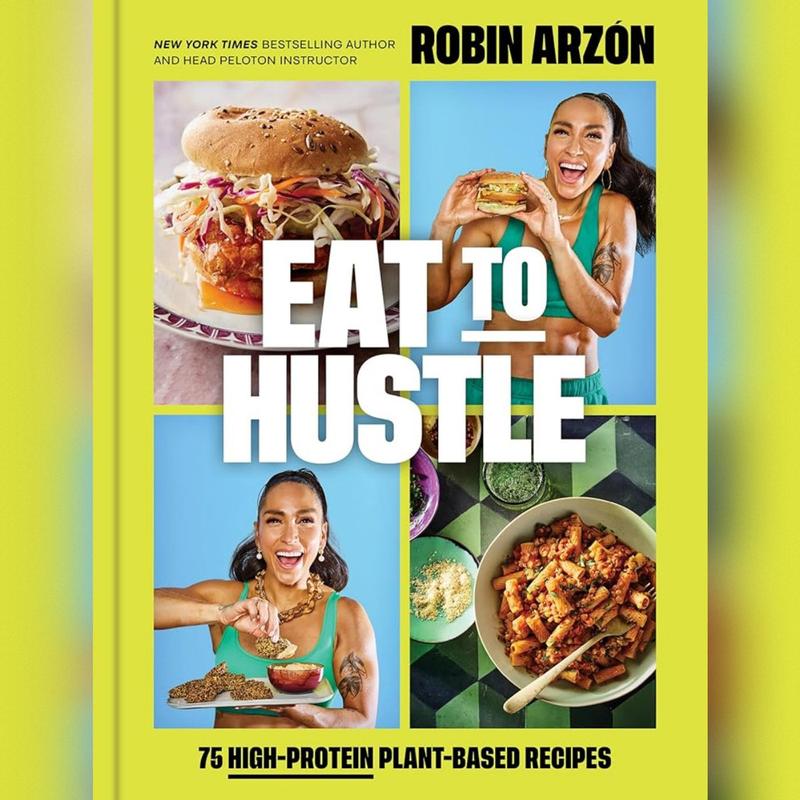
Our next guest, Robin Arzon, made a pretty dramatic career shift. She left her job as a corporate lawyer to pursue her passion. She's now the VP of Fitness for Peloton, an amazing instructor, an author, and a speaker, and now you can add a cookbook author, a vegan cookbook. Eat to Hustle is all about plant-based protein-rich recipes, the kind of food she relies on to fuel workouts, long days, and everything in between, including two children under six.
Arzon is a vegan. She also lives with type 1 diabetes. Through these recipes, she's trying to push back on the idea that you need meat to hit your protein goals or that eating plant-based meals means giving up flavors or foods you grew up with. You see, Robin has Puerto Rican and Cuban roots, and that influence shows up throughout the book. Robin Arzon is here with us now to talk about that shift from law to fitness and how being intentional about food became such a central part of her routine. Robin, welcome.
Robin Arzon: Thank you for having me. I'm so thrilled to be here.
Alison Stewart: Listeners, we'd like to hear from you. What are your favorite plant-based meals? Have you found good substitutes for dishes you love? Are you thinking about making the switch, and you have questions? Or maybe you're just a fan of Robin's. Our Phone number is 212-433-9692, 212-433-WNYC. Robin, what was that moment that you said, I've had enough with the law, and I would like to pursue something else?
Robin Arzon: I think that there were thousands of small moments.
Alison Stewart: Really?
Robin Arzon: I wouldn't say it was like jumping off a cliff. It was probably like tiny little inflection points, and I fell in love with movement and running. I remember sitting in my office, adjacent to Central Park. I could see a sliver of Central Park from my window. I was a junior associate, so no fancy office there, but I found that pull to count down the hours of my day until I could move my body. I thought, "Gosh, this is such an inverse relationship with how I should be leading my life." Then I just started to prioritize being able to pay my New York City rent with something that I felt in impassioned by, which was running and moving.
Alison Stewart: How did your diet change when you became a full-time fitness professional?
Robin Arzon: I was working really long hours at the law firm, and it was seamless web, as it was called at the time. Delivery service food was pretty much breakfast, lunch, and dinner. It was during that time, actually, that I started transitioning slowly again over a two-year period to a plant-based diet. It started with a lunchtime salad at the local bodega. One day, the chicken was undercooked, and I was like, "You know what, I'm going to make a swap tomorrow."
I swapped chicken for black beans. It started just with lunch, and then it migrated to my dinner time order. Okay, maybe I'll try Indian food or Thai food, or some foods that I think are going to give me energy but aren't going to be meat-based. It was exploration. It wasn't like I went home one day and I threw out everything in my kitchen and pantry. It really was iterative.
Alison Stewart: Did you notice that you felt differently?
Robin Arzon: I recovered from my workouts faster. I slept better. I had more energy. I didn't have that 4 PM energy slump. I realized that my digestion was improved. Again, this wasn't overnight, this was over a few months, but I did start to see those improvements after consistent plant-based eating after a few weeks.
Alison Stewart: Okay, so you decide to go in. You're going to go for it. What was the biggest learning curve in figuring out how to properly fuel your workouts?
Robin Arzon: It was more so trial and error. We all have our go-to meals, our go-to foods, or even nostalgic things that we just-- that's how things have always been done in this house. I had to think ahead for hungry Robin. [laughter] I'm always thinking ahead for hungry Robin. Now I can just speak to how I do things now. I normally do a semblance of meal preparation on a Sunday when I have a little bit more time, mainly preparing proteins like air-fried tofu, or I'll make my own seitan.
Again, a lot of these recipes are in Eat to Hustle, actually, all of them are, my cookbook. Then I will pair them with grains and with veggies at the time I'm going to eat them. I make protein bagels, and that helps me when I'm running around New York City like I am today. I throw a protein bagel in my bag, and I always have a smoothie every single morning. I usually drink half before my workout, half after. I'm usually doing multiple workouts a day with my work at Peloton. It's really bringing a number of small meals with me.
Alison Stewart: As you became vegan, how did it force you to become creative in the kitchen?
Robin Arzon: What I realized is that I could still maintain a lot of the flavors I was nostalgic for and even the textures that I was craving, but upgrade them or swap them with plant-based ingredients that had protein and fiber. I found that it aided my satiety, it aided my digestion. Thankfully, now we're having more of the protein and fiber conversation. When I started to transition, I felt like I was on an island alone.
Alison Stewart: Speaking Martian to people.
Robin Arzon: Yes, exactly. Especially as a high-performing athlete, I didn't just want to be sitting munching on a bag of spinach leaves. I needed something that sustained multiple hours of training a day. Thankfully, there are pioneers like Rich Roll and Scott Jurek, and people who have been really incredible endurance athletes for many, many years before I even embarked on that journey.
I would say the biggest thing for me was maintaining a minimum amount of protein for every single meal. That's really why I embarked on writing Eat to Hustle because I wanted to simplify it for folks. Every single recipe has the macronutrient breakdown, so you're going to know exactly how many grams of protein you're getting. It's all going to be pretty simple ingredients that you can find in your pantry or your local grocery store.
Alison Stewart: We're speaking with Robin Arzon. Her new cookbook is Eat to Hustle. It came out last week, and it features plant-based protein-rich recipes. You consulted a nutritionist for your book, Dalina Soto, and she pops up here and there with her little bits of wisdom. Why did you pick Dalina?
Robin Arzon: First of all, she's a fellow Latina. I wanted somebody who had a point of view rooted in science, but also understanding culture and understanding that food relates to community and feelings of home. She has been able to guide clients through her career on that journey. I don't expect to take the emotionality out of food. In fact, I want to infuse joy with practicality. That is exactly how I approach eating. I wanted a registered dietitian to get her eyes on the book, just so folks would have some reassurance that this isn't just me making it up. Although I've pressure tested it with over a decade of training, but it's also rooted in science.
Alison Stewart: Let's talk to Nicole, who's calling from Kew Gardens. Hey Nicole, thanks for taking the time to call, All Of It.
Nicole: Hi, Alison. Love your show. Thanks for taking my call.
Alison Stewart: Sure.
Nicole: Our whole family, I have four children and a husband, and our whole family is vegetarian. Although my second son last year at age 15 decided that he was going to be a meat-eater, much to our chagrin, but hey, you do you bro. Okay. He is a meat-eater, and I cook his stuff on separate pans and things like that, but he's his own person, so there's that. I know a lot of ways to get, because I've been a vegetarian for almost 30 years now, how to get plant-based protein. As I've entered this darling and beautiful perimenopausal state that I'm in, I've heard so much about collagen, and I'm wondering how a vegetarian/vegan can get collagen from a vegetarian diet.
Robin Arzon: Hi, thank you so much for calling. That's a great point. There are supplement companies that sell plant-based forms of collagen. Jury's out. I would do your research on the efficacy on whether the absorption is the same, but generally there are products from the sea that help with our collagen production as we age.
Alison Stewart: Listeners, we want to hear from you. What are your favorite plant-based meals? Have you ever found a good substitute for dishes you love? Do you have creative ways, thinking about the kitchen, or are you a fan of Robin's? Our number is 212-433-9692, 212-433-WNYC. This text says, "I make something I call kitchen sink, a can of minestrone soup that I supplement with lots of red beans and chickpeas, and I top it off with salsa. Yummy and filling."
Robin Arzon: Love that.
Alison Stewart: Love that. You and Dalina both weigh in on the biggest vegan myths. First of all, when you talk to her, and when you put this together, where do these myths come from?
Robin Arzon: A lot of times, they're related to something that just went wild on TikTok or went wild on the news. Oftentimes, it's related to a study or two. Really unpacking what was the control group? What was the causation or correlation there? Let's unpack that. Also, we shouldn't discount individually how we feel. We could report on study after study, but if that way of eating doesn't sit well with you in digestion, doesn't aid sleep, if you don't feel like it's aiding your energy, then that's all the sample size you need to have.
Alison Stewart: What are some of the myths that you like to bust? Give me three.
Robin Arzon: Number one, that plant-based foods don't have protein. Plants themselves have protein. Eating a variety of plant-based foods gets you to the full amino acid profile that will put on muscle. Since becoming a plant-based athlete, I've probably put on 12 pounds of muscle in about a decade. That's with a lot of hard work and intentional eating, but it's absolutely possible to maintain muscle mass as we age with plant-based foods.
Number two, that soy is inherently bad. There are entire communities around the world that eat soy on a regular basis, and they do not have increased risk of cancer. I would just say, generally speaking, you want to know where your foods are coming from. Organic foods, to the extent that we can source them properly, are usually a better option. At least that's what it is in my household. I would say, number three, that it needs to be overly complicated or that you have to relinquish foods that you love.
A lot of the recipes in Eat to Hustle are actually comfort foods. Foods that I was nostalgic for in the 90s. Things that my Cuban refugee mama was like, "No, we're not getting that. You're not getting that." Literally, there's a whole purse snack chapter and there are many energy muffins, for example, that used to be these prepackaged muffins from the 90s that my mom was like, "We're not getting that. You can have rice and beans for dinner." I created a recipe that has 12 grams of protein per serving. It is a nod to kind of more fun foods that we might have had back in the day.
Alison Stewart: I was going to ask you about your Cuban and your Puerto Rican roots, there's pernil. There's a vegetarian pernil in here.
Robin Arzon: Yes, tofu chicharrones, which is directly from my Christmas holiday table.
Alison Stewart: Vegetarian pernil plate. Explain to us what you think is the magic ingredient in here.
Robin Arzon: I would say it's the adobo and the sazon and the seasonings. We were able to create, recreate pernil, which is normally a pork, roasted pork, and infuse it with protein and make sure that you have the maduros, you have arroz con gandules, the rice and beans, and that there are many points in the book. We have a flan recipe that has no dairy and is pumped up with protein. Side note, my mom said that my abuela Carmita would have been very proud.
That was the only vote of confidence I needed to get that book out into the world, knowing that my abuelas, my grandmothers, would be proud. I call myself a remix artist in the kitchen. In the same way that I hope to empower folks to move their bodies with Peloton, I hope to empower folks in the kitchen to make choices and just experiment. We don't have to relinquish the recipes that we grew up with.
Alison Stewart: We're talking to Robin Arzon. Her new cookbook is called Eat to Hustle. Let's talk to James in Gowanus. Hey James, thanks for making the time to call, All Of It.
James: Hi there. Thanks for letting me on. I wanted to ask because I heard in the introduction that she is a type 1 diabetic. As a type 1 diabetic myself, I know that that condition has a lot of impact on people's fitness and on how often they choose to control their diet. If it's not too personal, I'd love to ask her how being type 1 diabetic impacted her writing this book.
Robin Arzon: Yes. Thank you. The carb counts certainly aid by fellow type 1 diabatties, I like to say. The carb counts obviously are relevant to how much insulin we are going to give ourselves in whatever system or shots that we are using. I'm personally on a closed-loop system. I was already an athlete when I was diagnosed as an adult, so I was very body aware of how different foods affect my energy, how different types of movement affect my energy. Then, of course, after being diagnosed as type 1 diabetic, that became even more granular and nuanced.
I would say fueling as a plant-based athlete has really helped me with my T1D management because my carbs are almost always paired with protein and fiber, which, in fact, impacts glucose spikes. I pair meals that are more carb-heavy around my movement and really, really prioritize protein ahead of everything. I would encourage folks who are T1D to experiment with some of the recipes in this book. You are going to be armed with the tools of macronutrient breakdowns for every single recipe.
Alison Stewart: Let's talk to Vanessa in Brooklyn. Hey, Vanessa, thanks for calling All Of It.
Vanessa: Hey, I'm just calling because I'm a huge fan of Robin's. Robin, I've been riding with you since 23rd street when I was preparing for my wedding and trying to get extra fit. Now I'm so still riding with you, I don't know, 12, 13 years later, 11 years, however many years it's been. I also have a nine-year-old daughter who's also named Athena. I just wanted to say what resonates with me the most about you among so many things, that you're a badass and all those things, but that you preach about getting stronger as we get older. As I'm almost 50 now, that empowers me every day.
Robin Arzon: Wonderful. Thank you so much for that acknowledgement, and thank you for rocking with me over a decade later.
Alison Stewart: I rocked with Robin this morning, what can I say? Okay, in your book Eat to Hustle, you have a section called Shop Smarter, Not Harder, like our audience, public radio, and they know what tofu is. When you're thinking about the spices that you should have in your kitchen, what are some spices that you should have on hand?
Robin Arzon: Ooh, don't underestimate miso for umami, nutritional yeast for additional B12, and that cheesy boost without the dairy. Coconut aminos or coconut aminos sprinkled on tofu broiled for 15 minutes is incredible. It develops this nice sweet glaze with a little bit of salt. Of course, the spice that I go to most readily is usually sazon and adobo.
That gives me more of a Latin vibe, but mojo is also something that I make often. I get a really high-quality oil, some citrus, and some garlic, and that will refresh-- The beauty of the plant-based proteins is that they will absorb almost any flavor palette. They are blank canvases. That gives us a lot of room to play in the seasoning aisle.
Alison Stewart: One of our listeners says, "Hi, Robin. Big fan. Are there protein powders Robin recommends?"
Robin Arzon: I get this question a lot. I think, do your research, make sure that it's third-party tested. I really like Jason Walsh's company RISE311. It's on the pricier side, but I know that he really vets and studies or gets his product tested and that that vanilla is just a go-to for me.
Alison Stewart: You're from Philly from the 215, so you know there's a cheesesteak in here.
Robin Arzon: You know I had to do a cheesesteak. Come on now. One of the things I had to mourn when I became plant-based was there were not going to be any more Pat and Geno's runs for me. Yes, I did a cheesesteak recipe, and I hope I made Philly proud.
Alison Stewart: We actually have somebody calling from Philly. Let's talk to Connie. Hi, Connie. Thanks for calling All Of It.
Connie: Hi, Robin. Hi, Alison. Robin, I love you. I love you. Representing Philly, I have a quick question about-- I'm wondering if you recommend any ingredients or particular meals to help with doms. I'm 36 hours out from one of your glutes and leg strength classes, and I'm struggling.
Robin Arzon: I hear you. Okay, well, protein's going to help. Water and hydration is going to help, I would say I always add dehydrated tart cherry into my water. I also increase my creatine. I'm on 20 grams of creatine a day, split up across four very large Stanley cups. Protein is obviously going to help. The amino acid profile is going to help with any muscle tears and things like that, but I'd say it's, it's more about consistent fueling, sleep, and a little bit of edge you're going to get from things like the tart cherry juice.
Alison Stewart: One of the things I wanted to ask you about was the book is called Eat to Hustle. For a little while, hustle got a little bit of a bad rap. I'm pro hustle by the way. What does hustle mean to you?
Robin Arzon: Hustle means you are somebody willing to define your own finish line and also name and claim when you need to pull back a little bit. Discipline doesn't mean going hard all the time without any parameters or without any boundaries. My hustle is remarkably consistent. It involves grit and work ethic. It involves accepting the adage that complaints are not conversation, but also my no is my no, and it's a full sentence.
If I need to pull back, if I need to sleep, I don't believe in glorifying doing more with less sleep or less boundaries, but I do think that hustle is something that is incredibly admirable because I think that the way we can reshape it and make it kind of-- if I can be hustle's PR rep in this day and age, that I think it includes self care.
Alison Stewart: This says thank you for these flavorful tofu suggestions. Your kids eat this way?
Robin Arzon: They do. My whole household does.
Alison Stewart: What's their favorite thing?
Robin Arzon: I would say, honestly, the dessert chapter. If I would make the cinnamon buns every day, they would be thrilled. The reason I created that cinnamon bun recipe is because I wanted-- it's 10 grams of protein per serving for the cinnamon buns. They're still cinnamon buns. That's a treat, that's a special occasion thing. I want them to see joy in food.
I don't want them to start counting numbers and think, oh, everything has to be the scientific experiment of getting my protein intake. For them, it's play. They cook with me. They've been cooking in the kitchen with me since they were a few weeks old. I would say that the creamy pasta, the paletas, and actually arroz con gandules, they're big rice and beans fans.
Alison Stewart: You're not a professional chef.
Robin Arzon: At all.
Alison Stewart: But it's clear that you love cooking when you talk about it, when you write about it. What made you decide to write a cookbook?
Robin Arzon: The number one question I get asked from folks is, "How do you get your protein?" Or, "How do I maintain my energy levels?" I just wanted to put it in a book that has beautiful photography, a lot of energy. It has a this Kitchen is for Dancing playlist. I wanted every little touch point to feel like you were coming into my home for a meal.
Alison Stewart: You spent time in the corporate world working crazy hours. You work crazy hours now I know. What advice do you have for people to try to maintain an intentional diet when you have a demanding job?
Robin Arzon: I would say, plan today for the version of yourself who's going to be grateful for how you acted tomorrow. In that, I mean it's small little wins. Whether it's planning for when you're going to be hungry later, putting a little purse snack in your purse, making double of a recipe, freezing half of it so you don't have to think about it in two weeks, I do that often, especially with the protein breads and the protein bagels. Give yourself grace. I would say consistency over intensity is the real flex. I love an intense workout. I love, I love high-energy things, but sometimes you just need to throttle and give yourself grace for making the simple next decision.
Alison Stewart: My guest has been Robin Arzon. The name of her cookbook is Eat to Hustle. It's been a pleasure having you.
Robin Arzon: Thank you. I'm thrilled.