
Patrick Ball on Dr. Langdon and 'The Pitt' Finale
Alison Stewart: This is All Of It. I'm Alison Stewart, live from the WNYC studios in Soho. Thank you for sharing part of your day with us. I'm really grateful that you're here. On today's show, artist Jean Shin is here to preview her new installation at Green-Wood Cemetery. We'll talk about Record Store Day, which is happening this Saturday. Get ready to call in and shout out your favorite independent place to buy vinyl. That's the plan. Let's get this started with an actor you can see on screen and on Broadway, Patrick Ball.
[music]
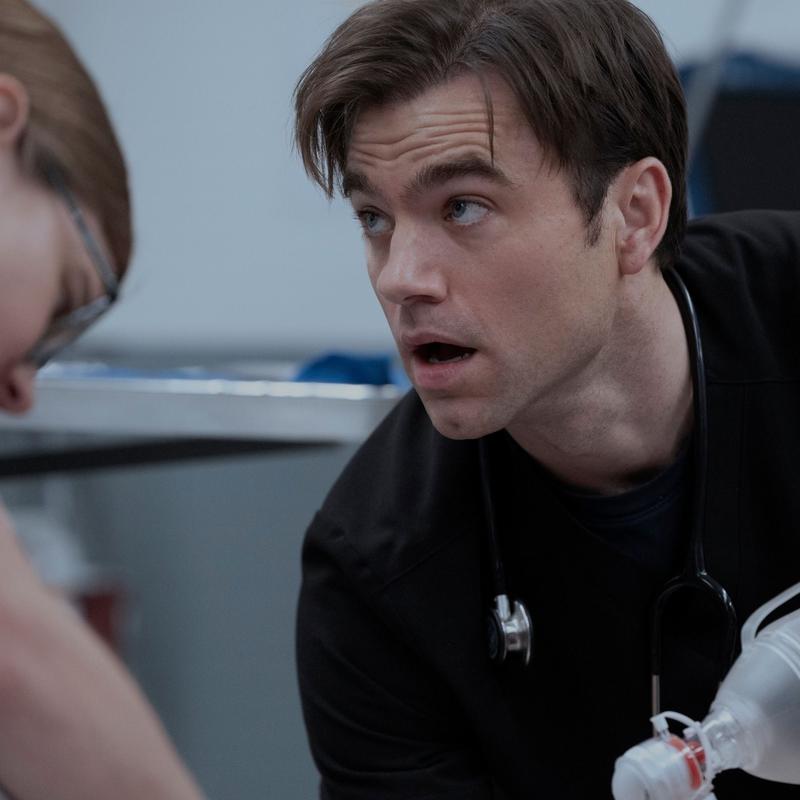
Alison Stewart: We've arrived at the finale of the award-winning show, The Pitt, a medical drama that takes place in one day, hour by hour. This season, we have watched as hotshot Dr. Langdon returns from rehab, humbler, less sure of himself, and making amends. Langdon is played by my next guest, actor Patrick Ball. Dr. Langdon was caught stealing medication from the emergency room and confessed to being addicted to painkillers after a serious back injury.
Season 2 takes place on his first day back in the hospital after rehab. As Langdon's shift progresses, he has to find his footing again as a doctor and see if he can reconnect with his mentor, Dr. Robby. The season finale of The Pitt is airing tonight on HBO at 9:00 PM, and I'm joined now by Patrick Ball, who is also making his Broadway debut in Becky Shaw. We'll talk about that in a minute. It's really nice to meet you.
Patrick Ball: Alison, thank you so much for having me. This is amazing.
Alison Stewart: What were you doing in the months before your audition for The Pitt?
Patrick Ball: I was living in Brooklyn. I was working, I think, four jobs at the time.
Alison Stewart: Oh, my gosh.
Patrick Ball: I was making coffee, I was working at a restaurant, and I was working as a wardrobe assistant for, and just like that, the Sex and the City reboot. I was driving the shoppers from store to store, picking up Carrie Bradshaw's shoes, which felt really iconic at the time.
Alison Stewart: [laughs] That's amazing. When did you get the call for the audition for The Pitt? What was going on?
Patrick Ball: It was just a regular self-tape. I was actually sick with COVID that week. I was sort of locked into my apartment, and it was one of maybe five self tapes I had that week.
Alison Stewart: Wow.
Patrick Ball: I had absolutely no reason to think that this was going to be any different than the other thousand self tapes I had done in the past. I'm sitting there sweating in my bedroom with no pants on and just sort of fire it off into the void. Then it came back, and it snowballed into this life-changing event for me.
Alison Stewart: What did you think of Dr. Langdon when you read about him on the page?
Patrick Ball: Well, it was really interesting because in the initial rounds of auditioning, the addiction aspect of him was not brought up.
Alison Stewart: Oh, interesting.
Patrick Ball: He was just described to me as sort of the cocky, fun-loving doctor that everybody hated to love. That was my way in with somebody that moves fast. I come from healthcare workers. My mom is a lifelong ER nurse. My dad is a lifelong paramedic. I have known very well that this is a blue-collar job, that this is ditch-digging work. I think often doctors, when they're represented in TV, are often these highly ennobled, super intelligent, super compassionate heroes. I just know, as somebody that comes from this community, that they don't necessarily identify themselves as heroes. Like, I can look at my parents and know that they're heroes, but that's not how they look at themselves. They're just trying to keep their head down and do the next right thing, which is what I wanted to do.
Alison Stewart: When the aspect of addiction came up, it was really interesting watching Season 1 again because you keep it close to your vest that he's going through addiction. At first, you think he's just sort of a hotshot, and he's just got-- it's like firing guns off. You realize he's under the influence of drugs, or at least he's trying to maintain some sort of going forward when he's under the influence of drugs. How did you talk to the writers about that? How did they talk to you about that?
Patrick Ball: I think Langdon gets busted with benzos in episode 10 of Season 1, and I think he is using that to wean himself down and control the anxiety and the withdrawal experience that he is having from having been addicted to opioids, to painkillers. I've got plenty of people in my life, I've got people within my family that have fallen into the trap of opioid addiction, and ended up there by not having nefarious motivations or being--
Alison Stewart: Of course, the way the prescriptions were originally given to people.
Patrick Ball: Exactly.
Alison Stewart: It was just like hand over fist to people.
Patrick Ball: I come from a farming family in North Carolina. I've got a cousin in my family who was the star of the family. He was the heir apparent, was going to take over the farm, and was the one that we were all betting on. He sort of blew out his knee working in the field one day, and a doctor prescribed him pain pills, and it led to a cataclysmic slide. This happens to people all across the country. I think the fact that we get to talk about it and I get to talk about it as Langdon, it feels like a real gift from the universe.
Alison Stewart: It's interesting because when we see Langdon in Season 2, 10 months have passed by. We don't really know what's happened in those 10 months. We know he's in rehab. What conversation did you have with the writers about what Langdon's life looked like in those few months?
Patrick Ball: Yes, they leave plenty of room for conjecture. We had some basic conversations, and I talked with Scott, the showrunner, and I was like, "What has the last 10 months been like? How's it going at home?" They communicated to me that Langdon has not been able to be the wage earner that he has been.
Alison Stewart: Oh, interesting.
Patrick Ball: He's got two kids at home. He's got a wife at home. His wife has pulled a lot of weight as far as caregiving goes for the children. I think up till now, Langdon has largely assumed the role of wage earner, and now he has lost his ability to come to work and to provide for his family. I think that has created all sorts of stress within the family. I think that he's back here. Whether he's ready or not to come to work, he's at work because he needs to be.
Alison Stewart: That's hard. Whether he's ready or not.
Patrick Ball: Yes.
Alison Stewart: That's a tough role to play because you've got to consider, is Langdon ready to be the doctor? Is he ready to be the doctor he could be? What does he think?
Patrick Ball: I think over the last 10 months, he's had to come to terms with the fact that the confidence with which he moved through the world and the privilege with which he moved through the world was propped up by lies, by lies that he was telling himself and telling the people around him. I think when you pause for a second and do that soul searching, a lot of that confidence can come into question. I think as somebody that has been through this early recovery process, I think the confidence you find on the other side of it is much more solid and much more genuine than anything that you experienced while in addiction. It's a process that you got to go through.
Alison Stewart: My guest is actor Patrick Ball. He plays Dr. Langdon in The Pitt. Season 2 finale will air tonight at 9:00 PM on HBO. Later, we'll talk with Patrick and his star in the Broadway debut of Becky Shaw, his Broadway debut of Becky Shaw. It's interesting this season, your physicality as Dr. Langdon compared to Season 1. Talk to me a little bit about your physicality, because in Season 1, you were like chest forward, going through the ER, and now it's a little more tentative.
Patrick Ball: Well, I think you're also seeing a Langdon that has not been on the train of The Pitt for 10 months. I think whenever you are in the ER, you have to move fast, you have to stay moving. You see it manifest in Robby. You see it manifest in Dana. You see it manifest in anybody that has spent a lot of time showing up in this workplace every single day and realizing that you have to be almost on this manic speed where you just keep moving.
Especially when you compound that with the fact that Langdon in Season 1 is very much running from his own shadow. That creates a sort of compulsion, compulsive movement, that now that I've spent 10 months away, and I've actually faced that shadow, and I also have not been working at the tempo of the ER, you realize that that tempo that you experienced in Season 1 maybe is not dispositional to who Langdon is-
Alison Stewart: Oh, interesting.
Patrick Ball: -but is something that is necessitated by this environment.
Alison Stewart: What makes Dr. Langdon a good doctor, in your opinion?
Patrick Ball: I think he's growing every day. I think he's still very much-- he's a resident. He's a doctor in training. I think there are certain things that he gets right. I think there is a impassive nature to this work. You have to be able to compartmentalize the work and show up. At any given moment, I have six patients that I'm responsible for, and I might take a loss and go through an event with a patient in Trauma 1 that is going to forever change those people's lives. I might be responsible for it. Then I've got to turn the page, and I've got to walk into Trauma 2 and show up for whoever's there.
That level of compartmentalization is something that is really essential for anybody that does this work. I saw it represented in my own parents growing up. I think that is something that he is able to do. I think the flip side of that, that he is learning and he is growing in, is an ability to really pause and be present and extend compassion.
Alison Stewart: Yes. It's interesting. We've talked to Noah Wyle when Season 1 first started, and he talked about having consultants on the show, medical consultants. How are they helpful to you? How are they helpful for you in creating the character, and also in doing the job?
Patrick Ball: We have a number of medical directors that are with us on set every day, as well as a certain number of background artists that you see in The Pitt that are med techs, that are-
Alison Stewart: Oh, really?
Patrick Ball: -real-life practicing physicians and nurses that will spend half their time with us in The Pitt and half their time working in actual ER, and they make sure that everything that we do, procedure-wise, is as accurate as possible, and we understand everything that we're saying. Just as useful for me as the procedural stuff is getting to just spend time in community with people that do this for real, and just see energetically how they move through the world, and seeing how much humor they have.
There is this very unique sense of gallows humor that was really present and of interest to me from the very beginning, just talking with Dr. Jake Lentz, who's one of the people on the show. He's just so funny, and he's so tired.
Alison Stewart: [laughs]
Patrick Ball: He's so tired because he is working so hard, but he just has this incredible sense of humor with him, which I was like, immediately, "This is a role model for what I want to do with Langdon."
Alison Stewart: What did your parents think of the show as medical professionals?
Patrick Ball: They were stoked. They were stoked.
Alison Stewart: [laughs]
Patrick Ball: I actually got to be with them. I was back in North Carolina for my dad's birthday, whenever I got the call to come to LA for the screen test, and I got to talk with them about it and read through some of the script. The first thing that they said, they were like, "Whoa, this is crazy. This is what I would actually do. This is how I would actually see this problem." They don't always feel that way. They often have a hard time watching medical dramas because they feel like the medicine isn't there. I was like, "Oh, yes, well, this is by the same people that made ER." ER was the same way. They were like, "Yes, but even ER felt like a television show. This feels like real medicine."
I'm very honored to be brought into this project. It was an incredible experiment on John and Noah and Scott's part to put a show out there that is so medicine-forward and so science-forward. I just feel really honored to be a part of it and glad it worked out.
Alison Stewart: Tonight is the finale of Season 2. Have you seen it?
Patrick Ball: I have not.
Alison Stewart: You've not seen it? I haven't seen it either. I had the opportunity to watch it, and I said, "I'm going to wait till nine o'clock tonight."
Patrick Ball: I watch with everybody else.
Alison Stewart: Really?
Patrick Ball: I don't get advanced screenings, so I watch week to week with everybody else.
Alison Stewart: They've talked a little bit about Season 3. Will we see Dr. Langdon in Season 3?
Patrick Ball: I hope so. They're in the writers' room right now, so standing by.
Alison Stewart: Standing by. We're going to talk after the break about your Broadway debut, Becky Shaw, but also Issa Brazones. Brunones?
Patrick Ball: Briones.
Alison Stewart: Thank you. She's also on Broadway as well in Just in Time. Have you folks, have you checked in with each other?
Patrick Ball: Oh, yes. I love Isa. She's become a dear friend. Her and Elysia, my partner, have become close friends. Me and Alicia went and saw Just in Time.
Alison Stewart: Her voice is amazing.
Patrick Ball: She's incredible. It's so clear. She has been doing musical theater on the Broadway level for a long, long time. She is so good at it, and she just seems so happy doing it. It's so amazing to see her in her element like that.
Alison Stewart: It's so interesting because you're all just very good actors. You've been at it for a while. Like you said in the beginning of the interview, you were struggling to make it, and now it's blown up in this way. You were really honest about your loans recently, about being able to pay off your student loans. What has this meant to you personally, this kind of success?
Patrick Ball: It's incredible. I spent 15 years trying to break into this industry. My dream was really Broadway, and that opportunity never came along. I auditioned for all of the film and TV, and nothing ever really hit. I'd accepted the fact that that wasn't going to happen. That wasn't going to happen. I was looking for an off-ramp. I was applying to fundraising jobs. At one point, somebody was trying to convince me to join the Connecticut State Police. I was just like, "Wait, what am I doing?" We had reached the point where I didn't think the dream was going to happen. For it to happen in my mid-30s like this and be able to pay off my student loans and to be able to feel like all those years of eating black beans for dinner paid off, it's amazing.
Alison Stewart: [laughs] Up next, we'll keep talking with Patrick about his Broadway debut in the play Becky Shaw, alongside his co-star, Becky Shaw herself, actor Madeline Brewer. This is All Of It.
Copyright © 2026 New York Public Radio. All rights reserved. Visit our website terms of use at www.wnyc.org for further information.
New York Public Radio transcripts are created on a rush deadline, often by contractors. This text may not be in its final form and may be updated or revised in the future. Accuracy and availability may vary. The authoritative record of programming is the audio record.