
Pamela Hanson Captures the '90s With Her Fashion Photography
Alison Stewart: This is All Of It on WNYC. I'm Alison Stewart. In a piece about photographer Pamela Hanson, The New York Times asked this question. How did Pamela Hanson become the photographer of choice for so many women? Well, perhaps she's very, very good at her job, and because she strives to be empathetic in her own words. In the 1990s, she's one of the few women making high-end images.
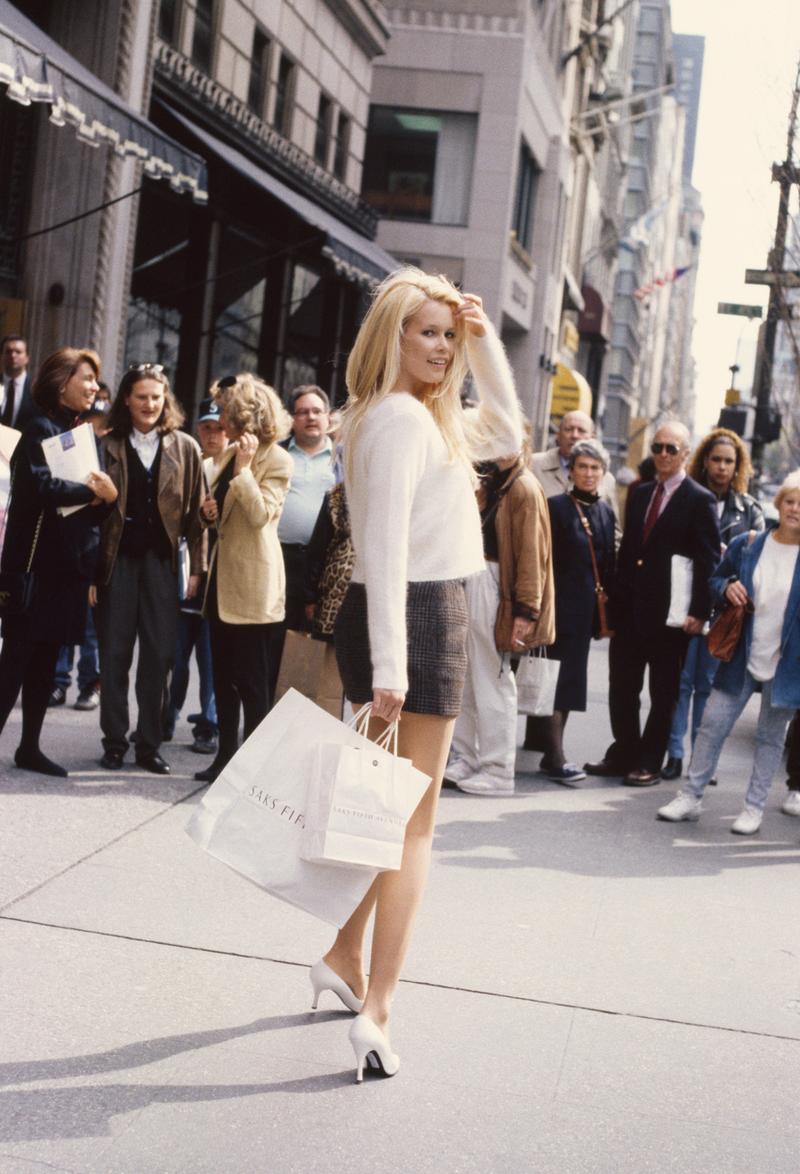
In her new book, Pamela Hanson: The '90s, it features Hanson's images of models like Naomi Campbell, Linda Evangelista, and her good friend Christy Turlington. The pictures are fashion-related from French Vogue to Mirabella, but also outtakes from shoots for Mademoiselle. On the back cover of a book, a woman in stockings with seams running down the back, and she is running down a non-gentrified street in the Meatpacking District.
It is very '90s, plus there's that, and a lot of smoking in these pictures as well. A sample of the photographs from the books are on our Instagram. You can check them out while you listen to this segment @AllOfItWNYC. You can see some photographs from the book in person in an exhibit at the Staley-Wise Gallery in SoHo through November 8th. Pamela Hanson is with me now in studio. It is so nice to see you.
Pamela Hanson: Nice to see you, too, Alison.
Alison Stewart: When you were thinking about memories or feelings that you most associate with the '90s, what are they?
Pamela Hanson: I've thought about it a lot, and I hadn't really thought about it before the book came out. I think there was an intimacy. We all grew up together. We were like a family. We ate together, and we shot on the streets. When we felt like eating, we'd go eat. I think there was just an intimacy. I was the only one with a camera because it was pre-iPhones and it was pre-internet. I think that allowed a kind of intimacy, and you didn't have to do. Now, you go on set, and there's behind-the-scenes, and there's video. There's not a lot of time to develop a relationship.
Alison Stewart: Oh, that's interesting.
Pamela Hanson: Then we had time, we hung out all day. I hung out with the girls. Plus, they were friends. They were closer to my age. As a team and with the editor, the stylists, and the hair and makeup, it was just a very-- and through this process, I've run into so many old assistants. Everybody was like, it was a family. I'm sure that still exists on a level today, but I think maybe that's what the girls were so comfortable, and it was intimate. We just traveled the world together. We had an amazing time. We were very, very lucky.
Alison Stewart: The '90s were the last analog decade you shot on film?
Pamela Hanson: Yes.
Alison Stewart: How do you think that affects how we absorb the pictures?
Pamela Hanson: Well, the quality's really different. There's no retouching in the book at all. Some photographers that shot in studio, like Richard Avedon, Steven Meisel, because it was very specific, they did a certain retouching, but it's not the same as now. I just think the quality of film is more intimate and more beautiful. It wasn't instant. You didn't have people hanging around the computer looking at what you were shooting and allowed you to have some privacy and the excitement of seeing the contact sheets when they came back in a week, and selecting the images and just had much more time, which I think is true about everything today.
Alison Stewart: How do you feel about retouching? Is it something you're--
Pamela Hanson: It's hard.
Alison Stewart: I'm curious what you think about it.
Pamela Hanson: It's hard because it's really hard to do nothing. I really try to do nothing. I've started shooting on film again when I can. Now, the timing is different. Clients are like, "We're shooting tomorrow, and we want the images in two days," because they're just used to. Sometimes it's hard, but I try not to because I really think-- and if you look at old magazines, there's Helmut Newton pictures. The girl has bloodshot eyes. Nobody thought anything about it. Now, I think our eyes train differently, so it's hard. I'd really rather not, but I think it's really hard to do absolutely nothing.
Alison Stewart: Why would you rather not? You want the image to appear--
Pamela Hanson: Just because I love people for who they are. I think we've gotten into this world where things-- this idea of perfection, which seems completely unreachable, which is why you see people that I'm just like, "Why are you doing that to yourself?" Age has got a whole different-- so I think it's like trying to show the authenticity and the intimacy as much as possible is something I like.
Alison Stewart: I'm speaking with photographer Pamela Hanson. We're discussing the book, Pamela Hanson: The '90s, which presents a collection of Pamela's fashion photography from that era. You can also see her show at the Staley-Wise Gallery in SoHo through November 8th. What was your camera of choice in the '90s?
Pamela Hanson: It was a Nikon, and I also shot transparency film, which, now, when I shoot film, it's negative film. I don't even know--
Alison Stewart: You'll have to explain that to me.
Pamela Hanson: Transparency is like a slide.
Alison Stewart: Okay.
Pamela Hanson: I'm sure they still make it, but yes. I was very inspired by film, by movies, and that was what inspired me more than other still images. I think we didn't have that many images now. Now, there's so much of an overload. You can see things all the time, and then to be inspired. That was really my inspiration at the beginning was more cinematic. It's giving the girl something to do and somewhere to go. Film gives it more of a cinematic quality.
Alison Stewart: All right, I want you to give us three films that we should check out. Three films that were important to you.
Pamela Hanson: Well, The Graduate. I love The Graduate. It wasn't even so much the fashion and all the French Nouvelle Vague. A Man and a Woman, Breathless. I was living in Paris at the time, too. Obviously, a lot of the films that I looked at were French and European that were-- and the light in Paris is so beautiful.
Alison Stewart: Ooh, is it different than any other place?
Pamela Hanson: Well, I think every city has its own light because this light reflects off the buildings a lot. In Paris, you have those warm, beautiful stone buildings. It reflects that beautiful, warm light. It does change if you're shooting on the street in New York. It's also amazing, but it's just very different. It's more like bouncing off of mirrors or shiny skyscrapers. It's interesting because it definitely gives an attitude or an edge to your pictures.
Alison Stewart: You're right. Now that you've said it, I'm thinking about photos that I've seen shot in LA.
Pamela Hanson: Right?
Alison Stewart: They're brighter, and it comes straight at your eye because of the level of the buildings. That's so interesting.
Pamela Hanson: Yes, the quality of the light is completely different.
Alison Stewart: Oh, that's so wild.
Pamela Hanson: I find LA really hard to shoot in for some reason. I mean, on the street. The LA is very much about the beaches and renting a location in a house or a studio.
Alison Stewart: What about Miami? What's the light like in Miami?
Pamela Hanson: Well, we used to shoot in Miami a lot.
Alison Stewart: A lot. [laughs]
Pamela Hanson: I'm sure they still do, but at the beginning of the mid-'80s, it was incredible.
Alison Stewart: It must have been, again, off of the art deco buildings. There's a certain--
Pamela Hanson: In the beginning, at South Beach, there was only old people's homes. There was one hotel. All the photo shoots that would be down there, we would all hang out together. You couldn't even go a block over because it was gangs and gun violence. Now, of course, it's completely different. Miami was great. Miami was a really good place. We used to go a lot in the winter because you have to shoot summer fashions in the winter and winter in the summer.
Alison Stewart: What did you see your job as on a shoot as the photographer? What was your job?
Pamela Hanson: Well, to get the best possible image, but to work together with-- I really love teamwork. It just really appeals to me. When you have a great team and you have a great fashion editor, it's a discussion, and a discussion with the girls like, "Let's tell a story." Okay. Now, you're downtown. Now, you're running down the street. Now, you're shopping. You have a baby in your arm. You're a busy mom. My job was to give it my own point of view, but also respect what the magazine needed or respect the clothes, because the editor would be like, "Yes, that's great, but the clothes look terrible."
[laughter]
Alison Stewart: Also, you had the makeup stylist. You had the hairstylist. It did seem like there was a whole posse involved.
Pamela Hanson: Yes, there always was, which was so great, because everybody was working to do the best possible image.
Alison Stewart: As you went through your archives, first of all, where does your archive live?
Pamela Hanson: In the storage unit in New York City, and partially in my studio.
Alison Stewart: You go to the storage unit. You're going to go through your archives. Were you looking for anything in specific?
Pamela Hanson: I started going through it because I was starting to scan all my archives. I realized that I had so much stuff in storage that I was paying for that I probably didn't need like negatives from some random lingerie catalog. I started doing that, and then I started looking at the pictures. Often, when you look back at things, at least for me, I was like, "Oh, that was a good picture."
I started just pictures I loved. As I was editing out and going through all these boxes and shoots with my archivist, I started taking out pictures because everyone was like, "You should do a book." Part of me was like, "Does anyone care?" Then I started looking, and I was like, "Yes, I like that picture. I like that." I started realizing, so I just started collecting them. Then when I was done, it ended at the end of the '90s because of digital.
I feel like when I started shooting digital, it was a struggle to find my point of view. It was definitely, for me personally, a difficult adjustment. Then I stopped that, and then I gave it all to an incredible creative director called Joseph Logan and an amazing editor called Martinka at Rizzoli. It was twice the size, so we had to edit it down. It was very hard. I had to let them do it because I was like, "My baby, don't throw that picture out."
Alison Stewart: [laughs] If you can do it with an objective eye and the pictures in this book, what do they contain? What is it that you like about them? Do you like the framing? Do you like the light? Do you like the action? What is it about the pictures that are in this book that you chose them?
Pamela Hanson: I love this photographer called Jacques Henri Lartigue, who's a photographer from the turn of the century. He's French. He was the first one that I was aware of that did like women running or jumping. I was always really interested in life. I'll see something, I'm sure a lot of people do, where you're just like, "Oh, that's cool," or "Oh, look at the light," or that moment. I think, for me, it was kind of-- I don't know. I had an emotional reaction to the images.
Alison Stewart: Oh, that's interesting.
Pamela Hanson: It could have been the girl, or it could have been the moment. I was like, "Oh, that's really a great moment, where she's jumping," or "Oh, yes, not all the girls are super active." That's what was so great, too, about the models is some of them would just be amazing at just sitting around and looking incredible and eating an ice cream. Other ones would be much more animated and much kookier, so you have to embrace that.
Alison Stewart: I'm speaking with Pamela Hanson. We're discussing her book, Pamela Hanson: The '90s, which presents a collection of Pamela's fashion photography. When did you first pick up a camera?
Pamela Hanson: I think I was 14 or 13. My sister was into photography, and I wanted to do everything she did. I got a camera and then built a darkroom, and then I did the high school yearbooks. I just always loved taking pictures. I think part of it was also, it creates a boundary. I don't know. It was a way of observing life and capturing life. I love people, and I love moments of life. I just started taking pictures. I didn't even realize in high school. I went to a reunion once, and they were like, "You always had a camera." I was like, "Oh, didn't even realize that."
Alison Stewart: Interesting. When did you realize it could be artistry, that photography could be artistry?
Pamela Hanson: Well, I worked in a photography gallery after college. I studied art history. I wanted to be a curator, and I worked with a really, really-- One of my best friends from high school worked in a gallery in Boston. I'd gone to school in Colorado. We came to New York for the auctions. We met this fashion photographer called Peter Strongwater in a bar. I was like, "What's a fashion photographer? How do you do that?" I was trying to figure out how I could make a more immediate living than being a curator.
He said, "Oh, you become an assistant." I moved back to Colorado to live with a boyfriend that my parents didn't approve of. He got disowned in parentheses. I just found the local photographer, and I was like, "I'll do anything." He was like, "I don't need an assistant, but come and return some fur coats or something." Then I worked for him for a year, and then I started looking at fashion magazines. I was like, "Oh, I like this photographer, and I like that."
Arthur Elgort was really who caught my eye. For obvious reasons, you could see his influence. My best friend growing up, who wrote the introduction, we were friends since we were three, knew him because she was modeling. She was an artist that was modeling to make money. I met with him. I was on my way to Paris to visit her, and he said, "You wouldn't make a very good assistant, but you speak French, and you have a driver's license. If you move to Paris, I'll hire you as a third assistant." He was incredibly generous. I went on a couple of shoots with him, like four or five as a third and as a driver. I started seeing how it all worked. Then I was like, "This is fun. I like this."
Alison Stewart: It's interesting, though, that you wanted to be a curator at such a young age.
Pamela Hanson: I just didn't think you could make a living doing photography. I was always interested in art history, and my dad collected old masters. None of any huge value, but I was surrounded by it. I was always very interested in art.
Alison Stewart: Do you think your experience with art and your exposure to art transformed into your photography in any way, or no?
Pamela Hanson: I took a painting class in college, and I was really bad at it. My really good friend, who's now a painter, was in my class. The teacher was like, "What grade do you deserve?" I said, "An A." She said a C, and she told me later. I was like, "Wouldn't you just say an A if you had a choice?" I don't know, to be honest. I'm sure maybe, but photography is so visceral for me that it's a really emotional thing. I just take pictures. I'm always looking and reacting to things.
Alison Stewart: It's interesting. You mentioned your friend Lisa in the book, and she wrote the foreword. It's really lovely. It's clear that you've been friends for a very long time.
Pamela Hanson: She was my first muse. I photographed her all the time when I first moved to Paris because she was a model. I started getting these little jobs that I had to do. She was my--
Alison Stewart: What's the base of your friendship, especially one that has lasted so long in an industry where people can be frenemies very easily? You and Lisa, it's clearly that you have love for one another. What's the basis of the friendship?
Pamela Hanson: It's really like a sister. We met when we were three. We were both expats growing up in Switzerland, her family and my family. There was just a bond. We grew up in a hectic, insane, but beautiful, but also maybe not the most straightforward childhood. We just bonded. I don't know. Again, I think it's just something stronger than we are because we've stayed. She ended up working for Vogue in LA, running the Vogue. Our lives have been incredibly parallel, but yes.
Alison Stewart: Lisa describes how hard you work. She wrote, "As I returned home at 6:00 AM, she was often at the table making calls to photo editors. She was a pit bull hanging on until they realized she wasn't giving up." "She" being you. Why did you want the gig so badly?
Pamela Hanson: I don't know. I really love taking pictures. When you're young, I think you just have--
Alison Stewart: You just do it.
Pamela Hanson: I just had a drive, and I just wanted it. I would just go to see these art directors in Paris, and it was a different time. You could show up at the magazine, and I was like, "Oh, I'm in the neighborhood." Finally, they were just like-- They started giving me little things, like doing a portrait of a woman's garden outside of Paris. I started doing that to keep taking pictures. Lisa was a model, so she'd always get invited out for dinner. She'd always be like, "I have to bring my roommate," and that's me.
[laughter]
Alison Stewart: "That's me."
Pamela Hanson: Maybe not what they had in mind.
Alison Stewart: When you started taking pictures, was there a gender divide among fashion photographers?
Pamela Hanson: I think there was, but there were some strong-- There was Sarah Moon. There was Annie Leibovitz. Ellen von Unwerth started right after me. I actually photographed her when she was a model when I first started.
Alison Stewart: Oh, really?
Pamela Hanson: Yes. Deborah Turbeville. Ellen, I think, has similar sensibility to mine, but it was much more mannered and created. Yes, I think there was, but I think it's true probably for everybody. If you've never been a guy, you don't-- and I think there still is and I think as in everything. I try not to think about that, because what's the point? I just say to everybody, "Just work really hard, and do what you feel." That's the other thing that's really hard. Make sure that it comes from you and not from something. You're trying to create somebody else's image.
Alison Stewart: I'm speaking with photographer Pamela Hanson. We're discussing her book, Pamela Hanson: The '90s, which presents a collection of Pamela's photographs from the '90s. Some of the photographs are on view now at Staley-Wise Gallery in SoHo through November 8th. If you'd like to see some of the photos, you can go to our Instagram @AllOfItWNYC while we're having this conversation. Let's talk about the gallery show, Staley-Wise, 100 Crosby Street. Why did you want the gallery show to be the companion to the book or the book to be the companion to the gallery show?
Pamela Hanson: It just happened organically. I'd been ruminating in this book for a couple of years and researching, and so then it just happened organically. They offered the time that they had the space for it. We had talked about maybe having a show, so it all worked out. No, I'm happy. It worked out really well.
Alison Stewart: How did you pick pictures for that show?
Pamela Hanson: Well, I had the gallery.
[laughter]
Alison Stewart: I was going to say, "Come on now." This book is pretty large.
Pamela Hanson: I know. I know. I let them choose because I think they know what people are interested in seeing.
Alison Stewart: You worked with so many different women. Did you have one model that you really enjoyed working with? You looked at the call sheet, and you're like, "Yes, I'm glad I'm working with her."
Pamela Hanson: Well, Christy is an obvious--
Alison Stewart: She's a lovely person.
Pamela Hanson: Also an incredible person, and still remains a really good friend. I actually really like shooting Naomi, even though she was often late, but she was still an incredible model. All of them, I like Nadja Auermann. I like Ana Drummond, who was an English model. They're not all supermodels. All the girls in the book, I had a connection with.
Alison Stewart: You got to shoot Beyoncé?
Pamela Hanson: I did, yes. She's also phenomenal.
Alison Stewart: I was going to ask you for a couple of adjectives to describe shooting Beyoncé.
Pamela Hanson: Well, first of all, I've never seen anyone who works as hard as she does. It's not an accident that she's who she is. I had shot her backstage a couple of times, so I knew her. I understood how she works and what she likes and what she's comfortable with. It was incredibly easy because I think she trusts me, and I trust her. Sara Moonves, who put that together, who owns W, who's also incredible. Yes, it was really, really fun. It was so much fun. I could have gone on. She's a very special person.
Alison Stewart: Pamela Hanson's book is called Pamela Hanson: The '90s. The show is at the Staley-Wise Gallery through November 8th. Thank you for coming to the studio.
Pamela Hanson: Thank you for having me.