
Oscar Nominee Rose Byrne on 'If I Had Legs I'd Kick You'
Alison Stewart: This is All Of It. I'm Alison Stewart, live from the WNYC studios in Soho. Thanks for spending part of your day with us. I'm grateful that you are here. On today's show, we'll hear from the artist whose sculptures are currently filling the famous spiral at the Guggenheim Museum. Her name is Carol Bove, and she joins us along with the exhibit's curator. Author T. Kira Madden is here to talk about her new novel, Whidbey, and the sister duo, Sybil, performs live in Studio 5.
That's our plan. Let's get this started with actor Rose Byrne.
[music]
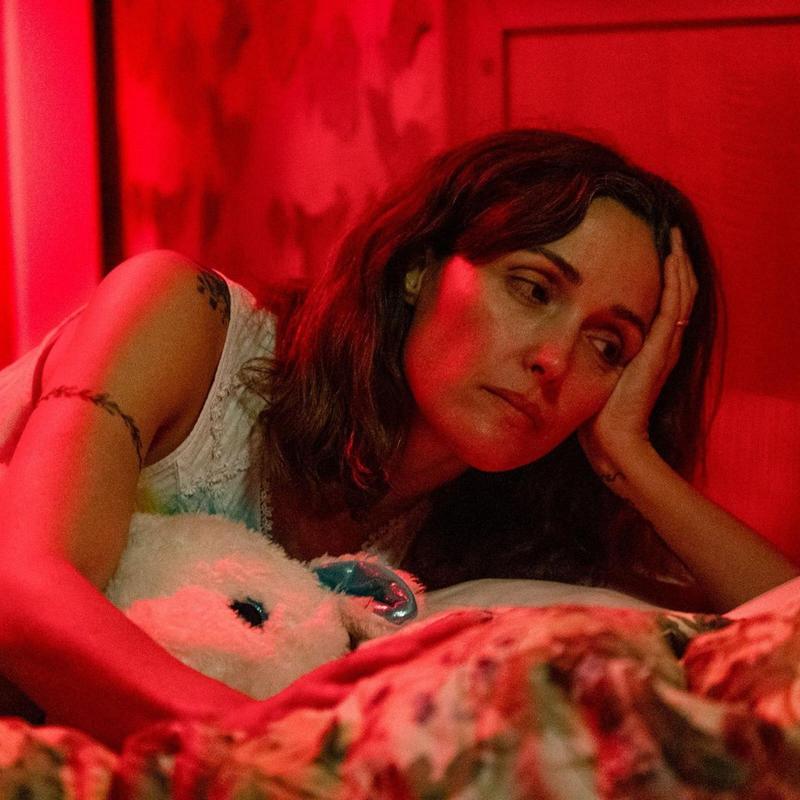
Alison Stewart: Rose Byrne, who stars in the film If I Had Legs I'd Kick You, has already earned a Golden Globe, an Indie Spirit Award, and a New York Film Critics Circle Award. This Sunday, she'll be up for an Academy Award for Best Actress. She stars as Linda, a mother whose life begins to unravel while dealing with a series of escalating crises, including her daughter's mysterious illness. It's no exaggeration to say that Byrne is at the center of everything. The center of the story, the center of the frame.
Sometimes the camera is so close to her face, you can see every eyelash, every small twitch. This is her first Academy Award nomination, and it's no surprise because the reviews for this film were immediately strong, particularly for Byrne's performance. The New York Times said, "Rose Byrne is magnificent as an overwhelmed mother in this wrenching, spiky drama." When she joined us in studio around the film's theatrical release, I started by asking Rose what she takes away from people responding so well to the film and to her performance, which is sometimes dark and unattractive.
Rose Byrne: I'm very emotional about it. I feel simultaneously really protective of the character and also want everybody to share this experience. It's a study in contrast, I suppose, at the moment, but it's been so extraordinary to talk to people about the film because it is such an experience, the movie, and that's been the gift is to talk to people from all walks of life. Some of my best friends are not parents, but they're caregivers, or they have other stresses in their life. Obviously, mothers and parents, men.
Alison Stewart: Sure.
Rose Byrne: It's a female protagonist that can be-- People can struggle with that. It's been just so beyond my wildest dreams having people share their experiences with me. It's a little bit undefinable, the film with genre. That's been really wild to see the response in terms of, "It's a comedy. No, it's a horror. No, it's a straight, dark drama." I love how no one can pin it down. It asks more questions than it answers. I'm still discovering things about the movie. I'm living for the ambiguity of it, and watching people try to pin it down. It defies that in many ways, I think, which is exciting. It's very original.
Alison Stewart: Why did you say yes to the part of Linda?
Rose Byrne: Oh, gosh, because I just couldn't say no. [laughs] I was like, "Oh, goodness me, what an opportunity." I was terrified, and also thought, "Oh, I have to do this. This is extraordinary. This is a tightrope. Where to begin? How do we begin to peel back the onion of this character?"
Alison Stewart: Bobby Cannavale, your partner, was here two days ago.
Rose Byrne: Yes, he was here. I know.
Alison Stewart: You had described him as really a good creative source for you when you're deciding about parts. I asked him why he liked this part for you. Let's listen.
Bobby Cannavale: I just thought that that script was so specifically a voice that I hadn't heard before. I'd never heard a voice like that, particularly about the subject matter, motherhood. I've never seen anything like that before. It read like a dark horror movie, and it jumped off the page in that way. I just thought, "Hey, this is something where you can use tools you haven't really gotten to the show.
Alison Stewart: Everything you have.
Bobby Cannavale: You can use everything, put it all together in a way that I hadn't read before. There have been things that Rose has done where she's elevated material many times that we've read together, and I've gone, "You can really score with this part and do well." I don't know. If all the other elements come together, maybe it can be good, but oftentimes, that's out of your hands. This one's pretty much Rose. She's just in every frame of the movie. I just thought, "I think you're ready, and I think it's a good match. I think you should meet this woman." They got on like a house on fire. Thank God the whole thing scored because it's an impressive feat, I think.
Rose Byrne: Oh, I've never had that experience of hearing-- My husband is such an extraordinary sounding board. He really is. He has such intuition around art and character, and he's my biggest cheerleader, and I am for him, too. I hope he feels that. He got it straight away, as you can see. He loved it. He got the movie in a very cellular sense, too.
Alison Stewart: It was interesting that he used the word tools, that you would get to use tools that you didn't get to use before. What tools do you think you got to use?
Rose Byrne: The character is a tightrope. She's wound so tight. She's profoundly disassociated, too. The challenge of playing a character who is disassociated yet being trying to be vitally present for the scene is a tightrope. It was such a challenge. Using absolutely everything I feel like has almost led to this. There's a lot of comedy in the film, which I obviously love and have done a lot of, but it's very, very dark, the comedy which I arose and gravitate toward as a viewer.
Then there are horror tropes. I guess the tools he means is all of those. I've done a lot of different genres, and in a way, it was exciting to try to put them all behind this character and really understand her perspective on it.
Alison Stewart: You shot this in 27 days, is that right?
Rose Byrne: We did. Yes.
Alison Stewart: What does shooting on a short schedule like that do for you creatively?
Rose Byrne: Mary Bronstein puts it well. She says limitations on art can be such a gift because you have to pivot and you have to be creative, and you don't have all the time in the world and all the money in the world and all the people saying yes to you in the world.
Alison Stewart: "Could we do a retake?"
Rose Byrne: Exactly. You have to be creative, and that can be so revealing and wonderful about choices you can make and places you can go with the performance. I never felt constrained by it, to be honest. We had a great preparation time, Mary Bronstein and I. That was definitely a huge key to being able to shoot it in that amount of time.
Alison Stewart: You and Mary had a lot of discussions beforehand. What did you talk about?
Rose Byrne: We sat down at her kitchen table for three days a week for five weeks, and we just went through every page of the script, every page, every beat, every syllable. I ask a lot of questions on a slow day. This was like question central. She was very candid with me. This is a personal story. It's inspired by something she went through. It's obviously a very abstracted version of that. She didn't respond to this situation like Linda does, but "What if you did behave like this? What person is in this state that these are the choices they're making and the choices she has to make at that for where she is right now?"
We would share personal stories. I'm a mother. She is a mother, obviously. We had this great time. It was like preparing for a play. It was really extraordinary. You don't get that with cinema usually, or tv, for that matter. Mary was very determined. She comes from performance. She started at NYU as an actress. She did it with Conan O'Brien, who's in the film with A$AP Rocky, with Danielle McDonald. I just loved it. Without that, I would have felt untethered.
Alison Stewart: My guest is actor Rose Byrne. We're discussing her new film, If I Had Legs I'd Kick You. It's about a mom unraveling as she's dealing with a series of escalating crises. You capture Linda's life over these few days. How much did you talk to Mary about what Linda's life looked like before we drop in on this moment?
Rose Byrne: I was obsessed with that-- What was my biggest question was, "Who was Linda before this? Who was she before she had a child?" That's what is going to inform all these choices and this response, because we spoke to a lot of women, mothers with children with special needs.
Alison Stewart: You did? Interesting.
Rose Byrne: It was fascinating to see how it affected them and their marriages. It was very different from conversation to conversation. Then we meet Linda, and at her core, I think Linda doesn't trust authority, and she doesn't like being told what to do. That, for me, was a big key to the character and how she's responding. I think she's had a past. I think she likes to have a good time. I think she doesn't like being put into a role necessarily and really bucks at any tradition in that sense. There's something about her that's a little punk.
Alison Stewart: She's a little punk.
Rose Byrne: Yes. That, for me, was something we really discovered in rehearsals.
Alison Stewart: We got a text here that says, "I saw If I Had Legs I'd Kick You at the New York Film Festival. Rose has to be nominated for every actor award. I've never wanted to hug yet shake the crap out of a character in a movie before, like Linda. Chef's kiss to Rose." That's a super fan from Harlem.
Rose Byrne: Oh, my gosh. That's so incredible. Thank you. I'm so moved. It's very emotional. That's very sweet. It is a challenging character. Look, Mary and I always had this conversation. The audience doesn't have to love her, but we have to love her, and we have to love Linda.
Alison Stewart: For sure.
Rose Byrne: Obviously, you want people to root for her even as she's making these terrible decisions along the way.
Alison Stewart: Can we talk about how close up the camera got to you?
Rose Byrne: Yes.
Alison Stewart: Did you know that was going to be the case?
Rose Byrne: I didn't, Alison. The first day, it got closer and closer and closer, and I was like, "Are you getting that close? That's how close you're going to get? Okay." I had to adjust a little bit, but then I understood the language she was using and the cinematic tools she was really employing. I didn't fully grasp it until I saw the film as well, because I was doing my job with taking care of the performance, and Mary, obviously, was directing the film. It was very revealing to me, even when I saw it, the language she's using and the-- What am I trying to say?
The pure perspective of this character and what she sees and what she can't see is as important, that she can't really see her daughter as well. The audience can't see the daughter.
Alison Stewart: I was interested because I think, last time you were here, it was Madea.
Rose Byrne: Oh, yes, that's right.
Alison Stewart: You're used to doing theater, and theater, you have to be a little bit bigger.
Rose Byrne: Of course.
Alison Stewart: Right now, with the camera so close to you, how does that change the way you do your job?
Rose Byrne: There's obviously this huge technical aspect to making a film and to performing on film. I would just have a constant dialogue with Mary and with the camera-- I became very close with the camera department. I like more information rather than less, so we would always just talk through the day, talk through the scenes. It's a wild relationship to have with the camera. You really do have to assess it and do internal work and just recalibrate constantly, because it can be as simple as not breathing, holding yourself.
Alison Stewart: Oh, interesting.
Rose Byrne: It's something that can be that simple. That's what is needed, like a physicality or stillness. I had never done that before. It was really fun and creative in a technical way, I suppose.
Alison Stewart: As you mentioned, we don't see your daughter in the film. We see her torso, we see her feet. The director did what I understand is to keep the focus on Linda, because you bring this cute little kid who's sick onto camera, and everybody pays attention to the child.
Rose Byrne: Of course, your sympathies, as they should, will go to the child. Unless you don't have a soul.
Alison Stewart: First, just logistically, was she there when you were performing?
Rose Byrne: Yes. Oh, absolutely. We have this wonderful actress, Delaney Quinn, who came in and just blew us away when we met with her. She was my scene partner. Absolutely. All my choices are informed by her. She was extraordinary. She, like brilliant actors, could just access her emotional life in seconds and was so present, and then could be so funny. Delaney is a lover of horror films, so she loved more of the extreme, like set pieces. She had a terrific sense of humor and is a gift and wonderful child.
Alison Stewart: Everything I've read said, "Her mysterious illness." Does it say that in the script?
Rose Byrne: That's a really good question. No, it doesn't. It just is very almost technical about what Linda has to do in the script. It very much mirrors the film. There's very little information given, but a lot of emotional information and technical information about what she has to do, what she's doing, where they're going. The script doesn't give you any more clues in terms of "How long have they been doing this program, how long have they lived here? How long has she been a therapist? How long has she been seeing her therapist? How long has her husband--" et cetera. There was fun to fill in those gaps behind the scenes.
Alison Stewart: In the film, your character, Linda, she's exhausted. She is exhausted. What's your approach to physicality when you're playing a role that is clearly someone who is at her end?
Rose Byrne: The trap is that it becomes one note, and that she's just exhausted or just hysterical. That was always the thing, it's trying to find all the-- It's corny, but the colors, of all the different musical qualities that she performed, for want of a better expression. That was something we were really focused on. I'm always trying to find the joke because I'm goofy, but I love the physicality of it. A lot of the film, she's drunk, or she's stoned. The key always with that is if someone is drunk, they're acting as sober as they can. That was always the key. Trying to act as normal as one can is always a helpful thing, I think, to start from.
Alison Stewart: Everything gets kicked off, at least in this part of her life, we should say, by this hole in the ceiling. It just falls through her apartment. She keeps coming back to the apartment to visit the hole. In your mind, what does the hole represent to Linda?
Rose Byrne: It's so interesting because I don't think she knows. I don't think she knows, but she knows that it's, again, some sort of existential threat to her. I don't think she can see the parallels in her life. In the script, there was this beautiful symmetry with things that are happening in her home, that are happening to her daughter, things that are happening to her patients that are happening to her, things that her therapist is telling her that then she's telling to her own patients.
There's a cyclical nature to the character and to the film. I think she thinks if she can figure out how to fix this or what's happening with the hole, then she can fix her daughter, but she's not quite putting the two together yet until the end, I think.
Alison Stewart: I kept thinking about the hole because we live in New York City apartments, and you've had a neighbor. It's been a slow drip, a slow drip, a slow drip, and then a giant hole comes through your apartment. I keep thinking about Linda as we keep seeing these drips that are happening with her. With each crisis, it's another drip, it's another drip, it's another drip. How close do you think Linda is to caving in?
Rose Byrne: I think she does cave in. I think it's a study of caving. Recently, something got stuck in the sink at home in our bathroom, and I ended up pulling out some stuff from that sink that was disgusting. I thought about the film. In the moment, I was so transfixed. What was in this hole? What was coming out? How did it get in there? It was so mesmerizing in the most gory way, but there's an element to that, too, of what-- Another person said to me, it's like an existential birth canal. It really can go anywhere.
Alison Stewart: I'll think about that as well. It's interesting, the cast around you is great. What does it do for you when the cast around you-- A$AP Rocky's really good in it.
Rose Byrne: He's wonderful.
Alison Stewart: -is stable, and they can do their job? What does that allow you to do?
Rose Byrne: It allows me, in the most simple sense, to have fun and to be able to reveal the scene and explore a scene and my performance-- You can prepare as much as you want, and you never want to see an actor's homework, but you can't make any decision until you're in front of the other actor and you're reacting of what they're giving you. It's all informed by those performances. Conan, Rocky, Danielle McDonald, Delaney Quinn. Mary is very-- she was so unconventional with her casting in the best possible way, because none of these actors are-- It's not a stunt.
Conan is very much risking his-- he's such a national treasure. He didn't have to do this. He's playing such an uptight, very tense, by-the-book, limited therapist who is very disinterested in his patient when we meet him, and he actively has a little contempt for her. He worked very, very hard. Rocky, again, his character is the kindest character in the film, has the most curiosity, maybe doesn't always have the best outcome with his intentions, but he had to have a natural charisma that you cannot teach.
Alison Stewart: You cannot teach it.
Rose Byrne: You can not teach.
Alison Stewart: I said that to somebody after seeing Highest 2 Lowest. I was like, "That kid has charisma."
Rose Byrne: That's just a genetic lottery on a cellular level. He just fills the screen with his smile and his warmth. Again, it's a really nuanced performance that's very gentle and lovely.
Alison Stewart: It was interesting watching you and Conan together, because he's known for his comedic roles. You're known for some of your comedic roles. What was it like acting against someone, against type in a way, against him being this funny, funny guy?
Rose Byrne: Look, in between, we would have a lot of laughs. I like to break the tension. I would laugh, and he would laugh, but it was so fun. It was so fun. I was so intrigued about what he would bring to that part, how hard he had worked. Then, as soon as we got into the room, it became so clear to me how this was how hard he had worked and how he was going to be completely different from the talk show host who listens to people all day. He's going to be sitting there, and he's not listening to this character.
Alison Stewart: No, not at all. I actually slightly gasped when I realized that she was a therapist, that Linda was a therapist.
Rose Byrne: When I read the script, I had to reread that page several times. I was like, "Wait, what?"
Alison Stewart: "What?"
Rose Byrne: I did. I remember going, "Hold on, hold on, hold on. What? What? What? Is she a therapist?" It was a fantastic reveal.
Alison Stewart: What did it reveal to you that the therapist was having so much trouble at home?
Rose Byrne: Oh, it was just a gift. I thought [crosstalk].
Alison Stewart: You think they're like a therapist school, and they sit on this little high pedestal, and then you realize a therapist is a person.
Rose Byrne: Of course, and a therapist has a therapist, who has a therapist, who has a therapist, till it's like the Wizard of Oz, I don't know, and it's a person behind a screen with smoke. The role of a therapist is so specific in one's life. I've had therapists before, and you don't know anything about them. Some, you know a little bit more than others, but it's that after a while, if you're curious, you want to start to chip away, "Who is this person?" It's like seeing the teacher out of school, when you were a little kid, and you cannot believe they exist at the shopping center. You're like, "Oh, my God, I thought you were just a cardboard cutout that lived at school."
There's this awkwardness and unease, and she captures that when they run into each other in the little vestibule in the kitchen. Whereas that very awkward exchange. It's brilliant comedy there, too, that is very fun. I loved the exploration of those roles that we play.
Alison Stewart: The men in this movie are not helpful to Linda. Her husband is away. Her therapist is unhelpful. The men hired to fix the hole in the ceiling disappear. What was interesting to you about the role that men play in the movie?
Rose Byrne: Very interesting. She's abandoned by all of them. Not only abandoned, but her husband on the phone is very aggressive. I think the peak of that is when she's on the phone to her patient's husband, telling him that his wife has left their child there, and he's unaware. It's again, a great, very dramatic reveal, but you feel her constantly embattled with men who aren't helping her and aren't listening to her and don't believe her, but then there's Rocky, who's this wonderful, gentle soul who's actually trying to help her. I feel Mary again, it was like a study in contrasts, and something that she was provoking some ideas with.
Alison Stewart: That was Rose Byrne discussing her star performance in the film If I Had Legs I'd Kick You. She's already won a Golden Globe and an Indie Spirit for her role, and she's nominated for Best Actress at the Academy Awards, her first-ever Oscar nomination. By the way, Rose is headed back to New York City to star with Kelli O'Hara in a remake of Noel Coward's Fallen Angels. Previews start on March 27th at the Todd Haimes Theatre.