
'Orwell: 2+2=5' on the Author's Lessons for 2025
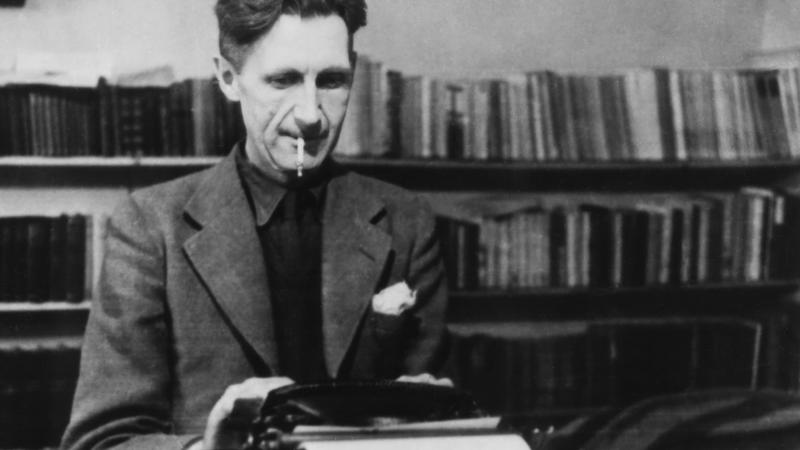
Alison Stewart: This is All Of It on WNYC. I'm Alison Stewart. The new documentary from Director Raoul Peck is titled Orwell: 2+2=5. It's a phrase from Orwell's last book, 1984. Peck uses some of Orwell's final printed words to tell his whole life story, but not in a biopic kind of way. Peck creates a kaleidoscope, juxtaposing Orwell's life and writing with news footage, film clips and essays, and diary entries from Orwell himself, read by actor Damian Lewis. Here's a clip.
Damian Lewis: Most people approve of capital punishment, but most people wouldn't do the hangman's job.
Protester 1: They don't represent us. They need to pay the ultimate price for their crimes.
Protester 2: Yes.
Protester 1: An example needs to be made.
Protester 3: Let us in.
Protester 1: Get in there. Come on.
Alison Stewart: Those voices you hear at the end come from footage from the January 6th protest, which happened 71 years after Orwell's death in 1950. We see how Orwell's words connect to authoritarian trends in the decades since and reverberate in an age of digital surveillance, scientific skepticism, and artificial intelligence. A review in Rolling Stone calls the film the scariest movie of 2025. Director Raoul Peck joins me to discuss. Raoul, it is lovely to meet you in person.
Raoul Peck: Thank you for the invitation.
Alison Stewart: What do you think about that review, the scariest movie of 2025?
[laughter]
Raoul Peck: I'm afraid that it's true. Orwell have been considered a dystopian writer, but in fact, he's a man who have gone to war. He served in the military as a colonial soldier. Since then, he has gone through a very personal, difficult moment, and he learned from it. I considered him like somebody very close, which I didn't think when I was younger. I read 1984, which sounded a little bit like science fiction for me. Then I realized that, in fact, he was talking about very fundamental patterns, the way authoritarian regime establish themselves, how they start destroying institution, attack academia, the justice system, the press, et cetera. That's the pattern, basically a playbook to disaggregate democracy.
Alison Stewart: I want to talk to you about the making of the film. There are no talking heads in this documentary. It's a collage of historical footage, films, there's voiceovers. At what point did this sort of collage idea come to you?
Raoul Peck: It's layer by layers. Once I decided that I was going to tell a story and not make a biography, so I have to find the characters for this story. I have to find the dramatic structure for this story. That's the first part of my job. I decided Orwell was going to tell his own story with his own voice and his own writing because I had access to his whole body of work, which is incredible and rare in our film industry. I knew I could use everything I wanted.
The story I built was him, in the last year of his life, struggling to write and finish 1984, which will make him one of the most famous author of the planet. He died four months after publication. I thought that was the ideal storyline to allow me to distress and go throughout his whole body of work. This is what I did.
Alison Stewart: It's interesting, you had access to everything he wrote through his estate. What was something that surprised you as you were going through all of that footage and all of those writings?
Raoul Peck: What surprised me the most was the fact that I did not anticipate that he would be as intimate and close to my own reality. I'm born in Haiti. I grew up in Congo and many other places, places of dictatorships. He became very trustful for me because, somehow, he visited my world; he lived there. When you see the photo of him with his Black nanny, like a young white little boy with his Black nanny, you know these stories. You know the stories of colonial families and how the absurdity of a Black nanny raising a white boy.
He went back at 19 as part of the Imperial British Army, and he basically went on the other side, being the bully, being the colonialist. He wrote about it because he felt that deeply as one of the worst things he had to do in his life. He felt very close to my reality, and that's why I could trust, also, his words. That was a very deep surprise for me.
Alison Stewart: When you saw that picture of him being held by the Black nanny, what was your visceral response?
Raoul Peck: It showed the contradiction of life somehow. I had made a film two years ago about Ernest Cole, the South African photographer. There is a sequence exactly about that where he's photographing Black nannies in apartheid South Africa. One of the nannies was saying, "Oh my God, I love this child so much, but I know when she grow up, she will be just like her mother." In that sentence, that's the absurdity of life that white parents would give their most precious being to somebody they probably totally disgraced, that don't respect. Then later, that same baby would forget that that person really cared for him or her. That's the total contradiction of life and racism.
Alison Stewart: Yes, you can be close, but not powerful. You can be powerful but not close.
Raoul Peck: Exactly. Not seeing the irony itself, that's the most craziest part, that many participate in your daily life and probably know most about you than any other person. Because she is in the house, and you don't see her. She's totally transparent. Then you think that she-- At the end, I use that picture again. I think the people watching have a totally different feeling about that. It's something that you can't explain, but it's a feeling of danger, of absurdity, after having seen the whole film and the violence of it. You see the aberration, the incredible contradiction of this Black nanny with this blonde child.
Alison Stewart: I'm speaking to Raoul Peck, director of Orwell: 2+2=5. It's in theaters today. You also had to tell the story of Eric Arthur Blair, which is George Orwell's real name. How did you decide on the balance of the responsibility of telling his story with your creative sensibility?
Raoul Peck: It would have been a very difficult film for me to make if, indeed, I had stayed on the belief that Orwell was this dystopian writer, this white, British, a bit not very cool guy, very British in his sense. I discover another man. Again, as I was telling before, he felt very close. I had that impression for many other writers that I made film about. James Baldwin, Sven Lindqvist.
For me, they were white writers. At one point, you forget that they are white or anything else, because they travel the world, they have gone to meet the other. Their judgment or their vision of the other is totally different and close to mine because I traveled a lot when I was a young person. That creates a different sensibility. You're not just in your own little world and think that you're the center of the planet. That changed everything.
Alison Stewart: The film begins-- is it Jura? Am I pronouncing that correctly? Where Orwell started writing 1984. Why did you want to open there?
Raoul Peck: I had, again, to find the right way to enter that story. The fact that I chose in 1984, which is, of course, an incredible analysis and rendering of any authoritarian regime being put in place. As we see in the film, there are similarities with Colin Powell at the UN preparing the attack on Iraq, or George W. Bush in his discourse about those Arabs and savages who have been raping women and killing children. That's the playbook that have been used again and again toward the Third World, my own country in Haiti, while different US administration were saying they are defending democracy.
There is a sentence in the Third World, when we hear it, we know something bad is going to happen when they say, "We're going to save American lives." This is Newspeak. This has nothing to do with reality, but it's like a dog whistle. When you live in the Third World, you know there is an attack coming.
Alison Stewart: We get to hear Orwell's own words. He says, "Early on, I was born into what you might describe as the lower upper middle class." How does that help us understand him better?
Raoul Peck: It shows that he has a very clear class analysis and that he understood what part of the society he was classified, basically. He went to a good school. He went to Eton, even though his parents didn't have the money to pay for that. He was a good student. Then he could have gone to Cambridge or to all the Ivy League schools. That's the tradition in British school system. He chose to enter the military at 19. He was always concerned, or not concerned, but aware of his place in society, a society, especially the British society, where every little degree of your place count. The nuance, that's what he explained very colorfully in the film.
Alison Stewart: It's interesting because, when he was 17 or 18, he said, "I was both a snob and a revolutionary."
Raoul Peck: Exactly. He lived that contradiction in himself because he had access to the best teacher in the world, the best school. At the same time, he felt that he didn't totally belong.
Alison Stewart: There's another quote we found from Orwell in his 1936 essay, Shooting an Elephant. He writes about being in Burma. "All I knew was that I was stuck between my hatred of the empire I served and my rage against the evil, spirited little beast who tried to make my job impossible." What do you hear when you hear that quote?
Raoul Peck: He's exactly in the belly of the beast. That's a rare position to be able to write about it.
Alison Stewart: Because he served in the Imperial Police.
Raoul Peck: Absolutely. You could ask the same kind of question about somebody, a guy working for ICE-
Alison Stewart: Or the National Guard.
Raoul Peck: -or the National Guard. ICE is specific because I think the National Guard might have the illusion they are defending the country.
Alison Stewart: I see.
Raoul Peck: ICE, they see the news as well. That's one reason why they are masked as well. They are not very proud, or at least some of them. They needed a job, they got the job, and you think they're not aware of what they are doing? Some of the people they are arresting could have been their own family, and they are very clear about that. They are leaving that contradiction, and some of them very painfully. That's what social class tells you as well. Sometimes you're in a position where you are aggressing your own class.
Alison Stewart: I'm speaking to Raoul Peck, director of Orwell: 2+2=5. It's in theaters today. It's so interesting because you hear these essays of Orwell being read over by Damian Lewis, and then you see very contemporary visuals. January 6th, ICE, to your point. What happened more often? Did the essays lead you to go think about history and apply the footage later, or did the footage just grab you and hold onto you, and you went back and you read Orwell and said, "Yes, this fits there"?
Raoul Peck: It was a mixture. It went both ways, but because I had to first write the scenario, the screenplay of the whole film, even though I would change it 100 times. Sometimes the image would come immediately. When you open the first chapter of 1984 and you have the character Winston Smith saying, "Yesterday, we went to the movies and there was a lot of war films, but one particular about refugees on the Mediterranean." Then you are reading that and you're seeing those real image of today of a large boat or small boat with 500 refugees trying to reach the European shore and sunking, literally sunking, or not getting the help from some sort of--
Alison Stewart: Coast Guard or something.
Raoul Peck: Yes, Coast Guard. Orwell is commenting that, as if he's a newscaster in the moment today. We had a lot of those moments where it was always about, "Oh my God, this is what's happening now."
Alison Stewart: That was my senior year of high school was 1984. It blows my mind when I think about it and reading it.
Raoul Peck: Oh, yes, it's almost an out-of-body feeling. You say, "Oh, my God, is it--" You have to pinch yourself to say, "Is Orwell talking about now? Was he a witness of what is happening?" It shows how deep his analysis went. In fact, he was never a dystopian. He was writing about things that he knows that he went through. He went to war. He volunteered as a young British man to help the Republic in Spain because he felt there was an injustice there. He joined there at the risk of his life.
You can see today where young people are asking themselves, how do they react to what's going on in this country or in France or in many other European countries or in the Third World, where there is a clear going toward more authoritarian regimes, where freedoms are being erased every day, where money and profit are taking more and more room. It asks the question, what do you do today as a young man? Are you ready to risk your life sometimes for a cause to uphold democracy?" Because that's what is at stake.
Alison Stewart: Do you have hope for 18-year-olds today? What have you seen so far?
Raoul Peck: Hope is not the word I would use, but I would say, like Orwell say, and I think most young people have access to knowledge so that they can come to that realization themselves. When Orwell say the degradation of language is the condition for the degradation of democracy, I think every young people can understand that, and then they can ask themselves the question, "In what world do I want to live?" The film doesn't give any recipe, but the film clarified what is at stake today. The decision is the decision of everybody, individual and collectively. We will have to find an answer to that.
Alison Stewart: The actor Damian Lewis narrates and reads Orwell's essays and diary entries. How did you come upon Damian Lewis to be your narrator?
Raoul Peck: I had a short list because I needed an actor. You say narrated because it's not narration for me, it's really embodied a character because I had to stick to the idea I'm making a film. It's not a report, it's not an analysis. It has to have all the elements of filmmaking. I need an actor that, if possible, had stage experience, somebody who could really make the text himself and not with the distance of a narrator. I wanted to avoid that because we had to be as close as possible to Orwell.
Orwell is the one telling us about his life, about his battles, about his reflection. We had to be totally immersed in that world. You didn't want to have a voice like the voice of God from elsewhere telling you the story. It has to be by the character himself.
Alison Stewart: Let's listen to Orwell talking about living in Burma. This is from your film Orwell: 2+2=5. It's Damian Lewis.
Damian Lewis: When I was not yet 20, I went to Burma in the Indian Imperial Police. In an outpost of empire like Burma, the class question appeared at first sight to have been shelved. Most of the white men in Burma were not of the type who, in England, would be called gentlemen, but they were white men in contradistinction to the other and inferior class, the natives.
Alison Stewart: If someone were to read 1984 and Animal Farm, but nothing else from Orwell, what would you point them towards next?
Raoul Peck: First thing, I would say why I write these incredible essays about the very candid and humble analysis of who he is as a writer and his task as a writer, what are his responsibilities. I think through that essays, you understand most of who Orwell is and how he think and how he really look back about most of his younger life. I think that's really the best entry to his work. By the way, that's one of the essays I use the most in the film.
Alison Stewart: The name of the film is Orwell: 2+2=5. I've been speaking with its director, Raoul Peck. Thank you so much for joining us.
Raoul Peck: Thank you for inviting me.