
Niyū Yūrk' Highlights Middle Eastern and North African History in New York
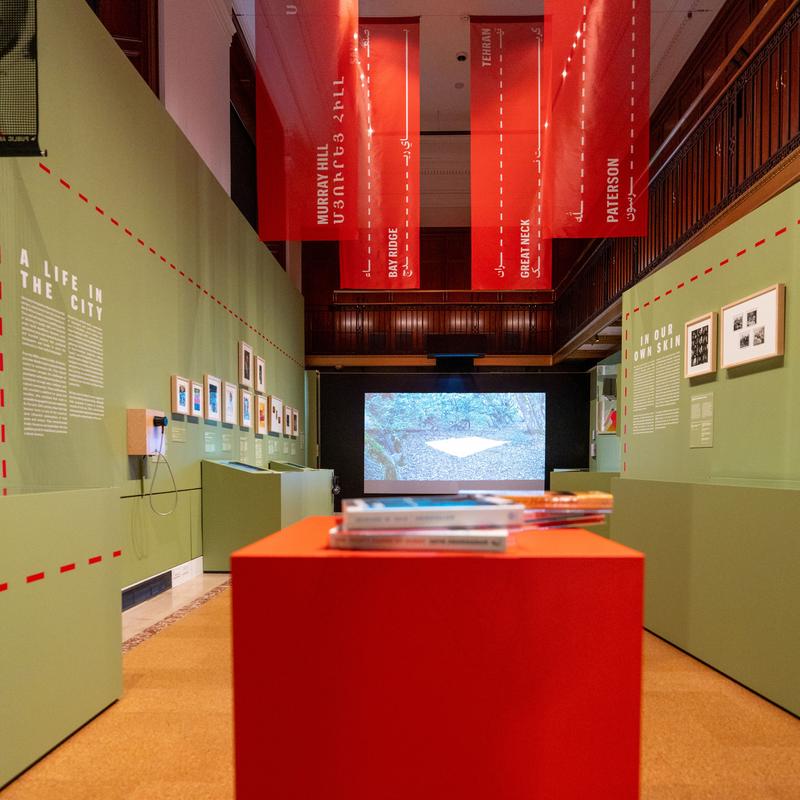
Alison Stewart: This is All Of It on WNYC. I'm Alison Stewart. The new exhibit at the New York Public Library shines the spotlight on a group of immigrants. It's called Niyū Yūrk: Middle Eastern and North African Lives in the City. From 1880 to 1940, New York City saw an influx of what was then called Greater Syria, an area that now encompasses present-day Lebanon, Syria, Jordan, Israel and Palestine. Many immigrants came through Ellis Island and settled in a little area of Lower Manhattan that became known as Little Syria. Once they were there, they began forming their own culture and communities by founding newspapers, opening restaurants and nightclubs, and so much more.
The exhibit draws on the extensive collection of Arabic language books and documents that the New York Public Library began collecting as far back as the late 1800s. Niyū Yūrk: Middle Eastern and North African Lives in the City is open now at the Stephen A. Schwarzman main branch through March 8th. On Friday night at 7:30pm, there will be a special library after hours event celebrating the exhibit which included curated talks, live music and more. That event will include a talk by Heba Abid, curator for Middle Eastern and Islamic Studies at the library, who joins me now to discuss the exhibit. It is really nice to meet you.
Heba Abid: It is nice to meet you too, Alison. Thank you so much for having me here.
Alison Stewart: Listeners, we want to hear from you. Is your family of Middle Eastern or North African descent? We want to hear your family's New York story. What brought you and your family to New York City? What was life like when your family arrived? We want to hear from Middle Eastern and North African listeners about their New York City story. You should give us a call at 212-433-9692 212433 WNYC. Did I say the exhibit correctly? I want to hear you say it.
Heba Abid: I can say it. Niyū Yūrk. That's how mostly Arabic speaking people pronounced and said New York when they arrived. They still say it such New York.
Alison Stewart: When did you begin working on this exhibit at the library?
Heba Abid: Well, I began thinking about the exhibition a year and six months ago. But it really started when I first began my job at NYPL, which was three years and three months ago. When I began researching Mina Diasporic materials at the New York Public Library and really almost conducting excavation of all these materials at the library, recollected sometimes in real time as these books, newspapers as you mentioned, were being produced by the community from the late 19th century. It was this project that I conducted back then, and then a year and six months ago, more or less, we thought, let's do an exhibition on this very underrepresented community in our programs and exhibitions.
Alison Stewart: You said MENA. MENA stands for?
Heba Abid: Middle Eastern and North African.
Alison Stewart: As you said, it was sort of an underrepresented group. Why do you think that was?
Heba Abid: Well, I believe it really started with the beginnings when you mentioned earlier. The first waves of MENA communities immigrated to the United States and to New York from the late 19th century. They really didn't belong to a specific ethnic group, or at least they couldn't fit in any category. For that reason, they started advocating and litigating their racial classification in court to be accounted for as white so that they could have access to citizenship, which was limited then to free white people or people of African descent. I think because of those, them being almost perceived as a monolithic group, I feel like that really was perpetuated in public discourse, in federal law, but also in cultural institutions.
Alison Stewart: The New York Public Library opened a division to this in 1897. What were the goals of the division, and what resources did you have available to you?
Heba Abid: Well, the Oriental division opened in 1897. It was not specifically dedicated to Middle Eastern and North African collections, but really, oriental is a term that we wouldn't use today, but that was a product of its time, of its era. It was a division with a very orientalist perspective and definition of that other part of the world. It encompassed any region from North Africa to the Middle East and South Asia. That division began collecting materials from the Middle East and North Africa, and materials produced by the communities. Newspapers, citizenship guidebooks, but also cookbooks as well, all resources that helped also the communities establishing their lives and navigating their new lives in the city.
We have resources from that time that tell us that Armenian and Syrian people from the community came to the reading room at the New York Public Library and read newspapers in their own languages. The division was actually serving the communities. It became a space to build a sense of belonging, a space where readers and patrons from MENA heritage could come and find accessible and have free access to knowledge.
Alison Stewart: My guest is Heba Abid, curator for Middle Eastern and Islamic Studies at the New York Public Library. We're talking about the exhibit she curated, Niyū Yūrk: Middle Eastern and North African Lives in the City. It's running now through March 8th. Listeners, we're talking about you and your stories. Middle Eastern, North African communities, folks who live here. How did your family come to New York City? Give us a call at 212-433-9692, 212433 WNYC. The largest population of Middle Eastern immigrants coming to New York came from what was now known as Greater Syria. What do we know about why immigrants were coming from that region?
Heba Abid: Well, for many reasons, because of an economic crisis that shaped the Middle East and especially present-day Syria, Lebanon, Palestine, Israel, but also because there were many Syria American missionary schools in the Middle East that spoke about this land of opportunities that America represented and everything that they could find. All the jobs they could find. This idea of immigrating to the US started burgeoning in their minds and people started coming here. Then obviously, when you have a group from a specific area, from Lebanon, then other groups from that same village would join their families here. That's how it began. But obviously, at every political upheaval in the Middle East and then American politics as well, we would witness a new wave of immigration. It started in the 1880s and then again in the 1940s after the Arab Israeli War in 1948, and then. Following the 2011 Arab Spring. All these moments really fostered again new waves of immigration.
Alison Stewart: In the earliest wave of immigration, where did they settle in New York City?
Heba Abid: They first settled in the Lower West Side of Manhattan near the Battery Park. Around streets, mostly street that was really the commercial cultural hub for these communities. Washington Street, Rector Street. Then, starting from the 1910s, they began moving to Brooklyn. You all know this store called Sahadi's on Atlantic Avenue, Damascus.
Alison Stewart: We love Sahadi. [laughter]
Heba Abid: That became the second home after the mother colony from the Lower East Side of Manhattan. They moved to bigger housing from the small and cramped tenements in the lower side. Then now you have communities in several other neighborhoods like Astoria. Bay Ridge and many more.
Alison Stewart: The exhibit notes that the majority of Middle Eastern North African immigrants who came to the city were Christians.
Heba Abid: Absolutely, yes.
Alison Stewart: How are Christian immigrants and Muslim immigrants treated differently when they came to the United States?
Heba Abid: We know that Muslims in the 1910s represented only 10% of the Middle Eastern diaspora in New York City. In fact, they did face greater suspicion and marginalization than Christians because Christians could use their tie to Christianity and also their connection to the Holy Land, because they all came from historical Palestine and that area, and that really facilitated their assimilation in America. An example in the exhibition is this very beautiful and striking photograph of Mohamed Judah, who is this Algerian.
Heba Abid: Immigrant who tried coming to the US and he stayed for a few days at ellis Island. In 1910, he was photographed by an Ellis Island clerk, Augustus Sherman, who is also a photographer. Officials labeled him as "believer" in the practice of polygamy, which is a charge that was commonly used in the United States to bar Muslims from entering the US. He only stayed a few days in Ellis Island and then he was denied entry, and he returned to what was then French Algeria.
Yes, and this was all caused by the 1891 Immigration Act that prohibited polygamists or persons who "admit their belief in the practice of polygamy, which posed a major barrier to Muslim immigration. Tey did have quite a different experience.
Alison Stewart: Let's take a couple of calls. Sonia is calling from Forest Hills. Hi, Sonia, thank you for making the time to call All Of It. You're on the air. Hi.
Sonia: Hi. My parents came to New York in the late '20s, and just for everybody's information, 27th street between 3rd Avenue and Lexington, and that whole street was called Little Armenia at one time.
Alison Stewart: Sonya, thank you so much for calling in. This text says, "I'm glad your guests mentioned Armenians. More than 100,000 Armenians came to America between the late 1800s and mid-1900s." My grandfather's family came through Syria to New York in 1902. They began a furniture company and a nut importing company. My mother went on to become a lawyer.
Heba Abid: Absolutely. Thank you, Sonia. And thank you to this--
Alison Stewart: Texter.
Heba Abid: Yes, texter, absolutely. The show is not restricted or limited to Arabic-speaking communities or Arab people in New York. It includes Armenians, Iranians, and also Turkish people. Armenians were a big part of this diaspora, especially after the Armenian genocide. Yes, Murray Hill was also a historical neighborhood for Armenians. They also founded nightclubs. They were musicians. They had stores. We actually have at the library incredible records of art dealers, Armenian art dealers who were very active in the 1920s in New York. Absolutely, they form an incredible instrumental part of this community and its history in New York City.
Alison Stewart: We've got Lily, who is calling in from Brooklyn. Hi, Lily. Thanks for taking the time to call All Of It. You are on the air.
Lily: Oh, hi. Yeah. My husband's family are all from Syria. They came about 100 years ago, and they all originally Lower East Side and then moved into Brooklyn. There's a very strong Syrian Jewish community alive and well down here. They're very proud to be Syrian. They're very insular. They usually marry each other. Just wanted to let everyone know.
Alison Stewart: Well, thanks for weighing in. We appreciate it.
Heba Abid: Thank you, Lily. I also want to mention that so many items didn't make the cut through the gallery, the exhibition gallery, but there is. If you ever want to visit the library, there is a book that I really wanted to incorporate. It was already too late in the process of creating the show, but it's a Sturian Jewish cookbook from the 1930s or 1940s published here in New York. If you ever want to come and consult it, please reach out to me.
Alison Stewart: The exhibit includes the first Arab language newspaper published in the United States. It was published in New York. What do we know about this paper?
Heba Abid: Newspapers. Yes. The press was really at the heart of early Middle Eastern life in New York. We know from 1890, and between 1890 and 1940, the city produced more than 50 Arabic language periodicals. One important story to know how-- the show is about MENA communities in New York, but also about New York through the lens of MENA people here. New York was instrumental on many aspects of this community. It is in New York that Naoum Mokarzel patented the first Arabic Linotype machine.
He adapted it from Latin characters to Arabic characters. That innovation sparked a boom in Arabic print culture, making the written word more accessible not only in New York City but also in the Middle East. That really fostered an explosion of the press in Middle East and made it more accessible to everyone. There were newspapers published in Arabic, Armenian, and other Middle Eastern languages from the 1890s. I would say.
Alison Stewart: It was also a big hub for poets and writers.
Heba Abid: Yes, Alison, yes. It was home for this literary society called the PEN League, al-Rābiṭah al-Qalamīyah. You probably know Khalil Gibran, who wrote the poet. He was a forming member, founding member of the PEN League that was formed in 1915, 1916. This group of writers that included a few women, this group of writers and poets really revolutionized and rethought Arabic literature, poetry, and language because they were exposed to American and English literature and they tried to innovate Arabic and break the conventions of Arabic classical literature.
Alison Stewart: We want to know more about women who are part of this. Tell us about the Syrian Ladies Aid Society.
Heba Abid: Oh, that's one of my favorite work. Well, I must say that it was a challenge to find written records of women's presence and contributions to this. I mean, that early era, early moment of MENA presence in New York, it was quite a challenge. We know that they were involved in every aspect of the burgeoning community in the late 19th century and early 20th centuries. Even though their presence is scarce in surviving records of the era, but their contributions were essentially not sustaining families. They worked as peddlers in. In textile factories. They contributed to advancing education and building the cultural fabric of the city.
The Syrian Ladies Aid Society was a collective and organization founded in 1907 to help newcomers navigate their new life in New York, find housing, learn English, learn new skills, to develop their own businesses. This group really supported women, but tried as well to help any newcomers, including men and families.
Alison Stewart: Heba, the exhibit deals with Islamophobia. We've just selected our first Muslim mayor. We saw moments of Islamophobia towards the end of the campaign. How do you hope the exhibit helps educate people about the long history of Muslim immigrants?
Heba Abid: Well, I would say through the exhibition or through items from the exhibition. I think Islamophobia was also a topic that I struggled to tackle in the show because there weren't enough materials in the collections to use to talk about this topic. Again, NYPL has incredible gems. I found this beautiful documentary, VHS video, a documentary by Jennifer Jajay and Nikki Bird that was done in a few weeks after 9/11 in October 2001. It is titled In My Own Skin: The Complexity of Being an Arab Woman. Yes. They talk. It's an interview of five Arab women in the aftermath of 9/11 where they talk about the struggles of being an Arab and Muslim woman in New York and in the United States.
The film and the documentary ends with a message of hope that I find again in the voice of Muslim communities today in New York, that it is a resilient community and they are more organized today, and they fight back, and they try to build awareness around this. We have now a Muslim mayor who is about to swear on a Quran soon. We hope that these things will contribute to a change in the city.
Alison Stewart: The name of the Zibit is Niyū Yūrk: Middle Eastern and North African Lives in the City. My guest has been its curator, Heba Abid. Thank you so much for being with us.
Heba Abid: Thank you, Alison.
Alison Stewart: That is All Of It for today. I'm Alison Stewart. I appreciate you listening, and I appreciate you.