
New York During the Revolution
Title: New York During the Revolution [music]
Alison Stewart: You're listening to All Of It on WNYC. I'm Alison Stewart. A lot is planned nationwide for America's 250th birthday. This year at the Museum of the City of New York, the focus is on the occupation of NYC. After the Battle of Long Island in 1776, New York was tightly controlled by the British Army for seven years. Soldiers roamed the streets, and people were fiercely divided between Loyalists and Patriots.
A new exhibit at the museum immerses a viewer into what New York was like during the Revolutionary period, including the sparks of rebellion at the Battle of Golden Hill, imagining the taverns where revolution was debated, and how New York became the first capital of the United States after the war. The exhibit is called The Occupied City: New York and the American Revolution. It's on view today at the Museum of the City of New York. It was created in collaboration with the Gotham Center for New York City History at CUNY.
My guests are museum senior scholar Sarah Henry. Welcome back to the show.
Sarah Henry: So glad to be here.
Alison Stewart: And Peter-Christian Aigner, director of the Gotham Center. Welcome.
Peter-Christian Aigner: Thanks for having me.
Alison Stewart: This show is big. It's taking over a large portion of the museum. Why do you think this exhibit deserves that kind of space?
Sarah Henry: Well, it is big. I've worked at the museum for 25 years, and this is the largest show we've ever done.
Alison Stewart: Wow.
Sarah Henry: Takes over the whole third floor. Look, this is a foundational moment in New York City history, and New York is actually pivotal to the Revolution. It's a story, I think, that New Yorkers don't know or don't know as well as they should. We're really looking to recenter New York in this moment of the 250th anniversary. It's also a complicated story because it's about New Yorkers who disagree with each other.
Alison Stewart: Oh, imagine that.
Sarah Henry: Yes. We wanted to give it space to really understand that the Revolution is not just about battles. It's about the lived experience of people who found themselves in a war zone. It's something that I think we can activate people's imagination to try to imagine themselves back in that time. We really wanted to give it the space it deserved.
Alison Stewart: Peter, what specifically interested you about New York's occupation during the conflict? What interested you as a curator?
Peter-Christian Aigner: This collaboration between the Gotham Center and the museum sprang out of work that we had done several years ago. We created a Freedom Trail for New York City, a walking tour in Lower Manhattan that's now a free smartphone app that you can download. We were thinking about exactly what Sarah alluded to. When we think about the Revolution, you think about Boston and Philadelphia, and it's really crazy because New York is at the center of action, from the beginning to the end. You'd said that it's focusing on the occupation, and that's right. It's the darkest and least-known period of New York City history.
We do the full sweep, and it deserves that because it's foundational to the creation of New York City as well as the country. It's a big, complicated story. I think that New York City really kind of shifting that lens gives you just a fresh take on the Revolution that really upends a lot of the traditional narrative. It's a lot more inclusive. The division that Sarah alluded to, that's long been pegged against New York City as if New York doesn't count because they're so divided, there are so many Loyalists and such like that. Reality is that that's the whole population.
I think New York gets you a better lens on that. We were just excited to take the project we had started and give it a really different shape, and we're really happy with the feedback we've gotten.
Alison Stewart: Sarah, when we were talking about New York being occupied during the Revolution, what was considered New York City then?
Sarah Henry: Well, New York City itself was just the tip of Manhattan. The far north end of New York City was Chambers Street. As the Museum of the City of New York, we take a more capacious view. Actually, that gives you even more diversity because in the years leading up to the Revolution, the heart of the revolutionary sentiment in New York was centered in this neighborhood where we are right now, especially along the waterfront, where there was a kind of turbulent activist grassroots politics fed by the sailors who were coming in and out of the city.
If you broaden the lens a little bit and consider what's happening in Upper Manhattan, what's happening in Queens, what's going on in The Bronx, even across the river in New Jersey in these more rural areas, small towns, you get people who are either really sympathetic to the British or really want to stay on the fence. You get much more of a spectrum when you broaden the lens beyond the then boundaries of New York City proper.
Alison Stewart: We're discussing a new exhibit about the history of New York City's occupation by the British Army during the Revolution. It's called The Occupied City: New York and the American Revolution. It's on view. My guests are scholar and curator Sarah Henry and Peter-Christian Aigner, director of the Gotham Center for New York City History at the CUNY Graduate Center. Peter, in the years leading up to 1776, before the Revolution and the occupation, why was New York important to the British Empire?
Peter-Christian Aigner: New York was described by many of the European and visitors from other parts of the colonies as London in miniature. The Board of Trade, which managed the British Empire, actually contemplated several times across the century whether or not to make New York the official headquarters. In this thing called the Seven Years' War, which actually lasted nine years, sometimes called the first global war, New York is actually the military headquarters of British North America, the Thirteen Colonies. Beyond that, the city actually functions as the magazine, which is another way of saying we were supplying the British in this major, major war.
The city grows enormously, its population, its built environment. People do very well by the British. But then coming into this period, within just a couple of years, the biggest protest-- everyone knows the Stamp Act. The Stamp Act is just the straw that broke the camel's back. There's a series of laws that are passed, basically because the British create this global empire, and they're saddled with that. We talk about Americans, "No Taxation Without Representation." The British had amassed this massive, massive debt, and they were paying taxes through the nose.
They pass all these laws basically to constrict the colonial economy, but it throws people out of work and inaugurates this long period of oppression, especially in places like New York. That's why we focus on cities like New York and these little port towns that are actually-- in total, they're a tiny percentage of the population, but they're the first ones to organize and respond to the Revolution and galvanize the population. In a place like New York, one in every four people are basically engaged in those trades. Those ordinary people that we still don't know anything about, those are the people that really make the Revolution possible.
Sarah Henry: I think also New York, strategically situated in a really valuable place for the British, especially when the Thirteen Colonies that decide to separate are stretched along the East Coast, the role of New York at the mouth of the Hudson River, if you can capture that, their hope was you sever this alliance, separate the Massachusetts folks from the Virginia folks. They expected that they might be able to just crush the rebellion with one fell swoop in New York.
Peter-Christian Aigner: Yes. It's the classic divide-and-conquer strategy. John Adams calls it the key to the whole continent. For the British, the idea is because the Hudson gives you 350 miles, that this is the age when rivers are highways. You'd have to go to Halifax, which is often frozen because it's the end of the Little Ice Age, to get more access to North America. The whole thinking for them is divide north and south, you can crush the rebellion. The first major battle of the war '76 happens here in the city. They sent 421 vessels carrying 35,000 people at a time when the population of New York was 25,000. The famous quote is it looked like "all London was afloat."
The idea was, as Sarah said, crush this rebellion that's been simmering and flaring up with all these laws that we pass and then repeal for a dozen years or so. Let's put an end to it once and for all.
Alison Stewart: I want to ask about the Battle of Golden Hill. Sent me straight to my maps. What happened on January 19th, 1770? Who wants to go? You want to do it?
Peter-Christian Aigner: Yes. I can do this because I'm the head of the Gotham Center, the only academic center devoted to New York's history. No offense, obviously, to Boston and Philadelphia, great cities and important cities in the history here. Boston Massacre, everyone knows about, but the actual first bloodshed in the American Revolution happened here in New York, and it's the Battle of Golden Hill.
Long story short, again, I alluded to before that this was the military headquarters, and there was more soldiers here than anyone else. The biggest riot over the Stamp Act happens in the city. They increase the number of soldiers that they have in town, and then they pass this thing, the Quartering Act, that actually requires New Yorkers to pay for a lot more by way of what they were doing to house the soldiers than before. The legislature drags its feet, and then finally they actually suspend the legislature, which is the most severe act that Parliament enacts until we get to Boston and the kickoff of the war.
They finally relent, and then they impose yet another tax, and New Yorkers just rebel. It's so tense--
Alison Stewart: They put down the polls.
Peter-Christian Aigner: Yes. Geography is really important here because the city is really tiny. The northern edge of the border is City Hall Park, and everyone's sort of cheek by jowl. You have literally the British commander in general of North America, arguably the richest people in the colonies, living side by side with some of the poorest.
Alison Stewart: That's interesting.
Peter-Christian Aigner: There's so much tension on the street that the officers are telling the soldiers not to go out and about, especially not on the waterfront where people are really suffering. Long story short, some soldiers are posting this broadside, basically defending themselves against all these attacks that they're getting from the rebels. Isaac Sears, who's like the Sam Adams of New York in this period, the guy behind every major street action, catches them and does a citizen's arrest. This mob gathers around, and then soldiers show up, and the mayor gets involved. They're marching back to the barracks at the top of the city and going through these narrow streets.
We don't know exactly what happened, but long story short, the bayonets come out. Dozens of people are severely injured. It's really a miracle that no one died. Then they have this protest in solidarity in Boston six weeks later, I think, and that results in deaths. They got the headline, but we were there first.
Alison Stewart: Sarah, you obviously are a curator of a museum, and you wanted this to be an interactive exhibit. Why did you decide to have the exhibit be that way, that people could interact with--
Sarah Henry: The exhibition is full of wonderful original historic objects from our collection and beyond. Of course, one of the things we want people to do is to encounter the primary sources. A lot of these things that survived from the 18th century, they really don't speak for themselves. You have to trigger people's interest and imagination. I think it relates to the larger goal of the exhibition, which is to get people to relate to this history and understand that this is our history. We created a variety of ways that people could put themselves in the shoes of the folks who were here 250 years ago.
They range from low tech, where you pick up a piece of paper and you can go through a little quiz that would bring you through the issues and see which side you might have fallen on in the early 1770s, and use an embosser to stamp a piece of paper, to much more high tech where we're using projected images to recreate the statue of King George that had stood at Bowling Green and had been torn down by the rebels after the Declaration of Independence was read aloud in July of 1776. You can use a real rope to simulate pulling down the animated statue, and that seems to be really popular with people.
It gives you a sense, even, I would say, something that's not interactive but feels interactive. When the elevator doors open and you enter the exhibition, what you're confronted with is three cannons pointing directly at you.
Alison Stewart: Wow.
Sarah Henry: They're at the side of a ship, a simulated side of a ship. I think it draws people up short because, like New Yorkers 250 years ago, our visitors are finding themselves in the sights of the British Navy, whether they chose to be or not. That really was the position of tens of thousands of New Yorkers, some of whom didn't want to get involved in this skirmish. Proved to be a lot more than a skirmish, but they really had no choice. To me, it opens bonds of sympathy and empathy with the people who are here and brings history to life in your mind, which is the first step to learning.
Alison Stewart: Peter, we have a question for you. This is texted in. "You mentioned Golden Hill, but didn't say where Golden Hill is located today. Where is it?"
Peter-Christian Aigner: It's actually not so far from here. It's intersections of John and Fulton. We were lucky enough to get a profile in The New York Times over the summer about our Freedom Trail app. You can learn more about the Battle of Golden Hill there. If you go there today, it's actually just-- and this is so symbolic of all this history. Eden's Alley is the quickest way to find it. It's just an alleyway that's used for garbage. It's just like so much else around the city. We were chatting before about what we think our most important sites are and such.
The thing that seems to grab people the most is-- I point to the part of the exhibit where we talk about the HMS Jersey. It's one of just a half dozen ships that was in Wallabout Bay, just over the East River here. This is the only place that the British managed to hold on to consistently. It's from beginning to end. When they win that battle in '76, Washington's outnumbered, et cetera.
Sarah Henry: We've all seen [crosstalk].
Peter-Christian Aigner: Yes. They think it's like this big victory, but actually it turns out to be a period victory. This is, I think, another key way that the New York lens changes the perspective on the war. Did the Americans win or did the British lose? Because it's a major logistical challenge for them to actually conduct a war while also bringing some sense of normalcy. Historians estimate that only 40% of the population across the colonies supported the war. That means that the British came in with a working majority, and they lost those hearts and minds because, like so many people before and so many people later, they found that it's really impossible to do two things at once.
The POW store is a huge one because it's the British headquarters, the only place they really managed to hold on to. All the POWs that they gather from across the colonies end up coming here, and stories about their treatment are just infamous at the time. 18,000 people died in these ships right here in New York City. That means that New York City is the graveyard for the people who fought and died for this country's existence. The people who are really responsible for it. That's three times the number of people who died on the battlefield, and there is no marker for them.
There's a monument on top of Fort Greene Park, which people don't really know about. There's another monument in the corner of Trinity graveyard, which people walk by all the time, but at Wallabout Bay, Brooklyn Navy Yard, nothing. It was a struggle even to get those other monuments up.
Sarah Henry: I'm glad you asked about where Golden Hill was and that you mentioned the lack of markers in the city. That's one reason we end the exhibition with a beautiful video montage, which is a meditation created by the video artist Tim Gersten of what these sites look like today. You just get to sit. After all the intensity of this very traumatic and exciting history, you have a moment at the end where you get to come back into the present, recognize that you know these spaces. You've probably walked on many of them many times without thinking about what happened there before. It's just a beautiful closure to the exhibition that people have really been basking in.
Alison Stewart: This is completely off topic, but when you're in downtown New York, do you ever feel ghosts?
Peter-Christian Aigner: Oh my God. City Hall Park is just like this giant mass of graveyards. One of the really great things-- I got my PhD. I'm really a 20th-century [unintelligible 00:17:33], but I came very close to actually doing this period. I've been working on this Revolution project for years, before the wonderful collaboration with the museum. It totally changed my whole view of things, looking at it from New York. One of those things is just like-- it's amazing to be walking around the city and seeing all those ghosts of things, and the way that that shifts things. I said before it's the darkest and least known period of the city's history.
Every day, there are cartmen-- This is like Monty Python but without the humor. Literally every day, they're carting people frozen dead. It's a harrowing experience. We have this sanitized view of the Revolution, that it's just this clean, bloodless affair. It's grim. I think that should give us some pause, but also some appreciation.
Alison Stewart: Yes, especially when you were down by William Street and Pearl Street. What your definition of ghost is, but it can be many different things.
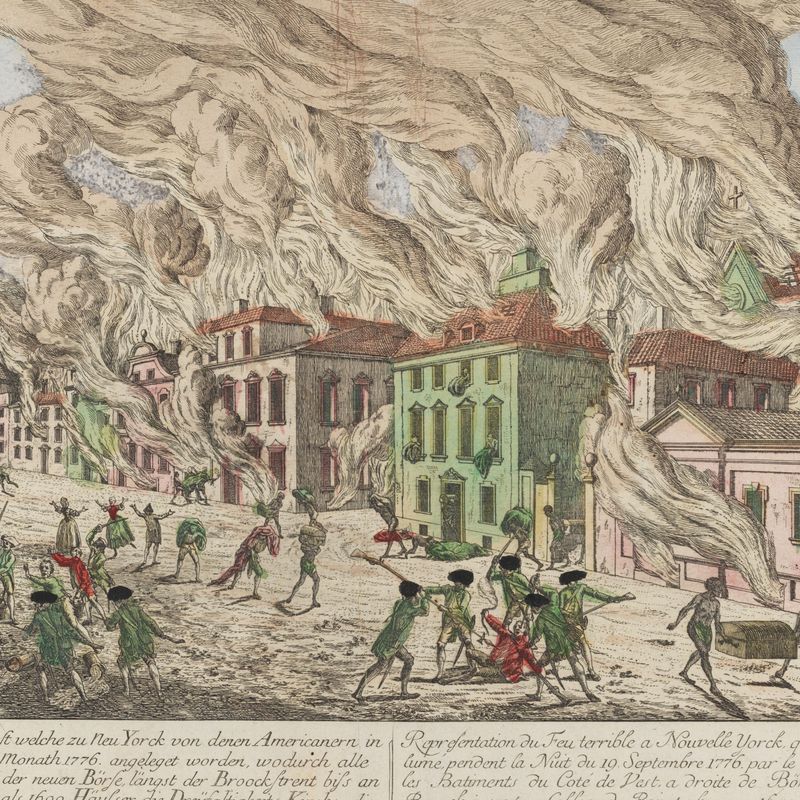
Sarah Henry: Well, New York is famous for erasing its own history and being very forward-driven, tearing things down. In the case of the Revolution, this is exacerbated by the fact that during the period of the Battle for New York, a huge fire breaks out right in the area where we're sitting now in Lower Manhattan, and a large portion of the then-existing city burns down. That's one reason why there aren't a lot of things you can still see in this area from that time. Because of that amnesia that we collectively have, it takes some digging, sometimes literally under our feet.
We have wonderful archaeological material in the exhibition, but activating your imagination to realize that there's this layer beneath us all the time. I start to look through the city and I see palimpsest, the shadows of what was here before. That is a really transforming way to walk through New York.
Alison Stewart: Someone sent a note that says, "Can you repeat the name of the Freedom Trail app? There are a lot of similar apps, but I'm not sure which one is associated with your guest."
Peter-Christian Aigner: The Freedom Trail we created for New York City is called NYC Revolutionary Trail. It's a free app you can download on your phone. It's the newyorkrevolutionarytrail.org. We're coming out with a new app that's like our Pokémon GO version next month called Echoes of Revolution. We were lucky enough to partner with the makers of the Assassin's Creed universe, which they created with-- They use this team of historians and millions of dollars worth of enterprise. Digitally, we created the entire streetscape, and we were lucky enough to actually incorporate that in the exhibition too so you get a taste of it when you come, and there's more information online. You can find us at gothamcenter.org.
Alison Stewart: I think we have time to ask about one record in the show that you say is one of the most important documents in American history, an inspection roll, part of what was called The Book of Negroes.
Sarah Henry: Yes.
Alison Stewart: Tell us a little bit more about this.
Sarah Henry: During the war, as essentially a military tactic, the British decided to issue a series of proclamations that offered freedom to enslaved people who escaped their enslavers if their enslavers were on the Patriot side. As a result, thousands of people escaping slavery streamed into New York to join the British cause. They became known as Black Loyalists. When the Treaty of Paris was signed, the Americans insisted that return of their property be included in there. For them, that meant return of these human beings, but the commander here, Sir Guy Carleton, basically said this would be a betrayal of our premise.
He found a loophole. Said that if you escaped before the treaty was actually signed, you were already free. You weren't property anymore, and you weren't going to be turned back. As a result, they held a series of hearings to examine the evidence for each person who claimed that they had come before the treaty was signed. They produced two volumes. They're called The Book of Negroes. Every line lists a person or a family and their history, their evidence that they presented about who they escaped from and when they escaped. If you could demonstrate this, then you were given passage on a ship to leave New York before the Americans came back to try to capture you.
There was a lot of trying to capture people going on because New York had become a refuge for these people. We were very lucky that the National Archives and Records Administration agreed to loan a volume of The Book of Negroes. To me, it's very stirring to have it back in New York City. It's been in safe hands in the archives, but it's a big piece of our city's history as well as the nation's, and it captures the story of individuals who otherwise would have been completely lost. We also created kind of a Memorial wall to them so every name that's in the book is printed on the wall. We created a facsimile, sort of oversized, that you can sit and page through so you can investigate it further.
We were able also in the exhibition to create some audio stories of characters who are lesser known. You can get the first-person narrative, beautiful audio stories recorded by Michelle Figueroa with a group of artists. We have two people whose names are in The Book of Negroes, where you can listen to their story. One of them is named Harry Washington, and he's named Harry Washington because he had been enslaved by George Washington at Mount Vernon and escaped and eventually came to New York. His story is absolutely astounding.
Alison Stewart: What do you hope people understand about New York after seeing this exhibit?
Peter-Christian Aigner: We said already that I think that New York changes the way that we see the Revolution. It's also really an important moment for the founding of New York. Part of the reason why we don't remember this history as much is that New York becomes the unofficial headquarters, capital of the country afterwards. Every bit of realty becomes too important to keep around for something silly like historic buildings. This is a moment where New Yorkers are really-- New York is a battlefield across this period. It's a civil war throughout, and New Yorkers are at each other's throats. We're at each other's throats now, but they find their way through that period and reconcile.
For example, we talk about-- and it's a story that involves everyone. I'm glad that Sarah brought up Harry Washington. We talk about other people like Manuel Soto, one of Black characters who's critical to saving the Revolution just a few weeks afterwards.
Alison Stewart: You know what? We have to wrap up soon.
Peter-Christian Aigner: Yes.
Alison Stewart: Do you want to finish your thoughts?
Peter-Christian Aigner: Just to say that you really can't understand the history of New York either unless you understand this period.
Alison Stewart: Go see The Occupied City: New York and the American Revolution. My guests have been Sarah Henry and Peter-Christian Aigner. Thank you so much for joining us and sharing all that history. That was amazing.
Sarah Henry: Thank you.
Alison Stewart: There's more, All Of It on the way. Stay with us. You'll hear our April Get Lit with All Of It book club event with Cynthia D'Aprix Sweeney and the band Ida. Stay with us.
[music]
Copyright © 2026 New York Public Radio. All rights reserved. Visit our website terms of use at www.wnyc.org for further information.
New York Public Radio transcripts are created on a rush deadline, often by contractors. This text may not be in its final form and may be updated or revised in the future. Accuracy and availability may vary. The authoritative record of programming is the audio record.